
Chapter 52
Interference and Resonance Patterns

Wave Coherence and Optics
Author: Mark Anthony Higgins
© Mark Anthony Higgins 11 October 2025
Revised Date: 23 February 2026
Audio Overview
Flow Algebra
flow "Interference and Resonance Patterns" v1.0

# ---------- PURPOSE ----------
# Describes the formation of interference and resonance as expressions of coherence superposition.
# Interference: spatial superposition of wavefields (constructive/destructive based on phase).
# Resonance: temporal superposition under feedback (constructive reinforcement of standing modes).
# IB measures coherence retention across both domains (spatial and temporal).
# IB = 1 → perfect coherence (stable standing pattern or bright interference fringe).
# IB < 1 → partial coherence (damped resonance, blurred or unstable interference).

# ---------- PARAMETERS ----------
params:
  units: "SI"
  λ: positive                  # wavelength [m]
  f: positive                  # frequency [Hz]
  ω: real = 2π*f               # angular frequency [rad/s]
  k: real = 2π/λ               # wavenumber [1/m]
  A1: real                     # amplitude of wave 1
  A2: real                     # amplitude of wave 2
  Δφ: real                     # phase difference [rad]
  IB: 0.0..1.0 = 1.0           # coherence index
  include_feedback: bool = false
  Q: positive = 100            # resonance quality factor (temporal coherence)
  λ_decay: nonnegative = 0.0   # damping coefficient [s^-1]
  dt: positive?                # timestep for feedback simulation

# ---------- STATE ----------
state WaveSystem:
  ψ1: complex                  # first wavefield
  ψ2: complex                  # second wavefield
  ψ_total: complex             # total superposed field
  I: real                      # resultant intensity |ψ_total|²
  Imax: real                   # max intensity
  Imin: real                   # min intensity
  contrast: real               # fringe or resonance contrast
  resonance_state: str         # "constructive", "destructive", or "damped"
  IB_rate: real                # rate of coherence change
  energy_feedback: real        # feedback energy fraction

# ---------- INVARIANTS ----------
invariants:

  # Wave superposition (spatial interference)
  WaveSystem.ψ1 = params.A1 * exp(i * params.k * x)
  WaveSystem.ψ2 = params.A2 * exp(i * (params.k * x + params.Δφ))
  WaveSystem.ψ_total = WaveSystem.ψ1 + WaveSystem.ψ2

  # Intensity from superposition
  WaveSystem.I = |WaveSystem.ψ_total|^2
  WaveSystem.Imax = (params.A1 + params.A2)^2
  WaveSystem.Imin = (params.A1 - params.A2)^2
  WaveSystem.contrast = (WaveSystem.Imax - WaveSystem.Imin) / (WaveSystem.Imax + WaveSystem.Imin)

  # Coherence evolution (spatial)
  if params.IB < 1:
    WaveSystem.contrast *= params.IB

  # Resonance feedback (temporal domain)
  if params.include_feedback:
    WaveSystem.energy_feedback = exp(-params.λ_decay * (params.dt or 1))
    params.Q = (params.Q * WaveSystem.energy_feedback)
    params.IB = clamp(params.IB - params.λ_decay * (1 - params.IB) * (params.dt or 1), 0, 1)
    WaveSystem.IB_rate = -params.λ_decay * (1 - params.IB)

  # Resonance state classification
  if abs(cos(params.Δφ)) > 0.9:
    WaveSystem.resonance_state = "constructive"
  elif abs(cos(params.Δφ)) < 0.1:
    WaveSystem.resonance_state = "destructive"
  else:
    WaveSystem.resonance_state = "damped"

# ---------- TRANSFORMS ----------
transforms:

  shift_phase:
    comment: "Adjust phase difference between sources."
    params.Δφ += Δφ_step

  adjust_feedback:
    comment: "Modify resonance feedback strength (e.g., cavity reflectivity)."
    if params.include_feedback:
      params.Q += ΔQ
      params.Q = max(params.Q, 1)

  decay_coherence:
    params.IB = clamp(params.IB - 0.01 * (1 - params.IB), 0, 1)

# ---------- MONITORS ----------
monitors:
  energy_conservation:
    assert WaveSystem.I >= 0
    comment: "Energy always non-negative under superposition."
  coherence_bounds:
    assert 0 <= params.IB <= 1
  resonance_quality:
    if params.include_feedback:
      comment: "Q-factor measures temporal coherence retention — higher Q = longer-lived resonance."

# ---------- SCENES ----------
scenes:

  double_source_interference:
    given params:
      A1: 1.0
      A2: 1.0
      λ: 500e-9
      Δφ: 0
      IB: 1.0
    expect:
      WaveSystem.resonance_state = "constructive"
      comment: "Bright fringe — full coherence, constructive interference."

  destructive_overlap:
    given params:
      A1: 1.0
      A2: 1.0
      Δφ: π
      IB: 1.0
    expect:
      WaveSystem.resonance_state = "destructive"
      WaveSystem.I ≈ 0
      comment: "Destructive interference — phase opposition cancels curvature."

  cavity_resonance:
    given params:
      A1: 1.0
      A2: 1.0
      Δφ: 0
      include_feedback: true
      λ_decay: 0.002
      Q: 200
    expect:
      WaveSystem.resonance_state = "constructive"
      params.IB ↓ slowly
      comment: "Standing resonance — feedback reinforces oscillation until damping dissipates coherence."

# ---------- NOTES ----------
notes:
  - **Interference Equation:**  
    \[
    I = I_1 + I_2 + 2\sqrt{I_1 I_2}\cos(\Delta\phi)
    \]
    Constructive interference occurs when \( \Delta\phi = 0 \); destructive when \( \Delta\phi = \pi \).

  - **Resonance Condition:**  
    \[
    2kL = m 2\pi
    \]
    where \(L\) is cavity length, \(m\) an integer — ensuring feedback waves are phase-aligned.

  - **Energy Exchange:**  
    Resonance stores energy through repeated coherence feedback; damping converts curvature energy into heat or radiation.

  - **Coherence Law:**  
    \[
    \dot{I_B} = -\lambda(1 - I_B)
    \]
    defines temporal coherence decay — loss of feedback alignment.

  - **Interpretation:**  
    - Interference = spatial coherence pattern.  
    - Resonance = temporal coherence loop.  
    - Both emerge from phase-locked feedback and curvature superposition.  

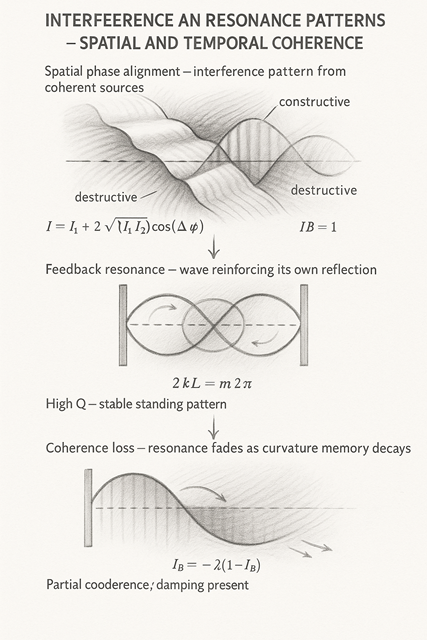
  - **Visualization:**  
    - Left: two waves overlapping — bright and dark fringes.  
    - Middle: standing wave in cavity — nodes and antinodes.  
    - Right: damped pattern fading as \(I_B\) decreases.
Overview

Interference and resonance reveal how energy and geometry merge through coherence alignment.
They are not separate phenomena but two dimensions of the same process:
interference governs spatial coherence — how waves overlay through space,
while resonance governs temporal coherence — how waves reinforce through time.
Both arise when curvature fields overlap in perfect phase, forming stable patterns that remember themselves.


🔹 1. Classical Form — Interference and Phase

When two or more waves of the same frequency meet, their amplitudes combine according to phase.
If their crests align, they reinforce; if crest meets trough, they cancel:

\[ I = I_1 + I_2 + 2\sqrt{I_1 I_2}\cos(\Delta\phi) \]

Constructive interference (Δϕ=0\Delta\phi = 0) produces bright fringes,
destructive interference (Δϕ=π\Delta\phi = \pi) produces darkness — the perfect cancellation of curvature.
Every interference pattern is a spatial memory map, recording the phase relationships between all sources.

Where the pattern is stable and repeatable, coherence is high (IB≈1I_B \approx 1).
Where environmental variation or damping introduces noise, coherence falls and the pattern blurs.


🔸 2. Resonance — Temporal Coherence Loop

Resonance is the time-domain analogue of interference.
It occurs when wave reflections align with their own history — the returning wave reinforcing the next oscillation.
Within a cavity or feedback loop, the condition

\[ 2kL = m 2\pi \]

ensures that each round trip re-enters in phase with the last, sustaining energy indefinitely in the ideal case.

This is temporal superposition — the wave constructively interfering with its own past.
Each cycle adds to the previous one, increasing amplitude until damping intervenes.
Resonance is therefore a curvature accumulator, a stable standing pattern in which energy is recycled rather than dispersed.


🔹 3. Coherence Law — The Fading of Alignment

Both interference and resonance rely on the same underlying rule of coherence retention:

\[ \dot{I_B} = -\lambda (1 - I_B) \]

When λ=0\lambda = 0, coherence is perfect — waves remain locked in phase indefinitely.
As λ\lambda increases, alignment degrades: fringes lose contrast, standing waves collapse, and energy spreads outward.
This describes the natural drift from ordered recursion toward equilibrium — a gradual loss of curvature memory.

In practical terms:

  • High IBI_B → sharp fringes, stable standing wave.
  • Medium IBI_B → soft contrast, transient oscillations.
  • Low IBI_B → incoherent light or sound — uniform energy with no memory of phase.

🔸 4. Unified Coherence Framework — Spatial ↔ Temporal Flow

Interference and resonance are not distinct events but two orientations of the same recursive process.

  • In interference, coherence manifests laterally — across points in space.
  • In resonance, coherence loops longitudinally — through time.

In both, the field re-enters itself, preserving curvature through constructive feedback.
Spatial phase alignment becomes temporal feedback alignment; both express the same conservation of coherent curvature.

Resonance, then, is interference viewed through time.
A cavity mode is the temporal echo of a bright interference fringe — a standing point in coherence space.


🔹 5. Dissipation and the Decay of Memory

No real system is perfectly coherent.
Losses in material, air, or boundary reflection create a slow drift in phase and amplitude.
The system’s geometry continues to obey the interference equations, but its coherence index IBI_B decreases with time.
The once-stable standing pattern begins to fade — first as a slow tremor of asymmetry, then as complete equilibrium.
This fading is not disappearance, but diffusion of memory:
the structured field relaxes back into randomness, energy redistributed but not destroyed.


🧠 Summary

Interference and resonance are two faces of the same phenomenon:
coherence superposition — the recursive reinforcement of curvature in space and time.

  • Interference = spatial coherence: waves meeting from different points
  • Resonance = temporal coherence: a wave meeting its own reflection.
  • IB = the degree of curvature memory sustained by the system.

When coherence is perfect, energy circulates as standing geometry.
When coherence decays, structure softens but the total field remains conserved — order transforms into uniformity.

In the HST–Flow view:

“Resonance is interference that remembers,
and interference is resonance seen all at once.”

Both are expressions of self-aligned recursion — the geometry of energy remembering itself through coherence.


Kireth Research
38 Thorndale Croft, Wetwang, Driffield
East Riding of Yorkshire YO25 9XZ
Designed By