Chapter 2
Radioactive Decay as Coherence Loss
Complex and Cosmological Systems
Author: Mark Anthony Higgins
Revised Date: 23 February 2026
Radioactive decay is usually described as a spontaneous event — a random process governed by probability and half-lives.
But within the HST framework, randomness gives way to structure.
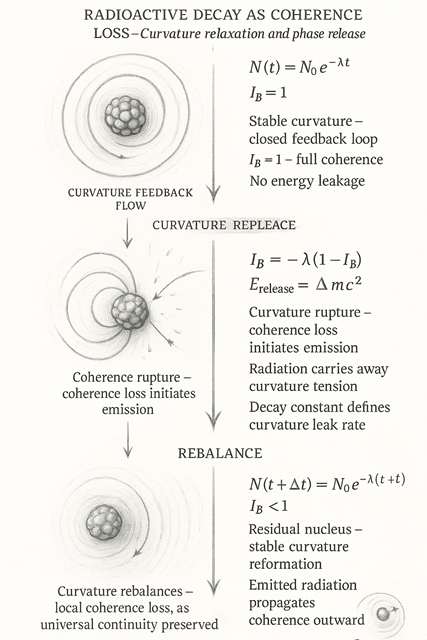
Decay is revealed as the gradual loss of curvature coherence inside a closed field system.
When a nucleus can no longer sustain perfect phase feedback, a portion of its curvature detaches and re-stabilises as emitted particles or radiation.
Energy is not destroyed or released arbitrarily — it is the echo of coherence seeking equilibrium.
Each decay event marks the field’s transition from metastable closure toward restored global balance.
In classical nuclear physics, the number of undecayed nuclei at time follows the exponential law:
\[ N(t) = N_0 e^{-\lambda t}, \qquad \frac{dN}{dt} = -\lambda N \]
where is the decay constant — the probability per unit time that a nucleus will decay.
Half-life, , defines the time required for half the sample to transition.
To a physicist, this expresses statistical behaviour.
In HST–Flow, it expresses field coherence dynamics — the curvature feedback law:
\[ \dot{I_B} = -\lambda (1 - I_B) \]
Here is the boundary coherence index — how strongly the field remains phase-locked to itself.
The same exponential pattern reappears because both equations describe one principle:
coherence decay through curvature leakage.
A nucleus is a curvature closure system: overlapping waveforms of mass-energy form a stable feedback loop.
When coherence is perfect (), internal phase reflections balance — energy neither leaks nor accumulates.
Over time, quantum and thermal perturbations introduce phase misalignment; curvature lines no longer perfectly re-enter the boundary.
This subtle mismatch reduces .
As feedback weakens, the loop releases excess curvature in the form of emitted particles (α, β) or radiative phase waves (γ).
Decay is not “disintegration,” but curvature realignment — a field surrendering local coherence to restore global balance.
In that sense, radiation is the field’s self-correction — the emission of phase tension that could not be internally resolved.
Each type of radioactive decay represents a distinct curvature unbinding channel:
| Decay Type | Process (Classical) | HST Interpretation (Curvature View) |
|---|---|---|
|
α-decay
|
Ejection of
a helium nucleus |
Large-scale curvature rupture
— closed sub-loop detaches from parent field |
|
β-decay
|
Neutron → proton +
electron + antineutrino |
Curvature polarity flip
— internal phase inversion rebalances charge symmetry |
|
γ-decay
|
Photon emission
|
Pure phase-coherence
release — curvature wave emitted without mass loss |
|
Fission
|
Nucleus splits
into fragments |
Full curvature fragmentation —
multiple smaller loops achieving new closure |
All represent feedback release pathways — the system distributing curvature until it regains equilibrium.
The apparent randomness of decay arises from the distributed coherence within an ensemble of nuclei.
Each nucleus has a unique microstate of phase alignment, influenced by its internal field history and environment.
From the outside, this distribution appears probabilistic, but each event is deterministic within its own curvature evolution:
once falls below a critical threshold, emission is inevitable.
Half-life thus reflects the average coherence decay constant across an ensemble.
Even in randomness, order persists — the law of exponential coherence drift ensures global predictability despite local variance
The energy released during decay is the relaxation of stored curvature tension:
\[ E_{\text{release}} = \Delta m\,c^2 \]
This is the same mass–energy transformation that appears in binding energy — but now inverted.
Where binding radiates coherence during closure, decay radiates coherence during unbinding.
The curvature loop’s energy density decreases as it re-opens, restoring flatness to the surrounding field.
This energy does not represent destruction, but reconnection of curvature memory with the larger coherence field of space–time.
Following emission, the remaining system’s field re-settles into a more stable curvature configuration — a lower-energy nucleus, or a fully decohered particle.
Each decay event therefore contains two halves:
Radiation, then, is the messenger of equilibrium: information carried away to reconcile local curvature change with universal coherence continuity.
Across all scales — from alpha decay to black-hole evaporation — the same coherence dynamic applies:
\[ \dot{I_B} = -\lambda (1 - I_B) \]
It is the fundamental law of curvature relaxation.
When curvature density exceeds its sustainable feedback capacity, the system naturally leaks energy to maintain coherence with the whole.
This universality explains why decay constants span orders of magnitude yet remain exponential — coherence relaxation is always multiplicative, never linear.
Binding and decay are complementary aspects of the same curvature cycle:
| Process | Curvature State | Energy Flow | Coherence Behaviour |
|---|---|---|---|
|
Binding
|
Open → Closed
|
Energy released
|
Coherence increases
|
|
Decay
|
Closed → Open
|
Energy released
|
Coherence decreases
|
Both processes emit energy because both represent curvature correction.
A binding field releases energy to achieve closure; a decaying field releases energy to relieve curvature strain.
In each case, radiation is the field’s way of maintaining phase continuity in the universal coherence network.
Radioactive decay is not a random breakdown of matter — it is the self-healing of curvature.
When a nucleus can no longer sustain its internal phase coherence, the curvature field partially opens, releasing energy to rebalance itself.
Every emitted photon or particle is a fragment of curvature finding its way back to equilibrium.
In the HST–Flow interpretation:
Decay is not death.
It is curvature remembering how to let go —
releasing tension so coherence may live on elsewhere.