Chapter 47
Angular Momentum Conservation
Motion and Inertial Coherence
Author: Mark Anthony Higgins
© Mark Anthony Higgins 11 October 2025
Revised Date: 23 February 2026
flow "Angular Momentum Conservation" v1.0
# ---------- PURPOSE ----------
# Expresses conservation of angular momentum as the rotational analogue of momentum coherence.
# When no external torque acts, total angular momentum (L_total) remains constant.
# Introduces coherence index (IB) to represent how perfectly rotational memory is retained.
# IB = 1 → perfect conservation (closed system).
# IB < 1 → partial coherence; internal friction, precession, or external torque cause slow loss or redistribution.
# ---------- PARAMETERS ----------
params:
units: "SI"
IB: 0.0..1.0 = 1.0 # rotational coherence index (1 = perfectly conserved)
N: positive # number of rotating bodies
loss_coeff: 0.0 # rotational damping rate [s^-1]
dt: 0.0? # timestep [s]
include_external_torque: false
τ_ext_total: vec3? # external torque acting on system [N·m]
include_feedback: true
# ---------- STATE ----------
state Rotation:
I_i[]: positive # moments of inertia [kg·m²]
ω_i[]: vec3 # angular velocities [rad/s]
L_i[]: vec3 # individual angular momenta [kg·m²/s]
L_total: vec3 # total system angular momentum [kg·m²/s]
dL_dt_total: vec3 # rate of change of angular momentum [N·m]
E_rot_total: real # total rotational energy [J]
reciprocity_error: real # deviation from perfect conservation [|ΔL|]
IB_rate: real # rate of coherence change
conservation_state: str # "conserved", "precessing", or "dissipative"
# ---------- INVARIANTS ----------
invariants:
# Compute individual angular momenta
for i in range(params.N):
Rotation.L_i[i] = Rotation.I_i[i] * Rotation.ω_i[i]
# Total angular momentum
Rotation.L_total = Σ_i(Rotation.L_i[i])
# External torque contribution
if params.include_external_torque and params.τ_ext_total is defined:
Rotation.dL_dt_total = params.τ_ext_total
else:
Rotation.dL_dt_total = [0, 0, 0]
# Check conservation
if norm(Rotation.dL_dt_total) <= 1e-9:
Rotation.conservation_state = "conserved"
else:
Rotation.conservation_state = "precessing"
# Rotational energy
Rotation.E_rot_total = 0.5 * Σ_i(Rotation.I_i[i] * norm(Rotation.ω_i[i])^2)
# Deviation from perfect conservation
Rotation.reciprocity_error = norm(Rotation.dL_dt_total)
# Coherence decay (rotational damping)
if params.loss_coeff > 0 and params.include_feedback:
params.IB = params.IB - params.loss_coeff * (1 - params.IB) * (params.dt or 1)
params.IB = clamp(params.IB, 0, 1)
Rotation.IB_rate = -params.loss_coeff * (1 - params.IB)
Rotation.conservation_state = "dissipative"
# ---------- TRANSFORMS ----------
transforms:
# External torque effect
apply_torque:
if params.include_external_torque:
ΔL = params.τ_ext_total * (params.dt or 1)
Rotation.L_total += ΔL
Rotation.conservation_state = "open"
# Precession effect (torque perpendicular to L)
gyroscopic_precession:
if params.include_external_torque and norm(params.τ_ext_total) > 0:
Ω_p = norm(params.τ_ext_total) / (norm(Rotation.L_total) or 1)
comment: "Precession frequency Ω_p = τ/L"
Rotation.conservation_state = "precessing"
# Feedback correction
restore_coherence:
correction = -0.01 * Rotation.reciprocity_error
params.IB = clamp(params.IB + correction, 0, 1)
# ---------- MONITORS ----------
monitors:
conservation_check:
if params.IB == 1 and not params.include_external_torque:
assert norm(Rotation.dL_dt_total) <= 1e-9
comment: "Angular momentum perfectly conserved (no external torque)."
elif params.IB < 1:
comment: "Partial coherence — internal damping or precession reduces L."
energy_consistency:
assert Rotation.E_rot_total >= 0
coherence_bounds:
assert 0 <= params.IB <= 1
# ---------- SCENES ----------
scenes:
isolated_rotor:
given params:
N: 1
IB: 1.0
include_external_torque: false
given Rotation:
I_i: [2.0]
ω_i: [[10.0, 0, 0]]
expect:
Rotation.L_total = [20.0, 0, 0]
Rotation.dL_dt_total = [0, 0, 0]
comment: "Isolated system — angular momentum constant, perfect conservation."
precessing_gyroscope:
given params:
N: 1
IB: 1.0
include_external_torque: true
τ_ext_total: [0, 1.0, 0]
dt: 1.0
given Rotation:
I_i: [5.0]
ω_i: [[0, 0, 20.0]]
enable:
- apply_torque
- gyroscopic_precession
expect:
Rotation.conservation_state = "precessing"
comment: "External torque perpendicular to L — precession occurs, |L| constant but direction changes."
damped_spinner:
given params:
N: 1
IB: 0.9
loss_coeff: 0.05
dt: 1.0
given Rotation:
I_i: [1.0]
ω_i: [[30.0, 0, 0]]
expect:
params.IB ↓
Rotation.E_rot_total ↓
comment: "Rotational damping — coherence and angular momentum slowly decay."
# ---------- NOTES ----------
notes:
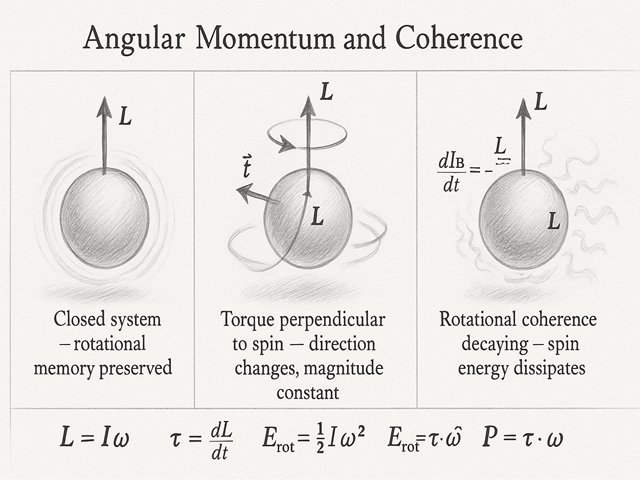
- **Conservation Law:** In absence of external torque,
\[
\frac{d\mathbf{L}}{dt} = 0, \qquad \mathbf{L} = I\boldsymbol{\omega}.
\]
- **With torque:** \(\boldsymbol{\tau} = \frac{d\mathbf{L}}{dt}\).
- **Rotational energy:** \(E_{\text{rot}} = \tfrac{1}{2}I\omega^2.\)
- **Power:** \(P = \boldsymbol{\tau} \cdot \boldsymbol{\omega}.\)
- **Coherence interpretation:** angular momentum is *rotational memory* — the persistence of curvature in rotation.
- \(I_B = 1\): complete memory — perfectly closed rotational field.
- \(I_B < 1\): memory loss — friction, drag, or asymmetry disrupts curvature feedback.
- **Feedback law:** \(\dot{I_B} = -\lambda(1 - I_B)\)
- **Gyroscopic precession:** under external torque, direction of \(\mathbf{L}\) changes while magnitude remains constant — a form of *coherent redirection* rather than loss.
- **Interpretation:** conservation of angular momentum ensures that rotational curvature remains constant within closed boundaries; changes require an external curvature (torque) or coherence decay.
- **Visualization:** arrows showing L constant for IB=1; tilted L vector (precession) for torque; shrinking L magnitude for IB < 1 (damping).
Angular momentum is the memory of rotation — the geometric record of a system’s curved motion.
When no external torque acts, this memory remains perfectly preserved:
$$ \frac{dL}{dt} = 0. $$
This simple statement hides a profound truth: rotation sustains itself through coherence.
The field of motion around a rotating body forms a self-supporting loop of curvature — one that persists until external influence or internal friction breaks its symmetry.
In this view, angular momentum conservation is not just a mechanical rule, but a law of curvature continuity.
When coherence is complete (), the loop is closed and energy circulates endlessly.
When coherence fades (), the loop leaks — the spin slows, the geometry unwinds, and motion diffuses into entropy.
$$ L = I\omega, \qquad \tau = \frac{dL}{dt}. $$
If no external torque acts (τ=0), then
$$ \frac{dL}{dt} = 0. $$
meaning both the magnitude and direction of angular momentum remain constant.
This is the rotational analogue of Newton’s First Law — motion continuing uniformly in the absence of net curvature.
The constancy of ensures that energy remains locked within its own geometric loop — a perfect equilibrium of rotational memory.
In the coherence framework, angular momentum represents the persistence of curvature alignment across time.
A rotating system’s geometry retains phase-locked tension between inertia and curvature — the memory of every prior moment of motion.
The boundary coherence index quantifies this retention:
$$ L_{\text{eff}} = I_B\,L. $$
Thus, angular momentum conservation is the persistence of rotational coherence — the geometry of motion remembering itself.
When a torque acts perpendicular to , its magnitude remains constant, but its direction changes.
This manifests as gyroscopic precession, where the rotation axis itself moves through space while retaining total angular momentum:
$$ \Omega_p = \frac{\tau}{|L|}. $$
In coherence language, the field does not lose memory — it reorients it.
The curvature tension remains intact but redistributes directionally — a rotational redirection of coherence, not decay.
Rotational damping is the slow erosion of this curvature memory.
The feedback governing coherence follows:
$$ \dot{I}_B = -\lambda(1 - I_B). $$
where is a decay constant determined by internal friction or drag.
As coherence decays, torque manifests spontaneously as internal feedback —
the field working against itself to restore alignment while dissipating energy outward.
The system’s total rotational energy:
$$ E_{\text{rot}} = \frac{1}{2} I \omega^2. $$
decreases as falls, transforming organized spin into distributed vibration.
Even so, total energy remains conserved — it merely changes form within a broader coherence field.
Angular momentum conservation describes a closed rotational boundary.
A perfectly coherent system maintains that boundary indefinitely; an open system trades its rotational memory with the environment through torque.
In every case, the total angular momentum of the combined system (object + environment) remains constant — curvature is not destroyed, only redistributed.
This expresses the universal rule of symmetry:
“Rotation, like motion, is never lost — only exchanged.”
Angular momentum conservation is the rotational heartbeat of coherence.
It ensures that curvature — once set in motion — continues to remember its path.
When no torque acts, the field remains self-contained, a perfect loop of memory.
When torque intervenes, the geometry reorients but does not forget.
When coherence fades, memory diffuses — rotation slows, energy spreads, but the total curvature remains conserved across space.
In the HST view:
Thus, conservation of angular momentum is not a static law — it is the persistence of motion through memory, the geometry of space remembering how it turned.