Chapter 48
Parallel Axis and Moment of Inertia
Motion and Inertial Coherence
Author: Mark Anthony Higgins
© Mark Anthony Higgins 11 October 2025
Revised Date: 23 February 2026
flow "Parallel Axis and Moment of Inertia" v1.0
# ---------- PURPOSE ----------
# Explains the Parallel Axis Theorem and the concept of the Moment of Inertia through coherence geometry.
# The moment of inertia represents distributed rotational memory — how mass stores rotational curvature about an axis.
# The Parallel Axis Theorem connects rotational inertia about any axis to that through the centre of mass (CoM).
# IB expresses how perfectly rotational memory is preserved between the two axes — 1 = ideal rigid body, <1 = flexible or dissipative system.
# ---------- PARAMETERS ----------
params:
units: "SI"
IB: 0.0..1.0 = 1.0 # rotational coherence index (1 = rigid coherence)
M: positive # total mass [kg]
d: real # distance between axes [m]
I_cm: positive # moment of inertia about CoM axis [kg·m²]
I_parallel: real # moment of inertia about shifted axis [kg·m²]
loss_coeff: 0.0 # coherence decay rate [s^-1]
include_feedback: true
dt: 0.0? # timestep [s]
# ---------- STATE ----------
state Inertia:
I_total: real # total moment of inertia about parallel axis [kg·m²]
ΔI: real # difference between axes [kg·m²]
E_rot_cm: real # rotational energy about CoM [J]
E_rot_parallel: real # rotational energy about shifted axis [J]
E_loss: real # energy dissipated due to decoherence [J]
IB_rate: real # coherence rate of change [s^-1]
balance_error: real # difference between theoretical and actual inertia [kg·m²]
inertia_state: str # "rigid", "elastic", or "dissipative"
# ---------- INVARIANTS ----------
invariants:
# Parallel Axis Theorem (ideal form)
# I_total = I_cm + M d²
Inertia.I_total = params.I_cm + params.M * (params.d^2)
# Coherence-adjusted inertia (loss or flexibility)
Inertia.I_total = params.IB * (params.I_cm + params.M * params.d^2)
Inertia.ΔI = Inertia.I_total - params.I_cm
# Rotational energy comparison
ω = 10.0 # arbitrary angular speed for comparison [rad/s]
Inertia.E_rot_cm = 0.5 * params.I_cm * ω^2
Inertia.E_rot_parallel = 0.5 * Inertia.I_total * ω^2
# Coherence loss — flexible systems store less rotational energy
if params.IB < 1:
Inertia.E_loss = (1 - params.IB) * 0.5 * params.M * (params.d^2) * ω^2
Inertia.inertia_state = "elastic"
else:
Inertia.E_loss = 0
Inertia.inertia_state = "rigid"
# Feedback decay (for non-ideal systems)
if params.loss_coeff > 0 and params.include_feedback:
params.IB = params.IB - params.loss_coeff * (1 - params.IB) * (params.dt or 1)
params.IB = clamp(params.IB, 0, 1)
Inertia.IB_rate = -params.loss_coeff * (1 - params.IB)
Inertia.inertia_state = "dissipative"
# Balance error
Inertia.balance_error = abs(Inertia.I_total - (params.I_cm + params.M * params.d^2))
# ---------- TRANSFORMS ----------
transforms:
# Coherence decay (progressive softening)
coherence_decay:
params.IB = params.IB - params.loss_coeff * (1 - params.IB) * (params.dt or 1)
params.IB = clamp(params.IB, 0, 1)
Inertia.I_total = params.IB * (params.I_cm + params.M * params.d^2)
Inertia.E_loss += (1 - params.IB) * 0.5 * params.M * params.d^2 * ω^2
Inertia.inertia_state = "dissipative"
# Restoring feedback
restore_feedback:
correction = -0.001 * Inertia.balance_error
params.IB = clamp(params.IB + correction, 0, 1)
# ---------- MONITORS ----------
monitors:
inertia_check:
if params.IB == 1:
assert abs(Inertia.balance_error) < 1e-9
comment: "Rigid system — parallel axis relation exact."
elif params.IB < 1:
comment: "Partial coherence — flexibility or energy loss alters rotational inertia."
energy_consistency:
assert Inertia.E_rot_parallel >= Inertia.E_rot_cm
coherence_bounds:
assert 0 <= params.IB <= 1
# ---------- SCENES ----------
scenes:
rigid_body:
given params:
IB: 1.0
M: 5.0
d: 0.5
I_cm: 2.0
expect:
Inertia.I_total = 2.0 + 5.0 * 0.25 = 3.25
Inertia.inertia_state = "rigid"
comment: "Rigid rotation — perfect coherence, full parallel axis equivalence."
flexible_system:
given params:
IB: 0.9
M: 5.0
d: 0.5
I_cm: 2.0
expect:
Inertia.I_total ≈ 0.9 * (2.0 + 1.25) = 2.925
Inertia.inertia_state = "elastic"
comment: "Partial coherence — flexible body stores slightly less rotational energy."
dissipative_body:
given params:
IB: 0.85
M: 5.0
d: 0.5
I_cm: 2.0
loss_coeff: 0.05
dt: 1.0
enable:
- coherence_decay
expect:
params.IB ↓
Inertia.I_total ↓
Inertia.E_loss > 0
Inertia.inertia_state = "dissipative"
comment: "Coherence decay — gradual energy loss and reduction of effective inertia."
# ---------- NOTES ----------
notes:
- **Parallel Axis Theorem:**
\[
I = I_{\text{cm}} + M d^2
\]
where \(I_{\text{cm}}\) is the inertia about the centre of mass and \(d\) is the perpendicular distance between axes.
- **Rotational energy:** \(E_{\text{rot}} = \tfrac{1}{2} I \omega^2.\)
- **Coherence index (IB):**
- \(I_B = 1\): rigid, ideal motion — inertia adds linearly.
- \(I_B < 1\): flexible or damped — inertia reduced due to internal deformation.
- **Feedback law:** \(\dot{I_B} = -\lambda(1 - I_B)\)
- **Physical meaning:** the moment of inertia is rotational curvature storage — the distribution of rotational memory.
- **Parallel Axis link:** energy and curvature stored about any axis include both the internal (I_cm) and distributed (M d²) curvature terms.
- **Interpretation:** IB quantifies how fully the distributed curvature contributes to rotational memory.
A rigid body has perfect coherence (full coupling); a soft or fluid body transmits less torque and stores less curvature energy.
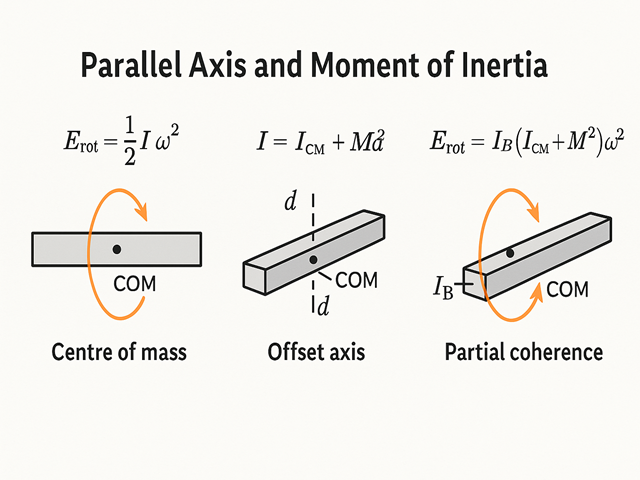
- **Visualization:** show two axes — one through the centre of mass, one parallel but offset; arrows indicating curvature coupling between them, fading when IB < 1.
The moment of inertia is the measure of how mass stores rotational curvature — how distributed matter resists changes in angular velocity.
It is not merely a scalar of resistance, but a map of rotational memory distributed across the body’s geometry.
The Parallel Axis Theorem connects this rotational memory at any point in the system to that about its centre of mass (CoM) — the reference frame where coherence is maximal.
In classical form:
$$ I = I_{\text{cm}} + M d^2. $$
where is the moment of inertia through the centre of mass, is total mass, and is the perpendicular distance between axes.
In the coherence framework, this relation represents curvature coupling between two memory frames — one local (through the CoM), and one distributed (shifted by ).
When coherence is perfect (), this coupling is complete and energy transfers between axes without loss.
When coherence falls below unity (), rotational curvature weakens — flexibility, internal friction, or structural compliance reduce the system’s ability to store full angular energy.
Each element of mass contributes to the system’s rotational inertia according to its distance from the axis of rotation:
$$ I = \sum_i m_i r_i^2. $$
Here, represents the radius of curvature — the distance each particle’s mass must “remember” its rotational motion.
Thus, moment of inertia quantifies how far energy must travel through the structure to maintain angular coherence.
In perfect rigidity (), the memory of motion propagates instantly through the whole body.
In a flexible or dissipative medium (), the curvature alignment lags — energy is stored unevenly or lost to deformation.
The coherence field becomes partial: not every region remembers the same rotation.
The Parallel Axis Theorem adds the curvature contribution from shifting an axis away from the centre of mass:
$$ I_{\text{parallel}} = I_{\text{cm}} + M d^2. $$
The additional term is not just geometric correction — it is the distributed curvature term, the energy required to maintain coherence between two axes of motion.
In the HST view, this second term represents the boundary coupling energy of the field — the part of the system that must re-align its rotational memory when the reference axis moves.
When , this coupling weakens:
$$ I_{\text{eff}} = I_B\,(I_{\text{cm}} + M d^2). $$
This reveals the theorem as a law of coherence continuity, not just geometry — the conservation of rotational memory across multiple curvature frames.
Rotational kinetic energy follows:
$$ E_{\text{rot}} = \frac{1}{2} I \omega^2. $$
When the rotation axis shifts, the distributed inertia increases, and so does the stored energy — provided coherence remains intact.
If the body is flexible or damped, only a fraction of this energy contributes to useful rotation:
$$ E_{\text{rot,eff}} = \frac{1}{2}\,I_B\,(I_{\text{cm}} + M d^2)\,\omega^2. $$
while the remainder,
$$ E_{\text{loss}} = (1 - I_B)\,\frac{1}{2}\,M d^2 \omega^2. $$
appears as heat or vibration.
The coherence decay law,
$$ \dot{I}_B = -\lambda(1 - I_B). $$
quantifies this gradual softening — the slow dissipation of rotational memory as the system’s curvature symmetry relaxes over time.
| Concept | Classical View | Coherence View |
|---|---|---|
|
Moment of Inertia
|
Resistance to angular acceleration
|
Rotational memory distribution
|
|
Parallel Axis Term (Md²)
|
Geometric correction
|
Curvature coupling between memory frames
|
|
Loss
|
Friction or internal damping
|
Decay of coherence alignment
|
|
Rigidity
|
Constant I
|
Perfect memory (I_B = 1)
|
In the coherence interpretation, inertia is not simply opposition to change, but the persistence of curvature information.
A rigid object perfectly mirrors its curvature between all parts; a flexible one leaks curvature energy into heat or internal oscillation.
The Parallel Axis Theorem and Moment of Inertia together describe the architecture of rotational memory.
They quantify how energy is stored, transferred, and retained through curvature coherence.
When , energy and geometry move in perfect alignment — the system is fully rigid.
When , the body’s geometry remembers imperfectly — motion lags, and energy diffuses.
In the HST view:
The moment of inertia is not just a number — it is the shape of memory in rotation, the field’s ability to keep its own curvature aligned across every axis of motion.