
Chapter 24
Zeroth–Third Laws of Thermodynamics (Recast)

Thermal and Entropic Flows
Author: Mark Anthony Higgins
© Mark Anthony Higgins 11 October 2025
Revised Date: 23 February 2026
Audio Overview
Flow Algebra
flow "Thermodynamics_0th_to_3rd_Recast"

# ---------- STATES ----------
state:
  system.U: float                    # internal energy (J)
  system.S: float                    # entropy (J/K)
  system.T: float                    # temperature (K)
  system.V: float                    # volume (m³)
  system.P: float                    # pressure (Pa)
  system.N: float                    # particle number (mol or count)
  system.μ: float                    # chemical potential (J/mol)

  # environment (boundary reservoir)
  boundary.T_env: float              # environmental temperature (K)
  boundary.P_env: float              # environmental pressure (Pa)
  boundary.S_env: float              # entropy reservoir (J/K)
  boundary.integrity.IB: float       # 0..1, coherence of system–boundary coupling

  # exchanges
  exchange.Q: float                  # heat flow (J)
  exchange.W: float                  # work (J)
  exchange.dS: float                 # entropy flow (J/K)
  exchange.mode: "reversible"|"irreversible"

  # derived quantities
  gradients.∇T: float                # temperature gradient (K/m)
  gradients.∇μ: float                # chemical potential gradient
  gradients.∇S: float                # entropy gradient (field form)
  time.t: float

# ---------- PARAMETERS ----------
params:
  kB: 1.380649e-23                  # Boltzmann constant (J/K)
  R: 8.314462618                    # gas constant (J/mol·K)
  dt: float
  relaxation.τ: float               # equilibration time constant
  irreversible.entropy_rate: float  # baseline entropy production term

# ---------- INVARIANTS ----------
invariant:
  - first_law:
      dU = δQ - δW
      δQ = T dS
      δW = P dV + μ dN
  - second_law:
      dS_total = dS_system + dS_env ≥ 0
  - zeroth_law (thermal coherence):
      if T1 = T2 = constant → thermal equilibrium
      i.e., no net ∇T ⇒ ∂μ J_coh^μ = 0 (thermal)
  - third_law (entropy limit):
      lim_{T→0} S → S₀ (finite or →0 for perfect crystal)
  - entropy_flux:
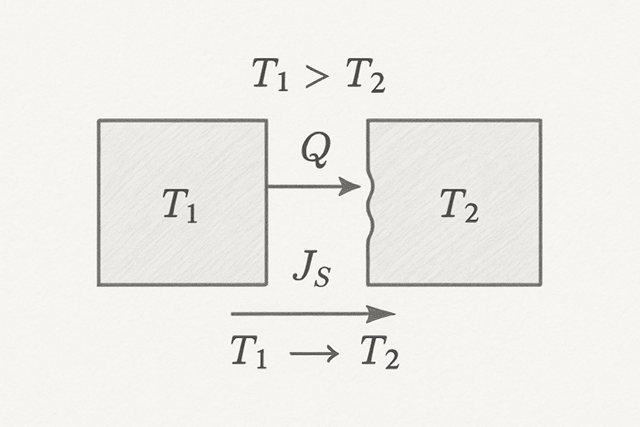
      J_S = exchange.Q / T
  - equilibrium_condition:
      ∇T = 0 and ∇μ = 0 → no net flow of energy or matter
  - coherence_relation:
      ΔS * T = ΔU - PΔV - μΔN (boundary energy balance)

# ---------- TRANSFORMS ----------
transform:

  thermal_exchange:
    do:
      # heat flow proportional to temperature difference
      exchange.Q = (boundary.T_env - system.T) * params.kB / params.dt
      system.U += exchange.Q
      system.S += exchange.Q / system.T
      exchange.dS = exchange.Q / boundary.T_env
      boundary.S_env -= exchange.dS

  mechanical_exchange:
    do:
      exchange.W = system.P * d(system.V)
      system.U -= exchange.W

  chemical_exchange:
    do:
      dN = -(∇μ * params.dt)
      system.U += system.μ * dN
      system.N += dN

  entropy_production:
    do:
      if exchange.mode == "irreversible":
        σ = params.irreversible.entropy_rate
        system.S += σ * params.dt
      boundary.integrity.IB = clamp(boundary.integrity.IB - σ*0.01, 0, 1)

  approach_equilibrium:
    do:
      # relax temperature and chemical potential toward environment
      system.T += (boundary.T_env - system.T) * exp(-params.dt / params.relaxation.τ)
      system.μ += (0 - system.μ) * exp(-params.dt / params.relaxation.τ)
      gradients.∇T = (boundary.T_env - system.T)
      gradients.∇μ = (0 - system.μ)

  tick:
    do:
      time.t += params.dt

# ---------- MONITORS ----------
monitor:
  energy_balance:
    observe: [system.U, exchange.Q, exchange.W]
    report: "Tracks internal energy balance via dU = δQ - δW."

  entropy_evolution:
    observe: [system.S, boundary.S_env, exchange.dS]
    report: "Total entropy change; checks dS_total ≥ 0 (Second Law)."

  equilibrium_state:
    observe: [system.T, boundary.T_env, gradients.∇T]
    report: "Zeroth Law: equilibrium when ∇T ≈ 0, coherence restored."

  low_temperature_limit:
    observe: [system.T, system.S]
    report: "Third Law: entropy approaches constant as T→0."

  coherence_integrity:
    observe: [boundary.integrity.IB]
    report: "Thermal coupling integrity; weakened by irreversible dissipation."

# ---------- NOTES (coherence view) ----------
note:
  - The **Zeroth Law** expresses **coherence equality**: thermal equilibrium is not a passive state but a perfectly balanced phase exchange across boundaries.
  - The **First Law** is the **energy conservation loop**: dU = δQ - δW ensures energy transforms but total curvature remains closed.
  - The **Second Law** encodes **directionality of coherence** — entropy increases as phase information disperses into finer microstates.
  - The **Third Law** defines the **limit of coherence compression**: as temperature approaches zero, fluctuations vanish, and all curvature aligns — coherence becomes absolute.
  - In HST terms:
      • Temperature = average curvature agitation (phase jitter).  
      • Entropy = total curvature spread — the field’s informational roughness.  
      • Equilibrium = uniform curvature tension; coherence fully symmetric.  
  - All four laws are **coherence conservation in disguise**: energy, entropy, and equilibrium are just different projections of one boundary condition — ∂μ J_coh^μ = 0.
  - Irreversibility marks not destruction but redistribution: a shift of coherence granularity from ordered to diffuse forms.

# ---------- WHAT THIS FLOW CAPTURES ----------
doc:
  summary: >
    Thermodynamics_0th_to_3rd_Recast unifies the classical thermal laws under
    boundary-coherence logic. It tracks how energy, entropy, and temperature
    evolve through reversible and irreversible exchanges between system and
    environment. In this framing, equilibrium is coherence equality, entropy
    is curvature dispersion, and the Third Law is the still point of perfect
    coherence — where all gradients vanish and geometry rests.
Interpretation and Coherence View

Thermodynamics describes how energy moves and balances between systems,
but beneath the equations lies something deeper: coherence seeking equilibrium.
Each of the thermal laws is not merely an empirical rule,
but a statement about how curvature, information, and boundary structure maintain continuity.


Zeroth Law — Thermal Coherence

The Zeroth Law establishes the very concept of temperature as a coherence relation.
When two systems are in equilibrium with a third, they share a common temperature:

\[ T_{1} = T_{2} = T_{3} \]

In classical form this defines temperature; in HST it defines phase alignment.
No heat flows because no curvature gradient remains — the systems’ microscopic oscillations are phase-matched.
Temperature is therefore not an intrinsic property, but a measure of coherence mismatch between boundaries.

When \( \nabla T = 0 \), coherence is complete.

\( \partial_{\mu} J_{\text{coh}}^{\mu} = 0_{\text{thermal}} \)

This is equilibrium in its purest sense — the curvature field resting in perfect symmetry.


First Law — Conservation of Curvature Energy

The First Law

\[ dU = \delta Q - \delta W \]

describes energy conservation: heat added to a system either changes its internal energy or performs work.
In the coherence frame, internal energy (U) is stored curvature tension,
heat (Q) is random phase motion entering from the boundary,
and work (W) is ordered curvature transfer — coherence directing form.

Energy never disappears; it only changes boundary encoding — from field to motion, from structure to vibration.
Every exchange preserves total curvature consistency.


Second Law — Direction of Coherence Flow

The Second Law introduces entropy (S), the measure of curvature dispersion:

\[ dU = \delta Q - \delta W \]

Entropy does not mark disorder, but divergence of phase paths.
When coherence becomes diffuse, possibilities multiply — not chaos, but richer topology.
The law simply states that once coherence spreads, it cannot spontaneously compress without restoring structure from elsewhere.

In HST terms, entropy is phase roughness,
and its growth is the natural broadening of curvature into balance with the wider field.
The arrow of time arises not from cause but from coherence relaxation.


Third Law — Limit of Coherence Compression

As temperature approaches zero,

\[ \lim_{T \to 0} S \;\to\; S_{0} \]

entropy approaches a constant — often zero for a perfect crystal.
This is the still point of coherence: all microstates align,
fluctuations vanish, and curvature tension becomes uniform.
At absolute zero, the field cannot communicate further — the system becomes a single, timeless pattern.

It is not the death of motion, but the silence of perfect memory:
coherence so complete that nothing needs to change.


Unified View — The Coherence Cycle
Classical LawConventional MeaningCoherence Interpretation (HST)
Zeroth
Temperature equality
Phase alignment — no curvature gradient
First
Energy conservation
Curvature tension redistributed
Second
Entropy increase
Phase dispersion and coherence diffusion
Third
Entropy→constant at 0 K
Perfect coherence — curvature rest state

Every thermodynamic process is thus a curvature negotiation between matter and boundary:
heat flow as phase transfer, work as field re-alignment, entropy as distributed memory.


In Essence

Thermodynamics is the language of coherence at rest.
It shows how the universe shares its internal tension — heat, motion, structure —
until every boundary becomes smooth.

  • Temperature is the rhythm of curvature.
  • Entropy is the breadth of its memory.
  • Energy is the tension that keeps it alive.

When these balance, coherence holds.
The four laws are not limits of physics — they are the grammar of stability.

In the end, equilibrium is not stillness but perfect communication —
the moment when every oscillation knows where it belongs,
and the field no longer needs to correct itself.


Kireth Research
38 Thorndale Croft, Wetwang, Driffield
East Riding of Yorkshire YO25 9XZ
Designed By