
Chapter 59
Tunnelling as Phase Re-alignment

Quantum Coherence and Boundary Systems
Author: Mark Anthony Higgins
© Mark Anthony Higgins 11 October 2025
Revised Date: 23 February 2026
Audio Overview
Flow Algebra
flow "Tunnelling as Phase Re-alignment" v1.0

# ---------- PURPOSE ----------
# Describes quantum tunnelling as a continuity of phase coherence across a potential barrier.
# Rather than particles “passing through” walls, tunnelling reflects phase re-alignment
# — the wavefunction re-establishing curvature coherence across a region of suppressed amplitude.
# IB measures coherence retention; lower IB implies partial phase decoherence within the barrier.

# ---------- PARAMETERS ----------
params:
  units: "SI"
  ħ: real = 1.054571817e-34       # reduced Planck constant [J·s]
  m: positive                     # particle mass [kg]
  E: positive                     # particle total energy [J]
  V0: positive                    # barrier potential height [J]
  a: positive                     # barrier width [m]
  IB: 0.0..1.0 = 1.0              # phase coherence index (1 = perfect)
  λ_decay: nonnegative = 0.0      # coherence loss rate [s^-1]
  dt: positive?                   # timestep [s]
  include_reflection: bool = true

# ---------- STATE ----------
state Barrier:
  k1: real                        # wavenumber in region I (E > 0)
  κ: real                         # decay constant inside barrier (V0 > E)
  k2: real                        # wavenumber in region III
  T: real                         # transmission coefficient
  R: real                         # reflection coefficient
  phase_shift: real               # phase change across barrier
  barrier_opacity: real           # qualitative transparency measure
  coherence_loss: real            # 1 - IB
  regime: str                     # "transparent","tunnelling","opaque"

# ---------- INVARIANTS ----------
invariants:

  # Region I (before barrier)
  Barrier.k1 = sqrt(2*params.m*params.E) / params.ħ

  # Inside barrier (E < V0) => imaginary wavevector κ
  if params.E < params.V0:
    Barrier.κ = sqrt(2*params.m*(params.V0 - params.E)) / params.ħ
    Barrier.regime = "tunnelling"
  else:
    Barrier.κ = 0
    Barrier.regime = "transparent"

  # Region III (after barrier)
  Barrier.k2 = sqrt(abs(2*params.m*params.E)) / params.ħ

  # Transmission probability (1D barrier)
  if params.E < params.V0:
    Barrier.T = exp(-2 * Barrier.κ * params.a)
  else:
    Barrier.T = 1 / (1 + 0.25 * ((params.V0**2) / (params.E*(params.V0 - params.E))) * sin(Barrier.k1 * params.a)^2)

  # Reflection coefficient (optional)
  if params.include_reflection:
    Barrier.R = 1 - Barrier.T
  else:
    Barrier.R = 0

  # Phase shift across barrier (complex transmission phase)
  Barrier.phase_shift = atan2(Im(exp(-Barrier.κ * params.a)), Re(exp(-Barrier.κ * params.a)))

  # Coherence decay law
  if params.λ_decay > 0 and params.dt is defined:
    params.IB = clamp(params.IB - params.λ_decay * (1 - params.IB) * params.dt, 0, 1)
  Barrier.coherence_loss = 1 - params.IB

  # Barrier opacity (qualitative measure)
  Barrier.barrier_opacity = exp(-Barrier.κ * params.a) * params.IB

# ---------- TRANSFORMS ----------
transforms:

  adjust_energy:
    comment: "Vary particle energy to test barrier penetration probability."
    params.E += ΔE
    if params.E > params.V0:
      Barrier.regime = "transparent"

  widen_barrier:
    comment: "Increase barrier width a → reduces tunnelling probability exponentially."
    params.a += Δa

  decay_coherence:
    comment: "Apply internal phase decoherence during tunnelling."
    params.IB = clamp(params.IB - 0.01 * (1 - params.IB), 0, 1)
    Barrier.coherence_loss = 1 - params.IB

  restore_coherence:
    comment: "Phase feedback restores alignment after barrier."
    params.IB = clamp(params.IB + 0.01 * (1 - params.IB), 0, 1)
    Barrier.coherence_loss = 1 - params.IB

# ---------- MONITORS ----------
monitors:
  probability_conservation:
    assert Barrier.T + Barrier.R <= 1.0001
    comment: "Transmission and reflection probabilities within unitary limit."
  coherence_bounds:
    assert 0 <= params.IB <= 1
  barrier_limit:
    if params.E < params.V0:
      comment: "E < V0 → tunnelling regime."
    else:
      comment: "E > V0 → over-barrier transmission."

# ---------- SCENES ----------
scenes:

  thin_barrier:
    given params:
      m: 9.11e-31
      E: 1.0e-19
      V0: 2.0e-19
      a: 1.0e-10
      IB: 1.0
    expect:
      Barrier.T ≈ exp(-2 * Barrier.κ * a)
      Barrier.regime = "tunnelling"
      comment: "Thin barrier — moderate phase suppression, high coherence."

  thick_barrier:
    given params:
      m: 9.11e-31
      E: 1.0e-19
      V0: 2.0e-19
      a: 5.0e-10
      IB: 1.0
    expect:
      Barrier.T ≪ 1
      Barrier.regime = "opaque"
      comment: "Thicker barrier exponentially suppresses amplitude — low phase transmission."

  decohering_tunnel:
    given params:
      m: 9.11e-31
      E: 1.0e-19
      V0: 2.0e-19
      a: 2.0e-10
      IB: 0.7
      λ_decay: 0.05
      dt: 1.0
    enable:
      - decay_coherence
    expect:
      Barrier.T ↓
      Barrier.coherence_loss > 0
      comment: "Decoherence widens effective barrier — tunnelling phase misalignment."

  perfect_alignment_recovery:
    given params:
      m: 9.11e-31
      E: 1.0e-19
      V0: 2.0e-19
      a: 2.0e-10
      IB: 0.8
    enable:
      - restore_coherence
    expect:
      Barrier.T ↑
      Barrier.coherence_loss ↓
      comment: "Phase re-alignment beyond barrier restores coherence and transmission."

# ---------- NOTES ----------
notes:
  - **Tunnelling Probability:**  
    \[
    T \approx e^{-2\kappa a}, \qquad 
    \kappa = \frac{\sqrt{2m(V_0 - E)}}{\hbar}.
    \]

  - **Interpretation:**  
    Classical intuition forbids crossing when \(E < V_0\),  
    but the wavefunction never fully vanishes — curvature continuity demands phase continuity across all boundaries.  
    The apparent “tunnelling” is the **phase re-alignment** of curvature beyond the barrier.

  - **Coherence Law:**  
    \[
    \dot{I_B} = -\lambda(1 - I_B)
    \]
    Models decoherence inside the barrier — imperfect phase continuity.

  - **Curvature View (HST–Flow):**  
    - Inside the barrier, curvature amplitude decays exponentially but phase continuity persists.  
    - The wavefunction re-aligns its curvature beyond the barrier; if IB = 1, perfect phase transmission occurs.  
    - Reduced IB introduces mismatch — partial reflection, phase lag, or diffusion.  
    - Thus, tunnelling is not energy leakage but *boundary phase inheritance*.

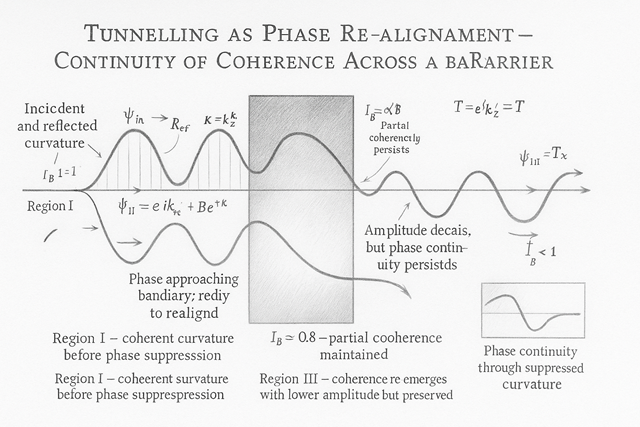
  - **Visualization:**  
    - Left: incoming and reflected waves before barrier (IB=1).  
    - Middle: exponential decay within barrier (phase field still coherent).  
    - Right: re-emergent wave beyond barrier (phase re-aligned, reduced amplitude if IB<1).
Overview

Quantum tunnelling is not the passage of a particle through a wall — it is phase continuity across a suppressed curvature zone.
Where classical energy halts, coherence continues; where amplitude decays, phase re-aligns.
In the HST framework, tunnelling is not a violation of energy conservation, but a preservation of boundary coherence — the field re-establishing its curvature memory on the far side of a potential barrier.


🔹 1. Classical Form — The Barrier Paradox

In classical mechanics, a particle of energy EE less than the potential barrier V0V_0 cannot pass.
In wave mechanics, however, the de Broglie curvature persists into the forbidden region with an exponentially decaying amplitude:

\[ \psi(x) \sim e^{-\kappa x}, \qquad \kappa = \frac{\sqrt{2m(V_0 - E)}}{\hbar} \]

The probability of transmission through a barrier of width aa becomes:

\[ T \approx e^{-2\kappa a} \]

The amplitude falls, but the phase remains defined — and where phase persists, curvature coherence can re-form beyond the boundary.
What emerges is not a particle that “passed through,” but a field that never fully disconnected.


🔸 2. Coherence Interpretation — The Continuity of Curvature

In the HST view, the wavefunction’s phase embodies the memory of curvature alignment across space.
When the wave meets a barrier, the field compresses its curvature — energy density rises locally, amplitude shrinks, but phase continuity remains non-zero.
The field therefore seeks equilibrium by re-aligning its curvature across the boundary.

The transmission coefficient TT is not the “chance of passage,” but the degree of successful phase inheritance across the barrier.
The coherence index IBI_B expresses how intact the phase relationship remains:

\[ I_B = e^{-2\kappa a} \quad \text{(idealised form)} \]

Perfect coherence (IB=1I_B = 1) allows full phase alignment and amplitude restoration.
Reduced IBI_B corresponds to phase mismatch, yielding partial transmission and reflection.


🔹 3. Barrier Geometry — Phase Suppression, Not Stopping

Inside the barrier, the field does not vanish; it transforms.
Amplitude attenuates exponentially, but its curvature continues to evolve under imaginary wavenumber κ\kappa.
This region acts as a phase compressor — converting oscillatory curvature into stored potential curvature.

At the exit, phase continuity requires that the re-emerging field adopt a curvature consistent with both regions — effectively realigning itself into a stable outgoing wave.
This re-emergence is not a traversal in space-time, but a restoration of coherence geometry across a boundary discontinuity.


🔸 4. Decoherence and Partial Reflection

If environmental noise or internal friction reduces coherence, IBI_B falls below 1.
The feedback law,

\[ \dot{I_B} = -\lambda (1 - I_B) \]

governs the degradation of phase integrity inside the barrier.
Low IBI_B increases effective barrier width — phase misalignment accumulates, transmission falls exponentially, and reflection dominates.
In this regime, the barrier behaves as a phase-diffusive interface, redirecting curvature back into the incident region.
Tunnelling thus becomes incomplete re-alignment rather than failure of motion.


🔹 5. The Re-aligned State — Memory Restored Beyond the Barrier

On the far side, the emerging field carries a modified phase — slightly delayed, amplitude-reduced, but still coherent.
This new wave is a continuation of the original field, having re-established curvature continuity after temporary suppression.
The system’s coherence loop remains closed, albeit with reduced amplitude:

\[ \psi_{\text{out}} = I_B^{1/2} e^{i\phi_{\text{shift}}} \psi_{\text{in}} \]

  • If IB=1I_B = 1, the field is fully restored — a perfect phase echo.
  • If IB<1I_B < 1, coherence is only partially retrieved — the wave emerges dimmer, yet recognisably the same.

Tunnelling is thus re-coherence, not transport.


🔸 6. Unified Coherence Framework — The Barrier as Phase Mirror
In HST–Flow logic:
  • The barrier is not an obstacle but a phase mirror, partially reflecting and partially realigning coherence.
  • The transmission amplitude measures how effectively the field maintains continuity under curvature tension.
  • The exponential decay is a geometric penalty for maintaining curvature through misaligned space.
  • At full alignment, the system preserves unity; at partial alignment, coherence leaks outward, but never disappears.

Thus, tunnelling is the field’s way of maintaining coherence conservation when energy constraints disallow classical continuity.
It proves that the wavefunction is not a description of probability, but of phase structure resilience — the persistence of curvature memory even through apparent separation.


🧠 Summary

Tunnelling is phase re-alignment through suppressed curvature.
It is the field’s ability to maintain coherence continuity across boundaries that classical mechanics deems impassable

In the HST–Flow interpretation:

  • The barrier compresses curvature but not phase.
  • Transmission is coherence recovery, not traversal.
  • Reflection is curvature redirection under partial decoherence.
  • IBI_B quantifies phase integrity through the barrier.

A barrier never stops coherence — it only tests how faithfully the universe can remember its own phase.


Kireth Research
38 Thorndale Croft, Wetwang, Driffield
East Riding of Yorkshire YO25 9XZ
Designed By