
Chapter 64
Equivalence Principle and Curvature Feedback

Relativistic and Curvature Flows
Author: Mark Anthony Higgins
© Mark Anthony Higgins 11 October 2025
Revised Date: 23 February 2026
Audio Overview
Flow Algebra
flow "Equivalence Principle and Curvature Feedback" v1.0


# ---------- PURPOSE ----------
# Expresses the equivalence principle (gravitational and inertial acceleration indistinguishable)
# as curvature feedback maintaining local coherence (phase alignment).
# IB measures local curvature coherence; 1 = perfect local equivalence, <1 = partial distortion (non-inertial noise).
# Acceleration and gravity both appear as curvature gradients in space–time; local physics remains coherent (Lorentz form preserved).

# ---------- PARAMETERS ----------
params:
  units: "SI"
  c: positive = 2.99792458e8           # speed of light [m/s]
  g: real = 9.80665                    # gravitational field [m/s²]
  a: real = 9.80665                    # equivalent proper acceleration [m/s²]
  h: real = 1.0                        # local height difference [m]
  φ: real = g * h / c^2                # dimensionless potential difference
  IB: 0.0..1.0 = 1.0                   # curvature coherence index
  λ_drift: nonnegative = 0.0           # coherence drift rate [s^-1]
  dt: positive?                        # timestep [s]
  include_redshift: bool = true
  include_tidal: bool = true

# ---------- STATE ----------
state Curvature:
  Δτ_surface: real                     # proper time at lower potential
  Δτ_high: real                        # proper time at higher potential
  ratio_redshift: real                 # gravitational redshift factor
  a_equiv: real                        # equivalent acceleration from curvature
  curvature_gradient: real             # ∂g/∂r or effective curvature gradient
  phase_feedback: real                 # curvature feedback factor restoring coherence
  IB_rate: real                        # dIB/dt
  regime: str                          # "inertial-equivalent", "curved-coherent", "distorted"

# ---------- INVARIANTS ----------
invariants:

  # Local equivalence: gravitational vs. inertial acceleration
  Curvature.a_equiv = params.a - params.g
  if abs(Curvature.a_equiv) <= 1e-9:
    Curvature.regime = "inertial-equivalent"
  else:
    Curvature.regime = "curved-coherent"

  # Gravitational time dilation (for redshift)
  if params.include_redshift:
    Curvature.Δτ_high = 1.0
    Curvature.Δτ_surface = sqrt(1 - 2 * params.φ)
    Curvature.ratio_redshift = Curvature.Δτ_surface / Curvature.Δτ_high
  else:
    Curvature.ratio_redshift = 1.0

  # Curvature gradient (tidal coherence deviation)
  if params.include_tidal:
    # Simple heuristic tidal curvature estimate ∝ g/radius (local)
    r = 6.37e6 # Earth-like radius
    Curvature.curvature_gradient = params.g / r
  else:
    Curvature.curvature_gradient = 0

  # Phase feedback: acceleration adjusts curvature to restore coherence (ΔIB)
  Curvature.phase_feedback = (params.g - params.a) / params.g

  # Coherence law
  if params.λ_drift > 0 and params.dt is defined:
    params.IB = clamp(params.IB - params.λ_drift * (1 - params.IB) * params.dt, 0, 1)
  Curvature.IB_rate = -params.λ_drift * (1 - params.IB)

  # Regime tagging
  if params.IB == 1:
    Curvature.regime = "inertial-equivalent"
  elif params.IB > 0.5:
    Curvature.regime = "curved-coherent"
  else:
    Curvature.regime = "distorted"

# ---------- TRANSFORMS ----------
transforms:

  vary_height:
    comment: "Adjust potential difference by changing height."
    params.h += Δh
    params.φ = params.g * params.h / params.c^2

  change_acceleration:
    comment: "Change proper acceleration (elevator, rocket)."
    params.a += Δa
    Curvature.a_equiv = params.a - params.g

  add_tidal_effects:
    comment: "Increase curvature gradient (simulate nonuniform field)."
    Curvature.curvature_gradient *= (1 + Δfraction)

  decay_coherence:
    comment: "Simulate local loss of curvature coherence (vibration, gravitational noise)."
    params.IB = clamp(params.IB - 0.02 * (1 - params.IB), 0, 1)

  restore_equivalence:
    comment: "Re-synchronise local inertial frame (feedback restores coherence)."
    params.IB = clamp(params.IB + 0.05 * (1 - params.IB), 0, 1)

# ---------- MONITORS ----------
monitors:
  equivalence_check:
    if abs(Curvature.a_equiv) <= 1e-9:
      comment: "Local frame equivalence holds (a = g)."
    else:
      comment: "Local curvature feedback compensates acceleration."

  redshift_consistency:
    assert Curvature.ratio_redshift <= 1
    comment: "Time at lower potential runs slower — gravitational redshift consistent."

  coherence_bounds:
    assert 0 <= params.IB <= 1

# ---------- SCENES ----------
scenes:

  perfect_equivalence:
    given params:
      g: 9.80665
      a: 9.80665
      IB: 1.0
    expect:
      Curvature.a_equiv ≈ 0
      Curvature.regime = "inertial-equivalent"
      comment: "Freely falling or accelerated frame — indistinguishable locally."

  gravitational_redshift:
    given params:
      g: 9.80665
      h: 100.0
      include_redshift: true
    expect:
      Curvature.ratio_redshift < 1
      comment: "Time dilation between surface and higher altitude — curvature gradient effect."

  tidal_curvature:
    given params:
      g: 9.80665
      IB: 0.8
      include_tidal: true
    expect:
      Curvature.curvature_gradient > 0
      Curvature.regime = "curved-coherent"
      comment: "Nonuniform field introduces small phase misalignments — partial coherence."

  decohering_field:
    given params:
      g: 9.80665
      a: 9.0
      λ_drift: 0.05
      dt: 1.0
      IB: 0.7
    enable:
      - decay_coherence
    expect:
      params.IB ↓
      Curvature.regime = "distorted"
      comment: "Local frame coherence drifting — gravitational noise or vibration reduces equivalence."

# ---------- NOTES ----------
notes:
  - **Equivalence Principle (Einstein):**  
    Locally, no experiment can distinguish uniform acceleration from a gravitational field.  
    In HST–Flow, this corresponds to *phase curvature feedback*: the local field reconfigures to maintain coherence invariance.

  - **Gravitational Redshift (Feedback Manifestation):**  
    \[
    \frac{\Delta \tau_{\text{surface}}}{\Delta \tau_{\text{high}}} \approx \sqrt{1 - \frac{2gh}{c^2}}.
    \]

  - **Coherence Law:**  
    \[
    \dot{I_B} = -\lambda(1 - I_B)
    \]
    models small loss of equivalence through environmental drift; coherence feedback restores local alignment.

  - **Curvature Feedback Concept:**  
    Gravity and acceleration both arise as *curvature feedback loops* — local changes in motion generate curvature tension, which adjusts to preserve the invariant interval:
    \[
    s^2 = c^2 \Delta t^2 - \Delta x^2 - \Delta y^2 - \Delta z^2.
    \]
    IB quantifies how well local geometry preserves phase continuity under this feedback.

  - **Interpretation (HST–Flow):**  
    - Acceleration and gravity are two expressions of curvature response.  
    - The feedback of space–time ensures coherence — the same Lorentz structure everywhere locally.  
    - Gravitational redshift and time dilation arise from differential phase curvature.  
    - Perfect equivalence (IB = 1): indistinguishable fields.  
    - Partial coherence (IB < 1): curvature gradients introduce small desynchronisations.

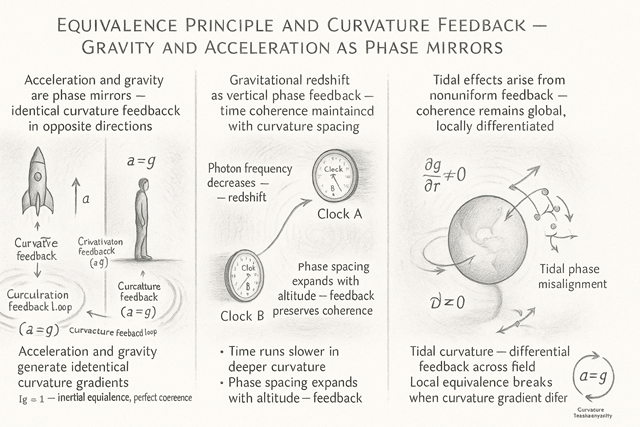
  - **Visualization:**  
    - Left: inertial frame (uniform acceleration equivalent to gravity).  
    - Middle: gradient curvature (gravitational redshift).  
    - Right: decohering field — tidal distortion, partial phase misalignment.
Overview

The equivalence principle is the statement that gravity and acceleration are locally indistinguishable — but beneath that symmetry lies something deeper:
it is the universe’s way of preserving phase coherence.
Acceleration and gravity are not separate causes of motion; they are curvature feedback responses — adjustments in local geometry that maintain the coherence of space-time when energy or motion changes.

In the HST view, the equivalence principle is not just a principle of relativity, but a law of coherence stability — the self-balancing feedback that ensures every local frame experiences the same Lorentz geometry, no matter how it moves.


🔹 1. Classical Form — Indistinguishability of Gravity and Acceleration

Einstein’s principle of equivalence states that no local experiment can distinguish between a uniform gravitational field and a uniformly accelerated frame.
If an observer inside a closed laboratory feels a downward force, there is no way to tell whether it arises from gravity pulling or the lab accelerating upward with acceleration aa:

\[ a = g \]

This equivalence is the foundation of general relativity.
In classical physics, it means that the laws of motion remain valid in both frames, provided we adjust for the curvature introduced by acceleration or gravitational potential.
The space-time interval stays invariant:

\[ s^2 = c^2 \Delta t^2 - \Delta x^2 - \Delta y^2 - \Delta z^2 = \text{constant} \]

Every observer measures the same geometry — but expressed through their own locally curved coordinates.


🔸 2. Coherence Interpretation — Curvature as Feedback

In the HST-Flow framework, the equivalence principle arises from curvature feedback — a self-correcting mechanism by which space-time preserves phase continuity.
Acceleration, like gravity, bends the local phase geometry, producing curvature tension.
To maintain global coherence, the field re-aligns itself, adjusting its local time and space calibrations so that the invariant interval remains constant.

The adjustment is phase-driven, not force-driven:
when acceleration or potential changes, local curvature shifts to keep the Lorentz structure phase-locked.
This curvature response is instantaneous in the field sense — a global self-consistency condition ensuring coherence across all local frames.


🔹 3. Gravitational Redshift — Curvature Feedback in Time

At different gravitational potentials, clocks tick at different rates because curvature feedback changes the local phase spacing of time.
The gravitational redshift expresses this:

\[ \frac{\Delta \tau_{\text{high}}}{\Delta \tau_{\text{surface}}} \approx 1 - \frac{g h}{c^2} \]

Lower clocks run slower because the curvature density near the surface is higher — local phase loops are more compressed.
Time dilation is therefore not a stretch of time, but a re-indexing of curvature phase to maintain global coherence.
The deeper in a gravitational field, the tighter the curvature — and the slower the local phase evolves.


🔸 4. Acceleration as Local Curvature Simulation

A rocket accelerating in flat space creates an identical curvature feedback pattern to a stationary observer in a gravitational field.
The field lines of acceleration map onto those of gravitational curvature — both produce the same phase gradient.
The equivalence a=ga = g is not coincidence; it is the boundary condition that makes coherence local and transferable.
Acceleration and gravity are both modes of curvature feedback — different ways the field preserves phase invariance under changing boundary conditions.


🔹 5. Coherence Drift and Local Integrity

In real systems, coherence is not perfect.
Clocks drift, potentials fluctuate, and gradients vary.
This operational integrity is represented by the frame-coherence index IBI_B, evolving as:

\[ \dot{I_B} = -\lambda_{\text{drift}} (1 - I_B) \]

When IB=1I_B = 1, local equivalence is perfect — acceleration and gravity are phase-identical.
When IB<1I_B < 1, small desynchronisations arise — local phase misalignments that represent tidal curvature or environmental noise.
Even then, global coherence (the constancy of s2s^2) is maintained — the system remains self-consistent, but slightly phase-noisy.


🔸 6. Tidal Curvature — Feedback Beyond Locality

The equivalence principle holds locally, but tidal curvature appears when feedback cannot remain uniform across an extended region.
The variation of curvature with position introduces small coherence gradients, represented by:

\[ \frac{\partial g}{\partial r} \neq 0 \]

This gradient marks the limit of local equivalence — where curvature feedback becomes differential.
In HST terms, it is where the local phase field cannot fully re-lock without introducing minor incoherence (a drop in IBI_B).
Tides are thus phase divergence effects — small failures of perfect feedback across space-time.


🔹 7. Unified Coherence Framework — Gravity as Self-Referential Curvature Feedback

The equivalence principle unifies gravity, inertia, and acceleration through phase curvature continuity.
Space-time behaves as a self-regulating coherence field:
when mass or energy creates a distortion, curvature feedback redistributes phase so that local observers always experience smooth continuity.

This is why free fall feels weightless — inside a gravitational field, local curvature feedback perfectly balances inertial acceleration.
It is also why general relativity extends the principle: gravity is not a force but a geometric feedback process, where curvature and motion evolve together to sustain coherence.

In HST–Flow language:

  • Acceleration = boundary-driven curvature realignment.
  • Gravity = geometry’s self-realising curvature feedback.
  • Equivalence = phase-matching between these processes.

Every observer, no matter their frame, experiences coherence — because the universe continually recalibrates curvature to keep phase memory intact.


🧠 Summary

The equivalence principle is not just a symmetry between gravity and acceleration — it is the curvature feedback law that keeps the universe coherent.
Acceleration and gravity are two expressions of the same mechanism: the field’s effort to preserve the invariant geometry of phase continuity.

In the HST–Flow interpretation:

  • a=ga = g: acceleration equals gravitational curvature feedback.
  • s2s^2: invariant curvature — coherence preserved under transformation.
  • IBI_B: local coherence integrity.
  • IB˙=−λ(1−IB)\dot{I_B} = -\lambda(1 - I_B): coherence drift law for desynchronisation.
  • Tidal curvature: differential feedback, coherence gradient.

Gravity is not a pull — it is curvature remembering how to stay coherent through motion.
Acceleration and gravity are the same feedback, seen from opposite sides of the boundary.

Kireth Research
38 Thorndale Croft, Wetwang, Driffield
East Riding of Yorkshire YO25 9XZ
Designed By