
Chapter 63
Mass–Energy Equivalence in Flow Form

Relativistic and Curvature Flows
Author: Mark Anthony Higgins
© Mark Anthony Higgins 11 October 2025
Revised Date: 23 February 2026
Audio Overview
Flow Algebra
flow "Mass–Energy Equivalence in Flow Form" v1.0

# ---------- PURPOSE ----------
# Expresses mass–energy equivalence (E = mc²) as a dynamic curvature flow.
# Mass is treated as bound curvature (static phase density).
# Energy is treated as curvature in motion (flow of phase through space–time).
# IB measures coherence integrity — how perfectly curvature confinement is maintained.

# ---------- PARAMETERS ----------
params:
  units: "SI"
  c: positive = 2.99792458e8          # speed of light [m/s]
  m: positive                         # rest mass [kg]
  v: real = 0.0                       # velocity [m/s]
  γ: real = 1/sqrt(1 - (v/c)^2)       # Lorentz factor
  IB: 0.0..1.0 = 1.0                  # curvature coherence index
  λ_decay: nonnegative = 0.0          # coherence decay rate [s^-1]
  dt: positive?                       # timestep [s]
  include_kinetic: bool = true
  include_rest: bool = true

# ---------- STATE ----------
state EnergyFlow:
  E_rest: real                        # rest energy = m c²
  E_kinetic: real                     # kinetic energy = (γ - 1) m c²
  E_total: real                       # total relativistic energy
  p: real                             # momentum [kg·m/s]
  flow_rate: real                     # dE/dt energy exchange rate [J/s]
  curvature_density: real             # curvature energy density (E/c² per volume)
  IB_rate: real                       # rate of coherence change
  regime: str                         # "static", "dynamic", or "decohering"

# ---------- INVARIANTS ----------
invariants:

  # Lorentz factor
  params.γ = 1 / sqrt(max(1e-18, 1 - (params.v/params.c)^2))

  # Momentum (relativistic)
  EnergyFlow.p = params.γ * params.m * params.v

  # Energy forms
  if params.include_rest:
    EnergyFlow.E_rest = params.m * params.c^2
  else:
    EnergyFlow.E_rest = 0

  if params.include_kinetic:
    EnergyFlow.E_kinetic = (params.γ - 1) * params.m * params.c^2
  else:
    EnergyFlow.E_kinetic = 0

  # Total energy
  EnergyFlow.E_total = EnergyFlow.E_rest + EnergyFlow.E_kinetic

  # Coherence law (mass–energy confinement stability)
  if params.λ_decay > 0 and params.dt is defined:
    params.IB = clamp(params.IB - params.λ_decay * (1 - params.IB) * params.dt, 0, 1)
  EnergyFlow.IB_rate = -params.λ_decay * (1 - params.IB)

  # Curvature density (energy per c² per arbitrary volume)
  EnergyFlow.curvature_density = EnergyFlow.E_total / params.c^2

  # Regime classification
  if params.v == 0:
    EnergyFlow.regime = "static"
  elif params.IB < 1:
    EnergyFlow.regime = "decohering"
  else:
    EnergyFlow.regime = "dynamic"

  # Energy–momentum invariant check
  invariant_check = (EnergyFlow.E_total/params.c)^2 - (EnergyFlow.p)^2
  assert invariant_check ≈ (params.m * params.c)^2 ± small_error
  # (Conceptual symbolic check — ensures curvature invariant holds)

# ---------- TRANSFORMS ----------
transforms:

  accelerate:
    comment: "Change velocity, re-evaluating γ and kinetic energy."
    params.v = clamp(params.v + Δv, -0.999999*params.c, 0.999999*params.c)
    params.γ = 1 / sqrt(1 - (params.v/params.c)^2)

  convert_mass_to_energy:
    comment: "Mass release (fusion/fission) — reduce m, increase E flow rate."
    Δm = m_loss
    params.m = max(params.m - Δm, 0)
    EnergyFlow.flow_rate = Δm * params.c^2 / (params.dt or 1)

  inject_energy:
    comment: "Add energy to mass system — increases effective inertia (γ or m)."
    ΔE = energy_input
    params.m += ΔE / params.c^2

  decay_coherence:
    comment: "Phase decoherence — curvature unbinding (radiative loss)."
    params.IB = clamp(params.IB - 0.01 * (1 - params.IB), 0, 1)

  restore_coherence:
    comment: "Curvature feedback restores integrity (self-stabilisation)."
    params.IB = clamp(params.IB + 0.01 * (1 - params.IB), 0, 1)

# ---------- MONITORS ----------
monitors:
  invariant_check:
    comment: "Ensure E² - (pc)² = (mc²)² holds."
  coherence_bounds:
    assert 0 <= params.IB <= 1
  velocity_bounds:
    assert abs(params.v) < params.c

# ---------- SCENES ----------
scenes:

  rest_energy_only:
    given params:
      m: 1.0
      v: 0.0
      IB: 1.0
    expect:
      EnergyFlow.E_total = m c²
      EnergyFlow.regime = "static"
      comment: "At rest, energy stored as bound curvature (static coherence)."

  moving_particle:
    given params:
      m: 1.0
      v: 0.8 * c
      IB: 1.0
    expect:
      EnergyFlow.E_total > m c²
      EnergyFlow.regime = "dynamic"
      comment: "Kinetic energy emerges as curvature flow — moving phase pattern."

  mass_to_energy_release:
    given params:
      m: 1.0
      v: 0.0
      dt: 1.0
    enable:
      - convert_mass_to_energy
    expect:
      EnergyFlow.flow_rate > 0
      comment: "Mass converted to radiant curvature — E = mc² realised as curvature unbinding."

  decohering_mass:
    given params:
      m: 1.0
      v: 0.1 * c
      IB: 0.8
      λ_decay: 0.02
      dt: 1.0
    enable:
      - decay_coherence
    expect:
      params.IB ↓
      EnergyFlow.regime = "decohering"
      comment: "Mass loses phase stability — coherence diffuses, energy radiates outward."

# ---------- NOTES ----------
notes:
  - **Mass–Energy Relation:**  
    \[
    E = mc^2 \quad \text{(rest)}, \qquad E_{\text{total}} = \gamma mc^2.
    \]

  - **Energy–Momentum Invariant:**  
    \[
    E^2 = (pc)^2 + (m c^2)^2.
    \]

  - **Flow Form (HST–Interpretation):**  
    Mass = bound curvature (phase potential).  
    Energy = curvature in motion (phase flux).  
    \(E = mc^2\) expresses the maximum curvature density a coherent system can store.

  - **Coherence Law:**  
    \[
    \dot{I_B} = -\lambda(1 - I_B)
    \]
    defines decay of phase integrity during conversion or motion.

  - **Interpretation (HST–Flow):**  
    - Rest mass is a *static curvature reservoir* — phase bound by geometry.  
    - Motion translates curvature into flow — phase kinetic energy.  
    - Mass–energy conversion occurs when phase coherence boundaries open.  
    - \(I_B = 1\): curvature fully bound (stable mass).  
    - \(I_B < 1\): partial release — radiation or transformation.  
    - The invariant \(E^2 - (pc)^2 = (mc^2)^2\) expresses total curvature conservation.

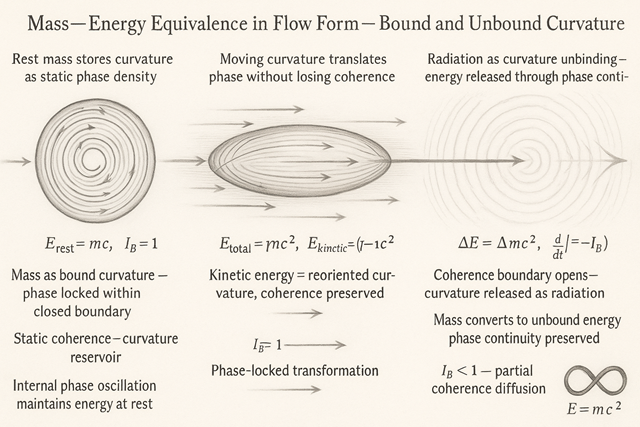
  - **Visualization:**  
    - Left: stationary curvature field (bound phase loops).  
    - Middle: moving curvature waves (energy flow).  
    - Right: coherence unbinding (radiation phase front).
Overview

Mass and energy are not different substances — they are two coherence states of the same field.
In the HST framework, energy is curvature in motion, while mass is curvature in equilibrium.
The equation

\[ E = mc^2 \]

is not a conversion formula but a boundary identity — expressing that the maximum energy stored in a coherent structure equals the curvature density required to sustain its boundary at light-phase velocity.

Where classical physics sees a transformation between forms, HST–Flow sees a reconfiguration of curvature coherence — the unfolding of phase potential into dynamic expression.


🔹 1. Classical Form — The Rest and the Moving Boundary
In special relativity, the total energy of a body in motion is:

\[ E_{\text{total}} = \gamma m c^2, \qquad E_{\text{kinetic}} = (\gamma - 1) m c^2 \]

Here

γ=1/1−(v/c)2\gamma = 1 / \sqrt{1 - (v/c)^2}

acts as the curvature compensation factor — describing how energy increases with velocity to preserve the invariant

\[ E^2 - (p c)^2 = (m c^2)^2 \]

At rest, energy is still present:

\[ E_{\text{rest}} = m c^2 \]

representing the intrinsic curvature tension that defines mass.
Motion merely redistributes that curvature — kinetic energy is phase reconfiguration, not addition.


🔸 2. Coherence Interpretation — Curvature as Bound Phase Density

Within HST–Flow, mass is a stable coherence loop: a region of curvature that has closed upon itself, maintaining constant phase continuity.
Every particle, atom, and star represents a boundary where curvature oscillations are phase-locked, storing energy as bound curvature density:

\[ \rho_{\text{curv}} = \frac{E}{c^2} \]

When that boundary moves, the same curvature begins to flow through space–time, appearing as kinetic energy.
The total curvature remains the same — it merely transitions from static coherence (mass) to propagating coherence (energy).

Thus, energy and mass are not exchanged quantities; they are different phase configurations of the same curvature invariant.


🔹 3. Motion and the Flow of Curvature

When an object accelerates, curvature lines inside it begin to tilt — phase flow develops through its boundary.
The kinetic energy term

\[ E_{\text{kinetic}} = (\gamma - 1) m c^2 \]

represents the energy required to realign curvature while preserving phase continuity across the field.

At light speed, curvature alignment becomes fully tangential — coherence cannot sustain a closed loop, and the field transitions into a purely radiative phase (a photon).
Thus, light is unbound curvature — mass set free through perfect phase propagation at cc.


🔸 4. Mass–Energy Conversion — Curvature Reconfiguration

When mass converts into energy — as in fusion, fission, or annihilation — coherence boundaries open, releasing stored curvature into motion.
The process follows:

\[ \Delta E = \Delta m\, c^2 \]

But no energy is created or destroyed — the total curvature field simply changes form.
Mass reduction (Δm\Delta m) corresponds to decreased curvature confinement, while ΔE\Delta E measures the released phase flow.
The conversion is thus a transition from closed to open coherence geometry.

When coherence integrity IBI_B decreases, curvature becomes less bound:

\[ \dot{I_B} = -\lambda (1 - I_B) \]

signifying radiative leakage or decoherence.
When IB=1I_B = 1, mass remains stable; when IB<1I_B < 1, curvature begins to unfold, radiating energy outward.


🔹 5. Energy–Momentum Invariant — The Geometry of Balance
The invariant

\[ E^2 = (p c)^2 + (m c^2)^2 \]

expresses curvature conservation across all motion states.
It means the total curvature content of the system is unchanged; what differs is its phase orientation — part static (mass), part dynamic (momentum).
When v=0v = 0, the curvature is fully confined; when v>0v > 0, part of it flows, forming a continuous coherence exchange between matter and motion.

In this view, energy is not the ability to do work — it is the ability of curvature to remain coherent while transforming.


🔸 6. Unified Coherence Framework — Bound and Unbound Phase

In HST–Flow, the relationship E=mc2E = mc^2 arises naturally from the universal curvature constant cc — the phase velocity of coherence.
All forms of energy, mass, and radiation share this velocity limit because all are manifestations of the same phase field.

  • Mass: curvature coherence locked in a boundary (static phase).
  • Kinetic energy: curvature flow within a moving boundary.
  • Radiation: curvature coherence released (pure phase motion).

Through this lens, E=mc2E = mc^2 describes curvature transference, not equivalence.
Mass and energy are two sides of the same curvature flow — one bound, one free — united by the same coherence constant cc.


🧠 Summary

Mass–energy equivalence is a statement of curvature continuity, not conversion.
It expresses how coherence reorganises between static and dynamic phase states while preserving the total curvature invariant of reality.

In the HST–Flow interpretation:

  • is curvature density × phase velocity squared.
  • Rest energy is bound curvature.
  • Kinetic energy is curvature in motion.
  • IBI_B measures coherence confinement — mass stability vs. energy release.
  • The invariant E2−(pc)2=(mc2)2E^2 - (pc)^2 = (mc^2)^2 ensures curvature conservation across transformations.

Energy and mass are the same coherence, viewed from different phases of motion —
one bound within its own curvature, the other flowing through space–time.


Kireth Research
38 Thorndale Croft, Wetwang, Driffield
East Riding of Yorkshire YO25 9XZ
Designed By