
Chapter 62
Time Dilation and Length Contraction as Boundary Effects

Relativistic and Curvature Flows
Author: Mark Anthony Higgins
© Mark Anthony Higgins 11 October 2025
Revised Date: 23 February 2026
Audio Overview
Flow Algebra
flow "Time Dilation and Length Contraction as Boundary Effects" v1.0


# ---------- PURPOSE ----------
# Model time dilation (Δt' = γΔτ) and length contraction (L' = L0/γ) as boundary effects:
# reindexings required to preserve interval coherence (s^2) across moving frames.
# IB encodes frame sync integrity (clock/ruler alignment). Lorentz invariance holds regardless.

# ---------- PARAMETERS ----------
params:
  units: "SI"
  c: positive = 2.99792458e8            # speed of light [m/s]
  v: real = 0.0                         # relative speed S' wrt S along +x [m/s]
  β: real = v/c                         # dimensionless velocity
  γ: real = 1/sqrt(1 - β^2)             # Lorentz factor
  IB: 0.0..1.0 = 1.0                    # frame coherence index (sync integrity)
  λ_desync: nonnegative = 0.0           # desynchronisation rate [s^-1]
  dt: positive?                         # timestep for sync drift [s]
  include_accel: bool = false           # if true, allow slowly varying v(t) (quasi-inertial)
  a: real = 0.0                         # proper acceleration magnitude [m/s^2] (optional, small)

# ---------- STATE ----------
state Boundary:
  Δτ: real                               # proper time interval of comoving clock [s]
  Δt_prime: real                         # dilated time seen in S' [s]
  L0: real                               # rest length of rod (in S) [m]
  L_prime: real                          # contracted length seen in S' [m]
  s2: real                                # invariant interval (example differential)
  simultaneity_offset: real               # Δt' from relativity of simultaneity
  IB_rate: real                           # d(IB)/dt (operational drift)
  regime: str                             # "aligned","noisy","desynchronised"

# ---------- INVARIANTS ----------
invariants:

  # Guard Lorentz domain
  params.β = params.v / params.c
  params.γ = 1 / sqrt(max(1e-18, 1 - params.β^2))

  # Time dilation and length contraction as boundary rules
  Boundary.Δt_prime = params.γ * Boundary.Δτ
  Boundary.L_prime  = (Boundary.L0 or 1.0) / params.γ

  # Interval coherence (using nominal differentials)
  Δt = 1.0e-9; Δx = 1.0e-1; Δy = 0.0; Δz = 0.0
  Boundary.s2 = (params.c^2)*(Δt^2) - (Δx^2 + Δy^2 + Δz^2)

  # Relativity of simultaneity (example offset for Δx at same t in S)
  Boundary.simultaneity_offset = - params.γ * (params.v * Δx) / params.c^2

  # Optional quasi-inertial update
  if params.include_accel and abs(params.a) > 0:
    # Small-step kinematic update (conceptual)
    params.v = clamp(params.v + params.a * (params.dt or 0), -0.999999*params.c, 0.999999*params.c)

  # Operational coherence drift (clocks, calibration, jitter)
  if params.λ_desync > 0 and params.dt is defined:
    params.IB = clamp(params.IB - params.λ_desync * (1 - params.IB) * params.dt, 0, 1)
  Boundary.IB_rate = -params.λ_desync * (1 - params.IB)

  # Regime tagging
  if params.IB == 1:
    Boundary.regime = "aligned"
  elif params.IB > 0.5:
    Boundary.regime = "noisy"
  else:
    Boundary.regime = "desynchronised"

# ---------- TRANSFORMS ----------
transforms:

  set_speed:
    comment: "Adjust relative speed and recompute γ."
    params.v += Δv
    params.v = clamp(params.v, -0.999999*params.c, 0.999999*params.c)

  resync_frame:
    comment: "Einstein synchronization / calibration restore."
    params.IB = clamp(params.IB + 0.05 * (1 - params.IB), 0, 1)

  inject_jitter:
    comment: "Increase desync to test robustness."
    params.IB = clamp(params.IB - 0.1 * (1 - params.IB), 0, 1)

  set_rest_geometry:
    comment: "Set proper time and rest length references."
    Boundary.Δτ = Δτ_ref
    Boundary.L0 = L0_ref

# ---------- MONITORS ----------
monitors:
  invariance_check:
    assert abs(Boundary.s2 - ((params.c^2)*(Δt^2) - (Δx^2 + Δy^2 + Δz^2))) <= 1e-12
    comment: "Interval s^2 invariant under reindexing."

  dilation_contraction:
    assert Boundary.Δt_prime >= Boundary.Δτ
    assert Boundary.L_prime <= (Boundary.L0 or 1.0) + 1e-12
    comment: "Time dilates, length contracts along the motion axis."

  gamma_domain:
    assert params.γ >= 1
    comment: "γ well-defined (|v| < c)."

  coherence_bounds:
    assert 0 <= params.IB <= 1

# ---------- SCENES ----------
scenes:

  clean_alignment:
    given params:
      v: 0.8 * c
      IB: 1.0
    given Boundary:
      Δτ: 1.0
      L0: 1.0
    expect:
      Boundary.Δt_prime = γ * 1.0
      Boundary.L_prime  = 1.0/γ
      Boundary.regime = "aligned"
      comment: "Ideal inertial mapping — boundary effects preserve s^2."

  mild_noise:
    given params:
      v: 0.6 * c
      IB: 0.8
      λ_desync: 0.02
      dt: 1.0
    enable:
      - inject_jitter
    expect:
      params.IB ↓
      Boundary.regime ∈ {"noisy","desynchronised"}
      comment: "Operational desync lowers IB; Lorentz invariance unaffected."

  resynchronise:
    given params:
      v: 0.6 * c
      IB: 0.6
    enable:
      - resync_frame
    expect:
      params.IB ↑
      Boundary.regime ∈ {"noisy","aligned"}
      comment: "Re-sync restores frame coherence for clocks/rulers."

  quasi_inertial_sweep:
    given params:
      v: 0.3 * c
      a: 0.05 * c
      dt: 0.5
      include_accel: true
      IB: 1.0
    expect:
      params.v ≠ 0.3 * c
      Boundary.Δt_prime = γ * Boundary.Δτ
      Boundary.L_prime = Boundary.L0/γ
      comment: "Slow drift in v reindexes γ; boundary effects update smoothly."

# ---------- NOTES ----------
notes:
  - **Lorentz Factor:**  
    \[
    \gamma = \frac{1}{\sqrt{1 - (v/c)^2}}.
    \]

  - **Boundary Effects (Core Laws):**  
    Time dilation: \(\Delta t' = \gamma \Delta \tau\).  
    Length contraction: \(L' = L_0 / \gamma\).  

  - **Interval Coherence:**  
    \[
    s^2 = c^2\Delta t^2 - \Delta x^2 - \Delta y^2 - \Delta z^2 \quad \text{(invariant)}.
    \]

  - **Simultaneity Offset:**  
    \[
    \Delta t' = -\gamma \frac{v\,\Delta x}{c^2}.
    \]

  - **Coherence Law (Operational Sync):**  
    \[
    \dot{I_B} = -\lambda_{\text{desync}}(1 - I_B).
    \]
    IB tracks practical clock/ruler alignment; boundary laws above preserve s² irrespective of IB.

  - **Interpretation (HST–Flow):**  
    Dilation and contraction are **boundary reindexings** that keep the global curvature (interval) coherent.  
    Frames with \(I_B=1\) are perfectly phase-locked; \(I_B<1\) reflects desync/noise, not a failure of Lorentz invariance.

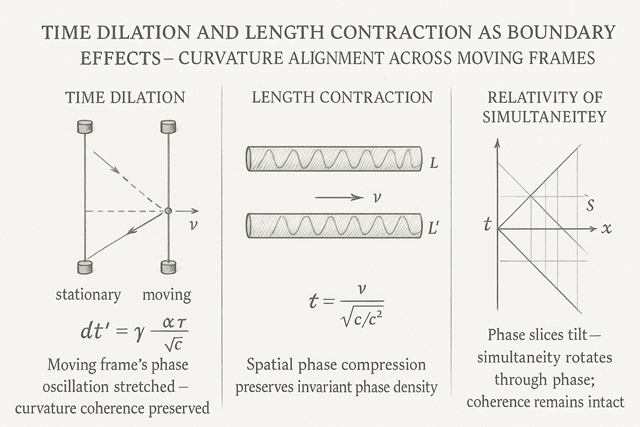
  - **Visualization:**  
    - Left: two light clocks (stationary vs moving) → Δt' = γΔτ.  
    - Middle: rod rest vs moving → \(L' = L_0/\gamma\).  
    - Right: Minkowski diagram showing simultaneity tilt.
Overview

Time dilation and length contraction are not distortions of space or time — they are boundary effects of coherence.
They describe how motion reshapes the phase geometry of reality while preserving its total curvature.
When one frame moves relative to another, its internal measurement grid — its clocks and rulers — reindexes itself to maintain interval invariance:

\[ s^2 = c^2 \Delta t^2 - \Delta x^2 - \Delta y^2 - \Delta z^2 = \text{constant} \]

What changes is not the underlying geometry, but the way each boundary reads it.
Each frame adapts its measurement intervals so that the global curvature — the invariant s2s^2 — remains consistent for all observers.


🔹 1. Classical Form — Lorentz Symmetry and the Preservation of Interval

In special relativity, transformations between two inertial frames SS and S′S' moving at relative velocity vv are given by:

\[ t' = \gamma \left( t - \frac{v x}{c^2} \right), \qquad x' = \gamma (x - v t) \]

where

\[ \gamma = \frac{1}{\sqrt{1 - (v/c)^2}} \]

These transformations preserve the space–time interval s2s^2, ensuring that every event’s geometric separation remains invariant.
Thus, when one observer measures a moving clock or rod, their readings differ not because one has been physically altered, but because their boundaries of measurement have been redefined to keep s2s^2 constant.


🔸 2. Coherence Interpretation — Frames as Boundary Maps of Curvature

In the HST framework, an inertial frame is not just a coordinate system; it is a phase-locked boundary structure — a set of synchronized clocks and rulers describing the same underlying curvature from a specific vantage point.
Each frame measures reality through its own rhythm of coherence.

When one frame moves relative to another, its internal rhythm (time phase) and spatial calibration (ruler phase) must reindex to maintain alignment with the global curvature.
This reindexing manifests as:

\[ \Delta t' = \gamma \Delta \tau, \qquad L' = \frac{L_0}{\gamma} \]

Time intervals expand; lengths contract.
The total curvature enclosed by each measurement — the invariant phase area — remains unchanged.
Reality stays perfectly coherent; only the phase spacing of its boundary changes.


🔹 3. Boundary Coherence — Why Clocks Dilate and Rulers Contract

Consider two light clocks: one stationary, one moving.
In the moving frame, light travels diagonally between mirrors — a longer path through the same number of curvature cycles.
The clock must therefore tick slower to preserve the constancy of light’s phase velocity cc.

Similarly, a rod aligned with motion must contract because its phase loops — its internal oscillations — densify along the direction of motion to maintain total curvature count.
In both cases, the physical boundary (clock or ruler) deforms its rhythm to uphold curvature invariance.

Thus, time dilation and length contraction are reciprocal boundary corrections ensuring global coherence across motion.


🔸 4. Desynchronisation and Frame Integrity (IB)

In practice, no frame is perfectly coherent.
Clocks drift, instruments flex, and small fluctuations accumulate.
This operational coherence is tracked by the boundary index IBI_B, evolving as:

\[ \dot{I_B} = -\lambda_{\text{desync}} (1 - I_B) \]

Here, IB=1I_B = 1 represents perfect synchronisation — an inertial, fully phase-aligned frame.
As IBI_B decreases, desynchronisation or environmental noise slightly misaligns the frame’s local phase grid.
Yet Lorentz symmetry (the preservation of s2s^2) still holds — coherence may degrade operationally, but the geometry itself remains invariant.

A real laboratory may drift (IB<1I_B < 1), but the universe does not.


🔹 5. Relativity of Simultaneity — Boundary Tilt in Phase Geometry

Events simultaneous in one frame are not in another.
The relation

\[ \Delta t' = -\gamma \frac{v\,\Delta x}{c^2} \]

captures this phase-tilt effect.
In coherence terms, simultaneity represents equal-phase slices through space–time.
When one frame moves, its slicing angle changes — its phase surfaces tilt through the global curvature field.
Different observers thus trace different cuts of the same coherent structure, each fully self-consistent within its own boundary frame.


🔸 6. Unified Coherence Framework — Geometry as a Phase-Locked Field

The Lorentz transformation can be seen as a curvature feedback law that ensures all moving observers remain phase-aligned with the same underlying geometry.
Each transformation is a boundary reindexing that preserves the coherence of space–time’s phase structure:

  • Time dilation: temporal phase expansion.
  • Length contraction: spatial phase compression.
  • Simultaneity: phase slice rotation.

Together they keep the invariant interval constant — a fixed coherence quantity shared by all frames.
Even when operational coherence IBI_B fluctuates, the universal curvature field remains intact.

Relativity is not the distortion of space or time — it is the conservation of phase coherence across motion.


🧠 Summary

Time dilation and length contraction express the boundary mechanics of coherence.
They are the adjustments frames make to maintain a shared invariant curvature — the same phase geometry observed through different calibrations.

In the HST–Flow interpretation:

  • Δt′ = γΔτ: clocks stretch their temporal phase spacing.
  • L′ = L₀/γ: rulers compress their spatial curvature.
  • IB: measures how well a frame maintains sync (operational coherence).
  • s² invariant: curvature coherence preserved for all observers.

Relativity is the boundary feedback system that keeps the universe phase-aligned —
motion translates coherence, it never breaks it.


Kireth Research
38 Thorndale Croft, Wetwang, Driffield
East Riding of Yorkshire YO25 9XZ
Designed By