Chapter 50
Snell and Reflection Flows
Wave Coherence and Optics
Author: Mark Anthony Higgins
© Mark Anthony Higgins 11 October 2025
Revised Date: 23 February 2026
flow "Snell and Reflection Flows" v1.0
# ---------- PURPOSE ----------
# Expresses how light interacts with a boundary through reflection and refraction (Snell’s law).
# Both processes arise from continuity of phase and conservation of tangential wavevector components.
# Introduces boundary coherence index IB to represent how perfectly phase continuity is maintained.
# IB = 1 → perfect optical coherence (ideal reflection or refraction).
# IB < 1 → partial coherence; scattering, absorption, or roughness at boundary.
# ---------- PARAMETERS ----------
params:
units: "SI"
n1: positive # refractive index of medium 1
n2: positive # refractive index of medium 2
θi: real # angle of incidence [radians]
θr: real? # reflection angle [radians]
θt: real? # transmission (refraction) angle [radians]
IB: 0.0..1.0 = 1.0 # boundary coherence index
λ0: positive # wavelength in vacuum [m]
include_absorption: bool = false
absorption_coeff: nonnegative = 0.0 # attenuation coefficient [1/m]
# ---------- STATE ----------
state Boundary:
incident_dir: vec2 # direction of incoming ray
reflected_dir: vec2 # direction of reflected ray
transmitted_dir: vec2 # direction of refracted ray
phase_continuity_error: real # |n1*sinθi - n2*sinθt|
reflection_coefficient: real # R = |Er/Ei|²
transmission_coefficient: real# T = |Et/Ei|²
energy_balance: real # R + T (+ loss)
reflection_state: str # "specular", "partial", or "diffuse"
# ---------- INVARIANTS ----------
invariants:
# Law of reflection
Boundary.θr = params.θi
# Snell’s law of refraction
Boundary.θt = arcsin( (params.n1 / params.n2) * sin(params.θi) )
# Phase continuity (tangential wavevector conserved)
Boundary.phase_continuity_error = abs(params.n1 * sin(params.θi) - params.n2 * sin(Boundary.θt))
# Fresnel energy ratios (simplified scalar approximation)
Boundary.reflection_coefficient = ((params.n1 * cos(params.θi) - params.n2 * cos(Boundary.θt)) /
(params.n1 * cos(params.θi) + params.n2 * cos(Boundary.θt)))^2
Boundary.transmission_coefficient = 1 - Boundary.reflection_coefficient
# Energy conservation (with optional absorption)
if params.include_absorption:
loss = params.absorption_coeff * (1 - params.IB)
Boundary.energy_balance = Boundary.reflection_coefficient + Boundary.transmission_coefficient - loss
else:
Boundary.energy_balance = Boundary.reflection_coefficient + Boundary.transmission_coefficient
# Reflection mode classification
if params.IB == 1:
Boundary.reflection_state = "specular"
elif params.IB > 0.5:
Boundary.reflection_state = "partial"
else:
Boundary.reflection_state = "diffuse"
# ---------- TRANSFORMS ----------
transforms:
update_coherence:
comment: "Boundary coherence decays with roughness or absorption."
params.IB = clamp(params.IB - params.absorption_coeff * (1 - params.IB), 0, 1)
restore_specular:
comment: "Feedback restores alignment for coherent reflection."
if params.IB < 1:
params.IB += 0.01 * (1 - params.IB)
params.IB = clamp(params.IB, 0, 1)
# ---------- MONITORS ----------
monitors:
snell_check:
assert Boundary.phase_continuity_error <= 1e-6
comment: "Tangential wavevector conserved — Snell’s law holds."
reflection_energy:
assert abs(Boundary.energy_balance - 1) <= 0.05
comment: "Energy balance within 5% — reflection/transmission consistent."
coherence_bounds:
assert 0 <= params.IB <= 1
# ---------- SCENES ----------
scenes:
perfect_reflection:
given params:
n1: 1.0
n2: 1.0
θi: 30° -> radians
IB: 1.0
expect:
Boundary.θr = 30° -> radians
Boundary.reflection_state = "specular"
comment: "Mirror-like reflection — perfect phase symmetry, IB = 1."
refraction_air_to_glass:
given params:
n1: 1.0
n2: 1.5
θi: 45° -> radians
IB: 1.0
expect:
Boundary.θt = arcsin((1/1.5)*sin(45°))
Boundary.phase_continuity_error ≈ 0
comment: "Perfect refraction obeying Snell’s law."
rough_surface:
given params:
n1: 1.0
n2: 1.5
θi: 45° -> radians
IB: 0.6
include_absorption: true
absorption_coeff: 0.1
enable:
- update_coherence
expect:
Boundary.reflection_state = "partial"
Boundary.energy_balance < 1
comment: "Boundary roughness causes partial coherence loss — diffuse reflection."
# ---------- NOTES ----------
notes:
- **Reflection law:**
\[
\theta_r = \theta_i
\]
The incident and reflected rays lie in the same plane; the angle of reflection equals the angle of incidence.
- **Snell’s law of refraction:**
\[
n_1 \sin \theta_i = n_2 \sin \theta_t
\]
Phase continuity ensures the tangential component of the wavevector is conserved across the boundary.
- **Energy balance:**
\[
R + T = 1 - L,
\]
where \(L\) represents loss through absorption or scattering (linked to \(1 - I_B\)).
- **Coherence interpretation:**
- \(I_B = 1\): perfect boundary — coherent reflection or refraction.
- \(I_B < 1\): roughness, scattering, or absorption break phase alignment.
- \(I_B \to 0\): incoherent diffusion — randomised phase, no mirror symmetry.
- **Physical meaning:**
Reflection and refraction are not separate forces but boundary reorganisations of wave curvature.
The field’s coherence determines whether energy reflects, transmits, or diffuses.
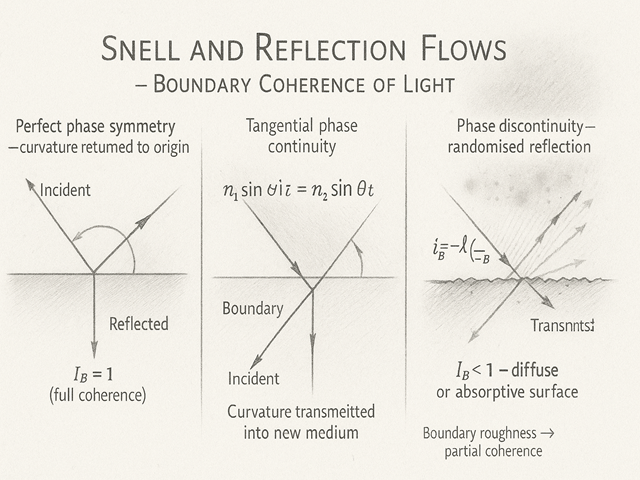
- **Visualization:**
- Left: incident and reflected rays with equal angles.
- Middle: refracted ray bending toward normal (n₂ > n₁).
- Right: rough boundary scattering pattern for low IB.
At every optical boundary, light does not simply bounce or bend — it negotiates coherence.
The direction of reflection and refraction emerge naturally from the system’s attempt to preserve phase continuity across a boundary of differing curvature (refractive index).
In classical terms, this yields the two great optical relations:
\[ \theta_r = \theta_i, \qquad n_1 \sin \theta_i = n_2 \sin \theta_t \]
But beneath these equations lies a deeper pattern: the boundary acts as a coherence membrane, redistributing curvature while maintaining the continuity of the tangential wavevector.
Reflection:
When a wave encounters a reflective interface, its incident and reflected rays lie in the same plane, and the angles are equal.
This symmetry arises because the component of the wave’s phase parallel to the boundary cannot change; it is a direct geometric echo of coherence conservation.
Refraction (Snell’s Law):
At a transparent boundary, part of the wave continues into the second medium.
The relationship ensures that phase fronts remain seamless at the interface — the wave bends, not to obey a law, but to maintain continuity of information.
In this sense, Snell’s Law is not an empirical rule, but the mathematical signature of coherence transmission.
In the coherence framework, every optical interface is a phase memory surface.
The boundary measures how consistently curvature is preserved between the two fields:
IB=1⇒perfect coherence (mirror or clear surface),
IB<1⇒scattering, absorption, or diffusion.
This transition from reflection to refraction to diffusion represents not separate phenomena, but a continuum of boundary coherence.
At every interaction, total energy remains constant:
\[ R + T + L = 1 \]
where is reflected energy, transmitted, and the incoherent loss linked to .
This explains why a polished mirror returns a clear image while rough stone scatters light — one preserves curvature, the other disperses it.
In the HST view, the refractive index n represents the density of curvature tension in a medium — the degree to which the local field slows and redirects propagation.
A wave crossing from to adjusts its path to equalise tangential coherence.
Reflection occurs when that continuity cannot be maintained; refraction occurs when it can be re-encoded within the new boundary geometry.
Thus, reflection and refraction are not opposites, but dual expressions of one law:
the conservation of curvature continuity across a boundary.
When the surface microstructure introduces phase scatter, each point reflects at a slightly different angle — coherence collapses into stochastic behaviour.
In Flow terms:
\[ \dot{I_B} = -\lambda (1 - I_B) \]
governs the boundary’s ability to retain phase memory.
As declines, energy spreads across many directions — the boundary ceases to function as a single coherent mirror and instead becomes a field of local incoherence.
This is the microscopic origin of diffuse reflection and matte surfaces.
Snell’s Law and the Law of Reflection are two faces of a single boundary flow:
a self-consistent exchange of curvature that preserves phase continuity across media.
In coherence language:
The parameter unites them — a single measure of boundary integrity.
Thus, optical behaviour at any interface is a statement of coherence:
The geometry of light remembers its path — perfectly when boundaries are smooth, partially when they are rough, and not at all when coherence is lost.