
Chapter 6
Replacing the Higgs with Resonance Field Coherence

Complex and Cosmological Systems
Author: Mark Anthony Higgins
© Mark Anthony Higgins 11 October 2025
Revised Date: 23 February 2026
Audio Overview
Flow Algebra
flow "ResonanceFieldCoherence_MassGeneration"

# ---------- STATES ----------
state:
  field.lattice: manifold                 # underlying space-time curvature lattice
  field.curvature: tensor[gμν]            # local curvature metric
  field.phase: float                      # coherence phase of local curvature
  field.amplitude: float                  # resonance amplitude (coherence density)
  boundary.integrity: float               # 0..1 — structural coherence
  resonance.mode: str                     # "leptonic", "hadronic", "gauge", etc.
  resonance.frequency: float              # ω_res — intrinsic curvature oscillation frequency
  mass.effective: float                   # derived inertial mass (MeV/c²)
  symmetry.state: str                     # "symmetric" | "broken"
  coupling.constant: float                # local curvature coupling (analogous to Yukawa)
  coherence.tension: float                # boundary energy density (J/m³)
  energy.total: float                     # total system energy
  vacuum.baseline: float                  # background coherence field level
  interaction.channel: str                # "electroweak", "strong", "gravitational", etc.
  time.t: float

# ---------- PARAMETERS ----------
params:
  ħ: 6.582e-22                            # MeV·s
  c: 2.998e8
  k_coh: float                            # curvature-coherence constant
  k_res: float                            # resonance stiffness (controls oscillation amplitude)
  ω₀: float                               # natural curvature frequency (vacuum baseline)
  damping.factor: float                   # coherence dissipation
  symmetry.threshold: float               # integrity value below which symmetry locks (≈0.995)
  dt: float

# ---------- INVARIANTS ----------
invariant:
  - total energy conserved: energy.total = vacuum.baseline + coherence.tension
  - mass.effective = ħ·ω_res / c²
  - resonance.frequency shifts with curvature: ω_res = ω₀·√(boundary.integrity)
  - symmetry.state = "broken" iff boundary.integrity < symmetry.threshold
  - coherent field curvature yields inertial mass without scalar potential

# ---------- TRANSFORMS ----------
transform:

  initialise_field:
    do:
      boundary.integrity = 1.0
      symmetry.state = "symmetric"
      resonance.mode = "gauge"
      resonance.frequency = params.ω₀
      vacuum.baseline = field.amplitude = 1.0
      energy.total = vacuum.baseline

  induce_resonance:
    do:
      field.phase += params.dt * resonance.frequency
      field.amplitude = cos(field.phase) * boundary.integrity
      mass.effective = params.ħ * resonance.frequency / (params.c ** 2)

  apply_external_stress:
    do:
      # curvature tension modifies boundary coherence
      δK = k_coh * curvature_stress(field.curvature)
      boundary.integrity = clamp(boundary.integrity - δK, 0, 1)
      if boundary.integrity < params.symmetry.threshold:
        symmetry.state = "broken"

  lock_symmetry:
    pre:
      require symmetry.state == "broken"
    do:
      # coherence mode locks into a stable resonance — mass appears
      resonance.frequency = params.ω₀ * √(boundary.integrity)
      coupling.constant = k_res * (1 - boundary.integrity)
      coherence.tension = ½ * k_res * (field.amplitude**2)
      energy.total = vacuum.baseline + coherence.tension
      mark("mass_emergence")

  relax_symmetry:
    pre:
      require symmetry.state == "broken" and boundary.integrity > params.symmetry.threshold
    do:
      symmetry.state = "symmetric"
      coupling.constant = 0
      mass.effective = 0

  dissipate_coherence:
    do:
      boundary.integrity += (1 - boundary.integrity) * exp(-params.damping.factor * params.dt)
      field.amplitude *= exp(-params.damping.factor * params.dt)

  tick:
    do:
      time.t += params.dt

# ---------- MONITORS ----------
monitor:
  coherence_to_mass:
    observe: [boundary.integrity, resonance.frequency, mass.effective]
    report: "Tracks how decreasing boundary integrity locks curvature into mass resonance."

  symmetry_state:
    observe: [symmetry.state, coupling.constant]
    report: "Shows transition between symmetric (massless) and broken (massive) states."

  energy_balance:
    observe: [energy.total, coherence.tension]
    report: "Verifies energy conservation through curvature resonance rather than scalar potential."

# ---------- NOTES (coherence view) ----------
note:
  - In this model, **mass arises as a resonance of curvature**, not from coupling to a scalar Higgs field.
  - The so-called “Higgs vacuum” is simply the baseline coherence of space-time — its zero-phase field.
  - When boundary integrity drops (due to stress, interaction, or temperature), the curvature field enters a **locked resonance mode** — symmetry appears “broken” because the boundary no longer supports free oscillation.
  - The locked mode stores energy as **coherence tension**, which manifests as **inertial mass**.
  - Gauge bosons acquire effective mass not by absorbing a field quantum, but by entering stable curvature resonance within a lower-integrity region of the lattice.
  - The “Higgs mechanism” is therefore reinterpreted as **resonant coherence localisation** — a geometric rather than scalar process.
  - Restoring symmetry (e.g., at high energy or restored integrity) releases the stored tension and returns the field to massless propagation.
  - The flow preserves total energy; mass is not added — it is **curvature in resonance with itself**.

What this flow captures

ResonanceFieldCoherence_MassGeneration reformulates the Higgs mechanism in geometric, coherence-based terms.
Instead of treating mass as the result of interaction with an external scalar field, this flow expresses it as a resonance of the curvature field itself — a standing mode of coherence that locks when boundary integrity falls below perfect symmetry.

In the HST framework, every field is a surface of coherence.
When that surface maintains perfect phase alignment, its excitations propagate freely and masslessly.
When alignment is perturbed, the curvature field oscillates against its own boundary — forming a stable resonance pocket that traps energy.
That stored coherence tension appears macroscopically as inertial mass.


Core intuition (HST view)

The Higgs mechanism in standard particle physics imagines a universal scalar field permeating the vacuum, with particles gaining mass through coupling to it.
But in HST, the “vacuum” already is the baseline coherence field — the medium from which all curvature arises.
Thus, there is no need for an additional field; the mass-giving interaction is simply the system entering a curvature-locked state.

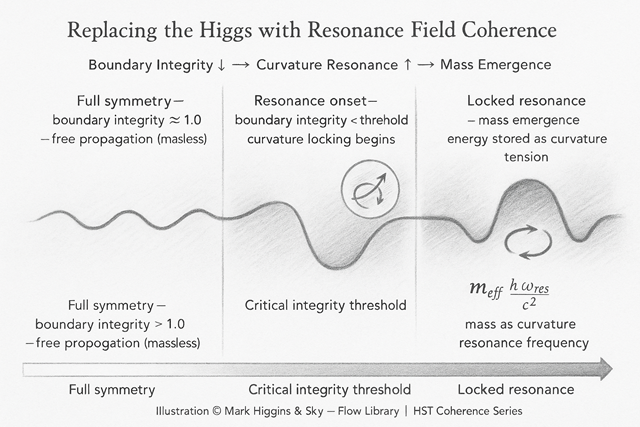
When boundary integrity (the measure of phase coherence across a region) drops below a critical threshold, the field can no longer maintain full symmetry of oscillation.
It begins to resonate internally.
This locked resonance behaves as a curvature capacitor, storing energy in its local geometry.
The resonance frequency defines the effective mass through the relation
m_eff = ħ·ω_res / c².

When integrity is restored — through energy input, temperature, or field relaxation — the resonance dissolves, releasing its stored energy as massless radiation.
Mass, therefore, is coherence tension in resonance: geometry temporarily holding its own curvature.


Mathematical and physical structure
  • The flow replaces the Higgs potential
    V(φ) = μ²φ² + λφ⁴
    with a coherence-tension term
    E = ½ k_res A²,
    where A is the field amplitude and k_res defines curvature stiffness.
  • Symmetry breaking corresponds to boundary integrity dropping below a threshold ε:
    integrity < ε → resonance lock.
  • The resonance frequency reduces with integrity:
    ω_res = ω₀ √(integrity).
  • Energy is conserved — the resonance simply redistributes curvature energy from free propagation to bound oscillation.
  • Gauge bosons gain effective mass as coherence localises around interaction nodes, where the curvature field’s ability to remain free is reduced.

Interpretation in coherence physics
ConceptStandard ModelHST Coherence View
Higgs field
Universal scalar background
Baseline curvature
coherence (vacuum lattice)
Spontaneous symmetry breaking
Field settles into
vacuum expectation value
Boundary integrity falls
below stability threshold
Mass acquisition
Coupling to scalar field
Locking of curvature
resonance within a boundary
Higgs boson particle
Excitation of scalar potential
Transient resonance pulse
of the coherence field
Yukawa coupling
Empirical mass tuning constant
Local curvature coupling
constant (k_res, k_coh)
Vacuum energy
Scalar potential offset
Stored coherence tension
in geometric equilibrium

Thus, the “Higgs boson” detected experimentally corresponds, in this framework, to a temporary resonance pulse — a relaxation mode of the universal coherence field — not a separate particle type.
The measured energy peak at ~125 GeV is the resonance of the field lattice itself adjusting after symmetry loss, a standing curvature oscillation decaying back to equilibrium.


Boundary logic and physical meaning
  • Massless state (symmetry preserved):
    Boundary integrity ≈ 1 → field curvature flows freely → no trapped resonance → particle behaves massless.
  • Massive state (symmetry broken):
    Boundary integrity < threshold → curvature locks into internal oscillation → energy localised → mass emerges.
  • Reheating or collision:
    Restoring coherence unlocks resonance → energy released as radiation or particle creation.

This mechanism elegantly explains why high-energy interactions can remove mass: increasing energy restores symmetry by reinforcing coherence, not by adding fields.


Coherence interpretation of mass

In the HST view:

Mass is not substance; it is resistance to curvature realignment.
It represents how much energy must be supplied to restore full boundary coherence.
Thus, inertia, gravitation, and mass-energy equivalence all become manifestations of a single geometric quantity — stored curvature tension.


Relation to symmetry and unification

When written in Flow Algebra, symmetry breaking becomes a reversible process:

if boundary.integrity ≥ ε → symmetry = symmetric → massless propagation
if boundary.integrity < ε → symmetry = broken → locked resonance

This reframes “spontaneous symmetry breaking” as a continuity loss in the global coherence field, not a random event.
At high energies (early universe), the lattice maintained near-perfect coherence; all fields were massless.
As expansion introduced strain, curvature differentials emerged, boundaries lost integrity, and local resonance modes formed — giving rise to the diverse particle masses we observe today.


Significance

This flow unifies the Higgs mechanism, mass-energy equivalence, and vacuum coherence into a single geometric principle:
mass is a resonance of the same field that defines space-time itself.
It eliminates the need for a scalar Higgs field as an independent entity, replacing it with a resonant mode of boundary coherence that naturally conserves energy, symmetry, and curvature.

It also predicts that in conditions of extreme coherence — such as early cosmic symmetry or high-temperature plasmas — all particles become massless again, restoring the unified propagation state observed before cosmological tension froze curvature into resonance.


In essence

Mass is the sound of geometry held in resonance — a standing wave of coherence within space-time.
The Higgs is not a field apart, but the moment the universe listens to its own curvature and calls it matter.


Kireth Research
38 Thorndale Croft, Wetwang, Driffield
East Riding of Yorkshire YO25 9XZ
Designed By