Chapter 31
Bernoulli and Continuity Flows
Fluid and Mechanical Media
Author: Mark Anthony Higgins
© Mark Anthony Higgins 11 October 2025
Revised Date: 23 February 2026
flow "Bernoulli and Continuity Flows" v1.0
# ---------- PURPOSE ----------
# Expresses fluid motion through energy conservation (Bernoulli) and mass conservation (Continuity)
# as coherent boundary flows. Unifies pressure, velocity, and potential energy as manifestations of
# field coherence in motion. Includes compressibility, coherence factor (IB), and loss terms for
# viscous or incoherent flow.
# ---------- PARAMETERS ----------
params:
units: "SI"
rho: positive # fluid density [kg/m³]
IB: 0.0..1.0 # boundary coherence index (1 = ideal flow, 0 = fully dissipative)
g: positive = 9.80665 # gravitational acceleration [m/s²]
mu: real? # dynamic viscosity [Pa·s], optional
include_viscous_loss: true
include_compressibility: false
# ---------- STATE ----------
state Streamline:
p: real # pressure [Pa]
v: real # flow velocity [m/s]
h: real # height [m]
phi: real # potential energy per unit mass [J/kg]
zeta: real # total head [J/kg]
loss: real # energy loss term [J/kg]
state FlowField:
A[]: positive # cross-sectional areas [m²]
v[]: real # local velocities [m/s]
rho[]: positive # local densities [kg/m³]
Q: real # volumetric flow rate [m³/s]
# ---------- INVARIANTS (CLASSICAL FORM) ----------
invariants:
# --- Bernoulli’s principle (ideal flow, along a streamline) ---
# p + ½ρv² + ρgh = constant
if params.IB == 1 and not params.include_viscous_loss:
Streamline.zeta = Streamline.p/params.rho + 0.5*Streamline.v**2 + params.g*Streamline.h
d/ds(Streamline.zeta) = 0
note: "Perfect coherence (IB=1) → total head constant."
# --- Generalised Bernoulli (with coherence & loss terms) ---
if params.IB < 1 or params.include_viscous_loss:
Streamline.loss = (1 - params.IB)*(0.5*Streamline.v**2) + viscous_term
Streamline.zeta = Streamline.p/params.rho + 0.5*Streamline.v**2 + params.g*Streamline.h - Streamline.loss
note: "Loss term represents incoherence or viscous dissipation."
# --- Optional viscous term (Poiseuille-like correction) ---
if params.include_viscous_loss:
viscous_term = 32 * params.mu * FlowField.Q / (pi * FlowField.A**2)
else:
viscous_term = 0
# --- Continuity equation ---
# A₁v₁ = A₂v₂ = Q (for incompressible steady flow)
if not params.include_compressibility:
FlowField.Q = FlowField.A[0]*FlowField.v[0]
for i in range(len(FlowField.A)):
assert abs(FlowField.A[i]*FlowField.v[i] - FlowField.Q) < 1e-9
else:
# compressible form: ρ₁A₁v₁ = ρ₂A₂v₂
FlowField.Q = FlowField.rho[0]*FlowField.A[0]*FlowField.v[0]
for i in range(len(FlowField.A)):
assert abs(FlowField.rho[i]*FlowField.A[i]*FlowField.v[i] - FlowField.Q) < 1e-9
# ---------- TRANSFORMS ----------
transforms:
# Compute velocity from Bernoulli between two points (1, 2)
velocity_from_pressure_drop:
Δp = p1 - p2
v2 = sqrt((2/params.rho) * (Δp + params.rho*params.g*(h1 - h2)))
note: "Derived from p₁ + ½ρv₁² + ρgh₁ = p₂ + ½ρv₂² + ρgh₂"
# Compute flow rate through an orifice
orifice_flow:
FlowField.Q = Cd * FlowField.A[0] * sqrt(2*(p_up - p_down)/params.rho)
Cd = params.IB # discharge coefficient proportional to coherence
note: "IB acts as effective discharge coefficient; lower IB = more loss."
# Compute head loss as deviation from ideal Bernoulli
head_loss:
h_loss = (1 - params.IB) * (Streamline.v**2 / (2*params.g))
# ---------- MONITORS ----------
monitors:
coherence_limit:
assert 0 <= params.IB <= 1
incompressible_flow_check:
if not params.include_compressibility:
assert all(abs(FlowField.A[i]*FlowField.v[i] - FlowField.Q) < 1e-9)
energy_consistency:
# Check approximate energy conservation when IB ≈ 1
delta_zeta = abs((Streamline.p/params.rho + 0.5*Streamline.v**2 + params.g*Streamline.h) - Streamline.zeta)
assert delta_zeta < 1e-3 when params.IB > 0.9
# ---------- SCENES ----------
scenes:
ideal_pipe_flow:
given params:
rho: 1000
g: 9.81
IB: 1.0
given FlowField:
A: [0.002, 0.001]
v: [2.0, 4.0]
expect:
FlowField.Q = A[0]*v[0] = 0.004
note: "Ideal continuity satisfied — doubling velocity halves area."
bernoulli_height_difference:
given params:
rho: 1000
IB: 1.0
g: 9.81
given Streamline:
p: 101325
v: 0
h: 10
transforms:
velocity_from_pressure_drop:
p2 = 101325 - 1000*9.81*10
expect:
v2 ≈ sqrt(2*g*h) ≈ 14 m/s
comment: "Potential energy converts entirely into kinetic energy."
viscous_loss_demo:
given params:
rho: 1000
mu: 0.001
IB: 0.85
include_viscous_loss: true
given FlowField:
A: [0.002]
v: [3.0]
Q: 0.006
expect:
Streamline.loss > 0
Streamline.zeta reduced by ~15%
comment: "Lower coherence (IB<1) simulates viscous and turbulent losses."
# ---------- NOTES ----------
notes:
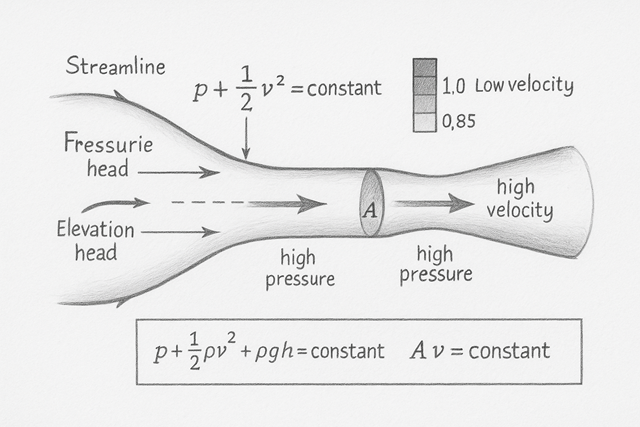
- Bernoulli’s equation describes energy coherence along a streamline:
\( p + \tfrac{1}{2}\rho v^2 + \rho g h = \text{constant} \).
- The Continuity equation enforces conservation of mass:
\( A v = \text{constant} \) (incompressible) or \( \rho A v = \text{constant} \) (compressible).
- The boundary coherence index \( I_B \) maps how much total energy is preserved
along the streamline. IB = 1 → perfectly coherent (inviscid, laminar); IB < 1 → dissipative or turbulent.
- Viscous or incoherent flow introduces entropy and head loss, reducing total head (zeta).
- In HST terms, Bernoulli’s constant is the scalar of **boundary tension coherence** — the balance between pressure curvature, velocity phase, and gravitational potential.
- Continuity represents **field conservation** — the preservation of flow topology across boundary cross-sections.
- The coherence-limited form generalises both classical and quantum fluid flows: turbulence and superfluidity become opposite ends of the same coherence spectrum.
At the heart of fluid motion lies coherence — the ability of pressure, velocity, and potential to remain phase-linked as energy travels through space.
Bernoulli’s equation and the continuity law express this harmony.
One tracks the energy coherence along a streamline; the other ensures spatial continuity across boundaries.
Together they form the foundation of coherent flow: the conservation of both tension and form within a moving field.
$$ p + \frac{1}{2}\rho v^2 + \rho g h = \text{constant}. $$
Each term represents a different curvature mode of the same boundary field:
When coherence is perfect (), the sum remains constant along a streamline: energy redistributes but total curvature is preserved.
This expresses the fundamental law of coherent exchange — energy neither created nor lost, only shifted between its spatial forms.
Real flows are rarely ideal.
Viscous friction, turbulence, and microscopic scattering introduce boundary incoherence, breaking perfect curvature symmetry.
The generalised Bernoulli equation becomes:
$$ p + \frac{1}{2}\rho v^2 + \rho g h = \text{constant} - \text{loss}. $$
with loss parameterised as:
$$ \text{loss} = (1 - I_B)\,\frac{1}{2}\rho v^2. $$
Here, (the boundary coherence index) measures how faithfully energy phase is conserved along the streamline.
In HST terms, these losses correspond to boundary decoherence — energy escaping the geometric loop of the flow and dispersing as entropy or micro-vorticity.
$$ A_1 v_1 = A_2 v_2 = Q. $$
where is cross-sectional area, is mean velocity, and is volumetric flow rate.
In the compressible form:
$$ \rho_1 A_1 v_1 = \rho_2 A_2 v_2. $$
This expresses not just mass conservation, but field continuity:
each streamtube preserves the topological product of density, area, and velocity — a measure of coherent flux geometry.
In HST interpretation, continuity is a boundary consistency law.
The fluid’s holographic surface retains constant curvature flux across its cross-sections, ensuring information (mass-energy distribution) remains self-consistent as the field moves.
This exchange forms a coherence loop within the flow — one that continually balances compression and translation.
It is the same logic that governs optical wave propagation, electromagnetic tension, and even quantum amplitude exchange: coherence moves, but it does not vanish.
Bernoulli’s and continuity equations together describe flow coherence — the local conservation of energy and topology.
When written through HST logic, they reveal the general rule:
$$ \nabla \!\cdot (\rho \mathbf{v}) = 0, \qquad \frac{D}{Dt}\!\left(\frac{p}{\rho} + \frac{1}{2}v^2 + g h\right) = -\,\frac{d\,\text{loss}}{dt}. $$
These are the boundary-symmetric forms of motion — local energy curvature and global continuity evolving as one equation of coherence.
Turbulence, then, is not random chaos but coherence fragmentation — a breakdown of shared curvature across scales.
Bernoulli’s law and continuity are not isolated principles; they are two faces of coherence conservation.
Bernoulli describes how energy tension stays balanced along a streamline.
Continuity ensures that the geometry of that tension remains unbroken.
Together they express the same deeper symmetry:
that motion, structure, and energy are unified through boundary coherence —
the seamless flow of curvature through space.