
Chapter 57
Pauli Exclusion and State Integrity

Quantum Coherence and Boundary Systems
Author: Mark Anthony Higgins
© Mark Anthony Higgins 11 October 2025
Revised Date: 23 February 2026
Audio Overview
Flow Algebra
flow "Pauli Exclusion and State Integrity" v1.0

# ---------- PURPOSE ----------
# Expresses the Pauli exclusion principle as a coherence integrity condition on fermionic wavefunctions.
# In the HST–Flow framework, no two identical fermions can share the same complete curvature loop in phase space.
# Overlap of identical quantum states breaks antisymmetric boundary coherence and causes the system to reconfigure.
# IB measures the coherence integrity of the antisymmetric wavefunction (IB = 1 → perfect antisymmetry, IB < 1 → partial coherence or entanglement leakage).

# ---------- PARAMETERS ----------
params:
  units: "SI"
  ħ: real = 1.054_571_817e-34        # reduced Planck constant [J·s]
  N: positive                         # number of identical fermions
  IB: 0.0..1.0 = 1.0                  # coherence integrity index
  λ_exch: nonnegative = 0.0           # exchange interaction rate [s^-1]
  dt: positive?                       # timestep [s]
  include_spin: bool = true
  antisymmetrised: bool = true
  include_bosons: bool = false        # optional contrast

# ---------- STATE ----------
state FermionSystem:
  ψ_i[]: complex                      # single-particle wavefunctions ψ_i(x)
  Ψ_total: complex                    # total antisymmetrised system wavefunction (Slater determinant)
  overlap_matrix: real[][]            # overlaps ⟨ψ_i|ψ_j⟩
  exchange_energy: real               # energy shift due to antisymmetry
  coherence_loss: real                # 1 - IB
  state_integrity: str                # "antisymmetric", "mixed", "violated"

# ---------- INVARIANTS ----------
invariants:

  # Construct antisymmetric wavefunction if enabled
  if params.antisymmetrised:
    FermionSystem.Ψ_total = (1/√(params.N!)) * det([ψ_i(x_j)])   # Slater determinant

  # Overlap integrals
  FermionSystem.overlap_matrix[i][j] = ⟨ψ_i|ψ_j⟩ = ∫ conjugate(ψ_i(x)) ψ_j(x) dx

  # Coherence integrity — Pauli limit: no overlap for i ≠ j
  FermionSystem.coherence_loss = mean(|FermionSystem.overlap_matrix[i][j]| for i ≠ j)
  params.IB = clamp(1 - FermionSystem.coherence_loss, 0, 1)

  # Exchange energy (qualitative)
  FermionSystem.exchange_energy = -params.λ_exch * Σ_{i<j} |⟨ψ_i|ψ_j⟩|^2

  # State classification
  if params.IB == 1:
    FermionSystem.state_integrity = "antisymmetric"
  elif params.IB > 0.5:
    FermionSystem.state_integrity = "mixed"
  else:
    FermionSystem.state_integrity = "violated"

  # Coherence evolution
  if params.λ_exch > 0 and params.dt is defined:
    params.IB = clamp(params.IB - params.λ_exch * (1 - params.IB) * params.dt, 0, 1)

# ---------- TRANSFORMS ----------
transforms:

  antisymmetrise_system:
    comment: "Enforce antisymmetry — generate Slater determinant."
    FermionSystem.Ψ_total = (1/√(params.N!)) * det([ψ_i(x_j)])

  overlap_test:
    comment: "Compute overlaps between identical particle states."
    FermionSystem.overlap_matrix[i][j] = ∫ conjugate(ψ_i) ψ_j dx

  restore_integrity:
    comment: "Reinstate full antisymmetric coherence."
    params.IB = min(params.IB + 0.01 * (1 - params.IB), 1)

  induce_overlap:
    comment: "Artificially reduce IB to simulate coherence violation."
    params.IB = max(params.IB - 0.1, 0)

# ---------- MONITORS ----------
monitors:
  exclusion_check:
    for i ≠ j:
      assert ⟨ψ_i|ψ_j⟩ ≈ 0
    comment: "Distinct fermionic states remain orthogonal — no double occupancy."

  integrity_bounds:
    assert 0 <= params.IB <= 1
    comment: "IB bounded within valid coherence limits."

  antisymmetry_persistence:
    if params.antisymmetrised:
      comment: "Total wavefunction remains antisymmetric under exchange of any two fermions."

# ---------- SCENES ----------
scenes:

  two_electrons_separate_states:
    given params:
      N: 2
      IB: 1.0
      antisymmetrised: true
      λ_exch: 0.0
    expect:
      FermionSystem.state_integrity = "antisymmetric"
      comment: "Distinct spatial and spin states — perfect antisymmetry."

  two_electrons_same_state_violation:
    given params:
      N: 2
      IB: 0.0
      antisymmetrised: false
    expect:
      FermionSystem.state_integrity = "violated"
      comment: "Overlap of identical quantum numbers — Pauli exclusion violated, coherence destroyed."

  exchange_interaction_decay:
    given params:
      N: 3
      IB: 0.8
      λ_exch: 0.02
      dt: 1.0
    enable:
      - induce_overlap
    expect:
      params.IB ↓
      FermionSystem.state_integrity = "mixed"
      comment: "Exchange coupling reduces coherence integrity — partial overlap among states."

# ---------- NOTES ----------
notes:
  - **Pauli Exclusion Principle:**  
    No two identical fermions can occupy the same quantum state:  
    \[
    \psi_i(x_1)\psi_j(x_2) - \psi_j(x_1)\psi_i(x_2) = 0 \text{ if } i=j.
    \]

  - **Antisymmetric Wavefunction:**  
    The total fermionic state is expressed as a Slater determinant:  
    \[
    \Psi(x_1,\dots,x_N)
    = \frac{1}{\sqrt{N!}}
    \begin{vmatrix}
    \psi_1(x_1) & \psi_1(x_2) & \dots \\
    \psi_2(x_1) & \psi_2(x_2) & \dots \\
    \vdots & \vdots & \ddots
    \end{vmatrix}
    \]

  - **State Integrity (IB):**  
    IB quantifies antisymmetry coherence.  
    - IB = 1 → perfect exclusion (no overlap).  
    - 0 < IB < 1 → partial coherence (mixed or entangled).  
    - IB = 0 → violation (identical occupation, breakdown of state integrity).

  - **Coherence Law:**  
    \[
    \dot{I_B} = -\lambda (1 - I_B)
    \]
    models integrity drift from exchange interactions or environmental entanglement.

  - **Interpretation (HST–Flow):**  
    Pauli exclusion is not merely a statistical rule — it is a *boundary coherence condition*.  
    Each fermion occupies a distinct curvature loop in phase space.  
    Overlap of identical loops collapses antisymmetry, forcing reconfiguration into orthogonal curvatures to preserve global coherence.

  - **Bosonic Contrast:**  
    If `include_bosons = true`, states may overlap constructively — shared curvature reinforcement instead of exclusion.  
    Bosons maximise coherence alignment; fermions preserve coherence orthogonality.

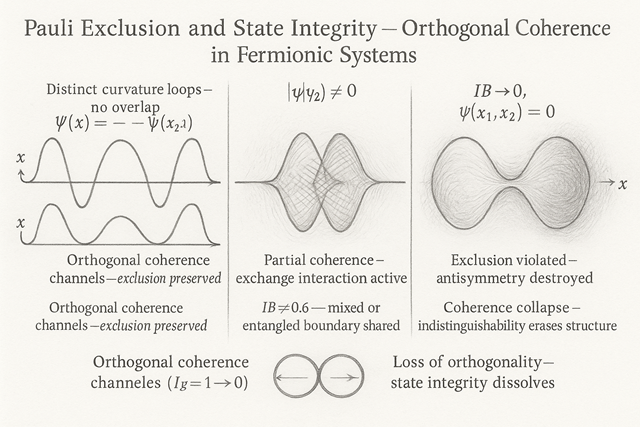
  - **Visualization:**  
    - Left: two non-overlapping fermionic wave packets (orthogonal, IB=1).  
    - Middle: partial overlap (IB≈0.5, mixed state).  
    - Right: complete overlap (IB=0, exclusion violation, coherence destroyed).
Overview

Pauli’s exclusion principle is not only a rule of occupancy — it is a law of coherence integrity.
It governs how identical fermionic fields preserve individuality within a shared boundary.
No two identical fermions can occupy the same complete state because such overlap would collapse their antisymmetric curvature loop — destroying the coherence structure that defines them.

In the HST framework, exclusion is the expression of orthogonal coherence:
each fermion maintains its own curvature channel to preserve the global coherence of the system.


🔹 1. Classical Form — The Exclusion Principle

In quantum mechanics, identical fermions obey antisymmetric wavefunctions:

\[ \Psi(x_1, x_2) = -\Psi(x_2, x_1) \]

This ensures that if two fermions attempt to occupy the same quantum state,

\[ x_1 = x_2 \;\Rightarrow\; \Psi(x_1, x_2) = 0 \]

The total wavefunction vanishes — the system forbids redundancy.
This antisymmetry is encoded in the Slater determinant, which automatically guarantees orthogonality between single-particle states:

\[ \Psi(x_1, \dots, x_N) = \frac{1}{\sqrt{N!}} \begin{vmatrix} \psi_1(x_1) & \psi_1(x_2) & \cdots & \psi_1(x_N) \\ \psi_2(x_1) & \psi_2(x_2) & \cdots & \psi_2(x_N) \\ \vdots & \vdots & \ddots & \vdots \\ \psi_N(x_1) & \psi_N(x_2) & \cdots & \psi_N(x_N) \end{vmatrix} \]

Each fermion thus occupies a unique quantum channel — no duplication allowed.


🔸 2. Coherence Interpretation — Boundary Orthogonality

In the coherence framework, exclusion arises because each fermion’s field curvature defines a distinct coherence loop in phase space.
These loops must remain orthogonal — non-overlapping — for the total system to preserve antisymmetric boundary integrity.

Two identical curvatures cannot coexist within the same boundary region:
the interference of identical curvature patterns would erase distinction, collapsing the system’s internal memory structure.

The coherence integrity index IBI_B expresses this alignment:

\[ I_B = 1 - \text{mean}\!\left( |\langle \psi_i | \psi_j \rangle| \right)_{i \ne j} \]

  • IB=1I_B = 1: Perfect antisymmetry — no overlap, maximal integrity.
  • IB<1I_B < 1: Partial coherence — entangled or mixed state.
  • IB=0I_B = 0: Overlap collapse — exclusion violated, system coherence broken.

This means the exclusion principle is not statistical, but structural:
a curvature integrity law ensuring distinct fermionic boundaries within shared coherence space.


🔹 3. Exchange and the Preservation of Integrity

The antisymmetric nature of fermionic states gives rise to exchange interactions — subtle coherence adjustments between neighbouring wavefunctions.
Even without direct contact, two electrons feel a correlation arising purely from the geometry of antisymmetry.
This exchange energy reflects the system’s effort to maintain coherence boundaries without overlap:

\[ E_{\text{exchange}} \propto -\sum_{i<j} \left| \langle \psi_i \mid \psi_j \rangle \right|^2 \]

The exclusion principle thus extends beyond occupancy — it actively shapes atomic structure, electron shells, and molecular bonding by enforcing curvature separation.


🔸 4. Decoherence and the Loss of Distinction

When environmental interactions, entanglement, or symmetry-breaking reduce coherence, IBI_B decays:

\[ \dot{I_B} = -\lambda (1 - I_B) \]

As coherence fades, orthogonality erodes — wavefunctions begin to overlap.
At the atomic scale, this leads to state mixing or degeneracy pressure relaxation.
At the macroscopic scale, the breakdown of fermionic exclusivity marks the transition toward collective coherence, where distinctions blur — a state approaching bosonic behaviour.

Thus, exclusion is not absolute; it is a dynamic balance between individuality (antisymmetry) and union (symmetry).
The decay of IBI_B traces this continuum.


🔹 5. Unified Coherence Framework — Orthogonality as Survival

In HST terms, the Pauli exclusion principle expresses a universal law of coherence self-preservation:

  • Every fermionic entity defines its existence through distinct curvature orientation in phase space.
  • Overlap destroys the system’s ability to differentiate — coherence integrity collapses.
  • Orthogonality preserves information — individuality maintained, memory sustained.

Fermions thus represent discrete coherence carriers, each holding a unique portion of curvature space.
Bosons, by contrast, embody shared coherence — alignment rather than separation.
Together they define the dual modes of universal coherence: orthogonal and collective memory.


🧠 Summary

The Pauli exclusion principle is not merely about “two electrons cannot share an orbital” —
it is a statement of curvature integrity in coherence space.

In the HST–Flow interpretation:

  • Antisymmetry ensures distinct coherence channels.
  • IB = 1 preserves orthogonal curvature memory.
  • Exchange maintains separation without energy loss.
  • Decoherence blurs distinction — orthogonality dissolves.

Thus, exclusion is not a barrier but a boundary condition —
a structural rule ensuring that reality remains resolvable.

Identity is the first form of coherence — and exclusion is how it survives.

Kireth Research
38 Thorndale Croft, Wetwang, Driffield
East Riding of Yorkshire YO25 9XZ
Designed By

