Chapter 29
Statistical Distributions (Boltzmann, Fermi–Dirac)
Thermal and Entropic Flows
Author: Mark Anthony Higgins
Revised Date: 23 February 2026
All systems share one unifying rule: states distribute according to energy and coherence.
Whether describing a classical gas, an electron sea, or a photon field, the same exponential foundation appears — the balance between energy cost and information spread.
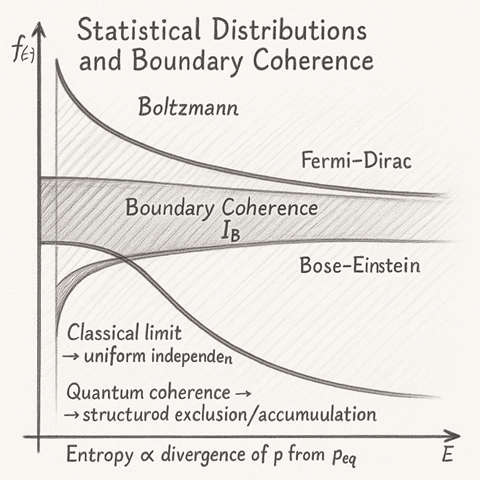
This flow unifies classical and quantum distributions under a single coherence framework, showing that Boltzmann, Fermi–Dirac, and Bose–Einstein statistics are not separate laws but different coherence geometries of the same exponential field.
At thermal equilibrium, each state has probability
$$ p_i = \frac{1}{Z}\, \exp\!\left[-\frac{E_i - \mu}{k_B T}\right]. $$
where
$$ Z = \sum_i \exp\!\left[-\frac{E_i - \mu}{k_B T}\right]. $$
This is the Boltzmann distribution, describing independent, distinguishable particles in the classical limit.
When quantum coherence between particles becomes relevant, occupation no longer follows pure exponentials but adds phase constraints on how energy states fill.
\( f(E) = \begin{cases} \dfrac{1}{e^{(E - \mu)/k_B T} + 1}, & \text{Fermi–Dirac} \\ \dfrac{1}{e^{(E - \mu)/k_B T} - 1}, & \text{Bose–Einstein} \\ e^{-(E - \mu)/k_B T}, & \text{Boltzmann} \end{cases} \)
| Statistic | Particle Type | Coherence Character | Limiting Condition |
|---|---|---|---|
|
Boltzmann
|
Distinguishable |
Independent occupancy |
\( e^{(E - \mu)/k_B T} \gg 1 \)
|
|
Fermi–Dirac
|
Fermions (e.g. electrons)
|
Exclusion symmetry
|
One particle per state
|
|
Bose–Einstein
|
Bosons (e.g. photons)
|
Collective coherence
|
Many particles per state
|
The form of reflects how coherence manifests at the quantum boundary:
fermions repel (anti-symmetric wavefunctions), bosons attract (symmetric wavefunctions), and classical particles remain non-interfering.
In Flow Algebra, we treat the equilibrium distribution as the coherent baseline , and introduce a boundary coherence index that measures alignment between the actual and equilibrium population maps.
$$ p_i = I_B\, p_{\mathrm{eq},i} + (1 - I_B)\,\frac{1}{Z}. $$
The entropy then grows with divergence from the equilibrium map:
$$ S_{\mathrm{phys}} = -k_B \sum_i p_i \ln p_i, \qquad \sigma = k_B\, T\, \frac{dD_{\mathrm{info}}}{dt}. $$
and coherence links directly to divergence:
$$ I_B = e^{-D_{\mathrm{info}}}. $$
Thus, the degree of equilibrium violation can be read as an information distance in phase space.
| Concept | Classical Meaning | Coherence Meaning |
|---|---|---|
|
Temperature
𝑇
|
Mean kinetic energy
|
Rate of energy-information exchange
|
|
Chemical potential
𝜇
|
Energy to add a particle
|
Boundary bias toward occupancy
|
|
Partition function
𝑍
|
Normalisation of probabilities
|
Total coherence volume
|
|
Entropy
𝑆
|
Measure of disorder
|
Information divergence
from perfect alignment |
|
IB
|
–
|
Coherence memory of the distribution
|
Entropy in this view measures how much the statistical field has forgotten its ideal equilibrium shape.
The closer remains to the smaller , the higher , and the more reversible the microscopic flow.
(a) Classical (Boltzmann) Limit
$$ \text{When } e^{(E_i - \mu)/(k_B T)} \gg 1, $$
$$ p_i \approx \frac{1}{Z}\, e^{-\frac{E_i - \mu}{k_B T}}. $$
Particles act independently, coherence minimal but uniform — boundary alignment global rather than quantum.
(b) Quantum (Fermi/Bose) Regime
When occupation probabilities approach unity (low T or high density):
$$ p_i = \frac{1}{e^{(E_i - \mu)/(k_B T)} \,\pm\, 1}, $$
the system’s coherence enforces statistical symmetry:
Entropy reflects the structure of this symmetry —
it grows when coherence breaks and state occupation drifts toward uniformity.
In the HST model, every energy level corresponds to a boundary mode — a coherent standing wave on the system’s holographic surface.
Statistical distributions are not just probabilities, but field population densities on that boundary.
Thermal equilibrium () means each boundary mode maintains correct phase population.
As coherence drops (), these modes flatten — the geometric curvature of energy-space smooths into noise, and information divergence manifests as entropy.
Statistical distributions are the fingerprints of coherence at the microscopic level.
Boltzmann shows energy balance in isolation; Fermi–Dirac and Bose–Einstein reveal how coherence geometry modifies occupancy.
When coherence is perfect, entropy vanishes — information is conserved within the boundary.
When coherence fades, populations blur, and energy becomes memoryless.
Through Flow Algebra, these curves are no longer empirical fits — they are the statistical shadow of boundary geometry in motion.