Chapter 61
Lorentz Transformation and Frame Coherence
Relativistic and Curvature Flows
Author: Mark Anthony Higgins
© Mark Anthony Higgins 11 October 2025
Revised Date: 23 February 2026
flow "Lorentz Transformation and Frame Coherence" v1.0
# ---------- PURPOSE ----------
# Express Lorentz transformations as coherence-preserving mappings between inertial frames.
# γ(v) ensures invariance of the space–time interval s^2; events reindex without breaking causal/phase coherence.
# IB measures frame coherence (clock sync, ruler calibration, inertial purity). IB=1 → ideal inertial alignment.
# ---------- PARAMETERS ----------
params:
units: "SI"
c: positive = 2.99792458e8 # speed of light [m/s]
v: real = 0.0 # boost velocity of S' relative to S along +x [m/s]
β: real = (v/c) # dimensionless speed
γ: real = 1/sqrt(1-β^2) # Lorentz factor
IB: 0.0..1.0 = 1.0 # frame coherence index (sync integrity)
λ_desync: nonnegative = 0.0 # desynchronisation rate [s^-1] (noise, drift)
dt: positive? # timestep for coherence drift
include_transverse: bool = true # include y,z (unchanged) in 1D boost model
# ---------- STATE ----------
state Frame:
# S coordinates (event in S)
t: real # time in S [s]
x: real # x in S [m]
y: real # y in S [m]
z: real # z in S [m]
# S' coordinates (event mapped to S')
t_p: real # t' in S' [s]
x_p: real # x' in S' [m]
y_p: real # y' in S' [m]
z_p: real # z' in S' [m]
# Invariants & kinematics
s2: real # c^2Δt^2 - Δx^2 - Δy^2 - Δz^2
γ_local: real # recomputed gamma
β_local: real
length_contracted: real # L' for a rod at rest in S (x-extent)
time_dilated: real # Δt' for moving clock
simultaneity_offset: real # Δt' from relativity of simultaneity
u: vec3? # 3-velocity in S
u_p: vec3? # 3-velocity in S'
# Coherence
IB_rate: real # dIB/dt (drift)
regime: str # "inertial-aligned","noisy-aligned","desynchronised"
# ---------- INVARIANTS ----------
invariants:
# Dimensionless speed & gamma (guard numerical domain)
params.β = params.v / params.c
params.γ = 1 / sqrt(max(1e-18, 1 - params.β^2))
Frame.β_local = params.β
Frame.γ_local = params.γ
# Standard Lorentz boost (x-axis)
Frame.t_p = params.γ * (Frame.t - (params.v * Frame.x) / params.c^2)
Frame.x_p = params.γ * (Frame.x - params.v * Frame.t)
if params.include_transverse:
Frame.y_p = Frame.y
Frame.z_p = Frame.z
else:
Frame.y_p = 0; Frame.z_p = 0
# Interval invariance (use differentials conceptually)
# Here treat (Δt,Δx,Δy,Δz) as small separations around the event
Δt = 1.0e-9 # nominal differential for check
Δx = 1.0e-1
Δy = 0.0
Δz = 0.0
Frame.s2 = (params.c^2)*(Δt^2) - (Δx^2 + Δy^2 + Δz^2)
# Time dilation and length contraction exemplars (for objects at rest in S)
Δt_proper = 1.0
Frame.time_dilated = params.γ * Δt_proper
L0 = 1.0
Frame.length_contracted = L0 / params.γ
# Relativity of simultaneity (offset for events separated by Δx at same t in S)
Frame.simultaneity_offset = - params.γ * (params.v * Δx) / params.c^2
# Velocity addition (if velocities provided)
if Frame.u is defined:
ux, uy, uz = Frame.u
denom = (1 - params.v*ux/params.c^2)
Frame.u_p = [
(ux - params.v) / denom,
(uy / params.γ) / denom,
(uz / params.γ) / denom
]
# Coherence decay (clock/ruler drift, jitter)
if params.λ_desync > 0 and params.dt is defined:
params.IB = clamp(params.IB - params.λ_desync * (1 - params.IB) * params.dt, 0, 1)
Frame.IB_rate = -params.λ_desync * (1 - params.IB)
# Regime classification
if params.IB == 1:
Frame.regime = "inertial-aligned"
elif params.IB > 0.5:
Frame.regime = "noisy-aligned"
else:
Frame.regime = "desynchronised"
# ---------- TRANSFORMS ----------
transforms:
boost_velocity:
comment: "Change relative speed v (S' w.r.t. S) and recompute mapping."
params.v += Δv
params.v = clamp(params.v, -0.999999*params.c, 0.999999*params.c)
compose_boosts_collinear:
comment: "Compose collinear boosts v ⊕ w = (v + w)/(1 + vw/c^2)."
params.v = (params.v + w) / (1 + (params.v*w)/(params.c^2))
params.v = clamp(params.v, -0.999999*params.c, 0.999999*params.c)
rotate_axes:
comment: "Rotate spatial axes (passive) — does not affect invariants."
# conceptual placeholder; orientation changes but interval preserved
resync_clocks:
comment: "Apply Einstein synchronisation to restore frame coherence."
params.IB = clamp(params.IB + 0.05 * (1 - params.IB), 0, 1)
inject_noise:
comment: "Increase desync to test robustness."
params.IB = clamp(params.IB - 0.1 * (1 - params.IB), 0, 1)
# ---------- MONITORS ----------
monitors:
interval_invariance:
assert abs(Frame.s2 - ((params.c^2)*(Δt^2) - (Δx^2 + Δy^2 + Δz^2))) <= 1e-12
comment: "Space–time interval invariant across frames."
gamma_domain:
assert params.γ >= 1
assert abs(1 - params.β^2) > 1e-12
comment: "γ well-defined; |v| < c."
dilation_contraction_signs:
assert Frame.time_dilated >= Δt_proper
assert Frame.length_contracted <= L0 + 1e-12
comment: "Time dilates; lengths contract along motion."
coherence_bounds:
assert 0 <= params.IB <= 1
# ---------- SCENES ----------
scenes:
moving_clock:
given params:
v: 0.8 * c
IB: 1.0
expect:
Frame.time_dilated = γ * 1.0
comment: "Time dilation: Δt' = γ Δτ with γ≈1/√(1-0.8^2)."
moving_rod:
given params:
v: 0.6 * c
IB: 1.0
expect:
Frame.length_contracted = L0/γ
comment: "Length contraction along x: L' = L0/γ."
simultaneity_shift:
given params:
v: 0.7 * c
IB: 1.0
expect:
Frame.simultaneity_offset ≠ 0
comment: "Events simultaneous in S are not simultaneous in S'."
velocity_addition:
given params:
v: 0.8 * c
IB: 1.0
given Frame:
u: [0.7 * c, 0, 0]
expect:
Frame.u_p[0] = (0.7c - 0.8c)/(1 - 0.56) # bounded by c
comment: "Relativistic velocity addition preserves |u'| < c."
noisy_sync:
given params:
v: 0.5 * c
IB: 0.7
λ_desync: 0.02
dt: 1.0
enable:
- inject_noise
expect:
params.IB ↓
Frame.regime = "desynchronised"
comment: "Clock/ruler jitter lowers frame coherence; mappings still preserve s^2."
resynchronise:
given params:
v: 0.5 * c
IB: 0.6
enable:
- resync_clocks
expect:
params.IB ↑
Frame.regime ∈ {"noisy-aligned","inertial-aligned"}
comment: "Einstein re-sync restores operational coherence."
# ---------- NOTES ----------
notes:
- **Lorentz Factor:**
\[
\beta = \frac{v}{c}, \qquad \gamma = \frac{1}{\sqrt{1-\beta^2}}.
\]
- **Boost (x-axis):**
\[
t' = \gamma\!\left(t - \frac{v x}{c^2}\right),\quad
x' = \gamma(x - v t),\quad
y' = y,\; z' = z.
\]
- **Interval Invariance:**
\[
s^2 = c^2\Delta t^2 - \Delta x^2 - \Delta y^2 - \Delta z^2 \quad \text{is invariant.}
\]
- **Time Dilation / Length Contraction:**
\[
\Delta t' = \gamma \Delta \tau,\qquad L' = \frac{L_0}{\gamma}.
\]
- **Relativity of Simultaneity:**
\[
\Delta t' = -\gamma \frac{v\,\Delta x}{c^2}.
\]
- **Velocity Addition (3D):**
\[
u'_x=\frac{u_x - v}{1-\frac{v u_x}{c^2}},\quad
u'_{y,z}=\frac{u_{y,z}/\gamma}{1-\frac{v u_x}{c^2}}.
\]
- **Coherence Law (Frame Sync):**
\[
\dot{I_B} = -\lambda_{\text{desync}}(1 - I_B).
\]
IB encodes practical clock/ruler alignment; Lorentz invariance (s²) holds regardless, but operational coherence improves as IB→1.
- **Interpretation (HST–Flow):**
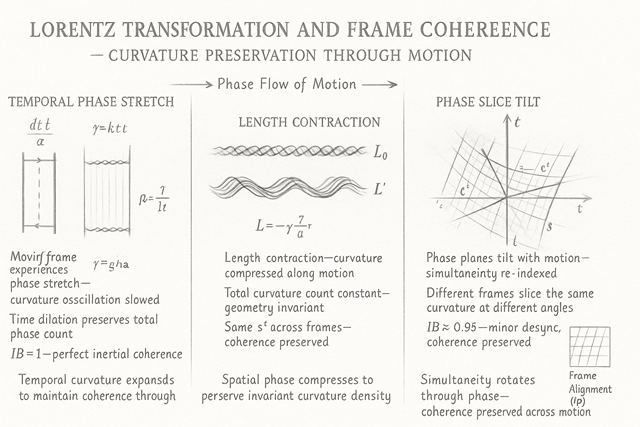
Lorentz transformation = **relabeling of the same curvature** with phase-consistent clocks and rulers.
Invariance of \(s^2\) ensures global coherence; \(I_B\) tracks *instrumental* coherence between frames (sync, drift, jitter).
The Lorentz transformation does not stretch or twist space–time — it preserves coherence between observers moving relative to one another.
When two inertial frames move at a constant velocity, they are not physically distorted versions of one another; they are different coordinate expressions of the same curvature structure.
Each measures the same invariant — the space–time interval — but slices it differently through time and space.
In the HST framework, Lorentz transformations are the phase re-indexings of global coherence.
The transformation between two inertial frames, and ′, moving at relative speed v along the x-axis, is given by:
\[ t' = \gamma \left( t - \frac{v x}{c^2} \right), \qquad x' = \gamma (x - v t), \qquad y' = y, \qquad z' = z \]
with
\[ \gamma = \frac{1}{\sqrt{1 - (v/c)^2}} \]
This ensures that the space–time interval remains invariant:
\[ s^2 = c^2 \Delta t^2 - \Delta x^2 - \Delta y^2 - \Delta z^2 \]
Every inertial observer agrees on , even though their measurements of and differ.
Time dilation and length contraction are not distortions, but manifestations of phase symmetry: different observers maintain global curvature by adjusting their local projections of it.
In HST–Flow, an inertial frame is a coherence field — a local mapping of global curvature through synchronized clocks and consistent spatial intervals.
Each observer defines a local reference grid, measuring the same invariant curvature with their own unit rulers and clocks.
The Lorentz transformation acts as a phase re-indexing operator, translating one frame’s coherence map into another’s:
\[ \Phi'(x', t') = \Phi(x, t)\, e^{i\phi(v)} \]
where encodes the velocity-dependent phase shift that preserves curvature continuity.
When , the frames are perfectly aligned — phase-locked descriptions of the same geometry.
If synchronization drifts or accelerations distort reference calibration, , producing small coherence mismatches: practical desynchronisation, not true physical deviation.
From the coherence viewpoint
\[ \Delta t' = \gamma \Delta \tau \]
\[ L' = \frac{L_0}{\gamma} \]
Both ensure the curvature count per cycle — the total number of phase rotations describing the event — remains invariant across frames.
Reality preserves its curvature sum even as coordinates shift.
Events simultaneous in one frame are phase-offset in another:
\[ \Delta t' = -\gamma \frac{v\,\Delta x}{c^2} \]
This is not a breakdown of coherence but its re-indexing: one observer’s constant-phase slice becomes another’s tilted phase surface.
Each frame defines simultaneity according to its orientation through the global coherence field.
Simultaneity is relative because phase planes tilt with velocity — yet coherence (the full geometry) remains exact.
No real observer is perfectly inertial.
Clocks drift, rulers expand with heat, and gravitational gradients induce curvature variations.
These effects are captured by the frame coherence index , which decays according to:
\[ \dot{I_B} = -\lambda_{\text{desync}} (1 - I_B) \]
As decreases, a frame becomes noisy-aligned — small timing errors accumulate, but the invariant structure persists.
Re-synchronisation restores coherence by re-aligning local clocks and rulers with the global curvature rhythm.
At the deepest level, all frames share the same underlying curvature — relativity simply defines how faithfully each one measures it.
In HST–Flow, space–time coherence behaves like a global standing wave of curvature, with Lorentz transformations acting as phase translations across its surface.
The constancy of the speed of light represents perfect phase velocity through this field.
Each observer moves through the same wave structure, describing it in coordinates that preserve coherence:
Thus, relativity does not distort the world — it keeps it coherent by redistributing phase.
Even when frames desynchronize (), the global structure remains invariant — the universal curvature field that all frames describe from different angles.
The Lorentz transformation preserves coherence across motion.
It ensures that every observer, regardless of velocity, describes the same underlying curvature field.
In the HST–Flow interpretation:
Relativity is coherence viewed from motion —
not a distortion of reality, but its preservation in translation.