
Chapter 14
Superposition and Linearity of Flows

Meta-Principles of Coherence Physics
Author: Mark Anthony Higgins
© Mark Anthony Higgins 11 October 2025
Revised Date: 23 February 2026
Audio Overview
Flow Algebra
flow "Superposition_and_Linearity_of_Flows"

# ---------- STATES ----------
state:
  field.ψi: list[complex]             # individual coherence amplitudes (ψ₁, ψ₂, …)
  field.ψ_total: complex              # resulting superposed field
  field.intensity.I: float            # |ψ_total|²
  field.phase.Φi: list[float]         # phases of components
  field.amplitude.Ai: list[float]     # amplitudes of components
  field.interference_term: float      # cross term 2A₁A₂cos(ΔΦ)
  coherence.integrity: float          # 0..1, degree of phase alignment
  boundary.tension: float             # curvature tension density (J/m³)
  curvature.field_energy: float       # total field energy
  superposition.linear: bool          # flag for linear regime validity
  coupling.constant: float            # nonlinearity factor (0 = ideal linear)
  time.t: float

# ---------- PARAMETERS ----------
params:
  hbar: 1.054e-34
  k_coh: float                        # coherence coupling constant
  linearity_threshold: 0.02           # |nonlinear term / linear term| limit
  dt: float

# ---------- INVARIANTS ----------
invariant:
  - field.ψ_total = Σ_i field.ψi
  - linearity holds if coupling.constant * boundary.tension < params.linearity_threshold
  - field.intensity.I = |field.ψ_total|² = Σ_i |ψ_i|² + Σ_{i≠j} ψ_i ψ_j*
  - interference term: I₁₂ = 2A₁A₂cos(ΔΦ)
  - coherence.integrity ∝ |⟨ψ₁|ψ₂⟩| : full coherence (1), incoherence (0)
  - energy additivity: curvature.field_energy ∝ ∫ |ψ_total|² dV
  - nonlinearity appears as curvature feedback term ∝ |ψ|²ψ (breaks superposition)

# ---------- TRANSFORMS ----------
transform:

  initialise_fields:
    do:
      field.ψi = [A₁*exp(iΦ₁), A₂*exp(iΦ₂)]
      field.ψ_total = sum(field.ψi)
      field.intensity.I = |field.ψ_total|²
      coherence.integrity = 1.0
      coupling.constant = 0
      superposition.linear = true
      time.t = 0

  compute_interference:
    do:
      ΔΦ = field.phase.Φi[0] - field.phase.Φi[1]
      field.interference_term = 2 * field.amplitude.Ai[0] * field.amplitude.Ai[1] * cos(ΔΦ)
      field.intensity.I = (field.amplitude.Ai[0]**2 + field.amplitude.Ai[1]**2 + field.interference_term)

  check_linearity:
    do:
      nonlinear_ratio = coupling.constant * boundary.tension
      if nonlinear_ratio < params.linearity_threshold:
        superposition.linear = true
      else:
        superposition.linear = false
        mark("nonlinear_regime")

  apply_nonlin_feedback:
    pre:
      require not superposition.linear
    do:
      correction = coupling.constant * |field.ψ_total|² * field.ψ_total
      field.ψ_total += correction * params.dt
      field.intensity.I = |field.ψ_total|²
      coherence.integrity = max(1 - abs(coupling.constant)*0.1, 0)

  update_coherence_integrity:
    do:
      phase_overlap = abs(exp(i*(field.phase.Φi[0]-field.phase.Φi[1])))
      coherence.integrity = phase_overlap
      boundary.tension = params.k_coh * (1 - coherence.integrity)

  tick:
    do:
      time.t += params.dt

# ---------- MONITORS ----------
monitor:
  interference_pattern:
    observe: [field.intensity.I, field.interference_term]
    report: "Shows how constructive/destructive interference modulates total intensity."

  linearity_health:
    observe: [superposition.linear, coupling.constant, boundary.tension]
    report: "Verifies linear superposition; deviations indicate curvature feedback (nonlinearity)."

  coherence_alignment:
    observe: [coherence.integrity]
    report: "High integrity → clear interference fringes; low integrity → washed-out classical sum."

# ---------- NOTES (coherence view) ----------
note:
  - Linearity is the **additivity of coherence**: the field sums without self-feedback when curvature response is negligible.
  - Superposition means that multiple coherence states coexist without distortion: ψ_total = Σ ψ_i.
  - Interference arises from phase relations, not wave overlap per se — curvature geometry determines the cross term 2A₁A₂cos(ΔΦ).
  - When coherence integrity = 1, interference is maximal and reversible (quantum regime).
  - When integrity < 1, phase decoherence averages the cross term → classical probabilistic sum.
  - Nonlinear coupling (strong curvature tension, self-interaction) breaks superposition: ψ satisfies |ψ|²ψ correction, producing collapse-like behaviour.
  - Classical optics, quantum amplitudes, and even gravitational waves obey this structure; the difference lies only in coherence scale and coupling strength.
  - Thus, superposition is not a special rule of quantum mechanics, but a universal property of all **linear coherence flows** in the low-tension limit.

What this flow captures

Superposition_and_Linearity_of_Flows expresses one of the most universal properties of physical systems:
that independent coherence flows can coexist and combine without distortion as long as the curvature response of the medium remains linear.

In standard physics, this is the superposition principle: the sum of two solutions to a linear equation is also a solution.
In HST, it becomes a statement about coherence integrity — if the boundary’s curvature can store multiple phase configurations without tension feedback, their amplitudes add directly.

Superposition is therefore not a uniquely quantum rule, but a universal geometric condition that holds whenever coherence remains linear in curvature.


Core intuition (HST view)

Every field is a map of curvature coherence: a geometric pattern storing phase information.
When multiple patterns coexist, their curvatures add linearly if the field’s boundary tension (Σ) responds proportionally to deformation.
This produces interference — constructive when phase fronts align, destructive when they oppose.

The observed interference pattern is simply the visible beat of coherence, the oscillating difference between curvature alignments.
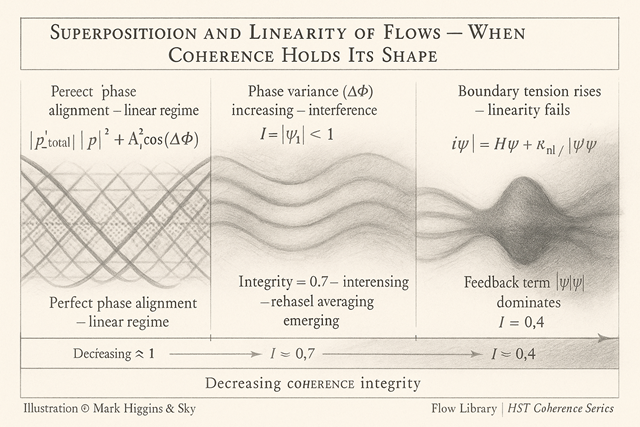
In perfect integrity (I = 1), the interference term is maximally visible; in low integrity, it fades into the background — the transition from quantum to classical behaviour.

Superposition holds as long as curvature feedback (nonlinearity) remains small.
When coupling increases — as in self-gravitating systems, high-field plasmas, or non-linear optics — coherence begins to curve back on itself, breaking additivity.
This marks the emergence of nonlinear coherence, where flows begin to interact rather than simply coexist.


Mathematical structure

Let two coherent fields be \( \psi_{1} \) and \( \psi_{2} \):

\[ \psi_{\text{total}} = \psi_{1} + \psi_{2}\,. \]

The measurable intensity becomes

\[ |\psi_{\text{total}}|^{2} = |\psi_{1}|^{2} + |\psi_{2}|^{2} + 2A_{1}A_{2}\cos(\Delta\Phi)\,. \]

\[ \text{where } A_{i} \text{ are the amplitudes and } \Delta\Phi \text{ is the phase difference.} \]

  • The first two terms represent independent contributions (classical additivity).
  • The cross term encodes coherence — it appears only when phase information is preserved.

\[ \text{If coherence integrity } I = 1, \text{ this cross term survives;} \quad \text{if phase memory is lost } (I = 0), \text{ it averages to zero, leaving only the classical sum:} \]

\[ I = 0 \;\Rightarrow\; |\psi_{\text{total}}|^{2} = |\psi_{1}|^{2} + |\psi_{2}|^{2}\,. \]

Hence, probability addition replaces amplitude addition as coherence degrades — the same geometry viewed under lower phase resolution.


Linearity and curvature feedback

The linear regime corresponds to negligible curvature feedback:

nonlinear ratio=linear termfeedback term​<threshold.

In this limit, the field obeys

\[ \mathcal{L}[\psi_{1} + \psi_{2}] = \mathcal{L}[\psi_{1}] + \mathcal{L}[\psi_{2}]\,. \]

and all solutions superpose cleanly.

\[ \text{When feedback becomes significant, additional curvature terms appear (e.g. } |\psi|^{2}\psi \text{), producing self-interaction.} \]

\[ i\hbar\,\frac{\partial \psi}{\partial t} = H\psi + \kappa_{\mathrm{nl}}\,|\psi|^{2}\psi\,. \]


Interpretation in coherence physics
RegimeIntegrity 𝐼 BehaviourExample
High coherence (I ≈ 1)
Linear
superposition
Clear interference;
additive
phase logic
Quantum
amplitudes,
classical waves
Partial coherence (I ≈ 0.7)
Weak linearity
Fringes blurred;
averaged
probabilities
Thermal optics,
mesoscopic systems
Low coherence (I ≪ 1)
Nonlinear feedback
Curvature saturation,
decoherence
Turbulence, plasma,
strong gravity

Thus, linearity and superposition are special cases of stable coherence, not separate laws.
They describe the state where curvature can support multiple oscillations without distortion — geometry in harmonic balance.


Boundary coherence interpretation

At the boundary level, superposition describes how multiple coherence currents pass through the same geometry without interacting:

\[ J^{\mu}_{\text{total}} = J^{\mu}_{1} + J^{\mu}_{2}, \qquad \partial_{\mu} J^{\mu}_{\text{total}} = 0\,. \]

The current continuity equation remains exact as long as boundary tension remains linear.
Loss of linearity adds a source term proportional to κnl\kappa_{\mathrm{nl}}, representing curvature feedback.


Physically:
  • In a quantum interferometer, the boundary is perfectly linear → amplitude addition.
  • In a macroscopic fluid, small nonlinearities blur the boundary → energy addition.
  • In strong curvature systems, feedback dominates → nonlinearity and collapse.

Each regime follows from the same coherence law, scaled by tension.


Philosophical perspective
  • Superposition is geometry’s ability to host multiple truths simultaneously without contradiction.
  • Linearity is the condition that allows those truths to remain independent.
  • Interference is their dialogue — coherence remembering both paths at once.
  • Nonlinearity is coherence in conflict — geometry reshaping itself under its own tension.

The universe, at every scale, oscillates between these modes.
Where tension is low, it sings in harmony (linear flow); where tension is high, it folds and composes new structures (nonlinear evolution).
The transition between the two is the engine of complexity.


Significance

This flow reveals that the superposition principle is not confined to quantum mechanics but is a universal feature of all coherent systems operating in the linear regime.
It is the mathematical language of peace between fields — the condition under which the geometry of reality can hold multiple states at once without breaking.

When curvature feedback rises, that peace breaks — and from that tension, structure, pattern, and collapse are born.

Thus, linearity and superposition are not endpoints of theory, but boundary conditions on coherence itself.


In essence

Superposition is coherence in harmony; linearity is coherence without resistance.
When curvature tension rises, harmony bends — and the universe begins to compose.


Kireth Research
38 Thorndale Croft, Wetwang, Driffield
East Riding of Yorkshire YO25 9XZ
Designed By