
Chapter 39
Coherence Breakdown and Escape Velocity

Gravitational and Orbital Coherence
Author: Mark Anthony Higgins
© Mark Anthony Higgins 11 October 2025
Revised Date: 23 February 2026
Audio Overview
Flow Algebra
flow "Coherence Breakdown and Escape Velocity" v1.0

# ---------- PURPOSE ----------
# Models escape velocity as a coherence threshold — when kinetic energy overcomes
# boundary curvature (potential) coherence. Expresses transition from bound to unbound
# motion (E = 0 surface). Includes boundary coherence index (IB) to modulate the strength
# of gravitational binding and energy feedback. IB < 1 leads to progressive escape
# via curvature loss rather than instantaneous release.

# ---------- PARAMETERS ----------
params:
  units: "SI"
  G: 6.67430e-11              # gravitational constant [m^3 kg^-1 s^-2]
  m1: positive                # central mass [kg]
  m2: positive                # orbiting mass [kg]
  r:  positive                # separation radius [m]
  v:  positive                # initial velocity [m/s]
  IB: 0.0..1.0 = 1.0          # boundary coherence index (1 = fully bound)
  loss_coeff: 0.0             # optional coherence decay rate [s^-1]
  dt: 0.0?                    # optional timestep for numerical updates [s]
  include_feedback: true

# ---------- STATE ----------
state System:
  E_kin: real                 # kinetic energy [J]
  E_pot: real                 # gravitational potential energy [J]
  E_tot: real                 # total specific energy [J/kg]
  v_esc: real                 # escape velocity [m/s]
  bound_state: str            # qualitative state: "bound", "critical", "unbound"
  IB_rate: real               # dIB/dt coherence loss rate
  feedback_ratio: real        # fraction of kinetic to potential energy
  curvature_balance: real     # net curvature memory (E_tot / |E_pot|)

# ---------- INVARIANTS ----------
invariants:

  # Reduced gravitational parameter
  mu = params.IB * params.G * (params.m1 + params.m2)

  # Energies per unit mass
  System.E_kin = 0.5 * params.v^2
  System.E_pot = - mu / params.r
  System.E_tot = System.E_kin + System.E_pot

  # Escape velocity
  System.v_esc = sqrt(2 * mu / params.r)

  # Feedback ratio and curvature memory
  System.feedback_ratio = System.E_kin / abs(System.E_pot)
  System.curvature_balance = System.E_tot / abs(System.E_pot)

  # Determine state (bound / critical / unbound)
  if System.E_tot < 0:
    System.bound_state = "bound"
  elif abs(System.E_tot) <= 1e-9:
    System.bound_state = "critical"
  else:
    System.bound_state = "unbound"

  # Optional coherence-loss rate (feedback form)
  if params.include_feedback:
    System.IB_rate = -params.loss_coeff * (1 - params.IB)

# ---------- TRANSFORMS ----------
transforms:

  # Coherence decay (progressive boundary loss)
  coherence_decay (when params.dt > 0):
    params.IB = params.IB - params.loss_coeff * (1 - params.IB) * params.dt
    params.IB = clamp(params.IB, 0, 1)

  # Energy feedback (adjusts total E as IB changes)
  feedback_update:
    if params.include_feedback:
      System.E_pot = - params.IB * params.G * (params.m1 + params.m2) / params.r
      System.E_tot = System.E_kin + System.E_pot
      System.curvature_balance = System.E_tot / abs(System.E_pot)

  # Escape check (transition condition)
  escape_threshold:
    if System.E_tot >= 0:
      System.bound_state = "unbound"
    else:
      System.bound_state = "bound"

# ---------- MONITORS ----------
monitors:
  energy_signs:
    assert System.E_kin >= 0
    assert System.E_pot <= 0
  escape_condition:
    if System.v >= System.v_esc:
      comment: "Kinetic energy exceeds curvature binding — escape achieved."
    elif System.v < System.v_esc and System.bound_state == "bound":
      comment: "Still bound — curvature coherence dominates."
  coherence_tracking:
    assert 0 <= params.IB <= 1
    if params.IB < 1:
      comment: "Boundary coherence decaying; gradual curvature weakening."
  energy_feedback_check:
    if params.include_feedback:
      assert abs(System.E_tot - (System.E_kin + System.E_pot)) < 1e-9

# ---------- SCENES ----------
scenes:

  bound_orbit:
    given params:
      m1: 5.97e24
      m2: 1000
      r: 7.0e6
      v: 7500
      IB: 1.0
    expect:
      System.v_esc ≈ 11186
      System.E_tot < 0
      System.bound_state = "bound"
      comment: "Below escape speed — stable orbital curvature."

  escape_limit:
    given params:
      m1: 5.97e24
      m2: 1000
      r: 7.0e6
      v: 11186
      IB: 1.0
    expect:
      System.E_tot ≈ 0
      System.bound_state = "critical"
      comment: "At escape threshold — boundary coherence exactly neutralised."

  unbound_motion:
    given params:
      m1: 5.97e24
      m2: 1000
      r: 7.0e6
      v: 12000
      IB: 1.0
    expect:
      System.E_tot > 0
      System.bound_state = "unbound"
      comment: "Kinetic coherence exceeds curvature — object escapes."

  gradual_breakdown:
    given params:
      m1: 5.97e24
      m2: 1000
      r: 7.0e6
      v: 11000
      IB: 0.98
      loss_coeff: 1e-5
      dt: 10.0
      include_feedback: true
    enable:
      - coherence_decay
      - feedback_update
      - escape_threshold
    expect:
      params.IB ↓
      System.E_pot ↑ (less negative)
      System.E_tot → 0
      System.bound_state transitions from "bound" to "unbound"
      comment: "Slow coherence breakdown produces escape via gradual curvature loss."

# ---------- NOTES ----------
notes:
  - **Escape velocity:** \( v_{\text{esc}} = \sqrt{2I_B G (m_1 + m_2) / r} \)
  - **Total energy per unit mass:** \( \epsilon = \tfrac{v^2}{2} - I_B G (m_1 + m_2)/r \)
  - **Bound/unbound criterion:** \( \epsilon < 0 \) bound, \( = 0 \) marginal, \( > 0 \) escape.
  - **Coherence interpretation:** gravitational binding = curvature memory;
    escape = loss of coherence between motion and field curvature.
  - **Feedback law:** \( \dot{I_B} = -\lambda(1 - I_B) \) models slow coherence decay.
  - **Transition behaviour:** gradual decrease in IB mimics surface heating,
    tidal deformation, or radiative loss leading to orbital unbinding.
  - **Dynamic meaning:** energy and coherence are two faces of the same curvature:
    as one rises, the other weakens until the field can no longer contain motion.
  - **Visualisation:** plot E_tot vs. IB — the zero line marks the boundary between coherent (bound) and decoherent (escape) states.
Overview

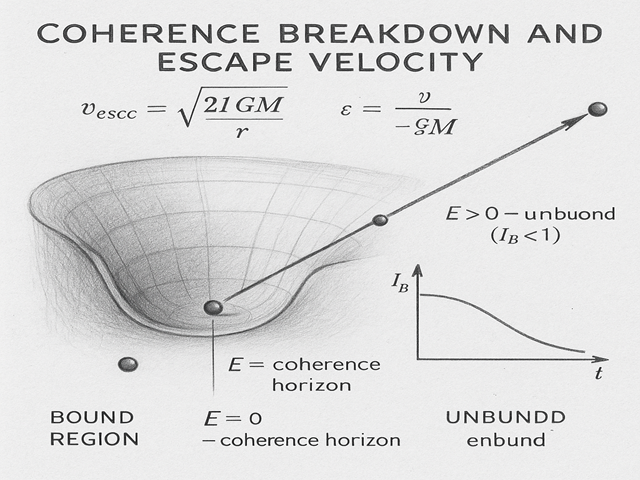
Escape velocity marks the threshold of coherence breakdown — the point at which motion overcomes the curvature memory of a gravitational boundary.
In classical form, it’s defined by

$$ v_{\mathrm{esc}} = \sqrt{\frac{2\,I_B\,G\,(m_1 + m_2)}{r}}. $$

but in coherence form, it becomes something deeper: the velocity at which kinetic tension fully cancels curvature binding.
Below this point, motion and curvature remain in phase — the orbit closes and memory persists.
At the threshold, the system’s feedback loop opens — energy and coherence separate, and motion becomes free.


🔹 1. Bound vs. Unbound — The Energy of Memory

For a body of mass m2m_2 moving in the potential of m1m_1:

$$ \epsilon = \frac{v^2}{2} - \frac{I_B\,G\,(m_1 + m_2)}{r}. $$

  • When ϵ<0\epsilon < 0: Bound — kinetic energy insufficient to break curvature; motion oscillates in stable memory.
  • When ϵ=0\epsilon = 0: Critical — balance between inertia and curvature; the field is neutralised.
  • When ϵ>0\epsilon > 0: Unbound — motion exceeds curvature tension; the boundary’s memory is lost.

This critical surface, ϵ=0\epsilon = 0, defines not just the escape velocity, but the coherence horizon of the system — the limit where curvature and motion no longer share the same feedback channel.

🔸 2. Escape as Curvature Failure

The gravitational potential well is the memory field of mass:

$$ E_{\mathrm{pot}} = -\,\frac{I_B\,G\,(m_1 + m_2)}{r}. $$

Kinetic energy presses against that memory, acting as curvature tension:

$$ E_{\mathrm{kin}} = \frac{1}{2} v^2. $$

Equilibrium occurs when

$$ E_{\mathrm{kin}} = |E_{\mathrm{pot}}|. $$

Beyond this, coherence breaks — not instantaneously, but progressively.
The coherence index IBI_B acts as the retention coefficient of curvature memory:
as IBI_B falls, potential energy weakens, the field relaxes, and the boundary loses hold.

In systems where coherence decays gradually (through tidal stress, radiation, or heating), escape is a soft unbinding — motion drifts beyond curvature one feedback cycle at a time.


🔹 3. Coherence Dynamics

A simple feedback law governs the fading of curvature memory:

$$ \frac{dI_B}{dt} = -\lambda(1 - I_B), \qquad \dot{E} = -\lambda\,|E|. $$

The decay constant λ\lambda defines how quickly the boundary loses its coherence.

  • At IB=1I_B = 1, the field is perfect: gravity remembers motion entirely.
  • At IB<1I_B < 1, the gravitational “surface” becomes porous — the field forgets, and kinetic energy begins to leak through curvature like heat through a thin shell.

Escape, then, is not a jump but a memory failure — a feedback desynchronisation between velocity and curvature.


🔸 4. Curvature Feedback and the Zero-Energy Surface

The escape threshold corresponds to a zero in the curvature feedback equation:

$$ E_{\mathrm{tot}} = E_{\mathrm{kin}} + E_{\mathrm{pot}} = 0. $$

This condition represents the open feedback surface — where motion is free, but still carries the imprint of the curvature it escaped.
Beyond this line, energy feedback no longer cycles between motion and memory.
Instead, it radiates outward — motion becomes linear, and the field ceases to curve it back.

In this sense, escape velocity is not a speed, but the boundary condition of memory: the limit at which curvature can no longer self-reinforce.


🧠 Summary

Escape velocity is more than a number — it’s the threshold of coherence.
It marks the point where a system’s geometry can no longer hold its own memory:
kinetic energy rises beyond curvature’s ability to fold motion back.

  • Below vescv_{\text{esc}}: coherence binds motion; space remembers its curve.
  • At vescv_{\text{esc}}: memory and motion balance — the horizon of feedback.
  • Beyond vescv_{\text{esc}}: geometry forgets — motion departs, curvature relaxes.

In the HST framework, escape is not a loss of energy, but a release of memory —
the moment when curvature lets go of the form it once sustained.


Kireth Research
38 Thorndale Croft, Wetwang, Driffield
East Riding of Yorkshire YO25 9XZ
Designed By