Chapter 40
Newton’s First Law — Stable Inertia
Motion and Inertial Coherence
Author: Mark Anthony Higgins
© Mark Anthony Higgins 11 October 2025
Revised Date: 23 February 2026
flow "Newton’s First Law — Stable Inertia" v1.0
# ---------- PURPOSE ----------
# Expresses Newton’s First Law (an object in motion remains in motion unless acted upon by a net force)
# through the framework of coherence and boundary feedback.
# Stable inertia is treated as the persistence of motion under perfect internal coherence (IB = 1),
# while deviations (IB < 1) represent curvature, resistance, or external disturbance.
# Introduces curvature feedback as the governing mechanism maintaining direction and velocity.
# ---------- PARAMETERS ----------
params:
units: "SI"
m: positive # mass [kg]
v: real # initial velocity [m/s]
F_ext: real = 0.0 # external net force [N]
IB: 0.0..1.0 = 1.0 # boundary coherence (1 = perfect inertial stability)
loss_coeff: 0.0 # damping rate or resistance factor [s^-1]
dt: 0.0? # timestep for updates [s]
curvature_effect: false # optional curvature feedback term for non-inertial reference frames
curvature_field: real? # curvature magnitude [m/s^2] (centripetal or gravitational)
include_feedback: true
# ---------- STATE ----------
state Motion:
a: real # acceleration [m/s^2]
v_new: real # updated velocity [m/s]
x: real # position [m]
E_kin: real # kinetic energy [J]
coherence_stress: real # measure of curvature or deviation [N]
equilibrium_state: str # "inertial", "resisted", or "accelerated"
# ---------- INVARIANTS ----------
invariants:
# Inertial motion — F = 0 → a = 0
if params.F_ext == 0:
Motion.a = 0
else:
Motion.a = params.F_ext / params.m
# Perfect coherence (IB = 1): motion persists at constant velocity
if params.IB == 1:
Motion.v_new = params.v
Motion.equilibrium_state = "inertial"
else:
# Reduced coherence → velocity drift or resistance
Motion.v_new = params.v * params.IB
Motion.equilibrium_state = "resisted"
# Optional loss or damping (e.g., friction)
if params.loss_coeff > 0:
Motion.v_new *= exp(-params.loss_coeff * params.dt or 0)
Motion.equilibrium_state = "resisted"
# Optional curvature feedback (centripetal or gravitational)
if params.curvature_effect and params.curvature_field is defined:
Motion.a += params.curvature_field
Motion.coherence_stress = params.m * params.curvature_field
else:
Motion.coherence_stress = params.m * (1 - params.IB) * 1e-3 # residual boundary deviation
# Kinetic energy
Motion.E_kin = 0.5 * params.m * Motion.v_new^2
# ---------- TRANSFORMS ----------
transforms:
# Time evolution — position update
propagate_motion (when params.dt > 0):
Motion.x += Motion.v_new * params.dt
if params.loss_coeff > 0:
Motion.v_new *= (1 - params.loss_coeff * params.dt)
# Coherence decay (motion persistence fades)
coherence_decay:
if params.include_feedback:
params.IB = params.IB - params.loss_coeff * (1 - params.IB) * (params.dt or 1)
params.IB = clamp(params.IB, 0, 1)
# ---------- MONITORS ----------
monitors:
inertial_condition:
if params.F_ext == 0 and params.IB == 1:
comment: "Inertial frame: object moves with constant velocity — stable inertia."
elif params.F_ext == 0 and params.IB < 1:
comment: "No net force, but coherence loss — internal resistance slows motion."
elif params.F_ext != 0:
comment: "External force applied — system accelerates; inertia no longer stable."
energy_conservation:
assert Motion.E_kin >= 0
# ---------- SCENES ----------
scenes:
perfect_inertia:
given params:
m: 1.0
v: 10.0
F_ext: 0.0
IB: 1.0
dt: 1.0
expect:
Motion.a = 0
Motion.v_new = 10.0
Motion.E_kin = 50.0
comment: "Constant velocity — perfect inertial stability (IB = 1)."
resisted_inertia:
given params:
m: 1.0
v: 10.0
IB: 0.95
loss_coeff: 0.01
dt: 1.0
enable:
- propagate_motion
- coherence_decay
expect:
Motion.v_new < 10.0
Motion.E_kin decreases
comment: "Internal coherence slightly reduced — gradual energy loss, motion decays."
accelerated_motion:
given params:
m: 1.0
v: 0.0
F_ext: 5.0
IB: 1.0
dt: 1.0
enable:
- propagate_motion
expect:
Motion.a = 5.0
Motion.v_new = 5.0
comment: "External force introduces acceleration — inertia responds as geometry feedback."
curvature_frame:
given params:
m: 1.0
v: 10.0
curvature_effect: true
curvature_field: -9.81
IB: 1.0
expect:
Motion.a = -9.81
Motion.coherence_stress = -9.81
comment: "In curved frame — gravity as curvature feedback; apparent acceleration without force."
# ---------- NOTES ----------
notes:
- **Newton’s First Law:** An object remains at rest or in uniform motion unless acted on by a net external force.
- In this formulation, inertia is a *coherent equilibrium* — the absence of net curvature feedback.
- **Equation form:** \( F = m a \), with \( a = 0 \) when \( F_{\text{ext}} = 0 \).
- **Energy:** \( E_k = \tfrac{1}{2} m v^2 \) constant when \( a = 0 \).
- **Coherence index (IB):** quantifies how perfectly a system preserves inertial motion.
- \( I_B = 1 \): stable, uncurved motion.
- \( I_B < 1 \): partial coherence loss — friction, drag, deformation.
- **Curvature feedback:** acceleration appears when boundary geometry bends motion — e.g., gravity or rotation.
- **Interpretation:** inertia is not the absence of force, but *the equilibrium of curvature tension at zero net gradient*.
- **Dynamic meaning:** motion continues because coherence is self-sustaining — the trajectory stores memory of its own velocity.
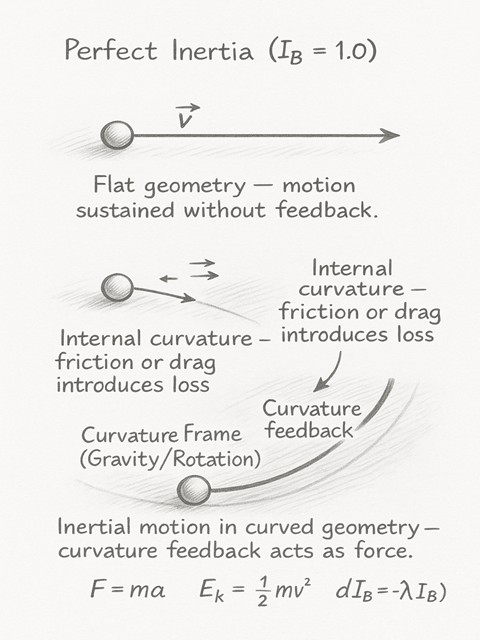
Newton’s First Law defines inertia — the tendency of an object to maintain its state of motion unless acted upon by an external force.
In coherence terms, this law describes a state of perfect internal equilibrium, where the boundary tension of motion is constant and no curvature feedback is required.
The object moves not because of force, but because coherence sustains direction — its geometry remembers its motion.
When coherence is complete (), inertia is perfectly stable: velocity remains constant, energy conserved, and curvature flat.
When coherence weakens (), residual curvature appears — resistance, drag, or deviation from uniform motion.
Inertia, therefore, is the absence of curvature, not the absence of cause.
In Newtonian form:
$$ F = m a, \qquad a = 0 \text{ when } F_{\mathrm{ext}} = 0. $$
An object either remains at rest or moves in a straight line with constant velocity unless acted upon by an external force.
This describes a perfectly coherent trajectory:
no change in direction, speed, or internal stress.
Velocity is the stored memory of prior curvature, and inertia is that memory continuing unaltered.
$$ a = 0, \qquad \sigma_c = 0. $$
When external curvature (force) or internal loss appears, coherence begins to drift:
\( I_B < 1 \;\Rightarrow\; \text{resistance, deviation, or energy decay.} \)
Thus, inertia is maintained not by the absence of influence, but by perfect boundary symmetry.
Every part of the system transmits motion equally — no lag, no compression, no energy gradient.
In this sense, motion persists because coherence closes perfectly on itself — the dynamic field is balanced in all directions.
Kinetic energy in this state remains constant:
$$ E_k = \frac{1}{2} m v^2 = \text{constant}. $$
As long as coherence remains unbroken (), energy simply circulates within the field’s internal geometry.
When coherence begins to decay (from friction, deformation, or environmental coupling):
$$ E_k(t) = E_{k,0}\,e^{-\lambda t}. $$
The loss coefficient represents small deviations from ideal symmetry — the physical measure of memory fading.
When the frame of reference itself curves, inertia manifests as apparent acceleration — the system appears to move even though no net force acts locally.
This is the foundation of inertial forces in non-inertial frames (e.g., rotation, gravity).
Curvature feeds back into acceleration:
\( a_{\mathrm{curv}} = \text{curvature field (e.g., } -9.81\ \text{m/s}^2\text{)} \)
Thus, even apparent forces are coherence effects — motion adapting to background curvature.
Flat geometry = stable inertia; curved geometry = apparent acceleration.
Inertia is a memory of velocity embedded in geometry.
Each body carries the record of its motion within its boundary field.
When no gradient disturbs that record, it persists indefinitely.
When gradients arise (forces, friction, curvature), the record begins to fade or deform.
The coherence index quantifies this:
So the First Law becomes a statement of temporal coherence:
$$ \frac{dI_B}{dt} = -\lambda(1 - I_B). $$
where is the system’s intrinsic instability rate.
Stable inertia means : motion fully self-remembering.
Newton’s First Law is not only a statement of stillness or uniform motion — it is the law of preserved coherence.
Motion persists because the system’s geometry is perfectly self-consistent.
Force is what happens when that coherence is disturbed.
In the HST view:
Stable inertia, therefore, is the natural state of perfect geometric memory —
the quiet balance of motion and coherence, where nothing needs to act because everything already agrees.