
Chapter 43
Law of Conservation of Momentum

Motion and Inertial Coherence
Author: Mark Anthony Higgins
© Mark Anthony Higgins 11 October 2025
Revised Date: 23 February 2026
Audio Overview
Flow Algebra
flow "Law of Conservation of Momentum" v1.0

# ---------- PURPOSE ----------
# Expresses conservation of momentum as a coherent exchange of curvature and energy between interacting bodies.
# In the absence of external forces, total momentum remains constant — representing perfect reciprocal coherence (IB = 1).
# When coherence decays (IB < 1), small asymmetries appear, representing internal loss, deformation, or radiation.
# Momentum is treated as a conserved boundary flow within a closed system.

# ---------- PARAMETERS ----------
params:
  units: "SI"
  IB: 0.0..1.0 = 1.0           # boundary coherence index (1 = perfect conservation)
  N: positive                  # number of interacting bodies
  loss_coeff: 0.0              # rate of coherence loss [s^-1]
  dt: 0.0?                     # timestep [s]
  include_external_force: false
  F_ext_total: vec3?           # external net force on system [N]
  include_feedback: true

# ---------- STATE ----------
state Momentum:
  p_i[]: vec3                  # individual momenta of each body [kg·m/s]
  m_i[]: positive              # masses of each body [kg]
  v_i[]: vec3                  # velocities of each body [m/s]
  p_total: vec3                # total system momentum [kg·m/s]
  dp_dt_total: vec3            # total rate of change of momentum [N]
  E_kin_total: real            # total kinetic energy [J]
  reciprocity_error: real      # deviation from perfect conservation (|Δp|) [kg·m/s]
  IB_rate: real                # rate of coherence decay
  conservation_state: str      # "conserved", "asymmetric", or "open"

# ---------- INVARIANTS ----------
invariants:

  # Compute momenta
  for i in range(params.N):
    Momentum.p_i[i] = Momentum.m_i[i] * Momentum.v_i[i]

  # Total system momentum (vector sum)
  Momentum.p_total = Σ_i(Momentum.p_i[i])

  # External force contribution (if any)
  if params.include_external_force and params.F_ext_total is defined:
    Momentum.dp_dt_total = params.F_ext_total
  else:
    Momentum.dp_dt_total = [0, 0, 0]

  # Momentum conservation check
  if norm(Momentum.dp_dt_total) <= 1e-9:
    Momentum.conservation_state = "conserved"
  else:
    Momentum.conservation_state = "open"

  # Kinetic energy
  Momentum.E_kin_total = 0.5 * Σ_i(Momentum.m_i[i] * norm(Momentum.v_i[i])^2)

  # Reciprocity error (internal asymmetry)
  Momentum.reciprocity_error = norm(Momentum.dp_dt_total)

  # Coherence decay (if losses included)
  if params.loss_coeff > 0 and params.include_feedback:
    params.IB = params.IB - params.loss_coeff * (1 - params.IB) * (params.dt or 1)
    params.IB = clamp(params.IB, 0, 1)
    Momentum.IB_rate = -params.loss_coeff * (1 - params.IB)

# ---------- TRANSFORMS ----------
transforms:

  # Momentum exchange between two bodies (collision or interaction)
  collision_exchange:
    Δp = Momentum.p_i[0] + Momentum.p_i[1]
    if params.IB == 1:
      Momentum.p_i[0] = Momentum.m_i[0] * Momentum.v_i[0]
      Momentum.p_i[1] = -Momentum.p_i[0]   # perfectly elastic reflection
    else:
      Momentum.p_i[0] = params.IB * Momentum.m_i[0] * Momentum.v_i[0]
      Momentum.p_i[1] = -params.IB * Momentum.m_i[1] * Momentum.v_i[1]

  # Apply external impulse
  impulse:
    if params.include_external_force:
      J = params.F_ext_total * (params.dt or 1)
      Momentum.p_total += J

  # Coherence feedback correction
  restore_feedback:
    correction = -0.01 * Momentum.reciprocity_error
    params.IB = clamp(params.IB + correction, 0, 1)

# ---------- MONITORS ----------
monitors:
  momentum_conservation:
    if params.IB == 1 and not params.include_external_force:
      assert norm(Momentum.dp_dt_total) <= 1e-9
      comment: "Perfect conservation — total momentum constant."
    elif params.IB < 1:
      comment: "Partial coherence — momentum loss through boundary dissipation."
  energy_consistency:
    assert Momentum.E_kin_total >= 0
  coherence_bounds:
    assert 0 <= params.IB <= 1

# ---------- SCENES ----------
scenes:

  isolated_system:
    given params:
      N: 2
      IB: 1.0
    given Momentum:
      m_i: [2.0, 2.0]
      v_i: [[5.0, 0, 0], [-5.0, 0, 0]]
    expect:
      Momentum.p_total = [0, 0, 0]
      comment: "Closed system — total momentum zero; perfect reciprocal coherence."

  collision_exchange:
    given params:
      N: 2
      IB: 1.0
      dt: 1.0
    given Momentum:
      m_i: [1.0, 1.0]
      v_i: [ [10.0, 0, 0], [-10.0, 0, 0] ]
    enable:
      - collision_exchange
    expect:
      Momentum.p_total = [0, 0, 0]
      Momentum.reciprocity_error = 0
      comment: "Perfectly elastic collision — equal and opposite momentum exchange."

  inelastic_collision:
    given params:
      N: 2
      IB: 0.85
      dt: 1.0
    given Momentum:
      m_i: [1.0, 1.0]
      v_i: [ [10.0, 0, 0], [-5.0, 0, 0] ]
    enable:
      - collision_exchange
    expect:
      Momentum.reciprocity_error > 0
      Momentum.p_total ≠ [0, 0, 0]
      comment: "Inelastic collision — partial coherence; momentum not fully reflected."

  external_impulse:
    given params:
      N: 1
      include_external_force: true
      F_ext_total: [100.0, 0.0, 0.0]
      dt: 0.5
    given Momentum:
      m_i: [2.0]
      v_i: [[0.0, 0.0, 0.0]]
    enable:
      - impulse
    expect:
      Momentum.p_total = [50.0, 0.0, 0.0]
      comment: "External impulse adds system momentum — open boundary."

# ---------- NOTES ----------
notes:
  - **Law of Conservation of Momentum:** The total momentum of a closed system remains constant if no external forces act:
    \[
    \sum_i \mathbf{p}_i = \text{constant}, \qquad \frac{d}{dt}\sum_i \mathbf{p}_i = 0.
    \]
  - **Momentum definition:** \(\mathbf{p}_i = m_i \mathbf{v}_i\).
  - **Force relation:** \(\mathbf{F}_i = \frac{d\mathbf{p}_i}{dt}\).
  - **Coherence interpretation:** momentum exchange is boundary reflection of curvature energy.
    - \(I_B = 1\): total system curvature conserved (perfectly closed system).
    - \(I_B < 1\): partial transmission — energy escapes as deformation, radiation, or heat.
  - **Feedback law:** \(\dot{I_B} = -\lambda(1 - I_B)\) governs how system coherence evolves under internal friction or external influence.
  - **Action–reaction link:** Newton’s Third Law ensures that internal momentum flows cancel pairwise when IB = 1.
  - **Physical meaning:** momentum conservation represents **reciprocal memory symmetry** — what one part loses, another gains.
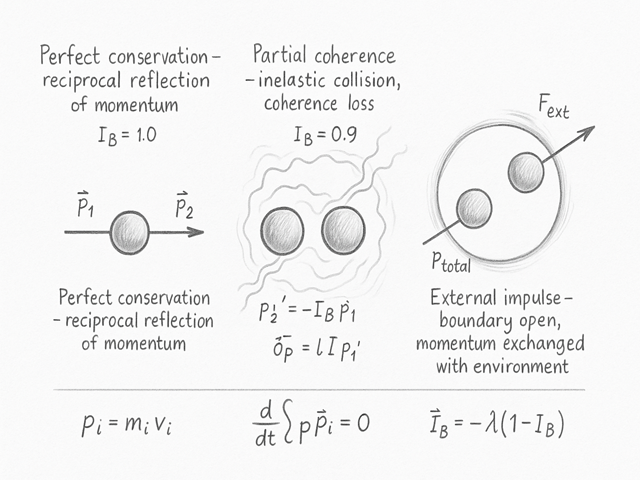
  - **Visualization:** draw two colliding spheres — equal and opposite momenta for IB = 1; partial overlap and smaller reflected vectors for IB < 1.
  - **Applications:** collision dynamics, rocket propulsion, recoil systems, plasma interactions, astrophysical conservation of momentum.
Overview

The conservation of momentum is the law of reciprocal memory — the assurance that when one body changes its motion, another changes in equal and opposite measure.
In classical form, it states that within a closed system with no external forces, total momentum remains constant:

$$ \sum_i \mathbf{p}_i = \text{constant}, \qquad \frac{d}{dt}\sum_i \mathbf{p}_i = 0. $$

In coherence terms, it represents the continuity of curvature exchange between interacting boundaries.
When coherence is perfect (IB=1I_B = 1), the field transmits momentum flawlessly — no loss, no delay, no asymmetry.
When coherence is partial (IB<1I_B < 1), the exchange becomes imbalanced — energy leaks into other modes (heat, deformation, radiation), and momentum symmetry fades.


🔹 1. Classical Momentum and System Closure
For each body:

$$ \mathbf{p}_i = m_i \mathbf{v}_i, \qquad \mathbf{F}_i = \frac{d\mathbf{p}_i}{dt}. $$

In a closed system, all internal forces are paired:

$$ \sum_i \mathbf{F}_i = 0. $$

Hence,

$$ \frac{d}{dt}\sum_i \mathbf{p}_i = 0. $$

and total momentum is conserved.

This expresses Newton’s Third Law at the system level —
each action and reaction cancel as equal and opposite curvature flows, leaving the total geometry unchanged.


🔸 2. Coherence and Momentum Flow

In coherence geometry, momentum is a boundary flow of curvature — the directional memory of energy within a system.
When two bodies interact, momentum is exchanged through their shared boundary; energy and curvature reflect symmetrically.
This reflection is governed by the boundary coherence index IBI_B:

$$ \mathbf{p}_2' = -\,I_B\,\mathbf{p}_1'. $$

  • IB=1I_B = 1: perfect reflection — momentum transfer complete and symmetric.
  • IB<1I_B < 1: partial reflection — part of the curvature energy absorbed or dissipated.
  • IB=0I_B = 0: full absorption — momentum destroyed locally but conserved globally (as internal excitation or heat)

Thus, momentum conservation describes how energy and curvature redistribute within a boundary memory, not merely a transfer of “mass × velocity.”


🔹 3. Elastic and Inelastic Coherence
Interaction TypeCoherence (IB)BehaviourExample
Elastic
𝐼 𝐵 = 1
Perfect momentum
and energy reflection
Ideal collision,
photon recoil
Inelastic

0 < 𝐼 𝐵 < 1

Partial energy retention,
some loss to
deformation or heat

Real material collision
Dissipative

𝐼 𝐵 → 0 

Total momentum
asymmetry, energy
lost to field
Absorptive impact
or radiation

Elastic interactions preserve total field coherence — every impulse mirrored in equal curvature.
Inelastic interactions show how partial coherence breaks symmetry yet still respect global conservation through redistribution.


🔸 4. External Impulse and Open Systems

If an external force acts on the system, momentum changes by impulse:

$$ \Delta \mathbf{p}_{\mathrm{total}} = \int \mathbf{F}_{\mathrm{ext}}\,dt. $$

This opens the boundary — coherence is no longer closed, and total system momentum shifts.
However, the underlying field remains conservative: the external region absorbs the counter-momentum.
Momentum is never destroyed — it simply leaves one coherence loop to join another.


🔹 5. Feedback Law for Coherence Decay

Loss of coherence corresponds to gradual relaxation of boundary alignment:

$$ \dot{I}_B = -\lambda(1 - I_B). $$

As coherence fades, the reciprocal symmetry between interacting bodies weakens — momentum exchange becomes less instantaneous.
This is the physical root of drag, viscosity, and radiative recoil:
momentum is still conserved, but redistributed across temporal feedback delay.


🧠 Summary

The Law of Conservation of Momentum is the geometry of perfect feedback.
It is not a coincidence of forces, but a continuity of curvature:
energy flowing across boundaries while preserving the total coherence of spac

  • Action–reaction symmetry ensures closed curvature.
  • Coherence (IB) determines how perfectly that curvature reflects.
  • Loss becomes curvature absorbed — not disappearance, but diffusion of memory.

Momentum conservation, in the HST sense, is the reciprocal memory of motion —
the universe remembering every interaction it performs.
No motion is lost; it is only rephrased — another boundary, another echo of coherence.


Related Chapters
Kireth Research
38 Thorndale Croft, Wetwang, Driffield
East Riding of Yorkshire YO25 9XZ
Designed By