
Chapter 20
Lenz Law — Opposing Feedback

Field and Energy Systems
Author: Mark Anthony Higgins
© Mark Anthony Higgins 11 October 2025
Revised Date: 23 February 2026
Audio Overview
Flow Algebra
flow "LenzLaw_OpposingFeedback"

# ---------- STATES ----------
state:
  field.B: vec[float,3]                  # magnetic flux density (T)
  field.E: vec[float,3]                  # induced electric field (V/m)
  magnetic.flux.ΦB: float                # magnetic flux through a loop (Wb)
  emf.ℰ: float                           # electromotive force (V)
  current.I: float                       # induced current (A)
  resistance.R: float                    # circuit resistance (Ω)
  inductance.L: float                    # self-inductance (H)
  induced.flux.Φind: float               # induced opposing flux (Wb)
  direction.sense: str                   # "oppose" | "assist"
  energy.stored.U: float                 # magnetic energy stored (J)
  feedback.sign: float                   # +1 assist, -1 oppose
  coherence.integrity: float             # 0..1 (1 = perfect self-regulation)
  boundary.integrity: float              # field-boundary coherence (0..1)
  poynting.vector.S: vec[float,3]        # local energy flux (W/m^2)
  curvature.tension.Σ: float             # curvature tension density (J/m^3)
  time.t: float

# ---------- PARAMETERS ----------
params:
  μ0: 4π×10^-7
  ε0: 8.854e-12
  dt: float
  k_coh: float                           # curvature–coherence coupling
  sign_rule: -1                          # Lenz feedback constant

# ---------- INVARIANTS ----------
invariant:
  - Faraday law (integral): ℰ = - dΦB/dt
  - Induced current: I = ℰ / R
  - Opposing field: Φind = L I
  - Net flux: Φ_total = ΦB + Φind
  - Magnetic energy: U = ½ L I²
  - Power balance: ℰ I = dU/dt + I²R
  - Feedback condition: feedback.sign = -sign(dΦB/dt)
  - Coherence continuity: ∂μ J^μ_coh = 0 ↔ energy + curvature balance
  - Coherence integrity → 1 when induced curvature exactly cancels driver curvature
  - In HST form: curvature feedback opposes field change to preserve Σ_total constant

# ---------- TRANSFORMS ----------
transform:

  initialise_circuit:
    do:
      field.B = [0,0,1e-3]
      ΦB = surface_integral(field.B, loop_area=A)
      current.I = 0
      resistance.R = 10.0
      inductance.L = 2.0e-3
      coherence.integrity = 0.995
      boundary.integrity = 0.995
      time.t = 0

  compute_induced_emf:
    do:
      dΦ_dt = rate_of_change(magnetic.flux.ΦB, time.t)
      emf.ℰ = - dΦ_dt                      # Faraday’s sign rule
      feedback.sign = -sign(dΦ_dt)

  update_induced_current:
    do:
      current.I = emf.ℰ / resistance.R
      induced.flux.Φind = inductance.L * current.I
      direction.sense = "oppose" if feedback.sign < 0 else "assist"
      field.E = induced_field(loop_geometry(), emf.ℰ)
      update_energy_balance()

  update_energy_balance:
    do:
      energy.stored.U = 0.5 * inductance.L * current.I**2
      power_input = emf.ℰ * current.I
      dissipation = current.I**2 * resistance.R
      curvature.tension.Σ = params.k_coh * energy.stored.U
      coherence.integrity = 1 - abs(dΦ_dt) / (abs(dΦ_dt) + curvature.tension.Σ)
      boundary.integrity -= small_radiative_loss(poynting.vector.S)

  update_poynting_flux:
    do:
      poynting.vector.S = (1/params.μ0) * cross(field.E, field.B)
      if dot(poynting.vector.S, normal_to_loop()) < 0:
        mark("energy_return")
      else:
        mark("radiative_loss")

  tick:
    do:
      time.t += params.dt

# ---------- MONITORS ----------
monitor:
  emf_vs_flux:
    observe: [emf.ℰ, magnetic.flux.ΦB, induced.flux.Φind]
    report: "Verifies ℰ = −dΦB/dt and Φind opposes ΦB (Lenz rule)."

  current_feedback:
    observe: [current.I, feedback.sign, direction.sense]
    report: "Tracks induced current direction; always opposes change in flux."

  energy_flow:
    observe: [energy.stored.U, poynting.vector.S]
    report: "Monitors energy storage in inductance and flux exchange with field."

  coherence_health:
    observe: [coherence.integrity, boundary.integrity]
    report: "Integrity → 1 for perfect feedback; deviation implies radiative or resistive loss."

# ---------- NOTES (coherence view) ----------
note:
  - Lenz’s Law expresses **negative feedback in coherence curvature**: the induced field always forms to oppose the cause of flux change.
  - It is a law of **coherence conservation**, not resistance: the field acts to stabilise total curvature tension Σ.
  - In HST, the induced EMF is the **phase recoil** of boundary coherence when curvature shifts; the minus sign encodes geometric self-regulation.
  - Energy stored in an inductor is curvature tension confined in a looped coherence path: U = ½ L I².
  - The Poynting vector shows how curvature energy circulates between field and boundary: when Σ changes, energy is exchanged, not lost.
  - Perfect feedback (I = 1) maintains equilibrium; imperfect feedback (I < 1) radiates tension as electromagnetic waves.
  - Thus, Lenz’s Law is the **field-level manifestation of universal coherence feedback** — geometry ensuring stability by opposing its own imbalance.
What this flow captures

LenzLaw_OpposingFeedback explains the principle of electromagnetic self-regulation — how the universe prevents runaway curvature by inducing equal and opposite coherence.
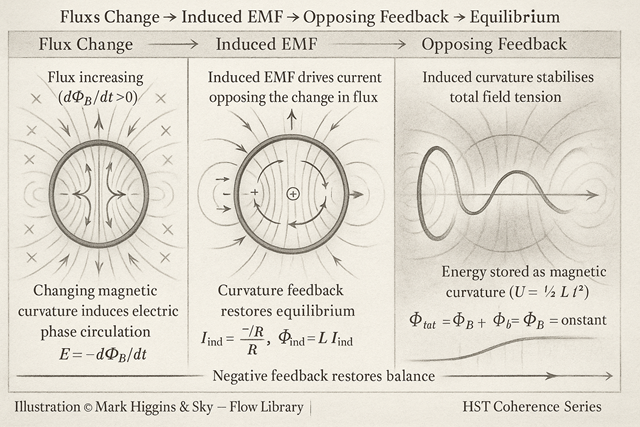
In classical physics, Lenz’s Law states that the induced current opposes the change in magnetic flux that created it.
In HST, this becomes a statement about curvature feedback:
the field induces an equal and opposite phase shift to preserve overall coherence tension.

No field change can occur without the geometry creating its own restoring reaction.
Lenz’s Law is therefore the operational form of the universe’s deeper rule:

Coherence resists distortion.


Core intuition (HST view)

In electromagnetic terms:

\[ \mathcal{E} = -\,\frac{d\Phi_{B}}{dt}\,. \]

The negative sign expresses nature’s built-in feedback — a law of coherence, not of opposition.
It says: whenever curvature tension (magnetic flux) changes, the boundary generates a counterflow of phase (electric EMF) that restores equilibrium.

In geometric language:

  • Magnetic flux (Φ₍B₎) is the curvature field’s stored tension.
  • Electric circulation (E-field) is the phase adjustment that restores balance.
  • The minus sign is not arbitrary — it encodes the feedback loop geometry: the induced curvature must rotate back into phase alignment.
  • Lenz’s Law is therefore the local conservation of coherence, ensuring that total curvature energy remains stationary under change.

Mathematical structure

From Faraday’s law:

\[ \oint_{C} \mathbf{E} \!\cdot\! d\mathbf{l} = -\,\frac{d\Phi_{B}}{dt}\,. \]

Induced EMF:

\[ \mathcal{E} = -\,\frac{d\Phi_{B}}{dt}\,. \]

Induced current:

\[ I = \frac{\mathcal{E}}{R}, \qquad \Phi_{\mathrm{ind}} = L I, \qquad \Phi_{\mathrm{total}} = \Phi_{B} + \Phi_{\mathrm{ind}}\,. \]

Power and energy:

\[ \mathcal{E} I = \frac{dU}{dt} + I^{2}R, \qquad U = \tfrac{1}{2} L I^{2}\,. \]

The curvature feedback term L  stores magnetic energy as looped coherence — the field’s self-memory of its motion.
Energy does not vanish or appear spontaneously; it moves between curvature, boundary, and phase, preserving total coherence.


Interpretation in coherence physics
Classical conceptHST reinterpretation
Magnetic flux change
Variation in curvature tension (Σ)
Induced EMF
Restoring phase curvature opposing distortion
Induced current
Flow of coherence restoring equilibrium

Stored field energy \( U = \tfrac{1}{2} L I^{2} \)

Curvature tension trapped in a closed phase loop
Minus sign in EMF
Geometric feedback
field curvature correcting its own displacement
Resistance
Boundary dissipation
(coherence loss through heat or radiation)

Thus, Lenz’s Law is a stabilisation principle — curvature geometry ensuring the total coherence field remains self-consistent under transformation.


Boundary coherence and feedback

When the magnetic flux through a loop changes, the field’s boundary coherence momentarily shifts.
The induced EMF appears as a curvature recoil — a redistribution of phase alignment that resists the flux variation.
The faster the flux changes, the stronger the restoring field.

Boundary integrity II measures how well the feedback closes:

  • \( I = 1:\; \text{perfect feedback — induced field cancels exactly, system fully reversible.} \)
  • \( I < 1:\; \text{partial feedback — energy imbalance radiates outward as electromagnetic waves.} \)

At equilibrium, the boundary ensures that

\[ \partial_{\mu} J^{\mu}_{\mathrm{coh}} = 0\,. \]

maintaining coherence continuity through self-correction.


Energy and feedback flow

The magnetic energy stored in an inductor:

\[ U = \tfrac{1}{2}\,L\,I^{2}\,. \]

is curvature energy held in rotational form.
When current changes, this energy feeds back into the system as an opposing EMF, slowing the change.
This inertial behaviour of fields is the electromagnetic analogue of curvature inertia — geometry’s reluctance to alter its own phase structure.

The Poynting vector

\[ \mathbf{S} = \frac{1}{\mu_{0}}\,(\mathbf{E} \times \mathbf{B})\,. \]

shows how energy circulates: during field collapse, energy flows back into the circuit; during excitation, energy enters the field.
No energy is lost in the ideal case — it merely rotates between curvature forms.


Unified geometric interpretation
  • Curvature seeks phase equilibrium: whenever it changes, it induces an opposite twist to stabilise.
  • Opposing EMF is the language of feedback, not resistance.
  • Field energy is stored curvature tension; inductance measures how much curvature a boundary can contain per unit current.
  • Coherence continuity ensures reversibility: fields cannot break coherence; they can only reorient it.

Lenz’s Law is thus the electromagnetic expression of a universal rule of geometry:

Every change in curvature creates its own correction.


Philosophical coherence

Lenz’s Law reveals the ethical structure of physics — every action generates a restoring symmetry.
The universe doesn’t resist change to punish it; it does so to preserve coherence.
Energy feedback is the physical manifestation of that deeper truth:
geometry remembers its balance and corrects itself through motion.

The minus sign of induction is the mark of memory in the field —
the universe refusing to forget its equilibrium.


Significance

This flow closes the electromagnetic cycle begun with Faraday and Ampère.
It demonstrates that induction is not just causal but coherent:
curvature self-regulates to maintain equilibrium across boundary changes.

The “opposing EMF” is not friction or delay — it is the geometry’s way of ensuring conservation of coherence.
Lenz’s Law is, therefore, the local rule of global stability — the feedback system that lets energy move while keeping the universe in balance.


In essence

The field resists not out of opposition, but remembrance.
Curvature opposes its own imbalance so coherence can remain whole.
Lenz’s Law is the minus sign of memory written into the language of motion.

Kireth Research
38 Thorndale Croft, Wetwang, Driffield
East Riding of Yorkshire YO25 9XZ
Designed By