Chapter 7
Expansion Flows and Boundary Tension
Cosmological and Global Coherence
Author: Mark Anthony Higgins
© Mark Anthony Higgins 11 October 2025
Revised Date: 23 February 2026
flow "ExpansionFlows_BoundaryTension"
# ---------- STATES ----------
state:
# geometry / kinematics
scale.a: float # scale factor (a=1 at reference epoch)
hubble.H: float # expansion rate (1/s)
decel.q: float # deceleration parameter
curvature.K: float # normalized spatial curvature (+1,0,-1 analogue)
conformal.η: float # conformal time
# boundary coherence & tension
boundary.integrity: float # 0..1 (1 = perfectly coherent global boundary)
tension.Σ: float # global boundary tension density (J/m^3)
release.rate: float # coherence release rate → drives expansion (J/m^3/s)
release.mode: str # "smooth" | "pulse" | "phase_transition"
# energy components (co-moving densities)
rho.m: float # matter (dust)
rho.r: float # radiation
rho.coh: float # coherence-release reservoir (dark-energy analogue)
p.m: float # pressure of matter (≈0)
p.r: float # radiation pressure (= rho.r/3)
p.coh: float # effective pressure of coherence channel (w≈-1 + δw)
# equation-of-state bookkeeping
w.m: float # 0
w.r: float # 1/3
w.coh: float # ≈ -1 + ε
total.rho: float
total.p: float
# perturbations (coarse)
delta_m: float # linear matter contrast
growth.f: float # d ln delta_m / d ln a
# time
time.t: float
# ---------- PARAMETERS ----------
params:
c: 2.998e8
G: 6.674e-11
k_coh: float # converts integrity deficit → tension (J/m^3)
k_rel: float # converts tension change → release.rate
ε_w: float # small deviation from -1 in w.coh
K0: float # initial curvature sign/scale normalisation
a_ref: float # reference scale (often 1.0)
dt: float
# ---------- INVARIANTS ----------
invariant:
# HST–Friedmann mapping (coherence form). The “coherence curvature” term plays Λ-role.
- hubble.H^2 = (8π*G/3) * (rho.m + rho.r + rho.coh) - (curvature.K * params.c^2) / scale_radius(scale.a)^2
- total.rho = rho.m + rho.r + rho.coh
- total.p = p.m + p.r + p.coh
- w.m = 0, w.r = 1/3, w.coh ≈ -1 + params.ε_w
- energy exchange only via release.rate between Σ (tension store) and rho.coh (reservoir)
- boundary.integrity ∈ [0,1]; lower integrity → higher release.rate
- matter/radiation continuity in comoving volume:
d(rho.m)/dt = -3*hubble.H*rho.m
d(rho.r)/dt = -4*hubble.H*rho.r
- coherence reservoir continuity with source:
d(rho.coh)/dt = -3*hubble.H*(1 + w.coh)*rho.coh + release.rate
# ---------- TRANSFORMS ----------
transform:
initialise_cosmos:
do:
scale.a = params.a_ref
curvature.K = params.K0
boundary.integrity = 0.995 # near-perfect early symmetry
tension.Σ = k_coh_to_sigma(boundary.integrity, params.k_coh)
w.coh = -1 + params.ε_w
rho.m, rho.r, rho.coh = seed_densities()
p.m = w.m * rho.m; p.r = w.r * rho.r; p.coh = w.coh * rho.coh
hubble.H = compute_H(rho.m, rho.r, rho.coh, curvature.K, scale.a, params)
time.t = 0; conformal.η = 0
delta_m = 1e-5
update_tension_and_release:
do:
# integrity drift (e.g., global strain, topology updates)
boundary.integrity = clamp(boundary.integrity + integrity_drift(), 0, 1)
tension.Σ = k_coh_to_sigma(boundary.integrity, params.k_coh)
release.rate = params.k_rel * max(Σ_deficit_rate(tension.Σ), 0)
if release.mode == "pulse" and trigger_phase_event():
release.rate += pulse_injection()
elif release.mode == "phase_transition" and crossing_threshold(boundary.integrity):
release.rate += latent_release(tension.Σ)
continuity_update:
do:
# standard redshifting
rho.m += (-3*hubble.H*rho.m) * params.dt
rho.r += (-4*hubble.H*rho.r) * params.dt
# coherence reservoir with source
rho.coh += (-3*hubble.H*(1 + w.coh)*rho.coh + release.rate) * params.dt
# pressures
p.m = w.m * rho.m; p.r = w.r * rho.r; p.coh = w.coh * rho.coh
update_H_q_a:
do:
hubble.H = compute_H(rho.m, rho.r, rho.coh, curvature.K, scale.a, params)
# Raychaudhuri (coherence form)
adot = hubble.H * scale.a
ddota = - (4π*G/3) * scale.a * (total.rho + 3*total.p/params.c^2) + coh_backreaction(release.rate)
decel.q = - (scale.a * ddota) / (adot^2 + 1e-30)
# advance scale
scale.a += adot * params.dt
conformal.η += params.c * params.dt / max(scale.a,1e-12)
perturbation_growth:
do:
# simple linear growth in Λ/DE background (fits well for f ≈ Ω_m^γ)
Ωm = rho.m / max(total.rho,1e-30)
growth.f = Ωm^0.55
delta_m += growth.f * delta_m * (adot_over_a(scale.a, hubble.H)) * params.dt
tick:
do:
time.t += params.dt
# ---------- MONITORS ----------
monitor:
hubble_track:
observe: [hubble.H, scale.a, decel.q]
report: "Expansion rate, scale factor, and deceleration parameter over time."
tension_budget:
observe: [boundary.integrity, tension.Σ, release.rate, rho.coh]
report: "How integrity loss converts boundary tension into a coherence reservoir (DE analogue)."
density_fractions:
observe: [rho.m, rho.r, rho.coh]
report: "Tracks Ω_m, Ω_r, Ω_coh and their redshift scaling."
curvature_health:
observe: [curvature.K]
report: "Flatness/stability check; small |K| indicates near-critical global coherence."
growth_monitor:
observe: [delta_m, growth.f]
report: "Structure growth under a tension-driven expansion background."
# ---------- NOTES (coherence view) ----------
note:
- Expansion is a **release of global boundary tension**: as integrity falls, stored curvature relaxes outward, increasing a(t).
- The **coherence reservoir** ρ_coh acts like dark energy: nearly constant density with w ≈ -1, sourced by release.rate from Σ.
- Matter and radiation redshift normally (a^-3, a^-4); the reservoir dilutes weakly per its w and is replenished by tension release.
- The Raychaudhuri term shows acceleration when (ρ + 3p/c^2) becomes negative due to the reservoir’s pressure (w < -1/3).
- Curvature K is the large-scale imprint of boundary geometry; near-zero K corresponds to near-critical global coherence.
- Pulsed or transition modes in release.rate capture epochs like inflation bursts or late-time acceleration onsets.
- In the perfect-coherence limit (integrity → 1, release.rate → 0), ρ_coh → const baseline and expansion slows toward matter/radiation behaviour.
- Energy is not created; **boundary tension Σ → reservoir ρ_coh** via release.rate, which then does global p dV work as a(t) grows.
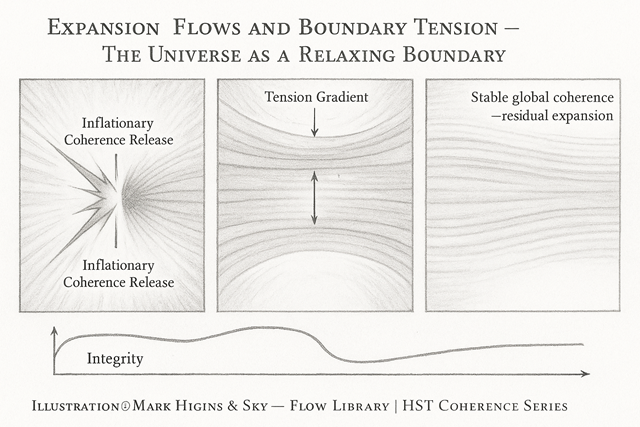
ExpansionFlows_BoundaryTension reinterprets cosmic expansion as a coherence-driven release process rather than an unexplained metric stretching.
In the HST framework, the universe is a single dynamic boundary — a coherent curvature field under internal tension.
As global integrity relaxes, stored curvature tension is released outward, generating the observed expansion of space.
This flow replaces the cosmological constant and scalar inflaton with a unified geometric process:
the continuous or episodic release of boundary tension that maintains overall coherence while changing the curvature distribution of the universe.
The resulting dynamics reproduce the Friedmann and Raychaudhuri equations — but with physical meaning restored to the “dark energy” term as coherence release energy rather than vacuum energy density.
In the standard model of cosmology, the scale factor expands under an energy density composed of matter, radiation, and a cosmological constant .
However, in coherence physics, the quantity represented by is not a property of the vacuum — it is the rate at which boundary coherence relaxes.
The universe’s total curvature is encoded on a global boundary.
When this boundary’s integrity (its internal coherence alignment) is perfect, curvature is static and no expansion occurs.
When coherence begins to slip — whether from early strain, temperature, or topology drift — the boundary’s stored tension releases as field expansion.
That release appears as accelerated expansion: a cosmic-scale rebalancing of curvature.
In this picture:
The flow is fully consistent with the Friedmann framework, rewritten in coherence form:
\[ H^{2} = \frac{8\pi G}{3}\,\big(\rho_{m}+\rho_{r}+\rho_{\mathrm{coh}}\big) - \frac{K\,c^{2}}{a^{2}} \,. \]
Where \[ \rho_{\mathrm{coh}} \ \text{is the \emph{coherence–release reservoir}, equivalent in form to dark energy,} \] \[ \text{but dynamically fed by the tension–release rate } \dot{\Sigma}. \]
The pressure of this reservoir is defined by its effective equation of state:
\[ p_{\mathrm{coh}} = w_{\mathrm{coh}}\,\rho_{\mathrm{coh}}, \qquad w_{\mathrm{coh}} \approx -1 + \varepsilon. \]
so that when coherence release is nearly constant, reproduces observed acceleration.
Energy continuity equations are modified by the source term:
\[ \dot{\rho}_{\mathrm{coh}} + 3H(1 + w_{\mathrm{coh}})\,\rho_{\mathrm{coh}} = \dot{\Sigma}. \]
where ˙ converts curvature tension into the coherence reservoir — the universe’s internal energy store for expansion.
| Conventional Term | HST Interpretation |
|---|---|
|
Space-time expansion
|
Global boundary relaxation
|
|
Cosmological constant (Λ)
|
Mean tension-release rate of curvature field
|
|
Inflation
|
Rapid coherence equalisation pulse
|
|
Dark energy
|
Stored curvature resonance maintaining boundary smoothness
|
|
Flatness
|
Balanced global coherence (K ≈ 0)
|
|
Accelerated expansion
|
Dominance of coherence-release term over matter term
|
Thus, the universe expands not because “space stretches” but because curvature rebalances — tension transforms into motion while preserving total coherence energy.
At early times, boundary integrity was near unity: the universe’s curvature field was taut and uniform.
Small fluctuations in integrity produced enormous energy gradients, leading to a burst of expansion — the inflationary pulse.
As expansion proceeded, boundary tension relaxed, producing the slower, steady release we observe as the Λ-like epoch today.
Over time:
| Variable | Meaning | HST role |
|---|---|---|
|
\( a(t) \)
|
Scale factor
|
Measure of released curvature extent
|
|
\( H(t) \)
|
Expansion rate
|
Temporal derivative of global coherence relaxation
|
|
\( \Sigma \)
|
Boundary tension density
|
Stored curvature energy per unit area
|
|
\( \rho_{\mathrm{coh}} \)
|
Coherence reservoir
|
Dynamic energy density of released curvature
|
|
\( q \)
|
Deceleration parameter
|
Indicator of curvature–pressure balance
|
|
\( K \)
|
Spatial curvature
|
Global coherence deviation from flatness
|
|
\( w_{\mathrm{coh}} \)
|
Effective equation-of-state parameter
|
Maps integrity loss rate to curvature release pressure
|
To reproduce observed cosmic behaviour:
\[ \Omega_{m} \approx 0.3, \qquad \Omega_{\mathrm{coh}} \approx 0.7, \qquad \Omega_{K} \approx 0. \]
matching Planck-era cosmological data — but derived from boundary logic, not arbitrary constants.
This flow demonstrates that cosmic expansion and acceleration arise naturally from the internal dynamics of coherence, without invoking an independent cosmological constant or exotic vacuum energy.
It completes the symmetry of HST cosmology: gravity contracts curvature locally; coherence release expands it globally.
Both are expressions of the same principle — curvature tension seeking equilibrium.
The HST model thereby unifies gravitation and cosmic expansion under one rule:
What gravity binds in local coherence, expansion releases in global coherence.
The universe does not expand into nothing — it relaxes into balance.
Cosmic acceleration is the breath of geometry itself: boundary tension easing across the infinite curvature of time.