Chapter 8
Dark Energy as Global Coherence Release
Cosmological and Global Coherence
Author: Mark Anthony Higgins
© Mark Anthony Higgins 11 October 2025
Revised Date: 23 February 2026
flow "DarkEnergy_GlobalCoherenceRelease"
# ---------- STATES ----------
state:
scale.a: float # cosmological scale factor
hubble.H: float # expansion rate (1/s)
decel.q: float # deceleration parameter
curvature.K: float # spatial curvature parameter
boundary.integrity: float # 0..1, global coherence measure
tension.Σ: float # boundary tension density (J/m³)
release.rate: float # dΣ/dt, coherence release rate (J/m³/s)
reservoir.ρcoh: float # coherence energy density (dark energy analogue)
reservoir.pcoh: float # coherence pressure (J/m³)
w.coh: float # equation-of-state parameter (≈ -1 + ε)
energy.m: float # matter density (J/m³)
energy.r: float # radiation density (J/m³)
total.energy: float
total.pressure: float
time.t: float
# ---------- PARAMETERS ----------
params:
G: 6.674e-11
c: 2.998e8
ħ: 6.582e-22
k_coh: float # curvature-coherence constant
k_rel: float # rate constant converting tension loss → energy reservoir
ε_w: float # deviation from -1
integrity.threshold: float # below which release dominates
dt: float
# ---------- INVARIANTS ----------
invariant:
- total.energy = energy.m + energy.r + reservoir.ρcoh
- total.pressure = (1/3)*energy.r + w.coh*reservoir.ρcoh
- hubble.H² = (8πG/3)(total.energy) - (curvature.K*c²)/(scale.a²)
- reservoir.pcoh = w.coh * reservoir.ρcoh
- w.coh ≈ -1 + params.ε_w
- d(reservoir.ρcoh)/dt = -3*hubble.H*(1 + w.coh)*reservoir.ρcoh + release.rate
- release.rate = params.k_rel * (1 - boundary.integrity) * tension.Σ
# ---------- TRANSFORMS ----------
transform:
initialise_field:
do:
scale.a = 1.0
curvature.K = 0.0
boundary.integrity = 0.995
tension.Σ = params.k_coh * (1 - boundary.integrity)
w.coh = -1 + params.ε_w
energy.m = seed_matter_density()
energy.r = seed_radiation_density()
reservoir.ρcoh = tension_to_reservoir(tension.Σ)
reservoir.pcoh = w.coh * reservoir.ρcoh
hubble.H = sqrt((8π*params.G/3)*(energy.m + energy.r + reservoir.ρcoh))
decel.q = -1.0
time.t = 0.0
compute_release_rate:
do:
release.rate = params.k_rel * (1 - boundary.integrity) * tension.Σ
tension.Σ = max(tension.Σ - release.rate*params.dt, 0)
if boundary.integrity < params.integrity.threshold:
boundary.integrity += small_recovery(params.dt)
reservoir.ρcoh += release.rate * params.dt
evolve_densities:
do:
energy.m += (-3*hubble.H*energy.m)*params.dt
energy.r += (-4*hubble.H*energy.r)*params.dt
reservoir.ρcoh += (-3*hubble.H*(1 + w.coh)*reservoir.ρcoh + release.rate)*params.dt
reservoir.pcoh = w.coh * reservoir.ρcoh
update_geometry:
do:
hubble.H = sqrt((8π*params.G/3)*(energy.m + energy.r + reservoir.ρcoh))
adot = hubble.H * scale.a
ddota = - (4π*params.G/3) * scale.a * ( (energy.m + 2*energy.r) + (1 + 3*w.coh)*reservoir.ρcoh )
decel.q = - (scale.a * ddota) / (adot² + 1e-30)
scale.a += adot * params.dt
tick:
do:
time.t += params.dt
# ---------- MONITORS ----------
monitor:
coherence_balance:
observe: [boundary.integrity, tension.Σ, release.rate, reservoir.ρcoh]
report: "Tracks conversion of boundary tension into the coherence reservoir driving expansion."
acceleration_state:
observe: [scale.a, hubble.H, decel.q]
report: "Expansion accelerates when coherence pressure dominates total curvature tension."
density_fractions:
observe: [energy.m, energy.r, reservoir.ρcoh]
report: "Shows evolving energy balance (Ω_m, Ω_r, Ω_coh) during global coherence release."
equation_of_state:
observe: [w.coh, reservoir.pcoh]
report: "Confirms near-vacuum pressure (w ≈ -1 + ε) and slow energy dilution."
# ---------- NOTES (coherence view) ----------
note:
- Dark energy is reinterpreted as the **global release of curvature coherence** stored within the cosmic boundary.
- The universe’s boundary has finite tension Σ that relaxes over time; its release powers expansion.
- The effective pressure p_coh = w_coh ρ_coh emerges from the curvature field’s resistance to total relaxation.
- w_coh ≈ -1 means nearly constant energy density, sustaining continuous acceleration.
- The reservoir ρ_coh is replenished by release.rate = k_rel(1 - integrity)Σ, linking boundary strain directly to expansion energy.
- When integrity approaches threshold (~0.995), release stabilises and the expansion rate asymptotes to a constant (de Sitter–like state).
- Unlike ΛCDM, this mechanism requires no fixed cosmological constant; it is **self-regulating**: the universe expands until coherence tension balances curvature strain.
- In the early universe, release.mode may have pulsed → inflation; today, it flows steadily → dark energy.
- Energy conservation holds: tension Σ decays into ρ_coh; expansion performs p dV work while maintaining total coherence.
DarkEnergy_GlobalCoherenceRelease redefines dark energy as a geometric consequence of coherence relaxation — not a mysterious fluid or cosmological constant, but the natural release of stored curvature tension within the universe’s boundary field.
In this view, cosmic acceleration is the breathing of geometry: energy once bound in curvature slowly relaxing into expansion.
This flow formalises that process through a continuity system where global boundary tension (Σ) converts into a coherence reservoir (ρ₍coh₎) that drives large-scale acceleration.
The equation-of-state parameter arises directly from the near-constant rate of this release — not from an imposed vacuum term, but from a self-regulating feedback between coherence, curvature, and expansion.
In the HST framework, the universe is not a container of energy — it is the coherence field itself.
Curvature tension represents the stored strain of maintaining global structure.
When coherence relaxes, that strain is released outward as field expansion.
What general relativity describes as an “accelerating scale factor” is, in coherence geometry, the redistribution of curvature energy through boundary release.
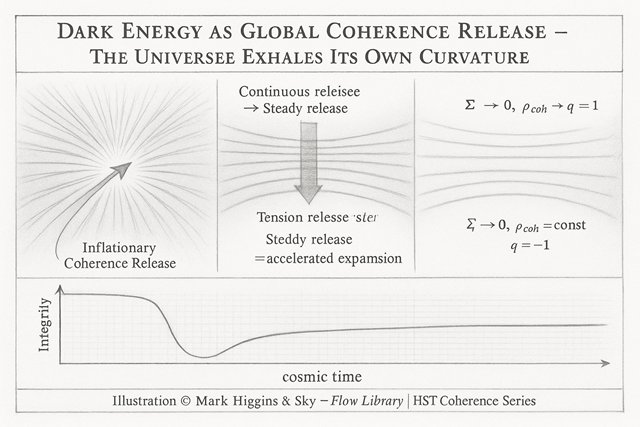
In the early universe, coherence release was rapid and violent — inflation.
Today, it continues softly and steadily — dark energy.
The same mechanism underlies both epochs: curvature tension easing toward equilibrium.
Where classical physics introduces a cosmological constant Λ to keep the equations balanced, HST shows that Λ is simply the steady-state form of global coherence release — Σ˙.
As long as Σ decays at a roughly constant rate, ρ₍coh₎ remains nearly constant, producing sustained acceleration.
\[ \dot{\rho}_{\mathrm{coh}} + 3H(1 + w_{\mathrm{coh}})\,\rho_{\mathrm{coh}} = \dot{\Sigma}. \]
where the right-hand term Σ ˙ supplies the coherence reservoir with energy released from boundary tension.
\[ p_{\mathrm{coh}} = w_{\mathrm{coh}}\,\rho_{\mathrm{coh}}, \qquad w_{\mathrm{coh}} \approx -1 + \varepsilon. \]
so that a nearly constant ρ₍coh₎ yields negative pressure, accelerating the expansion via the Friedmann term:
\[ H^{2} = \frac{8\pi G}{3}\,\big(\rho_{m} + \rho_{r} + \rho_{\mathrm{coh}}\big) - \frac{K\,c^{2}}{a^{2}}\,. \]
The coherence field thus mimics a cosmological constant when release is steady (Σ˙≈const.), but naturally decays if boundary integrity recovers.
| Concept | Conventional cosmology | HST coherence interpretation |
|---|---|---|
|
Dark energy
|
Vacuum energy density (Λ)
|
Stored curvature tension
released from the cosmic boundary |
|
Cosmological constant
|
Fixed geometric term
|
Constant-rate tension
release (steady relaxation) |
|
Inflation
|
Early fast coherence release
|
First global resonance discharge
|
|
Late-time acceleration
|
Residual release
|
Continuous relaxation toward equilibrium
|
|
Energy conservation
|
Vacuum energy problem
|
Tension Σ converts
into ρ₍coh₎, total energy conserved |
|
Flatness (K ≈ 0)
|
Fine-tuning
|
Global boundary coherence
balancing curvature gradients |
From this perspective, the accelerating expansion of the universe is not driven by a repulsive force, but by geometry exhaling — coherence letting go of its stored curvature.
The state variable boundary.integrity controls the strength of release:
The coherence reservoir (ρ₍coh₎) therefore behaves dynamically — replenished by Σ when the boundary relaxes, but not eternal.
Acceleration is a transient property of cosmic balance, not an inherent property of empty space.
\[ \Omega_{m} \approx 0.3, \qquad \Omega_{\mathrm{coh}} \approx 0.7, \qquad \Omega_{K} \approx 0. \]
These parameters yield H0≈70 km/s/Mpc without invoking Λ — the acceleration comes directly from coherence relaxation.
This flow completes the HST cosmological model:
where gravity arises from local curvature convergence (coherence contraction),
dark energy arises from global curvature relaxation (coherence release).
Both are dual manifestations of the same principle — the tendency of coherence to equalise curvature tension across all scales.
By reframing dark energy as a feedback process within the geometry itself, the universe becomes fully self-regulating: it expands not by command of a constant, but by its own search for balance.
Dark energy is not a force, but a sigh — the slow release of the universe’s own tension.
When geometry relaxes, expansion is its echo.
The cosmos is not driven outward by vacuum energy, but inwardly healed by coherence release.