Chapter 27
Carnot Cycle and Coherence Efficiency
Thermal and Entropic Flows
Author: Mark Anthony Higgins
© Mark Anthony Higgins 11 October 2025
Revised Date: 23 February 2026
flow "Carnot Cycle and Coherence Efficiency" v1.0
# ---------- PURPOSE ----------
# Models the ideal reversible Carnot cycle, extending it through HST coherence logic.
# Efficiency is interpreted as coherence retention — the fraction of boundary energy that
# remains phase-aligned between hot and cold reservoirs.
# ---------- PARAMETERS ----------
params:
units: "SI"
T_hot: positive # hot reservoir temperature [K]
T_cold: positive # cold reservoir temperature [K]
gamma: positive = 1.4 # heat capacity ratio (ideal-gas guide)
n: positive = 1.0 # moles of working substance
R: positive = 8.314462618
IB: 0.0..1.0 # boundary coherence index (1 = fully reversible)
include_adiabatic_checks: true
# ---------- STATE ----------
state WorkingFluid:
T: positive
p: positive
V: positive
S: real
U: real
state Reservoirs:
T_hot: params.T_hot
T_cold: params.T_cold
state Ports:
Qdot_hot: real # heat absorbed from hot reservoir
Qdot_cold: real # heat rejected to cold reservoir
Wdot_out: real # work output rate
sigma: nonneg # entropy production rate
# ---------- IDEAL CARNOT RELATIONS ----------
invariants:
# Reversible heat ratios
Q_hot / T_hot = Q_cold / T_cold
eta_carnot = 1 - (T_cold / T_hot)
# First law (power form)
ddt(WorkingFluid.U) = Ports.Qdot_hot + Ports.Qdot_cold - Ports.Wdot_out
# Entropy balance (perfect coherence)
if params.IB == 1:
Ports.Qdot_hot / T_hot + Ports.Qdot_cold / T_cold = 0
Ports.sigma = 0
# Coherence-adjusted entropy production (IB < 1)
if params.IB < 1:
Ports.sigma = (1 - params.IB) * abs(Ports.Qdot_hot / T_hot)
Ports.Qdot_cold / T_cold = - Ports.Qdot_hot / T_hot + Ports.sigma
# ---------- COHERENCE EFFICIENCY ----------
transforms:
# Coherence-based efficiency factor
eta_carnot = 1 - (params.T_cold / params.T_hot)
eta_coh = params.IB * eta_carnot
# Interpret eta_coh as the fraction of energy maintaining boundary coherence
Wdot_out = eta_coh * Ports.Qdot_hot
# Optional field guide (adiabatic compression/expansion)
if params.include_adiabatic_checks:
invariant: T * V^(params.gamma - 1) = const
# ---------- INVARIANT SET (SUMMARY) ----------
invariants summary:
eta_carnot = 1 - T_cold / T_hot
eta_coh = IB * eta_carnot
sigma = (1 - IB) * |Qdot_hot| / T_hot
# ---------- MONITORS ----------
monitors:
efficiency_bounds:
assert eta_coh <= eta_carnot + 1e-9
assert Ports.sigma >= 0
coherence_check:
log.debug = "IB = ${params.IB} → η_coh = ${round(eta_coh,4)}"
# ---------- SCENES ----------
scenes:
reversible_reference:
given params:
T_hot: 700.0
T_cold: 300.0
IB: 1.0
expect:
eta_coh = 1 - T_cold / T_hot
Ports.sigma = 0
comment: "Perfect coherence — reversible Carnot limit reached."
partial_coherence_example:
given params:
T_hot: 700.0
T_cold: 300.0
IB: 0.85
expect:
eta_coh = 0.85 * (1 - T_cold / T_hot)
Ports.sigma > 0
comment: "Entropy production reflects coherence loss."
# ---------- NOTES ----------
notes:
- In the classical Carnot cycle, reversibility means σ = 0 and efficiency depends only on T_hot/T_cold.
- In the coherence formulation, η is reduced by the boundary coherence factor IB.
- IB quantifies how faithfully energy phase is transferred between thermal boundaries.
- η_coh thus represents both thermodynamic and structural fidelity.
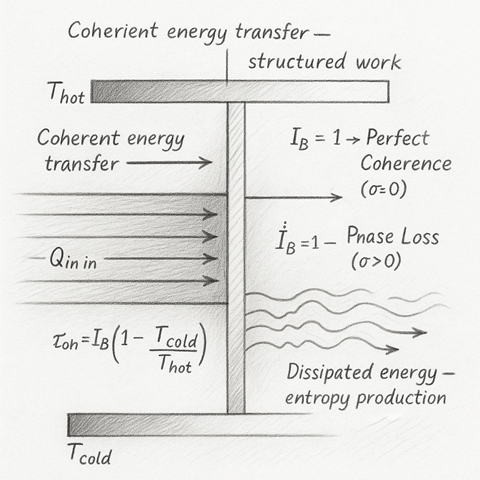
The Carnot cycle represents the theoretical limit of heat-to-work conversion — a perfectly reversible exchange between two temperature boundaries. In Flow Algebra form, it becomes the baseline coherence cycle, where every joule of energy remains phase-aligned between hot and cold reservoirs.
Efficiency is not just thermal here — it’s coherence efficiency, expressing how much of the boundary’s ordered tension survives without scattering
\(\eta_{\mathrm{Carnot}} = 1 - \tfrac{T_{\mathrm{cold}}}{T_{\mathrm{hot}}}, \quad \frac{T_{\mathrm{hot}}}{Q_{\mathrm{hot}}} = \frac{T_{\mathrm{cold}}}{Q_{\mathrm{cold}}}, \quad \sigma = 0.\)
These define the reversible ideal: no entropy generation () and perfect phase continuity between reservoirs.
Any deviation from this balance marks a loss of coherence — a physical signature of entropy in HST terms.
Holographic coherence reframes Carnot’s limit through the boundary coherence index .
It measures the fraction of energy that remains phase-matched across the boundary:
$$ \eta_{\mathrm{coh}} = I_B \left( 1 - \frac{T_{\mathrm{cold}}}{T_{\mathrm{hot}}} \right). $$
This simple multiplier extends Carnot efficiency into the real world, where geometry, material, and temporal mismatch introduce measurable coherence loss.
$$ \sigma = (1 - I_B)\, \frac{|\dot{Q}_{\mathrm{hot}}|}{T_{\mathrm{hot}}}. $$
linking entropy production directly to the degree of boundary misalignment.
Thus, entropy is not disorder, but a measurable curvature mismatch between coupled boundaries.
| Case | T hot (K) | T cold (K) | I B | ηcoh |
|---|---|---|---|---|
|
Ideal reversible
|
700
|
300
|
1.00
|
0.571
|
|
Moderate coherence
|
700
|
300
|
0.85
|
0.486
|
|
Low coherence
|
700
|
300
|
0.60
|
0.343
|
As \( I_B \) drops, the thermal gradient remains the same — yet less of that potential is realised as structured work.
The rest disperses as curvature noise (), measurable in the energy spectrum as broadband thermal radiation or surface scattering.
n HST terms, the Carnot boundary corresponds to zero differential curvature across the coherence membrane.
Work and heat become mirror flows across that surface: one structured, one distributed.
Reversibility is thus not a time symmetry, but a coherence symmetry — the moment when energy transfer preserves total phase integrity.
$$ \eta_{\mathrm{coh}} = I_B \left( 1 - \frac{T_{\mathrm{c}}}{T_{\mathrm{h}}} \right), \qquad \sigma = (1 - I_B)\, \frac{|\dot{Q}|}{T_{\mathrm{h}}}. $$
The classical Carnot cycle defines the thermal boundary of possibility.
The Coherence Carnot extends that line inward — into structure, timing, and phase fidelity.
It tells us that reversibility is not an absolute, but a function of how well a boundary remembers itself.
When , the system becomes its own memory — the true reversible state where energy, geometry, and information are one.