
Chapter 60
Born Rule and Measurement Collapse

Quantum Coherence and Boundary Systems
Author: Mark Anthony Higgins
© Mark Anthony Higgins 11 October 2025
Revised Date: 23 February 2026
Audio Overview
Flow Algebra
flow "Born Rule and Measurement Collapse" v1.0


# ---------- PURPOSE ----------
# Describes the Born rule and wavefunction collapse as boundary-driven coherence redistribution.
# In the HST–Flow framework, measurement is not destruction of superposition, but re-alignment of curvature coherence
# between the system and the measurement boundary.
# The Born rule |ψ|² represents the curvature density distribution — the stable weighting of coherence after realignment.

# ---------- PARAMETERS ----------
params:
  units: "SI"
  ħ: real = 1.054571817e-34      # reduced Planck constant [J·s]
  include_environment: bool = true
  IB: 0.0..1.0 = 1.0              # coherence index of the system (1 = full superposition)
  IM: 0.0..1.0 = 1.0              # coherence index of the measurement boundary
  λ_align: nonnegative = 0.0      # alignment rate constant [s^-1]
  dt: positive?                   # timestep [s]
  ψ: complex[]                    # system wavefunction across basis states
  φ: complex[]?                   # measurement operator eigenbasis (if defined)
  normalization_check: bool = true

# ---------- STATE ----------
state Measurement:
  ρ: real[]                       # probability density = |ψ|²
  P_outcome[]: real               # normalized probabilities after alignment
  overlap_matrix: real[][]        # |⟨φ_i|ψ_j⟩|² transition amplitudes
  coherence_transfer: real        # degree of system-boundary coherence exchange
  decoherence_loss: real          # coherence reduction (1 - IB)
  selected_state: str?            # dominant eigenstate after alignment
  regime: str                     # "superposed", "aligned", or "collapsed"

# ---------- INVARIANTS ----------
invariants:

  # Normalize ψ if requested
  if params.normalization_check:
    norm = Σ(|params.ψ[i]|^2)
    if abs(norm - 1) > 1e-12:
      params.ψ = params.ψ / sqrt(norm)

  # Born rule: ρ = |ψ|²
  Measurement.ρ[i] = |params.ψ[i]|^2  for each i

  # Measurement operator overlap (transition amplitudes)
  if params.φ is defined:
    Measurement.overlap_matrix[i][j] = |⟨params.φ[i]|params.ψ[j]⟩|^2

  # System–boundary coherence coupling
  Measurement.coherence_transfer = params.IB * params.IM

  # Decoherence from environmental coupling
  if params.λ_align > 0 and params.dt is defined:
    params.IB = clamp(params.IB - params.λ_align * (1 - params.IB) * params.dt, 0, 1)
    params.IM = clamp(params.IM - params.λ_align * (1 - params.IM) * params.dt, 0, 1)
  Measurement.decoherence_loss = 1 - (params.IB * params.IM)

  # Outcome weighting (Born rule distribution)
  total_weight = Σ(Measurement.ρ)
  Measurement.P_outcome = [ρ_i / total_weight for ρ_i in Measurement.ρ]

  # Collapse regime classification
  if params.IB == 1 and params.IM == 1:
    Measurement.regime = "superposed"
  elif params.IB > 0.5 and params.IM > 0.5:
    Measurement.regime = "aligned"
  else:
    Measurement.regime = "collapsed"

  # Dominant eigenstate selection (collapse direction)
  if Measurement.regime == "collapsed":
    index = argmax(Measurement.P_outcome)
    Measurement.selected_state = f"state_{index}"
  else:
    Measurement.selected_state = "none"

# ---------- TRANSFORMS ----------
transforms:

  apply_measurement:
    comment: "Couple system to measurement basis and compute new curvature weighting."
    if params.φ is defined:
      for i in indices(params.ψ):
        Measurement.P_outcome[i] = |⟨params.φ[i]|params.ψ[i]⟩|^2
      params.IB *= 0.9   # small coherence loss per interaction
      Measurement.regime = "aligned"

  collapse_to_state:
    comment: "Select one state based on curvature alignment (Born-weighted selection)."
    index = weighted_random(Measurement.P_outcome)
    params.ψ = [1 if i == index else 0 for i in range(len(params.ψ))]
    params.IB = 0.5
    Measurement.selected_state = f"state_{index}"
    Measurement.regime = "collapsed"

  restore_superposition:
    comment: "Reverse collapse by reintroducing coherence (conceptual)."
    params.IB = clamp(params.IB + 0.1 * (1 - params.IB), 0, 1)
    Measurement.regime = "superposed"

# ---------- MONITORS ----------
monitors:
  probability_normalisation:
    assert abs(Σ(Measurement.P_outcome) - 1) <= 1e-9
    comment: "Probabilities normalised (Σ|ψ|² = 1)."
  coherence_bounds:
    assert 0 <= params.IB <= 1 and 0 <= params.IM <= 1
  regime_consistency:
    comment: "Measurement regime consistent with coherence indices."

# ---------- SCENES ----------
scenes:

  pure_superposition:
    given params:
      ψ: [1/√2, 1/√2]
      IB: 1.0
      IM: 1.0
    expect:
      Measurement.regime = "superposed"
      comment: "System evenly coherent across basis states — full superposition."

  partial_alignment:
    given params:
      ψ: [√0.7, √0.3]
      IB: 0.8
      IM: 0.9
      λ_align: 0.05
      dt: 1.0
    enable:
      - apply_measurement
    expect:
      Measurement.regime = "aligned"
      Measurement.P_outcome ≈ [0.7, 0.3]
      comment: "Measurement boundary partially aligns curvature — Born weighting emerges."

  full_collapse:
    given params:
      ψ: [√0.9, √0.1]
      IB: 0.6
      IM: 0.5
    enable:
      - collapse_to_state
    expect:
      Measurement.regime = "collapsed"
      Measurement.selected_state = "state_0"
      comment: "Phase coupling saturates — coherence redistributed to one curvature channel."

  restored_coherence:
    given params:
      ψ: [√0.5, √0.5]
      IB: 0.4
      IM: 0.6
    enable:
      - restore_superposition
    expect:
      Measurement.regime = "superposed"
      comment: "Phase feedback restores partial coherence — interference returns."

# ---------- NOTES ----------
notes:
  - **Born Rule:**  
    \[
    P_i = |\psi_i|^2
    \]
    defines the curvature density distribution across possible outcomes.  
    It expresses how coherence amplitude redistributes upon boundary coupling.

  - **Measurement Collapse:**  
    Collapse is **phase realignment**, not destruction:  
    \[
    \psi \to \psi_i, \qquad \text{probability} = |\langle \phi_i|\psi\rangle|^2.
    \]
    The wavefunction adopts the curvature structure of the measurement boundary that maximises coherence compatibility.

  - **Coherence Law:**  
    \[
    \dot{I_B} = -\lambda(1 - I_B)
    \]
    governs internal phase integrity; measurement adds coupling term with boundary IB × IM.

  - **Interpretation (HST–Flow):**  
    - Before measurement: field curvature distributed across multiple phase domains.  
    - During measurement: boundary interacts, aligning its curvature with the system’s most coherent mode.  
    - Collapse: global curvature reconfigures to preserve coherence continuity.  
    - Born rule arises as the equilibrium weighting of curvature under alignment pressure.

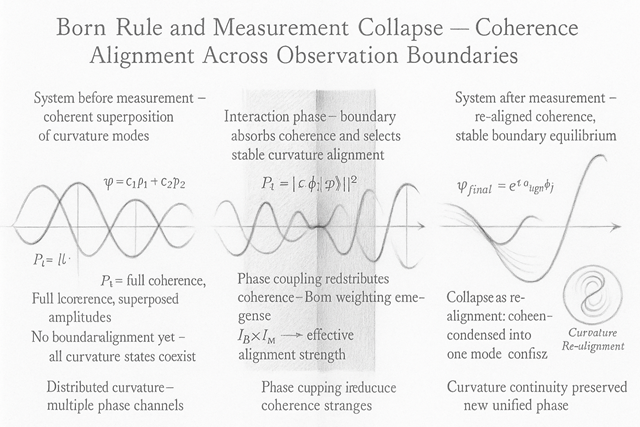
  - **Visualization:**  
    - Left: multiple phase channels (superposed amplitudes).  
    - Middle: alignment between system and measurement curvature — partial coherence coupling.  
    - Right: one dominant curvature channel remaining — coherence realigned, not destroyed.
Overview

The Born rule describes not randomness, but how coherence redistributes when a system encounters a boundary capable of measurement.
In the HST framework, the so-called "collapse" of the wavefunction is not destruction of superposition, but phase re-alignment — the curvature of a field reconfiguring to maintain coherence with a new boundary.

Every observation is therefore a coupling between two curvature systems:
the system under observation, and the boundary that defines what is being measured.
Probability arises not from chance, but from coherence geometry — the degree to which one curvature pattern aligns with another.


🔹 1. Classical Form — The Born Rule

In the conventional view, the Born rule gives the probability of observing a particular state:

\[ P_i = |\psi_i|^2 \]

It tells us that the likelihood of finding a particle in a particular configuration is proportional to the squared magnitude of its wavefunction.

When measurement occurs, the system’s superposition

\[ \psi = \sum_i c_i \phi_i \]

appears to “collapse” to a single eigenstate ϕj\phi_j, with probability Pj=∣cj∣2P_j = |c_j|^2.

But this picture omits how or why the collapse happens — it only describes the outcome statistically.
In HST, that missing dynamic is curvature coupling — the process through which two coherence fields find equilibrium.


🔸 2. Coherence Interpretation — Alignment of Curvature Fields

In HST–Flow, the wavefunction represents a distributed curvature field — a spatial map of coherence amplitude and phase.
A measurement device is another coherence system with its own field ϕi\phi_i.
When interaction begins, the system and boundary exchange curvature information, aligning their internal phase structures.

Each eigenstate ϕi\phi_i represents a distinct curvature configuration of the measurement boundary.
The overlap ∣⟨ϕi∣ψ⟩∣2|\langle \phi_i | \psi \rangle|^2 quantifies how compatible the system’s current coherence pattern is with each boundary configuration.
Thus, the Born rule arises not as an imposed statistical law, but as a natural geometric weighting:

\[ P_i = |\langle \phi_i | \psi \rangle|^2 \]

The most compatible curvature alignment — the one with maximal overlap — becomes the stable configuration after interaction.


🔹 3. Measurement Collapse as Coherence Redistribution

“Collapse” occurs when the coherence of the system, quantified by IBI_B, and that of the measurement boundary, IMI_M, reach an equilibrium through phase exchange:

Effective coherence:

\[ C = I_B I_M \]

If both are highly coherent (IB≈IM≈1I_B \approx I_M \approx 1), the superposition persists — both system and observer retain multiple phase channels (no unique outcome).
When the boundary is rigid (low IMI_M) or environmental coupling adds decoherence (low IBI_B), curvature alignment locks into one mode — the field reorganises into a single dominant geometry.

This transition is continuous, not discontinuous — a dynamic rebalancing of phase curvature rather than an instantaneous collapse.


🔸 4. Decoherence and the Role of the Environment

The environment acts as an expanding measurement boundary — a vast field of untracked curvature.
Each coupling drains coherence from the system via:

\[ \dot{I_B} = -\lambda (1 - I_B) \]

representing phase information lost into the environment.
As IBI_B decreases, off-diagonal elements in the density matrix fade, and the system’s effective curvature field simplifies to one dominant component — the apparent "collapse" seen in macroscopic measurement.

Yet even here, the underlying coherence is conserved globally — redistributed into the broader boundary system.
Nothing is destroyed; the coherence loop simply widens until individuality is lost.


🔹 5. Re-alignment, Not Erasure

After measurement, the surviving eigenstate is not arbitrary.
It is the curvature pattern that maintains phase continuity between the system and its measurement boundary:

\[ \psi_{\text{final}} = e^{i\phi_{\text{align}}} \phi_j \]

All other curvature modes cancel or diffuse, leaving a single coherent channel.
This preserves coherence within the new frame of observation, even as the old superposition dissolves.

The Born rule thus emerges as the stable geometric distribution of this realignment process — coherence reorganising into a self-consistent curvature structure that the boundary can sustain.


🔸 6. Unified Coherence Framework — Measurement as Boundary Equilibrium

In HST–Flow, measurement is a coherence transaction between two systems:

  • The measured system provides distributed curvature.
  • The measurement apparatus provides boundary constraints.

The final state is the equilibrium geometry between them — the curvature alignment that satisfies both fields simultaneously.
The Born rule quantifies that equilibrium as a weighting of overlap; collapse represents the curvature field settling into the most coherent configuration possible under those boundary conditions.

Thus, quantum measurement is not a break in physics but a completion of coherence alignment — the recursive merging of two curvature systems into a new, unified state.


🧠 Summary

The Born rule and wavefunction collapse describe not randomness but curvature negotiation — how coherence redistributes when a field meets a boundary.

In the HST–Flow interpretation:

  • |ψ|² represents curvature density, not probability.
  • Measurement is phase coupling between system and boundary.
  • Collapse is curvature re-alignment into the most coherent configuration.
  • Decoherence is information diffusion — coherence shared, not lost.

Observation is not the death of a wavefunction —
it is the birth of a new curvature memory shared between observer and observed.


Kireth Research
38 Thorndale Croft, Wetwang, Driffield
East Riding of Yorkshire YO25 9XZ
Designed By