Chapter 66
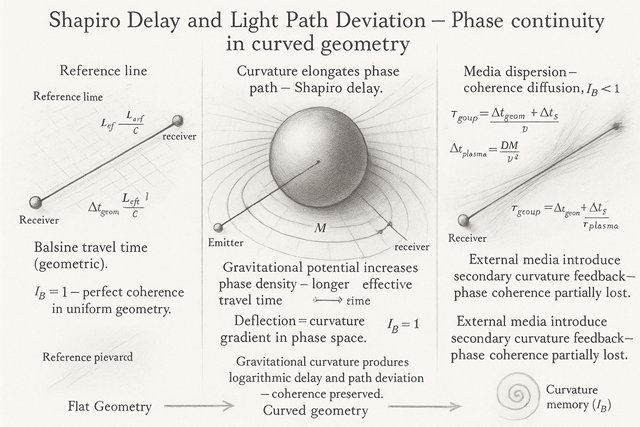
Shapiro Delay and Light Path Deviation
Relativistic and Curvature Flows
Author: Mark Anthony Higgins
© Mark Anthony Higgins 11 October 2025
Revised Date: 23 February 2026
flow "Shapiro Delay and Light Path Deviation" v1.0
# ---------- PURPOSE ----------
# Model gravitational time delay (Shapiro) and light bending as weak-field curvature feedback.
# Uses Schwarzschild weak-field: Φ(r) = -GM/r, with path impact parameter b.
# IB measures phase/signal coherence along the path (1 = perfect, <1 = noisy media or multipath).
# ---------- PARAMETERS ----------
params:
units: "SI"
c: positive = 2.99792458e8 # speed of light [m/s]
G: positive = 6.67430e-11 # Newton's constant [m^3 kg^-1 s^-2]
M: positive # lens mass [kg]
r_s: real = 2*G*M/c^2 # Schwarzschild radius [m]
r_e: positive # emitter radial distance from mass [m]
r_r: positive # receiver radial distance from mass [m]
b: positive # impact parameter (closest approach) [m]
IB: 0.0..1.0 = 1.0 # phase/signal coherence index
λ_media: nonnegative = 0.0 # coherence loss per unit time (plasma, turbulence) [s^-1]
dt: positive? # integration step for coherence [s]
include_plasma: bool = false # optional extra group delay from plasma
DM: nonnegative = 0.0 # dispersion measure [pc cm^-3] (scaled internally)
ν: positive? # observing frequency [Hz] (for plasma term)
# ---------- STATE ----------
state Path:
Φ_e: real # potential at emitter
Φ_r: real # potential at receiver
Δt_geom: real # flat-space travel time (baseline)
Δt_shapiro: real # Shapiro gravitational time delay
Δt_plasma: real # optional plasma delay
Δt_total: real # total excess delay over geometric baseline
α_deflect: real # total deflection angle (radians)
θ_image: real # apparent image shift (small-angle) [rad]
τ_group: real # group delay including media
coherence_loss: real # 1 - IB
regime: str # "weak-field","near-grazing","noisy"
# ---------- INVARIANTS ----------
invariants:
# Potentials at endpoints (weak field)
Path.Φ_e = - params.G * params.M / params.r_e
Path.Φ_r = - params.G * params.M / params.r_r
# Flat-space geometric baseline (straight-line, large-radius approx)
# Use effective path length L_eff ≈ sqrt(r_e^2 - b^2) + sqrt(r_r^2 - b^2)
L1 = max(0.0, sqrt(max(0.0, params.r_e^2 - params.b^2)))
L2 = max(0.0, sqrt(max(0.0, params.r_r^2 - params.b^2)))
L_eff = L1 + L2
Path.Δt_geom = L_eff / params.c
# Shapiro delay (standard logarithmic weak-field form)
# Δt_S ≈ (2GM/c^3) * ln( (r_e + r_r + L_eff) / (r_e + r_r - L_eff) )
# Guard the log argument for numerical safety
num = params.r_e + params.r_r + max(1e-18, L_eff)
den = max(1e-18, params.r_e + params.r_r - max(1e-18, L_eff))
Path.Δt_shapiro = (2 * params.G * params.M / params.c^3) * ln(num / den)
# Optional plasma group delay ~ DM / ν^2 (scaled to SI internally)
if params.include_plasma and params.ν is defined:
K_DM = 4.149e3 # s * MHz^2 * pc^-1 cm^3 (conventional factor), used in scaled form
Path.Δt_plasma = K_DM * (params.DM) / ((params.ν/1.0e6)^2) # seconds
else:
Path.Δt_plasma = 0
# Total excess delay over geometric
Path.Δt_total = Path.Δt_shapiro + Path.Δt_plasma
# Light deflection (weak field, small angle) α ≈ 4GM/(c^2 b)
Path.α_deflect = 4 * params.G * params.M / (params.c^2 * params.b)
# Apparent image shift (small angle lensing; for single pass, use α)
Path.θ_image = Path.α_deflect
# Group delay including media
Path.τ_group = Path.Δt_geom + Path.Δt_total
# Coherence evolution
if params.λ_media > 0 and params.dt is defined:
params.IB = clamp(params.IB - params.λ_media * (1 - params.IB) * params.dt, 0, 1)
Path.coherence_loss = 1 - params.IB
# Regime tag
if params.b <= 5 * params.r_s:
Path.regime = "near-grazing"
elif params.IB < 1 or params.include_plasma:
Path.regime = "noisy"
else:
Path.regime = "weak-field"
# ---------- TRANSFORMS ----------
transforms:
change_geometry:
comment: "Adjust endpoint radii or impact parameter."
params.r_e += Δr_e
params.r_r += Δr_r
params.b += Δb
vary_mass:
comment: "Change lens mass (e.g., different body)."
params.M += ΔM
params.r_s = 2*params.G*params.M / params.c^2
enable_plasma:
comment: "Turn on plasma dispersion at frequency ν with DM."
params.include_plasma = true
params.DM = DM_new
params.ν = ν_new
improve_coherence:
comment: "Operational mitigation (bandpass, de-scatter) to raise IB."
params.IB = clamp(params.IB + 0.05 * (1 - params.IB), 0, 1)
# ---------- MONITORS ----------
monitors:
causality:
assert Path.τ_group >= 0
comment: "Total group delay non-negative."
weak_field_validity:
assert params.b >> params.r_s
comment: "Small-angle/weak-field approximation appropriate if b ≫ r_s."
coherence_bounds:
assert 0 <= params.IB <= 1
scaling_sanity:
if Path.α_deflect < 1e-6:
comment: "Deflection is sub-arcsecond; consistent with solar-grazing scale."
# ---------- SCENES ----------
scenes:
solar_grazing:
given params:
M: 1.9885e30
r_e: 1.5e11
r_r: 1.5e11
b: 6.96e8 # ~ R_sun
IB: 1.0
expect:
Path.α_deflect ~ 4*G*M/(c^2*b)
Path.regime = "near-grazing"
comment: "Classic solar-grazing deflection and measurable Shapiro delay."
superior_conjunction_radar:
given params:
M: 1.9885e30
r_e: 1.5e11
r_r: 1.5e11
b: 1.5*6.96e8
IB: 0.95
expect:
Path.Δt_shapiro > 0
Path.τ_group = Path.Δt_geom + Path.Δt_shapiro
comment: "Two-way radar: extra round-trip delay from curvature (Shapiro)."
plasma_noisy_path:
given params:
M: 1.9885e30
r_e: 1.5e11
r_r: 1.5e11
b: 2.0*6.96e8
include_plasma: true
DM: 50.0
ν: 2.3e9 # 2.3 GHz S-band
IB: 0.8
λ_media: 0.02
dt: 1.0
expect:
Path.regime = "noisy"
Path.Δt_plasma > 0
params.IB ↓
comment: "Media adds dispersion and coherence loss; Shapiro still present."
massive_black_hole:
given params:
M: 4.0e6 * 1.9885e30 # Sgr A*
r_e: 8.0e3 * 3.086e16 # 8 kpc
r_r: 8.0e3 * 3.086e16
b: 100 * (2*G*M/c^2)
IB: 1.0
expect:
Path.α_deflect ≫ solar_grazing
Path.regime ∈ {"near-grazing","weak-field"}
comment: "Large deflection near SMBH; time delay dominated by curvature."
# ---------- NOTES ----------
notes:
- **Shapiro Delay (weak-field):**
\[
\Delta t_{\mathrm{S}} \approx \frac{2GM}{c^3}
\ln\!\left(\frac{r_e + r_r + L_{\mathrm{eff}}}{r_e + r_r - L_{\mathrm{eff}}}\right),
\quad L_{\mathrm{eff}} \simeq \sqrt{r_e^2 - b^2} + \sqrt{r_r^2 - b^2}.
\]
- **Light Deflection (small angle):**
\[
\alpha \approx \frac{4GM}{c^2 b}.
\]
- **Group Delay:** \(\tau_{\mathrm{group}} = \Delta t_{\mathrm{geom}} + \Delta t_{\mathrm{S}} + \Delta t_{\mathrm{plasma}}.\)
- **Plasma Dispersion (optional, scaling):** \(\Delta t_{\mathrm{plasma}} \propto \mathrm{DM}/\nu^2.\)
- **HST–Flow Interpretation:** Curvature increases phase path length (time delay) and tilts phase fronts (deflection).
\(I_B\) tracks how well the signal’s phase remains coherent along the curved path; lower \(I_B\) produces fringe washout or timing jitter.
- **Visualization:** ray skimming a mass with logarithmic time delay; bent wavefronts; optional plasma screen adding dispersion.
When light passes near a massive object, it does not slow or bend in the classical sense — it follows the phase curvature of space-time.
Both the Shapiro time delay and the deflection of light arise from a single principle: the path of coherence.
In HST terms, light traces the self-consistent geometry of its own curvature field.
Where the gravitational potential deepens, curvature density increases, and phase continuity demands an extended path length — manifesting as extra travel time and apparent bending.
In general relativity, a photon passing near a mass M in the weak-field limit experiences two key effects:
Shapiro delay (time delay):
\[ \Delta t_S = \frac{2GM}{c^3}\, \ln\!\left(\frac{r_e + r_r + L_{\mathrm{eff}}}{\,r_e + r_r - L_{\mathrm{eff}}\,}\right) \]
where and are the emitter and receiver distances, and is the geometric path length.
The logarithmic term represents how gravitational potential modifies the curvature of the time coordinate.
Deflection (light bending):
\( \alpha = \frac{4 G M}{c^2 b} \)
where is the impact parameter — the closest approach distance to the lensing mass.
Both effects emerge from the same underlying geometry: curvature redistributes phase alignment so that the photon remains coherent with the global field.
In the HST framework, light is not delayed in time — it accumulates curvature.
The gravitational potential acts as a phase-density gradient, increasing the curvature density along the photon’s path.
This phase gradient elongates the total phase arc length, producing a measurable time delay.
The same curvature gradient tilts the local phase fronts, producing the apparent deflection.
Both are expressions of curvature feedback — space-time responding to the mass distribution to maintain coherence between geometry and phase propagation.
A photon always moves at locally, but the global coherence loop is stretched:
\[ \tau_{\text{group}} = \Delta t_{\text{geom}} + \Delta t_S \]
The extra term represents not slowness, but path elongation through curvature — the wave following the minimum-phase condition of the HST field.
Space-time curvature is the memory of phase continuity.
When light traverses it, the curvature encodes the accumulated phase lag relative to flat geometry.
Each gravitational well acts as a phase integrator — storing a logarithmic record of coherence adjustment as light passes.
The field ensures that all paths remain globally consistent with the invariant interval:
\[ s^2 = g_{\mu\nu}\,\Delta x^{\mu}\Delta x^{\nu} = \text{constant} \]
The Shapiro delay is therefore the visible trace of this phase bookkeeping — a temporal echo of coherence preservation.
When a signal passes through additional media, such as plasma or interstellar turbulence, the same coherence law applies but with new terms.
The group delay becomes:
\[ \tau_{\text{group}} = \Delta t_{\text{geom}} + \Delta t_S + \Delta t_{\text{plasma}} \]
where
\[ \Delta t_{\text{plasma}} \propto \frac{\mathrm{DM}}{\nu^2} \]
This additional dispersion term is itself a curvature feedback through electromagnetic phase space — lower frequencies experience greater curvature elongation.
The coherence index captures how well the signal’s phase remains aligned; noise or dispersion lowers , turning sharp interference fringes into blurred phase structures.
The delay remains geometric, but the coherence becomes partially diffused.
Both Shapiro delay and deflection are boundary manifestations of the same curvature feedback process:
| Effect | Description | HST Interpretation |
|---|---|---|
|
Shapiro Delay |
Extended phase path |
Curvature-induced |
|
Deflection
|
Tilt of phase
fronts near mass |
Curvature gradient
in phase geometry |
|
Plasma Dispersion
|
Frequency-dependent
path extension |
Coherence gradient across
electromagnetic phase field |
Light does not traverse a distorted space; it traces the reindexed geometry that coherence demands.
The field adjusts continuously so that the photon’s phase evolution remains globally consistent with all curvature constraints.
The coherence index quantifies how faithfully the signal’s phase survives its journey:
\[ \dot{I_B} = -\lambda_{\text{media}} (1 - I_B) \]
When , coherence is perfect — the curvature feedback is noiseless, and the delay and deflection are sharply defined.
When , phase smearing occurs — coherence diffuses, though the underlying geometry remains invariant.
This distinction separates measurement uncertainty from physical coherence:
the universe remains perfectly coherent even when our detectors are not.
Light in a gravitational field is a phase-coherence probe of curvature.
Its delay and deflection trace the shape of the curvature feedback field connecting geometry and energy.
Each photon, radar echo, or wave packet becomes a strand in the universe’s recursive coherence weave — responding to curvature, but never breaking continuity.
Shapiro delay and light deflection are not separate effects — they are two directions of curvature feedback.
They show how phase continuity enforces coherence between light, gravity, and geometry.
In the HST–Flow interpretation:
Light never slows or bends — it remembers.
Its path is the story of coherence tracing curvature.