Chapter 46
Torque and Rotational Coherence
Motion and Inertial Coherence
Author: Mark Anthony Higgins
© Mark Anthony Higgins 11 October 2025
Revised Date: 23 February 2026
flow "Torque and Rotational Coherence" v1.0
# ---------- PURPOSE ----------
# Expresses rotational dynamics through the principle of coherence.
# Torque is treated as the curvature feedback linking angular acceleration and rotational energy.
# Perfect coherence (IB = 1) → torque transfers angular momentum without loss (rigid rotation).
# Reduced coherence (IB < 1) → partial energy transfer (friction, deformation, slippage).
# The flow unifies τ = Iα and L = Iω under the same coherence framework used for linear motion.
# ---------- PARAMETERS ----------
params:
units: "SI"
IB: 0.0..1.0 = 1.0 # rotational coherence index (1 = perfect rigidity)
I: positive # moment of inertia [kg·m²]
τ_ext: real # external torque applied [N·m]
α: real # angular acceleration [rad/s²]
ω_i: real # initial angular velocity [rad/s]
ω_f: real # final angular velocity [rad/s]
θ: real # angular displacement [rad]
loss_coeff: 0.0 # coherence decay rate [s^-1]
dt: 0.0? # timestep [s]
include_feedback: true
# ---------- STATE ----------
state Rotation:
L: real # angular momentum [kg·m²/s]
τ_net: real # net torque [N·m]
ΔE_rot: real # change in rotational energy [J]
E_loss: real # rotational energy loss [J]
IB_rate: real # rate of coherence change
balance_error: real # |τθ - ΔE_rot| difference [J]
rotation_state: str # "stable", "dissipative", or "accelerating"
# ---------- INVARIANTS ----------
invariants:
# Torque and angular acceleration relation
Rotation.τ_net = params.IB * params.I * params.α
# Angular momentum L = Iω
Rotation.L = params.I * params.ω_f
# Work done by torque (rotational analogue of W = F·s)
W_rot = Rotation.τ_net * params.θ
# Change in rotational kinetic energy
Rotation.ΔE_rot = 0.5 * params.I * (params.ω_f^2 - params.ω_i^2)
# Perfect coherence → τθ = ΔE_rot
if params.IB == 1:
Rotation.balance_error = abs(W_rot - Rotation.ΔE_rot)
Rotation.rotation_state = "stable"
else:
Rotation.E_loss = (1 - params.IB) * W_rot
Rotation.ΔE_rot = params.IB * W_rot
Rotation.rotation_state = "dissipative"
# Coherence decay
if params.loss_coeff > 0 and params.include_feedback:
params.IB = params.IB - params.loss_coeff * (1 - params.IB) * (params.dt or 1)
params.IB = clamp(params.IB, 0, 1)
Rotation.IB_rate = -params.loss_coeff * (1 - params.IB)
# ---------- TRANSFORMS ----------
transforms:
# Update angular velocity (α = τ/I)
propagate_rotation (when params.dt > 0):
params.α = Rotation.τ_net / params.I
params.ω_f = params.ω_i + params.α * params.dt
Rotation.L = params.I * params.ω_f
Rotation.ΔE_rot = 0.5 * params.I * (params.ω_f^2 - params.ω_i^2)
# Coherence feedback correction
coherence_feedback:
correction = -0.001 * Rotation.balance_error
params.IB = clamp(params.IB + correction, 0, 1)
# ---------- MONITORS ----------
monitors:
energy_balance:
if params.IB == 1:
assert abs(Rotation.τ_net * params.θ - Rotation.ΔE_rot) < 1e-9
comment: "Perfect rotational coherence — all torque converts to energy."
else:
comment: "Partial coherence — torque partially dissipated as heat or deformation."
coherence_bounds:
assert 0 <= params.IB <= 1
angular_momentum_check:
assert Rotation.L >= 0
# ---------- SCENES ----------
scenes:
perfect_rotation:
given params:
I: 2.0
α: 5.0
θ: 10.0
IB: 1.0
ω_i: 0.0
ω_f: 10.0
expect:
Rotation.τ_net = 10.0
Rotation.ΔE_rot = 100.0
comment: "Perfect coherence — rotational work equals energy change."
partial_rotation:
given params:
I: 2.0
α: 5.0
θ: 10.0
IB: 0.9
ω_i: 0.0
ω_f: 10.0
expect:
Rotation.ΔE_rot = 0.9 * τθ
Rotation.E_loss = 0.1 * τθ
comment: "Partial coherence — 10% energy lost to internal friction."
frictional_wheel:
given params:
I: 3.0
α: 4.0
θ: 5.0
IB: 0.85
loss_coeff: 0.05
dt: 1.0
enable:
- propagate_rotation
expect:
params.IB ↓
Rotation.E_loss > 0
comment: "Torque decays due to rotational friction — coherence fades over time."
gyroscopic_precession:
given params:
I: 5.0
ω_i: 100.0
α: 0.0
IB: 0.95
θ: 0.1
expect:
Rotation.τ_net small
Rotation.rotation_state = "stable"
comment: "Gyroscopic stability — near-perfect coherence, minimal energy loss."
# ---------- NOTES ----------
notes:
- **Torque–Energy Relation:** \( \tau \theta = \Delta E_{\text{rot}} \)
- **Rotational kinetic energy:** \( E_{\text{rot}} = \tfrac{1}{2} I \omega^2 \)
- **Torque law:** \( \tau = I \alpha \)
- **Angular momentum:** \( L = I \omega \)
- **Power in rotation:** \( P = \tau \omega \)
- **Coherence index (IB):**
- \(I_B = 1\): perfect rigidity — full torque transfer.
- \(I_B < 1\): internal slip — rotational energy lost to heat or vibration.
- **Feedback law:** \(\dot{I_B} = -\lambda(1 - I_B)\)
- **Interpretation:** Torque represents curvature tension in angular motion — the feedback between force and rotational displacement.
- **Dynamic meaning:** Rotation is sustained curvature coherence; torque acts as the mechanism that restores or disrupts that coherence.
- **Analogy:** Just as linear force bends velocity in a line, torque bends angular momentum around a center of curvature.
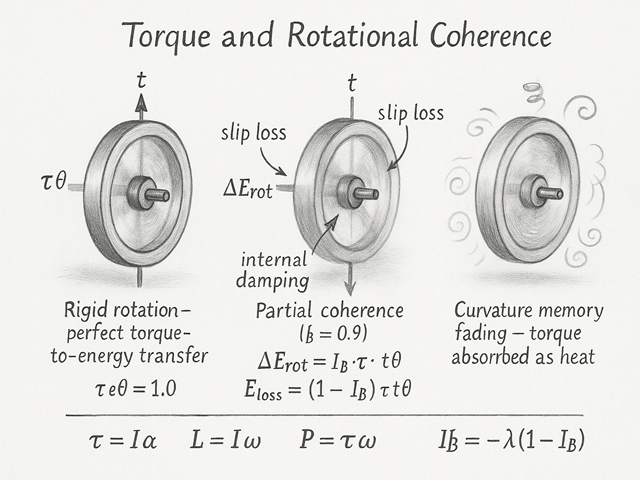
- **Visualization:** Show torque vector perpendicular to rotation plane, energy flowing between τθ and ΔE_rot, with faded arrows indicating loss when IB < 1.
Torque is the curvature analogue of force — the rotational tension that bends inertia around a center instead of through a line.
It measures how momentum flows across a circular path, maintaining angular coherence between the applied force and the resulting motion.
In classical terms:
$$ \tau = I\alpha, \qquad L = I\omega. $$
where is torque, I is moment of inertia, is angular acceleration, and is angular momentum.
In coherence terms, torque is the feedback of curvature memory — the rotational counterpart of linear force.
When coherence is perfect (), torque and motion are phase-locked: every newton-metre of applied curvature tension converts fully into angular acceleration and energy.
When coherence fades (), part of the torque diffuses — converted into friction, heat, or internal deformation rather than rotation.
Work in rotation mirrors linear work:
$$ W_{\text{rot}} = \tau \theta. $$
and the corresponding energy change:
$$ W_{\text{rot}} = \Delta E_{\text{rot}} = \frac{1}{2} I (\omega_f^2 - \omega_i^2). $$
In perfect rotational coherence, these two quantities balance exactly — no loss, no phase drift:
$$ \tau \theta = \Delta E_{\text{rot}}. $$
This expresses a pure curvature transfer: torque applied over an angular distance creates rotational energy with 100% fidelity.
In real systems, coherence is rarely perfect.
Some of the applied torque disperses into local vibrations or thermal motion — micro-curvature noise within the structure.
The coherence factor quantifies this retention:
$$ \Delta E_{\text{rot}} = I_B\,(\tau \theta), \qquad E_{\text{loss}} = (1 - I_B)\,(\tau \theta). $$
The coherence field thus mediates how efficiently angular curvature is transmitted across a material or structure.
Angular momentum encapsulates rotational coherence:
It acts as rotational inertia’s memory — a conserved curvature current.
When no external torque acts:
$$ \frac{dL}{dt} = 0. $$
This is the rotational analogue of Newton’s First Law:
the system continues spinning with constant angular momentum until an external curvature (torque) interacts with it.
When torque is applied, it alters the geometry of this memory:
$$ \tau = \frac{dL}{dt}. $$
The faster changes, the greater the curvature stress required to maintain coherence.
Loss in rotational coherence corresponds to micro-asymmetries in torque distribution —
small phase differences between applied force and structural response.
This can be captured dynamically as:
$$ \dot{I}_B = -\lambda(1 - I_B). $$
Here, represents how quickly a system forgets its rotational memory due to internal drag or damping.
This gradual loss represents the conversion of organized rotation into disordered motion — curvature transitioning from macro to micro scale.
Rotational power defines the rate at which torque performs work:
$$ P = \tau \omega. $$
In full coherence, maps directly to the rate of energy transfer;
in partial coherence, only a fraction () contributes to usable rotation:
$$ P_{\text{eff}} = I_B\,\tau\,\omega. $$
The remainder () manifests as internal heating or vibrational damping.
This shows torque as a dynamic coherence agent — continuously shaping and realigning the geometry of motion.
Torque is not merely a twisting force — it is rotational curvature in motion.
It transmits energy between angular and linear domains through coherence feedback.
When the system’s geometry is fully aligned (), rotation conserves its energy perfectly.
When coherence decays (), angular memory diffuses — motion transforms into internal noise, but the total energy remains conserved across scales.