Chapter 28
Entropy as Information Divergence
Thermal and Entropic Flows
Author: Mark Anthony Higgins
© Mark Anthony Higgins 11 October 2025
Revised Date: 23 February 2026
flow "Entropy as Information Divergence" v1.0
# ---------- PURPOSE ----------
# Expresses entropy as a measure of information divergence — the mismatch between
# the system's actual microstate distribution and its coherent reference distribution.
# Links thermodynamic entropy (σ, S) to informational coherence via Kullback–Leibler form.
# ---------- PARAMETERS ----------
params:
units: "SI"
k_B: 1.380649e-23 # Boltzmann constant [J/K]
T: positive # system temperature [K]
IB: 0.0..1.0 # boundary coherence index
reference_state: "equilibrium" # target distribution type (eq, coherent, etc.)
symbolic: true # enables symbolic use of p, q distributions
# ---------- STATE ----------
state System:
p_i[]: prob # actual microstate probabilities
q_i[]: prob # coherent reference probabilities
S_phys: real # thermodynamic entropy [J/K]
D_info: real # informational divergence [dimensionless]
sigma: real # entropy production rate [J/(K·s)]
# ---------- DEFINITIONS ----------
invariants:
# Shannon / Gibbs entropy
S_phys = - params.k_B * Σ_i( p_i * ln(p_i) )
# Kullback–Leibler divergence (information distance)
D_info = Σ_i( p_i * ln(p_i / q_i) )
# Link between thermodynamic and information forms
S_rel = - params.k_B * D_info # relative entropy = -k_B * divergence
# Entropy production rate in coherence form
sigma = params.k_B * Σ_i( dp_i/dt * ln(p_i / q_i) )
sigma >= 0
# Coherence link
params.IB = exp(-D_info) # high divergence => low coherence
# ---------- TRANSFORMS ----------
transforms:
coherence_entropy_relation:
S_phys = S_ref + (1 - params.IB) * ΔS_max
# ΔS_max: maximal entropy difference between coherent and fully random states
info_dynamics:
# Rate of coherence loss as information divergence
ddt(D_info) = Σ_i( dp_i/dt * (1 + ln(p_i / q_i)) )
sigma = params.k_B * T * ddt(D_info)
reversible_limit (when params.IB ≈ 1):
D_info → 0
sigma → 0
note: "Perfect coherence — no divergence between p and q distributions."
# ---------- MONITORS ----------
monitors:
positivity:
assert all(p_i >= 0)
assert abs(Σ_i(p_i) - 1) < 1e-9
entropy_increase:
assert sigma >= 0
coherence_bound:
assert 0 <= params.IB <= 1
# ---------- SCENES ----------
scenes:
coherent_equilibrium:
given:
p_i: [0.25, 0.25, 0.25, 0.25]
q_i: [0.25, 0.25, 0.25, 0.25]
T: 300
IB: 1.0
expect:
D_info = 0
sigma = 0
S_phys = 1.386 * params.k_B
comment: "Perfect symmetry — no information divergence."
decohered_system:
given:
p_i: [0.1, 0.2, 0.4, 0.3]
q_i: [0.25, 0.25, 0.25, 0.25]
T: 300
compute:
D_info = Σ_i( p_i ln(p_i / q_i) )
IB = exp(-D_info)
sigma = params.k_B * T * ddt(D_info)
expect:
D_info > 0
IB < 1
sigma > 0
comment: "Information asymmetry manifests as entropy production."
# ---------- NOTES ----------
notes:
- Entropy is the geometric distance between the actual system state (p) and its coherent baseline (q).
- In HST terms, this is a *boundary divergence*: a phase-space curvature mismatch between expected and realised fields.
- Coherence (IB) is the exponential of the negative information divergence, linking structure and thermodynamics.
- When p = q, coherence is complete (IB = 1, D_info = 0); as p diverges, σ rises, reflecting information loss.
- This formalism unifies physical and informational entropy within the same algebraic flow framework.
In classical physics, entropy is treated as a measure of disorder or uncertainty.
In Flow Algebra and Holographic Space-Time, entropy instead becomes a measure of coherence deviation — the distance between what the system is and what it could be if perfectly aligned.
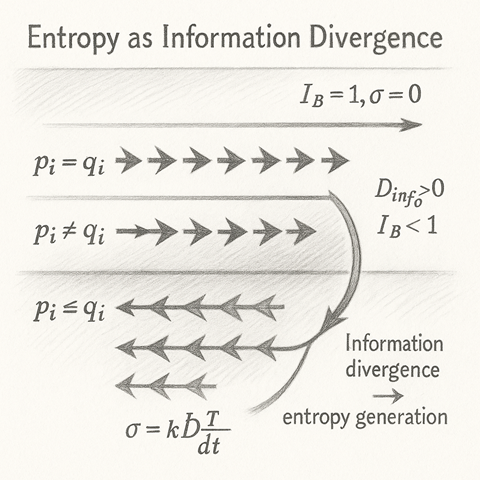
It quantifies information divergence: the geometric gap between the system’s actual probability distribution and its coherent reference distribution .
The classical and information-theoretic forms are unified as:
$$ S_{\mathrm{phys}} = -k_B \sum_i p_i \ln p_i, \qquad D_{\mathrm{info}} = \sum_i p_i \ln \frac{p_i}{q_i}, \qquad S_{\mathrm{rel}} = -k_B D_{\mathrm{info}}. $$
Here measures the absolute entropy of the system,
measures its relative divergence from coherence,
and converts that divergence into an entropy offset.
When , the two align perfectly — no information is lost, no entropy is produced.
The rate of entropy generation follows directly from the time derivative of divergence:
$$ \sigma = k_B\, T\, \frac{dD_{\mathrm{info}}}{dt} \ge 0. $$
Entropy production is therefore the temporal slope of information loss —
how fast the system’s microstate probabilities drift away from their coherent baseline.
In this framework, the boundary coherence index becomes an exponential measure of alignment:
$$ I_B = e^{-D_{\mathrm{info}}}. $$
Thus:
The connection between information and thermodynamics becomes exact:
$$ S_{\mathrm{phys}} = S_{\mathrm{ref}} + (1 - I_B)\, \Delta S_{\max}. $$
linking coherence loss to an entropy increase within the system.
In Holographic Space-Time, entropy arises not from disorder but from boundary misalignment —
the angular divergence between two field maps in phase space.
Each microstate carries a small vector of curvature; entropy accumulates as these curvatures lose collective alignment.
Information divergence is therefore the phase-space angle between expected and realised geometries.
As coherence decays, the boundary forgets its internal state — information becomes curvature noise.
| Domain | Variable | Interpretation |
|---|---|---|
|
Thermodynamics
|
S,σ
|
Energy-weighted
information divergence |
|
Information theory
|
\( D_{\mathrm{info}} \)
|
Statistical distance
between p and q |
|
Coherence theory
|
\( I_B \)
|
Alignment index \( = e^{-D_{\mathrm{info}}} \)
|
|
Geometry (HST)
|
curvature drift
|
Spatial representation of divergence
|
Entropy is thus the shadow of coherence loss — not a mystery of randomness, but the visible trace of structural deviation from perfect alignment.
\( I_B = e^{-D_{\mathrm{info}}}, \quad \sigma = k_B\, T\, \dfrac{dD_{\mathrm{info}}}{dt}. \)
These two equations complete the loop:
entropy production is simply information divergence evolving through time.
Entropy is not randomness itself — it is the measure of how far a system has drifted from perfect self-knowledge.
In Flow Algebra, that drift becomes quantifiable geometry.
When , the system remembers itself completely; when , it begins to forget.
Entropy, in this sense, is memory loss measured in energy units — the universal signature of coherence decay across physics, computation, and consciousness.