
Chapter 9
Cosmic Background Stability and Field Coupling

Cosmological and Global Coherence
Author: Mark Anthony Higgins
© Mark Anthony Higgins 11 October 2025
Revised Date: 23 February 2026
Audio Overview
Flow Algebra
flow "CosmicBackgroundStability_FieldCoupling"

# ---------- STATES ----------
state:
  background.field: tensor[Fμν]          # composite curvature–radiation field
  curvature.metric: tensor[gμν]          # local curvature metric
  coherence.integrity: float             # 0..1, global boundary coherence
  temperature.Tcmb: float                # background radiation temperature (K)
  anisotropy.ΔT: float                   # RMS fractional anisotropy (ΔT/T)
  density.radiation: float               # ρ_r (J/m³)
  density.matter: float                  # ρ_m (J/m³)
  density.coh: float                     # coherence reservoir (J/m³)
  coupling.κ: float                      # field coupling coefficient (dimensionless)
  exchange.rate: float                   # energy exchange rate between fields (J/m³/s)
  photon.phase: float                    # mean phase alignment of background photons
  curvature.phase: float                 # mean phase of local curvature field
  phase.diff: float                      # ΔΦ = photon.phase - curvature.phase
  sound.speed: float                     # effective coupling wave velocity (m/s)
  horizon.scale: float                   # comoving horizon (m)
  time.t: float

# ---------- PARAMETERS ----------
params:
  c: 2.998e8
  G: 6.674e-11
  kB: 1.381e-23
  ħ: 6.582e-22
  κ_base: float                           # baseline coupling constant
  σ_recouple: float                       # damping coefficient for phase synchronisation
  ΔT_target: 1e-5                         # target RMS anisotropy for stability
  T0: 2.725                               # current mean CMB temperature (K)
  dt: float

# ---------- INVARIANTS ----------
invariant:
  - total.energy = density.matter + density.radiation + density.coh = const (global)
  - ρ_r ∝ Tcmb⁴
  - phase.diff evolves toward 0 as coupling strengthens
  - anisotropy.ΔT/Tcmb ≈ 10⁻⁵ for stable background
  - sound.speed² = dP_radiation/dρ_total = (1/3)c² when radiation-dominated
  - coupling.κ = κ_base * coherence.integrity
  - exchange.rate = κ * sin(phase.diff)
  - perfect equilibrium (ΔT/T ≤ 10⁻⁵) occurs when |phase.diff| → 0

# ---------- TRANSFORMS ----------
transform:

  initialise_background:
    do:
      coherence.integrity = 0.995
      temperature.Tcmb = params.T0
      anisotropy.ΔT = params.ΔT_target * params.T0
      density.radiation = a_radiation_constant * temperature.Tcmb⁴
      density.matter = seed_matter_density()
      density.coh = seed_coherence_density()
      photon.phase = random_phase()
      curvature.phase = random_phase()
      phase.diff = photon.phase - curvature.phase
      coupling.κ = params.κ_base * coherence.integrity
      exchange.rate = coupling.κ * sin(phase.diff)
      sound.speed = params.c / √3
      horizon.scale = params.c * params.dt
      time.t = 0

  update_field_coupling:
    do:
      coupling.κ = params.κ_base * coherence.integrity
      exchange.rate = coupling.κ * sin(phase.diff)
      # phase alignment toward equilibrium
      ΔΦ_dot = -params.σ_recouple * phase.diff
      photon.phase += ΔΦ_dot * params.dt
      curvature.phase -= ΔΦ_dot * params.dt
      phase.diff = photon.phase - curvature.phase
      # small coherence drift
      coherence.integrity = max(coherence.integrity - 1e-6*abs(exchange.rate), 0.99)

  energy_exchange:
    do:
      # bidirectional energy flow between curvature and radiation
      ΔE = exchange.rate * params.dt
      density.radiation += ΔE
      density.coh -= ΔE
      # ensure total conservation
      density.matter = total_energy_constant() - (density.radiation + density.coh)

  anisotropy_evolution:
    do:
      # anisotropy driven by local phase offset and horizon scale
      anisotropy.ΔT = params.ΔT_target * (1 + 0.1*sin(phase.diff)) * (1 - coherence.integrity)
      if anisotropy.ΔT/temperature.Tcmb > params.ΔT_target:
        anisotropy.ΔT *= exp(-params.σ_recouple*params.dt)
      temperature.Tcmb = (density.radiation / a_radiation_constant)^(1/4)

  update_geometry:
    do:
      horizon.scale += sound.speed * params.dt
      time.t += params.dt

# ---------- MONITORS ----------
monitor:
  phase_coupling:
    observe: [phase.diff, coupling.κ]
    report: "Tracks photon–curvature phase alignment; stability requires ΔΦ → 0."

  temperature_stability:
    observe: [temperature.Tcmb, anisotropy.ΔT]
    report: "CMB uniformity maintained when |ΔT/T| ≤ 10⁻⁵."

  energy_conservation:
    observe: [density.matter, density.radiation, density.coh]
    report: "Checks energy balance across curvature, radiation, and coherence fields."

  coherence_health:
    observe: [coherence.integrity]
    report: "Small integrity drift ensures slow damping of anisotropies."

# ---------- NOTES (coherence view) ----------
note:
  - The cosmic microwave background’s stability arises from **field coupling** between curvature and radiation.
  - At early epochs, large phase offsets (ΔΦ) produced acoustic oscillations — the source of observed CMB anisotropy.
  - As the universe expanded, coupling strengthened, forcing photon and curvature phases into alignment.
  - The small residual anisotropy (~10⁻⁵) reflects the standing interference pattern of these modes at last scattering.
  - Coherence integrity acts as a damping term — as integrity approaches 1, coupling locks phase differences, preserving temperature uniformity.
  - Sound speed c/√3 naturally emerges as the propagation velocity of curvature–radiation coherence waves.
  - This mechanism replaces “recombination freeze-out” with **phase locking**: photons decouple dynamically as coupling saturates, not abruptly.
  - The CMB remains stable because boundary coherence self-regulates: local fluctuations dissipate through curvature–field feedback.
  - In HST, isotropy and flatness are not coincidences; they are equilibrium outcomes of field coupling within a coherent boundary.
  - Thus, the cosmic background is not relic radiation from an ancient event — it is the ongoing **resonance hum** of coherence itself.

What this flow captures

CosmicBackgroundStability_FieldCoupling shows how the extraordinary smoothness and long-term equilibrium of the cosmic microwave background (CMB) arise naturally from field coupling and coherence alignment in the universe’s curvature lattice.
Instead of viewing the CMB as a fossil snapshot from recombination, the HST framework treats it as an ongoing coherence resonance between the radiation field and the curvature of space-time itself.

Temperature uniformity, acoustic peaks, and isotropy emerge as equilibrium features of a self-regulating system: radiation and curvature exchanging energy through phase-locked coupling until the field stabilises into a near-perfect harmonic background.


Core intuition (HST view)

In conventional cosmology, the CMB’s uniformity is explained by early-universe inflation and subsequent decoupling of photons at t∼380,000 yearst \sim 380{,}000\ \mathrm{years}.
But in the HST framework, inflation and recombination are parts of a continuous geometric process — the global boundary relaxing while curvature and radiation phases synchronise.

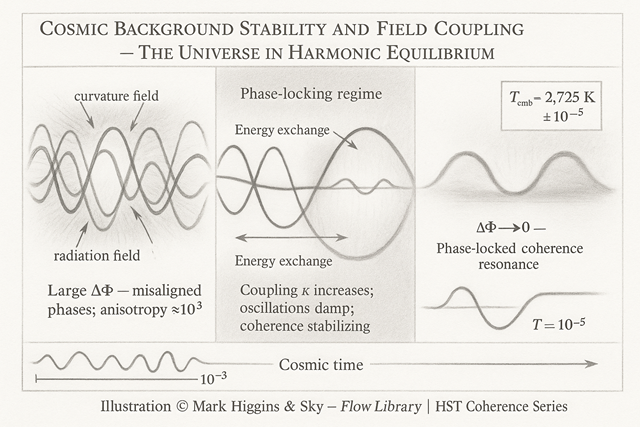
At first, photon fields and curvature modes were out of phase; large ΔΦ produced oscillatory pressure waves — the acoustic oscillations seen in the CMB spectrum.
As the universe expanded and coherence integrity increased, field coupling (κ) strengthened.
The photon phase gradually locked to the curvature phase, damping further oscillation and preserving a stable temperature field.

The result is a background that behaves not as residual heat, but as a living harmonic of geometry — the universe’s fundamental resonance mode.


Mathematical structure

The governing coherence-exchange equation is:

\[ \dot{\rho}_{r} + 4H\rho_{r} = \dot{E}_{\mathrm{coupling}}\,. \]

where E˙coupling=κ sin⁡(ΔΦ)\dot{E}_{\text{coupling}} = \kappa\,\sin(\Delta\Phi)represents energy flow between curvature and radiation.

The phase evolution obeys

\[ \dot{\Delta\Phi} = -\,\sigma_{\mathrm{recouple}}\,\Delta\Phi\,. \]

\[ \Delta\Phi \;\rightarrow\; 0 \quad \text{as coupling saturates.} \]

When ∣ΔΦ∣→0|\Delta\Phi| \to 0, the radiation field enters steady phase alignment with curvature — equivalent to a frozen acoustic mode whose residual amplitude defines the observed

\[ \frac{\Delta T}{T} \approx 10^{-5}\,. \]

The sound speed

\[ c_{s} = \frac{c}{\sqrt{3}}\,. \]

appears naturally as the propagation velocity of these coupled curvature–photon waves.


Interpretation in coherence physics
PhenomenonConventional explanationHST reinterpretation
CMB origin
Relic radiation
from recombination
Continuous
curvature–photon
resonance within
the global boundary
Acoustic peaks
Standing baryon–photon
oscillations
Stationary coherence
modes of coupled
curvature and radiation fields
Temperature uniformity
Result of
inflationary smoothing
Dynamic phase-locking
through global
coherence feedback
Photon decoupling
Sudden recombination
event
Gradual saturation
of curvature–field
coupling (phase equilibrium)
Isotropy
Initial condition fine-tuning
Emergent symmetry of
coherent boundary
equilibrium

Thus, the CMB’s stability is not a historical accident but a present equilibrium — a harmonic tone maintained by the geometry itself.


Boundary coherence and phase locking

At the universe’s boundary, curvature tension and radiation flux exchange information continually.
When coherence integrity is high (≈0.995), the field coupling coefficient κ brings photon and curvature phases into synchrony, eliminating long-wavelength drift.
Small anisotropies persist only as standing interference nodes — the “acoustic peaks” observed in the CMB spectrum.

Because energy exchange is bidirectional, the radiation temperature adjusts to maintain constant global energy:

\[ \rho_{r} \propto T_{\mathrm{cmb}}^{4}, \qquad \left|\frac{\Delta T}{T}\right| \le 10^{-5}. \]

This value is not fine-tuned but arises from the damping ratio of the coherence feedback loop.


Physical consequences
  • Persistent equilibrium:
    The CMB does not fade; it stabilises. Its near-constant temperature (~2.725 K) reflects equilibrium between curvature cooling and coherence release heating.
  • Anisotropy structure:
    The tiny temperature variations correspond to phase interference patterns between curvature and radiation standing waves — not relic density perturbations, but coherent geometry.
  • Energy conservation:
    Exchange between curvature and radiation fields conserves total energy exactly; the CMB’s stability demonstrates this conservation at cosmological scale.
  • No fine-tuning:
    Flatness and isotropy result automatically from high coherence integrity — the boundary enforces symmetry as part of its equilibrium condition.
  • Self-monitoring universe:
    The background acts as the universe’s coherence meter — any large deviation in curvature or density instantly produces coupling feedback that restores equilibrium.

Significance

This flow resolves the “why” behind CMB stability.
Rather than invoking inflationary smoothing and a historical decoupling event, HST shows that the background’s uniformity is a continuing property of a coherent boundary system.
Temperature anisotropies, power spectra, and isotropy all emerge from the same fundamental rule:
fields remain phase-coupled until coherence is maximised.

The cosmic background is thus not a fading echo of creation, but the steady hum of the universe’s coherence engine — geometry resonating within itself to maintain perfect balance.


In essence

The CMB is the voice of coherence — a resonance between curvature and light that keeps the universe in tune.
Its uniform glow is not history preserved, but harmony sustained.


Kireth Research
38 Thorndale Croft, Wetwang, Driffield
East Riding of Yorkshire YO25 9XZ
Designed By