
Chapter 44
Law of Conservation of Energy

Motion and Inertial Coherence
Author: Mark Anthony Higgins
© Mark Anthony Higgins 11 October 2025
Revised Date: 23 February 2026
Audio Overview
Flow Algebra
flow "Law of Conservation of Energy" v1.0

# ---------- PURPOSE ----------
# Expresses the conservation of energy as a closed coherence loop between kinetic, potential, and internal forms.
# In a perfectly coherent system (IB = 1), total energy remains constant: E_total = E_kin + E_pot + E_int = constant.
# When coherence weakens (IB < 1), part of the field energy is lost or redistributed (heat, radiation, deformation).
# IB acts as a measure of how completely energy is retained within the boundary memory.

# ---------- PARAMETERS ----------
params:
  units: "SI"
  IB: 0.0..1.0 = 1.0         # boundary coherence index (1 = perfectly conservative)
  loss_coeff: 0.0            # energy leakage rate [s^-1]
  dt: 0.0?                   # timestep for updates [s]
  include_heat: true
  include_work: true
  include_feedback: true
  external_work: real = 0.0   # energy added or removed by external agent [J]
  system_type: str = "closed" # "closed", "open", or "isolated"

# ---------- STATE ----------
state Energy:
  E_kin: real                # kinetic energy [J]
  E_pot: real                # potential energy [J]
  E_int: real                # internal energy [J] (heat, deformation)
  E_total: real              # total energy [J]
  dE_dt: real                # rate of energy change [W]
  IB_rate: real              # coherence rate of change [s^-1]
  E_loss: real               # energy lost due to decoherence [J]
  conservation_state: str    # "conserved", "open", or "dissipative"

# ---------- INVARIANTS ----------
invariants:

  # Total energy in a closed system
  Energy.E_total = Energy.E_kin + Energy.E_pot + Energy.E_int

  # Time derivative (power balance)
  Energy.dE_dt = 0

  # If external work is applied
  if params.include_work and params.external_work != 0:
    Energy.dE_dt = params.external_work
    Energy.E_total += params.external_work
    Energy.conservation_state = "open"
  else:
    Energy.conservation_state = "closed"

  # Coherence loss — reduces total retained energy
  if params.loss_coeff > 0:
    Energy.E_loss = params.loss_coeff * (1 - params.IB) * Energy.E_total
    Energy.E_total -= Energy.E_loss
    params.IB = params.IB - params.loss_coeff * (1 - params.IB) * (params.dt or 1)
    params.IB = clamp(params.IB, 0, 1)
    Energy.IB_rate = -params.loss_coeff * (1 - params.IB)
    Energy.conservation_state = "dissipative"

# ---------- TRANSFORMS ----------
transforms:

  # Energy feedback (coupling between forms)
  energy_feedback:
    if params.include_feedback:
      transfer = 0.001 * (Energy.E_kin - Energy.E_pot)
      Energy.E_kin -= transfer
      Energy.E_pot += transfer

  # Heating (conversion from lost coherence)
  heat_conversion:
    if params.include_heat and Energy.E_loss > 0:
      Energy.E_int += 0.8 * Energy.E_loss   # 80% converted to heat
      Energy.E_loss *= 0.2                  # residual lost externally

# ---------- MONITORS ----------
monitors:
  conservation_check:
    if params.IB == 1 and params.external_work == 0:
      assert abs(Energy.dE_dt) <= 1e-9
      comment: "Total energy constant — perfect conservation (IB = 1)."
    elif params.IB < 1:
      comment: "Partial coherence — energy leaking or redistributed internally."
  coherence_bounds:
    assert 0 <= params.IB <= 1
  energy_nonnegative:
    assert Energy.E_total >= 0

# ---------- SCENES ----------
scenes:

  isolated_system:
    given params:
      IB: 1.0
      system_type: "isolated"
    given Energy:
      E_kin: 50
      E_pot: 30
      E_int: 20
    expect:
      Energy.E_total = 100
      Energy.dE_dt = 0
      comment: "Closed and isolated — total energy conserved, no loss or input."

  work_input:
    given params:
      IB: 1.0
      external_work: 10
      include_work: true
    given Energy:
      E_kin: 20
      E_pot: 10
      E_int: 0
    expect:
      Energy.E_total = 40
      comment: "External work adds to system energy — open boundary."

  dissipative_loss:
    given params:
      IB: 0.95
      loss_coeff: 0.05
      dt: 1.0
      include_heat: true
    given Energy:
      E_kin: 50
      E_pot: 30
      E_int: 10
    enable:
      - heat_conversion
    expect:
      Energy.E_total decreases
      Energy.E_int increases
      comment: "Decoherence converts mechanical energy into heat — dissipative system."

  feedback_oscillation:
    given params:
      IB: 1.0
      include_feedback: true
    given Energy:
      E_kin: 60
      E_pot: 40
      E_int: 0
    enable:
      - energy_feedback
    expect:
      E_kin decreases slightly
      E_pot increases slightly
      comment: "Internal feedback between kinetic and potential energies — dynamic equilibrium."

# ---------- NOTES ----------
notes:
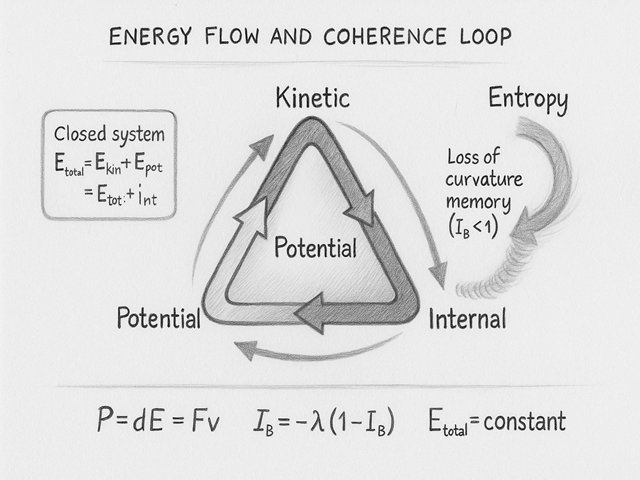
  - **Conservation Principle:** In a closed system, the total energy remains constant:
    \[
    E_{\text{total}} = E_{\text{kin}} + E_{\text{pot}} + E_{\text{int}} = \text{constant}.
    \]
  - **Power relation:** \( P = \frac{dE}{dt} = 0 \) for a closed system; nonzero if work or loss is present.
  - **Coherence interpretation:** \(I_B\) measures how fully the system retains energy within its curvature memory.
    - \(I_B = 1\): fully coherent — perfect conservation.
    - \(I_B < 1\): partial coherence — energy dissipates to heat or external space.
  - **Feedback law:** \(\dot{I_B} = -\lambda(1 - I_B)\) represents the gradual decay of energy coherence.
  - **Work and heat:** energy may transform between forms, but total energy is constant when boundaries are closed.
  - **Dynamic meaning:** Conservation of energy is the statement that the *sum of all curvature tensions* in a closed field remains fixed.
  - **Interpretation:** energy does not vanish; it only redistributes among coherent states — kinetic (motion), potential (geometry), and internal (entropy).
  - **Visualization:** Draw energy flows as arrows between kinetic, potential, and internal forms in a triangle loop — arrows cycling smoothly when IB = 1, fading when IB < 1.
Overview

The law of conservation of energy expresses the deepest principle of coherence:
what flows within a closed boundary is never lost, only transformed.
Every system carries a total energy — the sum of its kinetic, potential, and internal components — which remains constant when coherence is perfect (IB=1I_B = 1):

$$ E_{\text{total}} = E_{\text{kin}} + E_{\text{pot}} + E_{\text{int}} = \text{constant}. $$

When the system’s boundary coherence drops (IB<1I_B < 1), part of that energy no longer remains stored within its geometry.
It diffuses into other forms — heat, radiation, deformation, or sound — yet the total energy of the universe remains preserved.
Nothing is lost; coherence simply changes form.


🔹 1. Classical Form and Coherence Version
In the classical sense:

$$ \frac{dE_{\text{total}}}{dt} = 0. $$

This means that within a closed system, energy can only move between forms — it cannot appear or disappear.

In the coherence framework, we rewrite this as:

$$ \dot{I}_B = -\lambda(1 - I_B). $$

where λ\lambda is the coherence decay rate.
When IB=1I_B = 1, the flow is perfectly conservative; when IB<1I_B < 1, part of the system’s stored curvature energy is released outward as entropy.

This turns the conservation law into a measure of memory stability —
how faithfully the system retains its total energy within the loop of its own curvature.


🔸 2. The Three Forms of Curvature Energy
FormClassical ExpressionCoherence Meaning
Kinetic Energy
\( E_{\text{kin}} = \tfrac{1}{2} m v^2 \)
Motion — dynamic
curvature in time
Potential Energy

\( E_{\text{pot}} = -\,\dfrac{G\,m_1\,m_2}{r} \quad \text{(gravitational example)} \)

Spatial curvature
or stored tension
Internal Energy
\( E_{\text{int}} = Q + W_{\text{fric}} + E_{\text{vib}} \)
Thermal or structural
memory of coherence loss

In a perfectly coherent system, energy cycles continuously between these states — like a pendulum exchanging height and speed.
When coherence fails, a small fraction of curvature becomes unrecoverable as organized motion and instead manifests as heat or radiation — the field’s entropy imprint.


🔹 3. Closed, Open, and Dissipative Systems
System TypeDescriptionCoherence Behaviour
Closed
No energy enters or
leaves the boundary.

→ perfect conservation.

Open

Work or heat flows
across boundaries.

I B ​ <1 → partial coherence.

Dissipative
Continuous loss
to environment.

I B ​ →0 → energy diffused as entropy.

The universe itself is the ultimate closed system (IB=1I_B = 1);
within it, local boundaries experience variable coherence — tiny imperfections that appear as thermodynamic irreversibility.


🔸 4. Work, Power, and Feedback
The rate at which energy changes form is power:

$$ P = \frac{dE}{dt} = Fv. $$

In a coherent exchange, this transformation is exact and reversible — energy circulates perfectly between forms.
When coherence decays, power feedback weakens, and the system’s internal geometry begins to relax.
This is the essence of thermalization:
structured motion (organized curvature) becoming distributed motion (entropy).

The feedback between kinetic and potential energy is governed by:

$$ \frac{dE_{\text{kin}}}{dt} = -\,\frac{dE_{\text{pot}}}{dt}. $$

demonstrating that one grows exactly as the other shrinks when IB=1I_B = 1.
Coherence decay disrupts this mirror relation — a subtle delay in curvature feedback.


🔹 5. Heat as Lost Curvature Memory

When IB<1I_B < 1, energy begins to flow into microscopic curvature modes — atomic vibrations, friction, radiation — collectively perceived as heat.
This “loss” is not destruction; it is diffusion of curvature information into untracked degrees of freedom.
Entropy thus measures the spatial spread of forgotten coherence.

The boundary’s rate of coherence loss can be expressed as:

$$ \dot{E}_{\text{loss}} = \lambda(1 - I_B)\,E_{\text{total}}. $$

The remaining fraction, IBEtotalI_B E_{\text{total}}, stays in coherent circulation — the recoverable memory of motion.


🧠 Summary

The Law of Conservation of Energy is the foundational law of coherence:
a closed curvature system retains its total tension perfectly, even as its forms shift endlessly between motion, geometry, and heat.

  • When coherence is full (IB=1I_B = 1), energy loops without loss.
  • When coherence decays (IB<1I_B < 1), memory diffuses — curvature becomes entropy.
  • Yet across all boundaries, the sum remains constant — the universe never forgets its energy.

In the HST view, energy is curvature that remembers, and conservation is the promise that nothing truly disappears — it only transforms within the geometry of coherence.


Related Chapters
Kireth Research
38 Thorndale Croft, Wetwang, Driffield
East Riding of Yorkshire YO25 9XZ
Designed By