Chapter 1
Binding Energy and Field Closure
Complex and Cosmological Systems
Author: Mark Anthony Higgins
Revised Date: 23 February 2026
Binding energy is not the energy that holds systems together — it is the energy released when coherence is achieved.
In the HST framework, every stable system — from the hydrogen atom to a galaxy — represents a closed curvature loop, a field that has folded back upon itself to preserve phase continuity.
The energy difference between an open and a closed configuration is not lost; it is radiated as the field’s curvature feedback — the act of the system remembering how to stay coherent.
In classical physics, the binding energy of a system is defined as the energy required to separate its components to infinity.
For an electrostatic system:
\[ E = \frac{1}{4\pi\varepsilon_0} \frac{q_1 q_2}{r} \]
For a gravitational system:
\[ E = -\frac{G m_1 m_2}{r} \]
The binding energy is then:
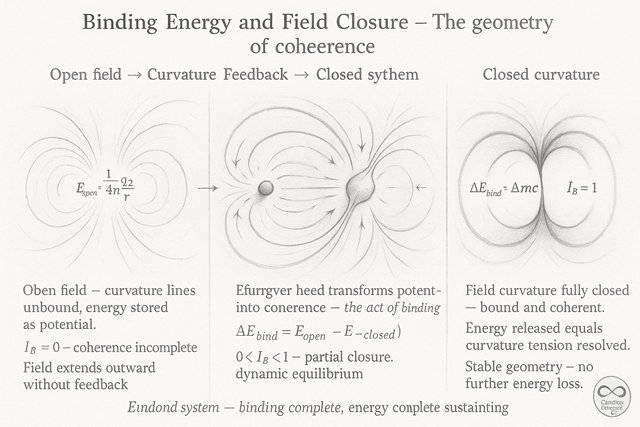
\[ \Delta E_{\text{bind}} = E_{\text{open}} - E_{\text{closed}} \]
It represents the difference between the potential energy of a separated configuration (open field) and a bound one (closed field).
The more negative the potential energy, the stronger the binding — indicating a deeper curvature of the field around the system.
But classical theory stops at the numbers — it does not explain why nature prefers the bound state, or how the field “knows” when to close.
In the HST–Flow model, a field is not a static potential — it is a curvature feedback system.
An open field represents an unclosed curvature: phase lines that extend infinitely without forming a stable loop.
When the system lowers its energy, the field reorganises to feed its own curvature back into itself, forming a closed phase geometry.
This transition releases energy because curvature becomes self-referential — it no longer extends outward but stabilises within its boundary.
The field’s energy density decreases, but its coherence increases.
This is why binding energy is always emitted when closure occurs — it is the energy returned to the environment as the field achieves phase lock.
\[ \text{Open: } \Phi_{\text{open}}, \qquad \text{Closed: } \Phi_{\text{closed}} = \Phi_{\text{open}} (1 + I_B) \]
Here, represents the closure coherence index, a measure of how completely the curvature re-enters itself.
When , the system is perfectly bound; when , the field is partially open or metastable.
Every binding process — atomic, molecular, gravitational, or nuclear — is a form of phase conservation.
When a system binds, it reduces its accessible degrees of freedom but increases its internal coherence.
This trade-off preserves the total phase integrity of the universe:
the field emits energy in order to become phase-stable.
In a hydrogen atom, for example, the electron’s open curvature collapses into a feedback loop around the proton, releasing:
\[ \Delta E_{\text{bind}} = 13.6\,\text{eV} \]
In that moment, a portion of open curvature is converted into closed curvature, and the field stores this geometry as the atom’s coherent boundary — its first level of stability.
No field remains perfectly closed forever.
Thermal agitation, radiation, or external perturbations can degrade coherence, leading to partial field opening and energy exchange.
This process is captured by the coherence-decay law:
\[ \dot{I_B} = -\lambda (1 - I_B) \]
Here, is the field’s loss constant, determined by how easily curvature escapes the system.
When , the field is perfectly closed — no radiation, no drift.
When , curvature gradually leaks, producing emission or instability (e.g., excited atomic states or decay chains in nuclei).
The same feedback governs recombination: when curvature re-enters the system, increases and energy is emitted — the system cools through coherence restoration.
Gravitational binding represents curvature closure on macroscopic scales.
The Earth–Moon system, for instance, forms a stable curvature loop: the gravitational potential between the two bodies creates a feedback cycle where orbital motion redistributes curvature to maintain equilibrium.
When tidal friction or radiation drains energy, the system loses phase alignment (); curvature partially opens, and orbital energy is released as heat or gravitational waves.
The field re-closes through slow curvature realignment, maintaining the overall coherence of the system even as energy diffuses outward.
At the largest scales, galaxies and clusters exhibit the same principle: curvature loops of motion and mass density self-balance to preserve coherence through gravitational binding.
The "potential well" is simply a region where phase curvature has folded deeply enough to trap its own coherence, manifesting as structural stability.
Nuclear binding, by contrast, represents curvature saturation at the smallest scales.
In this regime, the field closes upon itself so tightly that it becomes self-confining — curvature density peaks, and the feedback loop completes at femtometre distances.
The strong nuclear force is not an additional interaction in the HST picture — it is curvature feedback beyond the electromagnetic limit, where phase lines overlap and mutually reinforce closure.
Binding energy in this case — tens to hundreds of MeV per nucleon — reflects how deeply curvature has been folded into itself.
When a nucleus splits (fission) or merges (fusion), curvature realigns; the excess curvature density () is released as radiant energy, consistent with:
\[ \Delta E_{\text{bind}} = \Delta m\,c^2 \]
Thus, nuclear reactions are not destruction or creation of mass, but phase redistributions between open and closed curvature states — coherence trading across boundaries.
Every system in nature occupies a place along the coherence spectrum:
| Field State | Curvature Form | IB (Coherence Index) | Behaviour |
|---|---|---|---|
|
Open Field
|
Linear, unbound |
𝐼 𝐵 ≈ 0
|
Pure potential, |
|
Semi-Closed
|
Partial curvature
feedback |
0 < 𝐼 𝐵 < 1
|
Metastable, emission
and absorption |
|
Closed Field
|
Fully recursive
curvature |
𝐼 𝐵 = 1 |
Bound, stable,
phase-locked |
Each transition between these states involves an exchange of curvature feedback — energy either emitted or absorbed as the system reconfigures its coherence structure.
This universal spectrum extends across all domains — electromagnetic, gravitational, nuclear, and quantum — unified by the same feedback law:
\[ \dot{I_B} = -\lambda (1 - I_B) \]
It describes not just energy decay but the rate of coherence relaxation, the speed at which fields return to equilibrium after perturbation.
Binding energy is the signature of closure — the energy released when a system becomes capable of self-sustaining its own curvature.
This is why stable structures are always associated with energy emission: stars shine, atoms radiate photons, and gravitational systems release waves as they settle into coherent balance.
In HST terms, this energy is not "lost" — it is the curvature field’s own feedback echo, the energy required to restore balance between open and closed geometry.
The universe maintains coherence through these recursive energy exchanges, where emission and absorption are simply two directions of the same phase loop.
In HST–Flow, binding is not an additive force — it is curvature recursion.
A system becomes bound when its curvature phase lines fold inward to form a closed coherence loop, creating a self-contained geometry of energy.
This closure releases energy because curvature tension relaxes — the field’s phase density decreases, but its coherence increases.
Across all scales, the process is the same:
energy emission marks the moment a field remembers itself — when curvature reconnects its open ends and coherence becomes whole.
Binding energy is not a mysterious force; it is the energetic signature of closure — the moment curvature achieves self-consistency.
From atoms to galaxies, all stable systems exist because their fields have found ways to loop inward, storing phase coherence rather than extending it.
In the HST–Flow interpretation:
To bind is to remember.
Every atom, every star, every orbit is a loop of coherence —
the universe folding its curvature back into itself to stay whole.