Chapter 37
Centripetal Force and Curvature Stability
Gravitational and Orbital Coherence
Author: Mark Anthony Higgins
© Mark Anthony Higgins 11 October 2025
Revised Date: 23 February 2026
flow "Centripetal Force and Curvature Stability" v1.0
# ---------- PURPOSE ----------
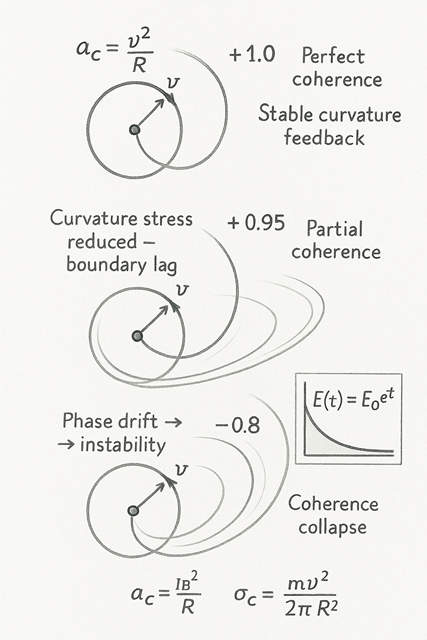
# Expresses centripetal acceleration as the curvature feedback maintaining circular motion.
# Links linear velocity, angular velocity, curvature radius, and boundary coherence (IB).
# Captures how coherent curvature tension provides inward acceleration, and how loss (IB < 1)
# introduces orbital drift, instability, or radial oscillation.
# ---------- PARAMETERS ----------
params:
units: "SI"
IB: 0.0..1.0 = 1.0 # boundary coherence index (1 = perfectly circular motion)
m: positive # particle mass [kg]
R: positive # radius of curvature [m]
v: positive # tangential speed [m/s]
G: positive = 6.67430e-11 # optional gravitational constant [m^3/kg/s^2]
include_gravity: false
loss_coeff: 0.0 # optional damping or coherence decay [s^-1]
dt: 0.0? # timestep for update [s]
# ---------- STATE ----------
state Motion:
ω: real # angular velocity [rad/s]
a_c: real # centripetal acceleration [m/s^2]
F_c: real # centripetal force [N]
F_t: real # tangential force (if non-zero) [N]
ΔR: real # radial drift (if IB < 1) [m]
E_kin: real # kinetic energy [J]
E_pot: real? # optional potential energy (gravitational) [J]
E_tot: real # total energy [J]
curvature_stress: real # effective inward curvature stress [N/m²]
# ---------- INVARIANTS ----------
invariants:
# Angular velocity ω = v / R
Motion.ω = params.v / params.R
# Centripetal acceleration a_c = IB * v² / R
Motion.a_c = params.IB * (params.v^2 / params.R)
# Centripetal force F_c = m a_c
Motion.F_c = params.m * Motion.a_c
# Kinetic energy E_k = ½ m v²
Motion.E_kin = 0.5 * params.m * params.v^2
# Optional gravitational potential for orbital context
if params.include_gravity:
Motion.E_pot = - params.IB * params.G * (params.m^2 / params.R)
Motion.E_tot = Motion.E_kin + Motion.E_pot
else:
Motion.E_tot = Motion.E_kin
# Effective curvature stress σ = F_c / A (A = 2πR × unit width assumed)
Motion.curvature_stress = Motion.F_c / (2*pi*params.R)
# Radial drift when IB < 1
Motion.ΔR = (1 - params.IB) * params.R * 0.01 # small geometric offset (1% of loss)
# ---------- TRANSFORMS ----------
transforms:
# Update radius and speed when IB changes (simulate coherence loss)
update_motion (when params.dt > 0):
params.R += Motion.ΔR
params.v = sqrt(Motion.a_c * params.R / max(params.IB, 1e-9))
Motion.ω = params.v / params.R
if params.loss_coeff > 0:
params.IB = params.IB - params.loss_coeff * params.dt
params.IB = clamp(params.IB, 0, 1)
# Optional feedback restoring coherence (spring-like correction)
curvature_feedback:
correction = (1 - params.IB) * (params.v^2 / params.R)
Motion.a_c += correction
params.IB = clamp(params.IB + 0.001 * correction, 0, 1)
# ---------- MONITORS ----------
monitors:
stability_check:
if params.IB >= 0.99:
comment: "Perfectly stable circular motion."
elif params.IB >= 0.9:
comment: "Slight coherence loss; mild radial oscillation."
else:
comment: "Curvature instability — orbit may spiral or collapse."
energy_consistency:
assert Motion.E_kin >= 0
if params.include_gravity:
assert Motion.E_tot < 0 when stable orbit
curvature_balance:
assert abs(Motion.a_c - params.v^2/params.R * params.IB) < 1e-9
# ---------- SCENES ----------
scenes:
ideal_circle:
given params:
m: 1.0
R: 10.0
v: 10.0
IB: 1.0
expect:
Motion.a_c = v²/R = 10.0
Motion.F_c = 10.0 N
comment: "Perfect coherence — uniform circular motion."
partial_instability:
given params:
m: 1.0
R: 10.0
v: 10.0
IB: 0.95
expect:
Motion.a_c = 0.95 * (v²/R)
Motion.ΔR ≈ 0.5% of R
comment: "Slight curvature loss causes radial drift; system remains quasi-stable."
decaying_motion:
given params:
m: 1.0
R: 10.0
v: 10.0
IB: 1.0
loss_coeff: 0.001
dt: 0.1
enable:
- update_motion
expect:
params.IB ↓
Motion.a_c ↓
Motion.ΔR ↑
comment: "Gradual coherence decay leads to spiraling orbit."
gravitational_orbit:
given params:
include_gravity: true
G: 6.67430e-11
m: 1000
R: 7e6
v: 7546
IB: 1.0
expect:
Motion.E_tot ≈ -0.5 * G m² / R
comment: "Gravitational balance between curvature stress and potential well."
# ---------- NOTES ----------
notes:
- **Centripetal acceleration:** \( a_c = v^2 / R \)
- **Force balance:** \( F_c = m v^2 / R \)
- **Angular velocity:** \( \omega = v / R \)
- **Curvature stress:** inward field tension maintaining boundary coherence.
- **Boundary coherence:** IB modulates how fully curvature is transmitted; IB = 1 → ideal circular motion.
- **Loss:** IB < 1 introduces radial drift or instability — curvature tension insufficient to maintain orbit.
- **Energy balance:** total energy constant when IB = 1, decays when loss_coeff > 0.
- **Feedback view:** curvature tension acts as the system’s self-correcting memory, keeping motion aligned to geometry.
- **Analogy:** in orbital systems, gravity provides curvature stress; in mechanical systems, tension or centripetal constraint does.
- **Interpretation:** curvature stability reflects the system’s ability to preserve coherent feedback between motion and boundary geometry.
Circular motion is not a property of velocity, but of curvature feedback.
An object moving in a circle must continuously turn its velocity vector — requiring an inward acceleration that balances the outward inertia of motion.
This inward pull, the centripetal force, is not a separate entity; it is the boundary stress maintaining geometric coherence.
When that stress weakens, the path unravels — the circle opens into a spiral, and curvature loses its memory.
In this flow, coherence () measures how faithfully a system preserves that memory.
When , the orbit is perfectly closed; when , curvature feedback lags, producing radial drift and oscillation.
The essential geometry of uniform circular motion:
$$ a_c = \frac{v^2}{R}, \qquad F_c = m a_c = m\,\frac{v^2}{R}. $$
This acceleration does not arise from an external “centripetal” agent,
but from internal coherence — the boundary’s capacity to continually redirect motion along a closed curvature path.
When coherence is partial (), only a fraction of curvature tension is transmitted:
$$ a_c = \frac{v^2}{R}, \qquad F_c = m a_c = m\,\frac{v^2}{R}. $$
The remainder of the field memory is lost, leading to slow outward drift:
$$ \Delta R = (1 - I_B)\,R\,\varepsilon, \qquad (\varepsilon \approx 0.01). $$
The system’s geometry thus becomes its feedback integrator: the path itself encodes how well motion and curvature remain in resonance.
Angular velocity links linear motion and geometry:
$$ \omega = \frac{v}{R}. $$
A constant implies perfect coherence: each angular step matches its geometric curvature exactly.
When coherence declines, becomes phase-shifted — small lags accumulate, creating precession or drift.
The boundary’s curvature stress acts as the restoring tension resisting that phase slip:
$$ \sigma_c = \frac{F_c}{2\pi R} = \frac{m v^2}{2\pi R^2}. $$
At perfect coherence (), this stress closes on itself, forming a static equilibrium of curvature and inertia.
$$ E_k = \frac{1}{2} m v^2. $$
In gravitational or orbital contexts, the potential energy curve supplies the exact opposing gradient:
$$ E_p = -\,I_B\,\frac{G\,m^2}{R}. $$
At equilibrium:
$$ E_k + E_p = \text{constant}. $$
This reflects a phase-balanced curvature feedback — motion feeding into field tension, tension feeding back into motion.
Loss of coherence (through friction, drag, or misalignment) perturbs this balance,
causing energy to leak slowly from the system:
$$ \dot{E} = -\lambda\,|E|. $$
As energy drains, curvature relaxes, and the orbit or rotation expands into instability.
Centripetal motion is an ongoing negotiation between inertia (which wants to move straight)
and coherence (which insists on turning).
This feedback can be summarized
$$ a_c = \frac{v^2}{R}, \qquad \frac{d a_c}{dt} = -\lambda(1 - I_B). $$
A coherent system () continuously regenerates curvature tension — energy circulates in phase with motion.
An incoherent one lags: the feedback delay causes cumulative radial deviation, producing oscillations or runaway instability.
In the extreme case (), curvature tension vanishes entirely — the motion becomes linear.
The circle collapses to a line: perfect inertia, zero memory.
Centripetal force is not a force at all — it is curvature memory in motion.
A coherent boundary continually realigns momentum with geometry, keeping the motion closed and stable.
When coherence is high, the system sustains perfect symmetry; when it decays, geometry begins to forget —
paths open, energy diffuses, and the memory of curvature fades into linear motion.
In this sense, stability itself is a feedback loop of coherence:
every circular path is a conversation between form, motion, and memory —
a perfect spiral of physics and geometry held together by the quiet tension of space.