
Chapter 55
Heisenberg Uncertainty as Phase Limit

Quantum Coherence and Boundary Systems
Author: Mark Anthony Higgins
© Mark Anthony Higgins 11 October 2025
Revised Date: 23 February 2026
Audio Overview
Flow Algebra
flow "Heisenberg Uncertainty as Phase Limit" v1.0


# ---------- PURPOSE ----------
# Expresses the Heisenberg uncertainty relations as a boundary on phase information (phase-space area).
# The fundamental limit: Δx Δp ≥ ħ/2 and Δt ΔE ≥ ħ/2.
# IB measures coherence of the quantum state; loss of coherence increases observed variances (never reduces the bound).
# Squeezing redistributes variance between conjugate pairs while preserving the minimum phase-area.

# ---------- PARAMETERS ----------
params:
  units: "SI"
  ħ: real = 1.054_571_817e-34    # reduced Planck constant [J·s]
  IB: 0.0..1.0 = 1.0              # coherence index (1 = pure/coherent state)
  α_excess: nonnegative = 1.0     # scales variance inflation from decoherence
  include_time_energy: bool = true
  ω0: positive?                   # reference frequency (for HO ground-state scaling)
  m: positive?                    # mass for HO example [kg]
  r: real = 0.0                   # squeezing parameter (+x-squeezed, -p-squeezed)
  dt: positive?                   # timestep for coherence dynamics
  λ_decoh: nonnegative = 0.0      # decoherence rate [s^-1]

# ---------- STATE ----------
state Phase:
  Δx: positive                    # position standard deviation [m]
  Δp: positive                    # momentum standard deviation [kg·m/s]
  A_min: real                     # minimal phase-area bound (ħ/2)
  A_obs: real                     # observed phase-area Δx Δp
  χ_excess: real                  # excess factor from coherence loss ≥ 1
  Δt: positive?                   # time uncertainty [s]
  ΔE: positive?                   # energy uncertainty [J]
  purity_hint: str                # "pure-like", "mixed", or "diffuse"
  regime: str                     # "minimum", "squeezed", "inflated"

# ---------- INVARIANTS ----------
invariants:

  # Fundamental bound on phase-area
  Phase.A_min = params.ħ / 2

  # Excess uncertainty from coherence loss (≥ 1)
  Phase.χ_excess = 1 + params.α_excess * (1 - params.IB)

  # If HO scaling supplied, set minimal-uncertainty (r=0) widths as reference
  if params.ω0 is defined and params.m is defined:
    Δx0 = sqrt(params.ħ / (2 * params.m * params.ω0))
    Δp0 = sqrt(params.ħ * params.m * params.ω0 / 2)
  else:
    # Fallback neutral scales (user can overwrite via scenes)
    Δx0 = 1.0
    Δp0 = params.ħ / (2 * Δx0)

  # Squeezed variances (redistribute while preserving ΔxΔp = ħ/2 for pure states)
  Δx_squeezed = Δx0 * exp(+params.r)
  Δp_squeezed = Δp0 * exp(-params.r)

  # Apply coherence inflation (cannot reduce the bound)
  Phase.Δx = Δx_squeezed * sqrt(Phase.χ_excess)
  Phase.Δp = Δp_squeezed * sqrt(Phase.χ_excess)

  # Observed phase-area
  Phase.A_obs = Phase.Δx * Phase.Δp

  # Time–energy (optional, phenomenological envelope)
  if params.include_time_energy and Phase.Δt is defined and Phase.ΔE is defined:
    assert Phase.Δt * Phase.ΔE >= params.ħ / 2

  # Purity / regime classification
  if abs(Phase.A_obs - Phase.A_min) <= 1e-12:
    Phase.purity_hint = "pure-like"
    Phase.regime = (params.r == 0) ? "minimum" : "squeezed"
  elif Phase.A_obs > Phase.A_min:
    Phase.purity_hint = (params.IB > 0.5) ? "mixed" : "diffuse"
    Phase.regime = "inflated"

  # Coherence dynamics (optional)
  if params.λ_decoh > 0 and params.dt is defined:
    params.IB = clamp(params.IB - params.λ_decoh * (1 - params.IB) * params.dt, 0, 1)

# ---------- TRANSFORMS ----------
transforms:

  squeeze_position:
    comment: "Increase r to reduce Δp and enlarge Δx (x-squeezing)."
    params.r += Δr

  squeeze_momentum:
    comment: "Decrease r to reduce Δx and enlarge Δp (p-squeezing)."
    params.r -= Δr

  apply_measurement_x:
    comment: "Projective x-measurement narrows Δx and inflates Δp to obey area bound."
    Phase.Δx = Phase.Δx * β_narrow       # 0 < β_narrow < 1
    Phase.Δp = max(Phase.A_min / Phase.Δx, Phase.Δp)
    Phase.A_obs = Phase.Δx * Phase.Δp

  apply_decoherence:
    comment: "Environment couples in phase noise — increases excess factor."
    params.IB = clamp(params.IB - γ * (1 - params.IB), 0, 1)  # γ ≥ 0
    Phase.χ_excess = 1 + params.α_excess * (1 - params.IB)

# ---------- MONITORS ----------
monitors:
  heisenberg_bound:
    assert Phase.A_obs >= Phase.A_min - 1e-15
    comment: "Phase-area obeys ΔxΔp ≥ ħ/2."

  squeezing_invariant:
    if params.IB == 1:
      assert abs((Δx_squeezed * Δp_squeezed) - Phase.A_min) <= 1e-12
      comment: "Pure squeezed states preserve the minimal area."

  coherence_bounds:
    assert 0 <= params.IB <= 1

# ---------- SCENES ----------
scenes:

  minimal_gaussian:
    given params:
      ħ: 1.054571817e-34
      m: 9.11e-31
      ω0: 1.0e15
      r: 0.0
      IB: 1.0
    expect:
      Phase.regime = "minimum"
      Phase.A_obs = Phase.A_min
      comment: "Coherent (minimum-uncertainty) Gaussian state."

  x_squeezed_p_antisqueezed:
    given params:
      ħ: 1.054571817e-34
      m: 9.11e-31
      ω0: 1.0e15
      r: +0.7
      IB: 1.0
    expect:
      Phase.regime = "squeezed"
      Phase.A_obs = Phase.A_min
      Phase.Δx > Δx0
      Phase.Δp < Δp0
      comment: "Area conserved; variance redistributed (x broader, p narrower)."

  decohered_mixed_state:
    given params:
      ħ: 1.054571817e-34
      m: 9.11e-31
      ω0: 1.0e15
      r: 0.0
      IB: 0.6
      α_excess: 1.0
    expect:
      Phase.regime = "inflated"
      Phase.A_obs > Phase.A_min
      comment: "Decoherence inflates variances; area strictly above the bound."

  projective_x_measurement:
    given params:
      ħ: 1.054571817e-34
      m: 9.11e-31
      ω0: 1.0e15
      r: 0.0
      IB: 1.0
    enable:
      - apply_measurement_x
    expect:
      Phase.Δx ↓
      Phase.Δp ↑
      Phase.A_obs ≥ Phase.A_min
      comment: "Measurement narrows x and necessarily broadens p to respect ΔxΔp ≥ ħ/2."

# ---------- NOTES ----------
notes:
  - **Heisenberg Bound:**  
    \[
    \Delta x\,\Delta p \;\ge\; \frac{\hbar}{2}, \qquad
    \Delta t\,\Delta E \;\ge\; \frac{\hbar}{2}.
    \]
    This is a limit on **phase information density**: a minimal area in the \((x,p)\) plane.

  - **Squeezing:**  
    For pure Gaussian states,
    \[
    \Delta x = \Delta x_0\,e^{+r},\quad
    \Delta p = \Delta p_0\,e^{-r},\quad
    \Delta x\,\Delta p = \frac{\hbar}{2}.
    \]
    Squeezing **redistributes** variances while preserving minimal area.

  - **Coherence Inflation:**  
    Decoherence cannot reduce the bound; it **inflates** observed variances:
    \[
    \Delta x\,\Delta p = \frac{\hbar}{2}\,\chi_{\text{excess}},\quad \chi_{\text{excess}}\ge 1.
    \]

  - **Measurement Back-Action:**  
    Any narrowing of one observable implies compensating broadening of its conjugate to maintain the area constraint.

  - **Interpretation (HST–Flow):**  
    The uncertainty relations are **phase-limit boundaries** — the smallest coherent loop in phase space.  
    Coherence \(I_B\) governs how close a real system sits to that boundary; loss of coherence pushes the state **outward** (larger area), never inward.

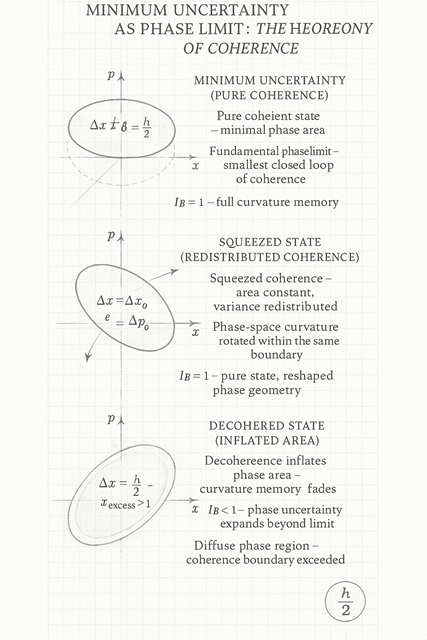
  - **Visualization:**  
    - Left: phase-space ellipse at minimal area (coherent state).  
    - Middle: squeezed ellipse (same area, rotated axes).  
    - Right: inflated ellipse under decoherence (area increased).
Overview

Uncertainty is not a flaw in measurement — it is a property of coherence itself.
It marks the limit of phase definition: the smallest possible loop in the geometry of motion.
At this scale, position and momentum, or time and energy, cannot both be perfectly known because they are not independent quantities — they are dual expressions of the same curvature viewed from orthogonal directions in phase space.

Heisenberg’s uncertainty principle does not describe ignorance, but the minimal unit of structure through which the universe maintains coherence.


🔹 1. Classical Form — The Bound on Precision

Classically, the uncertainty relations are expressed as:

\[ \Delta x\,\Delta p \ge \frac{\hbar}{2}, \qquad \Delta t\,\Delta E \ge \frac{\hbar}{2} \]

They define the minimal product of uncertainties between conjugate quantities.
One can sharpen position only by blurring momentum, and vice versa.
This reciprocity is not due to measurement disturbance, but because these quantities share the same underlying phase surface.

Just as a circle’s circumference and radius are linked by a fixed geometry,
the spreads Δx\Delta x and Δp\Delta p are bound by the same invariant:
the phase-space area Amin=ℏ/2A_\text{min} = \hbar / 2.


🔸 2. Phase-Space Interpretation — The Boundary of Coherence

In the coherence framework, uncertainty is a phase-limit, not a probability blur.
Each quantum state occupies a finite region of curvature in the (x,p)(x, p) plane — a loop of constant area that cannot be reduced without breaking coherence.
At full coherence (IB=1I_B = 1), this loop has the minimal area:

\[ A_{\text{min}} = \frac{\hbar}{2} \]

Any attempt to compress one axis (e.g., reduce Δx\Delta x) must expand the other (Δp\Delta p) to keep the area constant — preserving total curvature memory.

This principle is the foundation of squeezed states, where the field’s uncertainty is redistributed, not reduced.
The loop distorts into an ellipse, narrower along one axis, wider along the other — the total area unchanged.


🔹 3. Squeezing and Redistribution of Variance

For a pure Gaussian or harmonic oscillator state:

\[ \Delta x = \Delta x_0 e^{+r}, \qquad \Delta p = \Delta p_0 e^{-r}, \qquad \Delta x\,\Delta p = \frac{\hbar}{2} \]

The parameter rr defines the squeezing — a controlled rebalancing of uncertainty between position and momentum.
This shows that even at the quantum limit, the field can reshape its internal curvature distribution, provided coherence remains intact.
Squeezing does not violate Heisenberg; it expresses the freedom to rotate the phase ellipse within a fixed total area.


🔸 4. Decoherence — Inflation of the Phase Area

When coherence decays ( 𝐼 𝐵 < 1 ), the phase-loop expands:

\[ \Delta x\,\Delta p = \frac{\hbar}{2}\,\chi_{\text{excess}}, \qquad \chi_{\text{excess}} \ge 1 \]

Decoherence adds random phase components, inflating the ellipse into a larger, diffuse region.
No process can shrink it below the bound — coherence loss always increases uncertainty.

The relationship

\[ \dot{I_B} = -\lambda (1 - I_B) \]

governs the drift from pure to mixed states: a gradual diffusion of phase memory into the environment.
Where λ=0\lambda = 0, the system remains perfectly coherent; as λ\lambda increases, uncertainty expands and structure fades.


🔹 5. Measurement — Phase Collapse and Realignment

When a measurement constrains one observable (e.g., xx), the conjugate variable (pp) expands to restore the bound.
This is not collapse in a mystical sense, but rebalancing of coherence geometry.
The act of measurement does not destroy the wavefunction; it re-anchors one axis of the phase loop, forcing the other to compensate.

Thus, Heisenberg’s limit is not a barrier but a conservation rule — the universe’s way of ensuring no coherence loop shrinks beyond stability.


🔸 6. Unified Coherence Framework — The Phase Loop as a Unit of Reality

In HST–Flow terms, the uncertainty principle defines the first curvature quantum:
the minimal loop through which reality can sustain itself without contradiction.
Each physical system occupies nested phase loops; interactions are exchanges of curvature between them.
Squeezing, decoherence, and measurement are simply re-mappings of coherence within that invariant area.

This unites the probabilistic interpretation of quantum mechanics with geometric logic:
the wavefunction’s spread is not random — it is the shape of its coherence.


🧠 Summary

Heisenberg’s uncertainty is not uncertainty — it is phase conservation.
It expresses the smallest self-consistent loop in phase space, the minimal curvature memory a system can hold.

In the HST–Flow interpretation:

  • ΔxΔp ≥ ħ/2 defines the lower bound of coherent geometry
  • Squeezing redistributes curvature within the bound.
  • Decoherence inflates the area as coherence fades
  • Measurement rebalances axes to preserve phase continuity.

Thus, uncertainty becomes not a limit of knowledge but a limit of structure —
the point where coherence and geometry merge into the smallest loop the universe can draw.

The Planck loop is the first memory of reality —
the smallest circle of coherence that can still remember itself.


Kireth Research
38 Thorndale Croft, Wetwang, Driffield
East Riding of Yorkshire YO25 9XZ
Designed By