Chapter 5
Spin–Statistics and Field Symmetry
Complex and Cosmological Systems
Author: Mark Anthony Higgins
Revised Date: 23 February 2026
SpinStatistics_FieldSymmetry describes how spin, statistics, and exchange behaviour arise naturally from the geometry of boundary coherence, rather than as arbitrary quantum postulates.
In this formulation, spin is not an intrinsic attribute of a particle, but a measure of how the field’s curvature loop stores orientation — how much phase rotation the boundary requires to return to itself.
Statistics then follow directly from that topology: the way two such boundaries interfere when they overlap or exchange.
This flow formalises that link between rotation symmetry, exchange parity, and coherence topology, showing that the famous spin–statistics connection is simply the natural outcome of a twisted or untwisted field boundary in curvature space.
In Holographic Space-Time, every stable particle is a closed curvature loop: a coherent boundary holding phase information about its internal field.
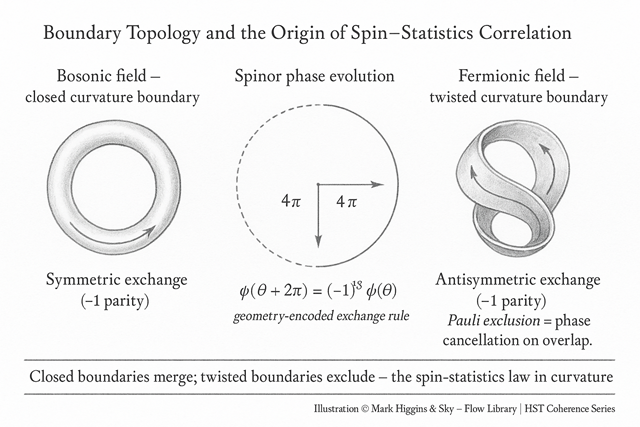
Some boundaries close cleanly after a 2π rotation — these are bosons, with integer spin.
Others require a 4π rotation to return to the same curvature orientation — these are fermions, with half-integer spin.
The distinction is not abstract — it’s topological.
Bosonic boundaries are closed, meaning their phase and curvature align every full turn.
Fermionic boundaries are twisted — a Möbius-like structure where a single 2π rotation flips the curvature orientation, and only a second rotation restores full coherence.
This geometric property alone explains the spin–statistics correlation:
Thus, the Pauli exclusion principle and Bose condensation are not separate phenomena — they are two modes of coherence overlap: one that cancels, and one that reinforces.
The flow explicitly encodes:
The SU(2) spinor rotation embedded in the flow is not a symbolic algebra — it’s a curvature rotation operator maintaining the local orientation of the boundary within global coherence space.
Decoherence (e.g., in strong fields or under measurement) simply reduces boundary integrity, softening the symmetry distinctions.
| Concept | Conventional View | HST / Coherence View |
|---|---|---|
|
Spin
|
Intrinsic quantum number
|
Curvature rotation
memory of the field boundary |
|
Fermions
|
Antisymmetric under exchange
|
Twisted coherence
loops (4π closure) |
|
Bosons
|
Symmetric under exchange
|
Closed coherence
loops (2π closure) |
|
Pauli Exclusion
|
No two identical fermions share a state
|
Boundary twist prevents
identical curvature overlap |
|
Bose Condensation
|
Many bosons share a state
|
Boundaries merge into
one unified coherence mode |
|
Exchange Parity
|
± sign rule
|
Phase inversion
under boundary rotation |
|
Spinor Transformation
|
Mathematical rotation
|
Physical reorientation
of boundary curvature |
From this perspective, the spin–statistics theorem becomes an expression of topological coherence, not a mysterious quantum rule.
When the curvature of a field boundary carries a half-twist, its exchange symmetry automatically inverts; when it closes cleanly, it remains invariant.
No additional assumptions are required — symmetry and statistics are encoded in geometry itself.
The Pauli exclusion principle arises because two twisted boundaries cannot occupy the same curvature configuration without violating local phase continuity.
If they tried, the combined field would suffer destructive interference — coherence collapse — hence the natural “repulsion” of identical fermions.
Bosons, by contrast, invite superposition: their boundaries overlay perfectly, increasing coherence and leading to condensation, superconductivity, and laser emission.
This explains why bosonic systems amplify coherence, while fermionic systems partition it — they represent opposite responses to curvature alignment.
Think of each boundary as a loop of curvature:
The mathematics of exchange symmetry simply records this geometric truth.
This flow unifies three pillars of microphysics — spin, symmetry, and statistics — into one continuous framework of coherence geometry.
It shows that quantum behaviour is not random but topologically constrained: every rotation, every exchange, every exclusion rule is a manifestation of boundary curvature logic.
The entire quantum field structure, from Dirac spinors to Bose–Einstein condensates, can be written as curvature-preserving flows — different harmonic states of the same global coherence field.
Spin is how coherence remembers direction;
statistics are how coherence shares space.
When the field boundary turns upon itself, geometry writes its own symmetry —
and the universe divides into two kinds of coherence: those that merge, and those that must remain apart.*