
Chapter 42
Newton’s Third Law — Reciprocal Coherence

Motion and Inertial Coherence
Author: Mark Anthony Higgins
© Mark Anthony Higgins 11 October 2025
Revised Date: 23 February 2026
Audio Overview
Flow Algebra
flow "Newton’s Third Law — Reciprocal Coherence" v1.0


# ---------- PURPOSE ----------
# Expresses Newton’s Third Law (for every action there is an equal and opposite reaction)
# as a law of reciprocal coherence. The interaction between two bodies is modelled as
# a feedback loop in momentum and curvature exchange. Perfect coherence (IB = 1)
# produces equal and opposite forces, maintaining total system symmetry.
# Partial coherence (IB < 1) introduces phase lag, asymmetry, or energy leakage
# between the interacting boundaries (representing imperfect transmission or delayed feedback).

# ---------- PARAMETERS ----------
params:
  units: "SI"
  m1: positive                # mass of body 1 [kg]
  m2: positive                # mass of body 2 [kg]
  F12: vec3                   # force on body 1 due to body 2 [N]
  F21: vec3                   # force on body 2 due to body 1 [N]
  IB: 0.0..1.0 = 1.0          # coherence index (1 = perfect reciprocity)
  phase_lag: real = 0.0       # feedback delay fraction (0 = synchronous, >0 = lag)
  loss_coeff: 0.0             # fractional loss (dissipation factor) [s^-1]
  dt: 0.0?                    # timestep [s]
  include_feedback: true

# ---------- STATE ----------
state Interaction:
  F_total: vec3               # net force sum (should be ≈ 0 for IB = 1)
  p1: vec3                    # momentum of body 1 [kg·m/s]
  p2: vec3                    # momentum of body 2 [kg·m/s]
  dp1_dt: vec3                # rate of change of p1 [N]
  dp2_dt: vec3                # rate of change of p2 [N]
  E_exchange: real            # energy transferred between bodies [J]
  reciprocity_error: real     # |F12 + F21| magnitude [N]
  coherence_rate: real        # dIB/dt rate
  symmetry_state: str         # "reciprocal", "asymmetric", "dissipative"

# ---------- INVARIANTS ----------
invariants:

  # Third Law ideal symmetry
  Interaction.F_total = params.F12 + params.F21

  # Perfect coherence (IB = 1) → F12 = -F21
  if params.IB == 1 and params.phase_lag == 0:
    params.F21 = -params.F12
    Interaction.symmetry_state = "reciprocal"
  else:
    # Phase-lagged and damped reciprocity
    phase_factor = (1 - params.phase_lag)
    params.F21 = -params.IB * phase_factor * params.F12
    Interaction.symmetry_state = "asymmetric"

  # Momentums
  Interaction.dp1_dt = params.F12
  Interaction.dp2_dt = params.F21
  Interaction.p1 += Interaction.dp1_dt * (params.dt or 0)
  Interaction.p2 += Interaction.dp2_dt * (params.dt or 0)

  # Energy exchange per unit time (power)
  Interaction.E_exchange = dot(params.F12, (Interaction.p1 / params.m1)) * (params.dt or 1)

  # Reciprocity error (measure of non-coherence)
  Interaction.reciprocity_error = norm(params.F12 + params.F21)

  # Coherence decay law (if feedback enabled)
  if params.include_feedback:
    Interaction.coherence_rate = -params.loss_coeff * (1 - params.IB)
  else:
    Interaction.coherence_rate = 0

  # Dissipative correction
  if params.loss_coeff > 0:
    params.F12 *= exp(-params.loss_coeff * (params.dt or 0))
    params.F21 *= exp(-params.loss_coeff * (params.dt or 0))
    Interaction.symmetry_state = "dissipative"

# ---------- TRANSFORMS ----------
transforms:

  # Coherence feedback (restores IB gradually when symmetry improves)
  coherence_feedback:
    correction = -0.01 * Interaction.reciprocity_error
    params.IB = clamp(params.IB + correction, 0, 1)

  # Update over time
  propagate (when params.dt > 0):
    Interaction.p1 += Interaction.dp1_dt * params.dt
    Interaction.p2 += Interaction.dp2_dt * params.dt
    Interaction.E_exchange += dot(params.F12, (Interaction.p1 / params.m1)) * params.dt

# ---------- MONITORS ----------
monitors:
  reciprocity_check:
    if params.IB == 1:
      assert norm(params.F12 + params.F21) <= 1e-9
    elif params.IB < 1:
      comment: "Asymmetry in action–reaction pair — partial coherence."
  energy_conservation:
    if params.IB == 1:
      assert abs(Interaction.E_exchange) <= 1e-9
    else:
      comment: "Energy asymmetry due to coherence loss or phase lag."
  coherence_bounds:
    assert 0 <= params.IB <= 1

# ---------- SCENES ----------
scenes:

  perfect_reciprocity:
    given params:
      m1: 1.0
      m2: 1.0
      F12: [5.0, 0.0, 0.0]
      IB: 1.0
      dt: 1.0
    expect:
      F21 = [-5.0, 0.0, 0.0]
      Interaction.reciprocity_error ≈ 0
      comment: "Equal and opposite forces — perfect reciprocity (IB = 1)."

  partial_reciprocity:
    given params:
      m1: 1.0
      m2: 1.0
      F12: [5.0, 0.0, 0.0]
      IB: 0.9
      dt: 1.0
    expect:
      F21 ≈ [-4.5, 0.0, 0.0]
      Interaction.reciprocity_error > 0
      comment: "Slight phase or energy lag — partial coherence, asymmetric exchange."

  delayed_feedback:
    given params:
      m1: 1.0
      m2: 1.0
      F12: [10.0, 0.0, 0.0]
      IB: 0.95
      phase_lag: 0.1
      dt: 0.1
    expect:
      F21 ≈ [-8.55, 0.0, 0.0]
      Interaction.symmetry_state = "asymmetric"
      comment: "Delayed feedback in curvature transmission — partial lag in reciprocal response."

  dissipative_collision:
    given params:
      m1: 2.0
      m2: 2.0
      F12: [10.0, 0.0, 0.0]
      IB: 0.8
      loss_coeff: 0.05
      dt: 0.5
    enable:
      - propagate
    expect:
      Interaction.reciprocity_error > 0
      Interaction.symmetry_state = "dissipative"
      comment: "Energy lost during interaction — reaction weaker than action."

# ---------- NOTES ----------
notes:
  - **Newton’s Third Law:** For every action, there is an equal and opposite reaction.
  - In this flow, the law is expressed as *reciprocal coherence*: momentum and curvature exchange across boundaries.
  - Ideal reciprocity: \( \mathbf{F}_{12} = -\mathbf{F}_{21} \), \( I_B = 1 \).
  - Partial reciprocity: \( \mathbf{F}_{21} = -I_B(1 - \phi)\mathbf{F}_{12} \), where \(\phi\) is phase lag.
  - **Momentum conservation:** total momentum constant when IB = 1.
  - **Energy balance:** asymmetry (\(I_B < 1\)) represents energy loss, phase delay, or imperfect coupling.
  - **Coherence view:** action and reaction are mirror states — two halves of one coherent exchange loop.
  - **Feedback law:** \( \dot{I_B} = -\lambda(1 - I_B) \) captures the rate of coherence recovery or loss.
  - **Interpretation:** the Third Law is not merely equality of forces, but the conservation of **reciprocal geometry** —
    each force curve is the reflection of the other’s curvature in phase space.
  - **Visualisation:** plot F12 vs F21 and IB over time to see perfect symmetry (mirror line) or lagging reciprocity under coherence decay.
Overview

Newton’s Third Law — for every action, there is an equal and opposite reaction — expresses not just physical opposition but reciprocal coherence.
When two bodies interact, they form a shared boundary through which momentum, stress, and curvature are exchanged.
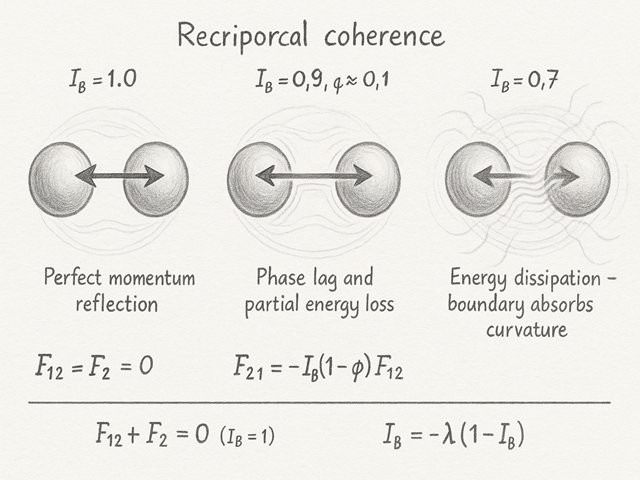
If that exchange is perfectly coherent (IB=1I_B = 1), the interaction is symmetric — every action produces an equal counter-action, conserving both energy and geometry.
When coherence decays (IB<1I_B < 1), the feedback weakens — one side responds slightly later or with less amplitude.
The result is phase lag, asymmetry, or loss — the physical signs of decoherent reciprocity.


🔹 1. Action and Reaction as Feedback Exchange

In classical form:

$$ \mathbf{F}_{12} = -\,\mathbf{F}_{21}. $$

These two forces are not independent. They are two ends of the same feedback loop — a coherent transfer of momentum through the shared curvature field.

The momentum continuity equation:

$$ F = \frac{d p}{d t}. $$

applies equally to both participants:

$$ \mathbf{F}_{12} = \frac{d\mathbf{p}_1}{dt}, \qquad \mathbf{F}_{21} = \frac{d\mathbf{p}_2}{dt}. $$

When the feedback between them is perfect (IB=1I_B=1),

$$ \mathbf{F}_{12} + \mathbf{F}_{21} = 0. $$

ensuring conservation of total momentum and perfect phase alignment.


🔸 2. Boundary Coherence and Asymmetry

Coherence between interacting boundaries determines how faithfully each side reflects the other’s force.
We write:

$$ \mathbf{F}_{21} = -\,I_B(1 - \phi)\,\mathbf{F}_{12}. $$

where IBI_B is the boundary coherence index and ϕ\phi is a small phase lag parameter.

  • IB=1,ϕ=0I_B = 1, \phi = 0: perfect symmetry, immediate feedback.
  • IB<1I_B < 1: partial coherence — delayed or attenuated response.
  • IB→0I_B \to 0: one boundary fully absorbs energy without reflection — pure dissipation.

In physical systems, IB<1I_B < 1 represents real processes like inelastic collisions, frictional damping, or delayed transmission of stress across deformable media.


🔹 3. Momentum Exchange and Energy Flow

The rate of change of momentum links directly to the power exchanged across the boundary:

$$ P = \mathbf{F} \cdot \mathbf{v} = \frac{dE}{dt}. $$

When the action and reaction are coherent, power flow is balanced — energy oscillates symmetrically between the two participants.

When coherence decays, power flow becomes non-reciprocal:
one side gains less energy than the other loses, and the remainder disperses as heat, vibration, or internal deformation.

This loss is captured phenomenologically by:

$$ \dot{I}_B = -\lambda(1 - I_B). $$

indicating that the degree of coherence (and thus reciprocity) decays at a rate λ\lambda.


🔸 4. Reciprocal Geometry and the Law of Reflection

Every force exists within a geometric mirror.
Forces always appear in pairs because every action is the curvature of another boundary.
When one surface pushes, the other curves inward; when one contracts, the other expands.
This symmetry ensures not just energy conservation, but geometric continuity — the universe maintaining its internal coherence through mirrored exchange.

In HST terms, Newton’s Third Law is the expression of field reciprocity:
the conservation of curvature between two coherent boundaries.
The reaction is not a separate event but the reflection of the action’s curvature pattern across a shared surface.


🔹 5. Coherence, Lag, and Dissipation

When coherence drops (IB<1I_B < 1), the reflection becomes blurred.
A phase lag ϕ\phi develops between action and reaction, creating a measurable imbalance:

$$ |\mathbf{F}_{12} + \mathbf{F}_{21}| > 0. $$

This is observed macroscopically as damping, hysteresis, or asymmetric collisions — systems where energy exchange is incomplete.

If the boundary regains coherence (IB˙>0\dot{I_B} > 0), symmetry can be restored.
Thus, reaction symmetry becomes a measure of field health — a diagnostic of how faithfully the universe maintains its curvature integrity.


🧠 Summary

Newton’s Third Law is not simply mechanical opposition — it is reciprocal coherence:
the perfect exchange of curvature, momentum, and energy between interacting boundaries.

  • Action = Reaction because both are the same process seen from opposite sides.
  • Force pairs are mirrors of curvature feedback — each completing the other’s geometry.
  • Loss of coherence (IB<1I_B < 1) breaks that mirror, leading to asymmetry, damping, and energy diffusion.

In this light, the Third Law is not a rule of opposition, but of balance through reflection —
a geometric law ensuring that every disturbance carries within it its own return wave —
a perfect curvature handshake that keeps the universe coherent.


Related Chapters
Kireth Research
38 Thorndale Croft, Wetwang, Driffield
East Riding of Yorkshire YO25 9XZ
Designed By