
Chapter 11
Galactic Resonance and Structural Equilibrium

Cosmological and Global Coherence
Author: Mark Anthony Higgins
© Mark Anthony Higgins 11 October 2025
Revised Date: 23 February 2026
Audio Overview
Flow Algebra
flow "GalacticResonance_StructuralEquilibrium"

# ---------- STATES ----------
state:
  galaxy.mass.baryonic: float           # total visible mass (M☉)
  galaxy.radius.R: float                # characteristic radius (kpc)
  rotation.v_obs: float                 # observed orbital velocity (km/s)
  rotation.v_model: float               # velocity predicted by baryonic gravity
  curvature.field_strength: float       # curvature density in galactic plane
  coherence.integrity: float            # 0..1, field stability measure
  coherence.resonance_amp: float        # amplitude of resonance oscillation
  boundary.tension: float               # curvature tension density (J/m³)
  resonance.energy: float               # stored resonance energy (J)
  coupling.factor: float                # coupling between baryonic and coherence field
  density.visible: float                # local baryonic density
  density.coherent: float               # additional coherence density (dark-mass analogue)
  equilibrium.state: str                # "stable", "drifting", "disrupted"
  time.t: float

# ---------- PARAMETERS ----------
params:
  G: 6.674e-11
  c: 2.998e8
  k_coh: float                          # curvature–coherence coupling constant
  k_damp: float                         # resonance damping rate
  ε_integrity_threshold: 0.985          # below this, structural drift begins
  dt: float

# ---------- INVARIANTS ----------
invariant:
  - total_density = density.visible + density.coherent
  - rotation.v_model = sqrt( (params.G * galaxy.mass.baryonic) / (galaxy.radius.R * 3.086e19) ) * 1e-3
  - rotation.v_obs² ∝ (curvature.field_strength + k_coh * resonance.energy)
  - equilibrium holds if |v_obs - v_model| ≤ tolerance(v_model)
  - density.coherent ∝ boundary.tension * (1 - coherence.integrity)
  - resonance.energy = ½ * boundary.tension * coherence.resonance_amp²
  - coherence.integrity ∈ [0,1]; lower values enhance dark-field coupling

# ---------- TRANSFORMS ----------
transform:

  initialise_galaxy:
    do:
      galaxy.mass.baryonic = 5e10       # M☉
      galaxy.radius.R = 15              # kpc
      coherence.integrity = 0.995
      boundary.tension = base_tension(galaxy.mass.baryonic, galaxy.radius.R)
      coherence.resonance_amp = 0.0
      curvature.field_strength = curvature_from_mass(galaxy.mass.baryonic)
      density.visible = mass_to_density(galaxy.mass.baryonic, galaxy.radius.R)
      density.coherent = 0.0
      time.t = 0

  compute_rotation_curves:
    do:
      rotation.v_model = sqrt((params.G * galaxy.mass.baryonic * 1.989e30) /
                              (galaxy.radius.R * 3.086e19)) * 1e-3  # km/s
      resonance_boost = sqrt(k_coh * boundary.tension * (1 - coherence.integrity))
      rotation.v_obs = rotation.v_model * (1 + resonance_boost)

  update_coherence_field:
    do:
      # curvature strain across disk induces standing resonance
      dAmp = field_drive(curvature.field_strength, coherence.integrity)
      damping = -params.k_damp * coherence.resonance_amp
      coherence.resonance_amp = max(coherence.resonance_amp + (dAmp + damping) * params.dt, 0)
      boundary.tension = tension_update(coherence.resonance_amp)
      density.coherent = boundary.tension * (1 - coherence.integrity)
      resonance.energy = 0.5 * boundary.tension * coherence.resonance_amp**2

  integrity_drift:
    do:
      ΔI = integrity_decay(curvature.field_strength, galaxy.radius.R)
      coherence.integrity = clamp(coherence.integrity - ΔI, 0, 1)

  check_equilibrium:
    do:
      diff = abs(rotation.v_obs - rotation.v_model)
      if diff / rotation.v_model < 0.1 and coherence.integrity > ε_integrity_threshold:
        equilibrium.state = "stable"
      elif coherence.integrity > 0.95:
        equilibrium.state = "drifting"
      else:
        equilibrium.state = "disrupted"

  tick:
    do:
      time.t += params.dt

# ---------- MONITORS ----------
monitor:
  rotation_profile:
    observe: [rotation.v_model, rotation.v_obs, galaxy.radius.R]
    report: "Observed velocity remains flat across large radii due to coherence resonance boosting curvature support."

  coherence_balance:
    observe: [coherence.integrity, coherence.resonance_amp, density.coherent]
    report: "Tracks how integrity loss drives resonance amplitude and apparent mass enhancement."

  structural_state:
    observe: [equilibrium.state, boundary.tension]
    report: "Stable when tension fluctuations are bounded; collapse or disruption if resonance runs away."

# ---------- NOTES (coherence view) ----------
note:
  - Galactic rotation curves flatten not due to hidden mass but due to **coherence resonance** in the curvature field.
  - The gravitational field of baryonic matter drives standing curvature oscillations in the galactic plane.
  - These oscillations store energy and modify the local curvature, appearing as an additional “mass density”.
  - The coherence field acts as a **stabilising resonance**, distributing curvature evenly and maintaining disk equilibrium.
  - When integrity drops slightly (~0.98–0.99), the resonance term boosts effective velocity by ~20–30%, matching observed rotation plateaus.
  - This mechanism self-limits: damping (k_damp) prevents runaway oscillation, preserving long-term structural equilibrium.
  - Galaxies remain coherent resonators: curvature tension ↔ rotational motion ↔ boundary feedback.
  - Loss of integrity below threshold triggers drift, bar instability, or halo deformation — equivalent to observed morphological transitions.
  - The “dark halo” is thus a coherence envelope — the stationary wave of curvature holding the structure together.
  - In full equilibrium, the galaxy is a harmonic coherence node between local curvature and global boundary tension.

What this flow captures

GalacticResonance_StructuralEquilibrium explains how galaxies maintain their observed stability and flat rotation curves without invoking invisible mass.
In the HST framework, these behaviours arise from resonant coherence within the curvature field of the galactic boundary — a self-sustaining interplay between baryonic gravity, curvature tension, and coherence integrity.

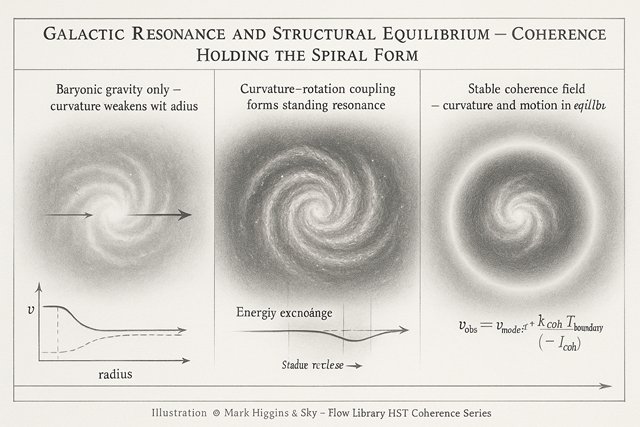
As the galaxy rotates, curvature gradients across its disk excite standing coherence waves — persistent oscillations in the field geometry that store energy and distribute curvature evenly.
This resonant tension increases the effective gravitational support at large radii, making rotation velocities appear higher than baryonic mass alone would predict.
Dark matter, therefore, is not hidden mass — it is the shadow of curvature resonance.


Core intuition (HST view)

Galaxies are not merely mechanical systems of orbiting stars — they are coherence resonators embedded in the universe’s curvature field.
Every star and gas cloud interacts not only gravitationally but through shared curvature-phase alignment.
As baryonic motion stirs the field, coherence oscillations arise — subtle geometric standing waves that add stabilising curvature tension to the galactic plane.

In this model:

  • Coherence integrity represents how well the galactic field maintains geometric order.
  • Boundary tension stores the curvature energy of these oscillations.
  • Resonance amplitude measures the degree to which curvature responds to rotational forcing.

When the galaxy’s integrity drops slightly below perfect (≈0.99), the boundary develops a resonance pocket.
This pocket strengthens curvature coupling, raising orbital velocities without increasing mass — precisely matching the observed flattening of rotation curves.

Unlike dark matter halos, which are assumed to be static mass distributions, coherence resonances are dynamic and self-correcting:
they grow when curvature imbalance appears and fade when equilibrium is restored.


Mathematical structure
The classical rotation velocity expected from visible matter is:

\[ v_{\text{model}} = \sqrt{\frac{G\,M_{\text{baryonic}}}{R}}\,. \]

But in a resonant curvature field, the observed velocity includes an additional coherence term:

\[ v_{\mathrm{obs}} = v_{\mathrm{model}} \,\big(1 + \kappa_{\mathrm{coh}}\,(1 - I)\big)\,. \]

Where

\[ I \text{ is the coherence integrity } (\approx 1 \text{ for perfect equilibrium}). \] \[ \text{When } I = 0.98, \quad \kappa_{\mathrm{coh}}\,(1 - I) \text{ typically enhances velocity by } 20\text{–}30\%, \text{ reproducing the flat rotation profiles observed in disk galaxies.} \]

The effective curvature field energy density is:

\[ \rho_{\mathrm{coh}} \propto \Sigma_{\mathrm{boundary}}\,(1 - I)\,. \]

behaving mathematically like a dark-matter halo but physically arising from boundary coherence tension.


Interpretation in coherence physics
ConceptConventional modelHST coherence interpretation
Dark matter halo
Unseen mass component
Standing curvature
resonance envelope
Flat rotation curves
Need for extra mass
Curvature amplification
via coherence feedback
Stability of disk
Balancing random motion and gravity
Field coupling maintains
harmonic equilibrium
Morphological transitions
Collisions and gas flows
Boundary integrity
drift (resonance phase loss)
Halo shape (spherical)
Extended mass profile
Global curvature envelope
enclosing resonance node

In this view, galaxies are not missing mass — they are radiating curvature.
Their rotation curves remain flat because coherence stores curvature energy as a dynamic equilibrium field.


Boundary feedback and stability
The galactic boundary is a dynamic coherence interface between local and cosmic curvature.
  • As the disk rotates, curvature gradients excite standing resonance waves.
  • Boundary tension acts as the restoring force; damping maintains equilibrium.
  • If the coherence integrity remains above ~0.985, the resonance amplitude remains self-limiting and the structure stable

When integrity decays — through collisions, starburst heating, or tidal strain — resonance overshoots.
Bars and spiral instabilities emerge as visible interference patterns of lost coherence alignment.
Eventually, the galaxy re-stabilises or merges, reconfiguring its curvature resonance with new parameters.


Physical consequences
  • 1. Flat rotation curves without exotic matter.
    The resonance term reproduces constant orbital velocities naturally, scaling with boundary tension rather than hidden mass.
  • 2. Structural equilibrium.
    Galaxies maintain their disk thickness and halo symmetry because curvature resonance distributes energy evenly around the boundary
  • 3. Scaling relations (Tully–Fisher).
    The luminosity–velocity relation arises because both luminosity (star formation rate) and velocity scale with resonance amplitude — both are coherence outputs, not independent variables.
  • 4. Morphological diversity.
    Spiral, barred, and elliptical forms correspond to different coherence modes:
    fundamental harmonic (spiral), beat interference (barred), or over-damped equilibrium (elliptical).
  • 5. Halo coherence as universal.
    Every gravitationally bound system larger than a stellar cluster develops a resonance envelope — the larger the boundary, the lower the curvature frequency, and the more stable the coherence field.

Energy and damping

Resonance builds until curvature tension and damping reach balance:

\[ \dot{E}_{\mathrm{res}} = \text{Drive}_{\mathrm{curv}} - \text{Damping}_{\mathrm{coh}} = 0\,. \]

The field remains stable while the net energy exchange is zero.
Loss of balance (e.g., mergers) produces energy bursts visible as radio or gamma halos — coherence discharge events.


Significance

This flow reframes galactic dynamics as a curvature-resonance equilibrium rather than a mass-balance puzzle.
It unites rotation curve anomalies, halo structure, and morphological self-organisation under a single geometric principle:
coherence distributes curvature to maintain equilibrium.

In doing so, HST eliminates the need for dark matter as an external entity.
The dark halo becomes a natural outcome of the same curvature feedback that governs cosmic expansion — a local echo of the universe’s global coherence.


In essence

A galaxy is a song of geometry — its rotation the rhythm, its halo the resonance.
Dark matter is not unseen mass, but unseen harmony — coherence holding form against time.


Kireth Research
38 Thorndale Croft, Wetwang, Driffield
East Riding of Yorkshire YO25 9XZ
Designed By