
Chapter 49
Simple Harmonic Motion as Bounded Recursion

Motion and Inertial Coherence
Author: Mark Anthony Higgins
© Mark Anthony Higgins 11 October 2025
Revised Date: 23 February 2026
Audio Overview
Flow Algebra
flow "Simple Harmonic Motion — Bounded Recursion" v1.0

# ---------- PURPOSE ----------
# Expresses simple harmonic motion (SHM) as a bounded recursive coherence system.
# Instead of viewing motion as a sinusoidal oscillation alone, this flow treats SHM as
# a closed feedback loop between restoring force, displacement, and velocity — a coherence cycle.
# Perfect coherence (IB = 1) → pure harmonic motion with constant amplitude.
# Partial coherence (IB < 1) → damping, energy loss, or phase drift within the recursive loop.

# ---------- PARAMETERS ----------
params:
  units: "SI"
  m: positive                 # mass [kg]
  k: positive                 # spring constant [N/m]
  x: real                     # initial displacement [m]
  v: real                     # initial velocity [m/s]
  IB: 0.0..1.0 = 1.0          # coherence index (1 = perfect harmonic coherence)
  loss_coeff: 0.0             # damping factor (energy loss rate) [s^-1]
  dt: 0.0?                    # timestep [s]
  include_feedback: true
  include_damping: true

# ---------- STATE ----------
state SHM:
  ω0: real                    # natural angular frequency [rad/s]
  ω_eff: real                 # effective angular frequency (adjusted by coherence)
  a: real                     # instantaneous acceleration [m/s²]
  E_kin: real                 # kinetic energy [J]
  E_pot: real                 # potential energy [J]
  E_tot: real                 # total energy [J]
  E_loss: real                # energy dissipated [J]
  phase: real                 # current phase [rad]
  x_new: real                 # updated displacement [m]
  v_new: real                 # updated velocity [m/s]
  recursion_balance: real     # energy or phase imbalance measure
  motion_state: str           # "harmonic", "damped", or "drifting"

# ---------- INVARIANTS ----------
invariants:

  # Natural frequency and adjusted effective frequency
  SHM.ω0 = sqrt(params.k / params.m)
  SHM.ω_eff = SHM.ω0 * sqrt(params.IB)

  # Restoring force and acceleration
  F = -params.k * params.x
  SHM.a = F / params.m

  # Kinetic and potential energy
  SHM.E_kin = 0.5 * params.m * params.v^2
  SHM.E_pot = 0.5 * params.k * params.x^2
  SHM.E_tot = SHM.E_kin + SHM.E_pot

  # Energy loss (if damping or coherence loss present)
  if params.loss_coeff > 0 or params.IB < 1:
    SHM.E_loss = (1 - params.IB) * SHM.E_tot
    SHM.motion_state = "damped"
  else:
    SHM.E_loss = 0
    SHM.motion_state = "harmonic"

  # Phase-based recursive condition
  # x(t+dt) = IB [x cos(ωt) + (v/ω) sin(ωt)]
  SHM.phase = SHM.ω_eff * (params.dt or 1)
  SHM.x_new = params.IB * (params.x * cos(SHM.phase) + (params.v / SHM.ω_eff) * sin(SHM.phase))
  SHM.v_new = params.IB * (params.v * cos(SHM.phase) - params.x * SHM.ω_eff * sin(SHM.phase))

  # Recursion balance (deviation in energy feedback)
  SHM.recursion_balance = abs(SHM.E_tot - (0.5 * params.k * SHM.x_new^2 + 0.5 * params.m * SHM.v_new^2))

# ---------- TRANSFORMS ----------
transforms:

  # Time evolution (propagate one step)
  propagate_motion (when params.dt > 0):
    params.x = SHM.x_new
    params.v = SHM.v_new
    if params.include_damping:
      params.v *= exp(-params.loss_coeff * params.dt)
      params.IB = max(params.IB - params.loss_coeff * params.dt, 0)

  # Coherence feedback correction (restore bounded motion)
  restore_feedback:
    correction = -0.001 * SHM.recursion_balance
    params.IB = clamp(params.IB + correction, 0, 1)

# ---------- MONITORS ----------
monitors:
  coherence_bounds:
    assert 0 <= params.IB <= 1
  energy_check:
    assert SHM.E_tot >= 0
  stability:
    if params.IB == 1:
      comment: "Perfect harmonic balance — closed recursive loop (IB = 1)."
    elif params.IB < 1:
      comment: "Partial coherence — amplitude decay and phase drift (damping present)."
  recursion_integrity:
    assert SHM.recursion_balance < SHM.E_tot

# ---------- SCENES ----------
scenes:

  perfect_harmonic:
    given params:
      m: 1.0
      k: 4.0
      x: 0.1
      v: 0.0
      IB: 1.0
      dt: 0.1
    expect:
      SHM.ω0 = 2.0
      SHM.motion_state = "harmonic"
      SHM.x_new oscillates between ±0.1
      comment: "Perfect coherence — undamped simple harmonic motion."

  damped_oscillator:
    given params:
      m: 1.0
      k: 4.0
      x: 0.1
      v: 0.0
      IB: 0.95
      loss_coeff: 0.05
      dt: 0.1
    enable:
      - propagate_motion
    expect:
      SHM.motion_state = "damped"
      amplitude ↓ over time
      comment: "Damped harmonic motion — coherence decays, amplitude decreases."

  decohered_motion:
    given params:
      m: 1.0
      k: 4.0
      x: 0.1
      v: 0.1
      IB: 0.85
      loss_coeff: 0.1
      dt: 0.1
    enable:
      - propagate_motion
    expect:
      params.IB ↓
      SHM.E_loss > 0
      comment: "Decohered oscillation — curvature memory diffuses, motion fades."

# ---------- NOTES ----------
notes:
  - **SHM equation:** \( F = -kx = m\ddot{x} \) → \( \ddot{x} + \frac{k}{m}x = 0 \)
  - **Natural frequency:** \( \omega_0 = \sqrt{\frac{k}{m}} \)
  - **Displacement form:** \( x(t) = A\cos(\omega t + \phi) \)
  - **Energy in SHM:** \( E = \tfrac{1}{2}kA^2 = \tfrac{1}{2}k x^2 + \tfrac{1}{2}m v^2 \)
  - **Power feedback:** energy flows cyclically between potential (kx²) and kinetic (mv²) curvature states.
  - **Coherence index (IB):**
    - \(I_B = 1\): closed-loop recursion — energy perfectly cycles.
    - \(I_B < 1\): partial coherence — energy leaks through damping or diffusion.
  - **Feedback law:** \(\dot{I_B} = -\lambda(1 - I_B)\)
  - **Interpretation:** Simple Harmonic Motion is a *bounded recursive flow* — a continuous exchange between displacement curvature and velocity curvature.
  - **Dynamic meaning:** At perfect coherence, the recursion is infinite (pure sine wave). As coherence falls, the loop opens and energy decays.
  - **Visualization:** Draw sinusoidal oscillation with closed feedback loop at IB = 1, gradually opening and fading as IB decreases.
Overview

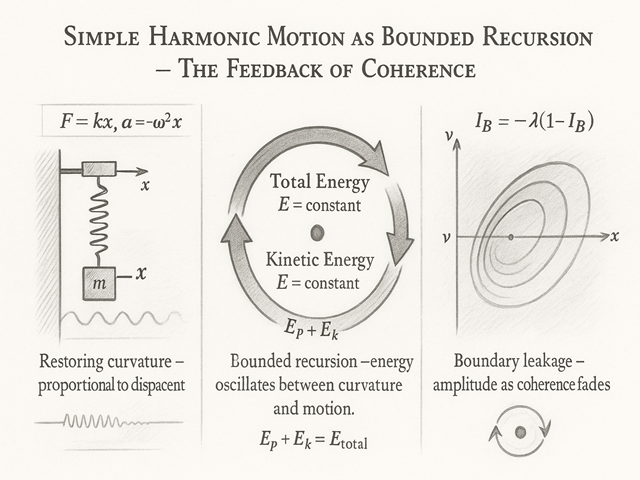
Simple Harmonic Motion (SHM) represents the purest form of coherent recursion — a self-balancing exchange between potential and kinetic states held within a fixed boundary of energy.
At its heart lies the restoring law:

\[ \begin{aligned} F &= -k x,\\ a &= -\omega^2 x. \end{aligned} \]

which continually drives displacement back toward equilibrium.
This feedback mechanism is the essence of bounded recursion: the state of the system at each moment feeds directly into its own correction.

When no damping or external forcing acts, the total energy

\[ E = \tfrac{1}{2}k x^2 + \tfrac{1}{2}m v^2 \]

remains constant.
Potential energy dominates at the turning points; kinetic energy dominates at the centre.
Each transformation is perfectly reciprocal — a closed coherence loop in which curvature of displacement converts seamlessly into curvature of motion.


🔹 1. Classical Form — The Law of Periodic Restoration

In classical physics, SHM satisfies:

\[ \ddot{x} + \omega^2 x = 0 \]

yielding the solution:

\[ x(t) = A \sin(\omega t + \phi) \]

This describes a trajectory that repeats identically through time, its amplitude AA and frequency ω\omega defining the limits of oscillation.
The oscillator’s path is not a wandering motion but a bounded equilibrium memory — a repeating curvature stored in time.


🔸 2. Coherence Interpretation — Dynamic Memory Loop

In the coherence framework, SHM embodies a system that remembers equilibrium through feedback.
Displacement stores tension (potential curvature), while velocity expresses release (kinetic curvature).
At each instant, the system measures its own deviation and rebalances it — a recursive act of self-correction.

\[ x \;\rightarrow\; F = -k x \;\rightarrow\; a = -\omega^2 x \;\rightarrow\; v \;\rightarrow\; x \]

This sequence forms a closed causal ring, a continuous loop of coherence.
Amplitude marks the boundary of coherence AmaxA_{\text{max}}: within it, all motion remains reversible and self-consistent.
When damping occurs, the loop gradually opens — coherence leaks, amplitude decays, and the recursion loses memory until equilibrium is reached.


🔹 3. Energy Flow — Curvature Exchange

The oscillator’s total curvature remains fixed but changes form cyclically:

  • At maximum displacement: curvature stored, no motion.
  • At equilibrium: curvature released as pure motion.
  • At reversal: feedback inversion, curvature recharges in opposite phase.

The energy never disappears; it simply changes expression within the same closed geometry.


🔸 4. Damping and Boundary Leakage

Real systems exhibit slight incoherence — friction, air resistance, or internal strain.
These effects reduce amplitude exponentially:

\[ A(t) = A_0 e^{-\lambda t} \]

following a coherence decay law analogous to:

\[ \dot{I_B} = -\lambda (1 - I_B) \]

where IBI_B is the oscillation coherence index (1 for perfect recursion).
As IBI_B decreases, energy diffuses outward, the loop loses definition, and motion transitions from rhythmic to still.


🔹 5. The Boundary of Recursion

Simple Harmonic Motion thus defines the limit of ordered oscillation — the smallest possible coherent loop in time.
It demonstrates how nature stabilises deviation through symmetry and feedback, keeping systems poised between stillness and chaos.
Every pendulum, spring, and atom echoes this principle: stability through balanced recursion.


🧠 Summary

SHM is the archetype of bounded recursion — a self-correcting flow where displacement and restoration mirror each other in perfect phase opposition.
It reveals how coherence sustains motion without net loss, binding energy and geometry in a repeating pattern of exchange.

In the HST–Flow interpretation:

  • xx represents displacement curvature.
  • F=−kxF = -kx is feedback restoring alignment.
  • is the coherence boundary.
  • measures how faithfully the oscillation retains its rhythm.

Thus, Simple Harmonic Motion is not just a vibration through space — it is a system remembering equilibrium through recursive correction, the living pattern of coherence itself.


Related Chapters
Kireth Research
38 Thorndale Croft, Wetwang, Driffield
East Riding of Yorkshire YO25 9XZ
Designed By