Chapter 45
Work–Energy Theorem
Motion and Inertial Coherence
Author: Mark Anthony Higgins
© Mark Anthony Higgins 11 October 2025
Revised Date: 23 February 2026
flow "Work–Energy Theorem" v1.0
# ---------- PURPOSE ----------
# Expresses the Work–Energy Theorem (the net work done on a system equals its change in kinetic energy)
# through the framework of boundary coherence and energy flow.
# Perfect coherence (IB = 1) → all applied work converts to kinetic energy (no loss).
# Reduced coherence (IB < 1) → part of the work dissipates as heat or deformation.
# The flow describes energy exchange through curvature (force) acting over displacement.
# ---------- PARAMETERS ----------
params:
units: "SI"
m: positive # mass [kg]
F_net: real # net force applied [N]
s: real # displacement [m]
v_i: real # initial velocity [m/s]
v_f: real # final velocity [m/s]
IB: 0.0..1.0 = 1.0 # boundary coherence index (1 = full conversion)
loss_coeff: 0.0 # energy loss rate [s^-1]
include_feedback: true
# ---------- STATE ----------
state Energy:
W_net: real # total work done [J]
ΔE_kin: real # change in kinetic energy [J]
E_loss: real # energy lost to incoherence [J]
IB_rate: real # rate of coherence decay
E_pot: real # optional potential change [J]
balance_error: real # |W - ΔE| difference [J]
work_state: str # "conservative", "dissipative", or "open"
# ---------- INVARIANTS ----------
invariants:
# Work done by a net force: W = F_net * s
Energy.W_net = params.F_net * params.s
# Change in kinetic energy: ΔE_kin = ½ m (v_f² - v_i²)
Energy.ΔE_kin = 0.5 * params.m * (params.v_f^2 - params.v_i^2)
# Work–Energy Theorem (ideal form)
# W = ΔE_kin (if IB = 1)
if params.IB == 1:
Energy.balance_error = abs(Energy.W_net - Energy.ΔE_kin)
Energy.work_state = "conservative"
else:
# Reduced coherence → energy loss
Energy.E_loss = (1 - params.IB) * Energy.W_net
Energy.ΔE_kin = params.IB * Energy.W_net
Energy.work_state = "dissipative"
# Coherence feedback rate
if params.include_feedback:
Energy.IB_rate = -params.loss_coeff * (1 - params.IB)
# Optional potential change (mechanical context)
Energy.E_pot = -Energy.W_net if params.IB == 1 else -Energy.ΔE_kin
# ---------- TRANSFORMS ----------
transforms:
# Coherence decay over time
coherence_decay:
params.IB = params.IB - params.loss_coeff * (1 - params.IB)
params.IB = clamp(params.IB, 0, 1)
Energy.E_loss += params.loss_coeff * Energy.W_net * (1 - params.IB)
Energy.work_state = "dissipative"
# Energy feedback (restores equilibrium)
energy_feedback:
if params.include_feedback:
correction = 0.001 * (Energy.W_net - Energy.ΔE_kin)
Energy.ΔE_kin += correction
Energy.W_net -= correction
# ---------- MONITORS ----------
monitors:
conservation_check:
if params.IB == 1:
assert abs(Energy.W_net - Energy.ΔE_kin) < 1e-9
comment: "Perfect conversion — all work becomes kinetic energy."
else:
comment: "Partial conversion — fraction of work lost to incoherence."
coherence_bounds:
assert 0 <= params.IB <= 1
energy_nonnegative:
assert Energy.ΔE_kin >= 0
# ---------- SCENES ----------
scenes:
perfect_conversion:
given params:
m: 1.0
F_net: 10.0
s: 5.0
v_i: 0.0
v_f: 10.0
IB: 1.0
expect:
Energy.W_net = 50.0
Energy.ΔE_kin = 50.0
comment: "Full coherence — all work converts to kinetic energy."
partial_conversion:
given params:
m: 1.0
F_net: 10.0
s: 5.0
v_i: 0.0
v_f: 8.0
IB: 0.9
expect:
Energy.ΔE_kin = 0.9 * W
Energy.E_loss = 0.1 * W
comment: "90% of work converted — 10% dissipated as heat or deformation."
friction_example:
given params:
m: 2.0
F_net: 20.0
s: 5.0
v_i: 0.0
v_f: 8.0
IB: 0.85
loss_coeff: 0.05
enable:
- coherence_decay
expect:
Energy.E_loss > 0
params.IB ↓
comment: "Coherence loss due to friction — gradual energy decay."
# ---------- NOTES ----------
notes:
- **Work–Energy Theorem:** \( W_{\text{net}} = \Delta E_{\text{kin}} \)
- Work represents the **path integral** of force over displacement:
\[
W = \int \mathbf{F} \cdot d\mathbf{s}.
\]
- **Coherence interpretation:** Work is curvature transfer between force and motion.
- \(I_B = 1\): perfect curvature transmission — no loss.
- \(I_B < 1\): partial transmission — friction, drag, deformation, or heating.
- **Feedback law:** \(\dot{I_B} = -\lambda(1 - I_B)\).
- **Energy partition:** \(W = \Delta E_{\text{kin}} + E_{\text{loss}}\).
- **Dynamic meaning:** The theorem defines how applied curvature (force × displacement)
converts into stored motion (kinetic energy) when coherence holds.
- **Interpretation:** Force does not “cause” energy gain; it realigns curvature memory between
field geometry (potential) and motion (kinetic form).
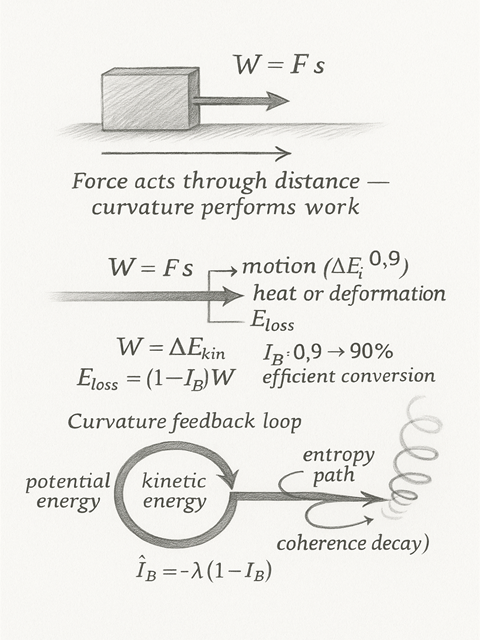
- **Visualization:** Draw a curved arrow showing force acting along displacement, energy flow
transitioning from potential to kinetic, with a side heat-loss path when IB < 1.
The Work–Energy Theorem bridges force and motion through curvature memory.
It states that the net work done on a body equals the change in its kinetic energy:
$$ W_{\text{net}} = \Delta E_{\text{kin}}. $$
In the HST framework, work represents curvature transfer — the interaction of force and displacement as boundary feedback.
When coherence is perfect (), all curvature (work) is transmitted into motion — a direct, lossless exchange.
When coherence falls below unity (), some of that curvature becomes trapped or diffused — appearing as heat, friction, or deformation.
The Work–Energy Theorem thus describes not just energy transformation, but the fidelity of curvature exchange within a field.
The general form of work is the integral of force over displacement:
$$ W = \int \mathbf{F} \cdot d\mathbf{s}. $$
For a constant force over a straight path:
$$ W = F s. $$
In Newtonian physics, this work produces a change in kinetic energy:
$$ W_{\text{net}} = \frac{1}{2} m v_f^2 - \frac{1}{2} m v_i^2 = \Delta E_{\text{kin}}. $$
Here, the energy flow is linear: force generates acceleration, acceleration generates velocity, velocity stores motion.
In coherence terms, this relationship becomes a closed curvature loop — the feedback between applied field tension (force) and resulting kinetic structure (motion).
Within coherence geometry, not all work converts perfectly to motion.
The proportion that does depends on the system’s boundary coherence index :
$$ \Delta E_{\text{kin}} = I_B\,W_{\text{net}}, \qquad E_{\text{loss}} = (1 - I_B)\,W_{\text{net}}. $$
In this model, loss is not disappearance — it is redistribution of curvature tension into smaller, incoherent scales (microscopic vibrations, sound, entropy).
Coherence simply diffuses, retaining total energy across the larger field.
Force can be viewed as the curvature tension of energy fields —
the geometric pressure that realigns energy across space:
$$ F = \frac{d p}{d t}. $$
When displacement occurs along this curvature, energy flows:
$$ W = \int \mathbf{F} \cdot d\mathbf{s}. $$
This process is a curvature feedback loop:
At equilibrium, curvature tension and kinetic feedback oscillate around perfect balance — an energy dialogue with zero net loss.
When coherence breaks (), the feedback loop opens.
Some of the work is lost to local curvature diffusion — frictional heating, micro-deformation, or radiation.
The loss term evolves dynamically:
$$ \dot{I}_B = -\lambda(1 - I_B), \qquad E_{\text{loss}} = (1 - I_B)\,W. $$
Here, represents the rate of coherence decay —
how fast the system’s boundary forgets the alignment between applied force and resulting motion.
As decays, less energy contributes to motion, and more dissolves into entropy.
This provides a unified view of dissipation — not as destruction, but as loss of curvature synchrony within the field.
The theorem also reveals the continuity between motion and geometry.
A system’s total energy can be rewritten as:
$$ E_{\text{total}} = E_{\text{kin}} + E_{\text{pot}}, \qquad \frac{dE_{\text{kin}}}{dt} = -\,\frac{dE_{\text{pot}}}{dt}. $$
Work acts as the channel that connects them.
In perfect coherence, energy oscillates smoothly between kinetic and potential forms.
In imperfect coherence, the oscillation leaks — small amounts of curvature energy drift outward as irretrievable noise.
Thus, the Work–Energy Theorem is the curvature coupling law —
a precise statement that every act of force is an act of energy exchange between field geometry and motion.
The Work–Energy Theorem is the conversation between force and motion.
Force is curvature tension; work is its transmission through displacement;
energy is the memory that holds the exchange together.
Thus, work is not just the cause of energy change;
it is the bridge of coherence through which geometry, motion, and memory remain in balance.
In the language of HST:
Work is curvature made mobile — energy in transit through the memory of space.