Chapter 10
Chandrasekhar Limit and Star Collapse
Cosmological and Global Coherence
Author: Mark Anthony Higgins
© Mark Anthony Higgins 11 October 2025
Revised Date: 23 February 2026
flow "ChandrasekharLimit_StarCollapse"
# ---------- STATES ----------
state:
# bulk properties
star.mass.M: float # total mass (M_sun)
core.mass.Mc: float # core mass (M_sun)
core.radius.Rc: float # core radius (km)
core.density.rho_c: float # central density (g/cm^3)
core.temperature.Tc: float # central temperature (K)
core.entropy.S: float # specific entropy (k_B/baryon)
core.Ye: float # electron fraction (e-/baryon)
composition.mu_e: float # mean molecular weight per e- (≈2 for C/O, ≈2 for He)
# pressures (dyn/cm^2)
pressure.degen_e: float # electron degeneracy pressure
pressure.therm: float # thermal gas + radiation pressure
pressure.total: float
# gravity / curvature
gravity.potential: float # |Φ| at core
gravity.compactness.C: float # GM/(Rc c^2)
boundary.integrity: float # 0..1 global/internal coherence
coherence.tension: float # curvature tension density
# neutrino channel
neutrino.lum: float # neutrino luminosity (erg/s)
neutrino.cooling_rate: float
# thresholds / references
limit.Mch: float # Chandrasekhar mass (M_sun)
limit.Mns_max: float # max cold NS mass (M_sun) ~ 2.0–2.3
limit.compactness_bh: float # C_crit ~ 0.5 (order) for BH trapping
# time
time.t: float
# ---------- PARAMETERS ----------
params:
G: 6.674e-8 # cgs
c: 2.998e10 # cm/s
hbar: 1.055e-27 # erg·s
m_e: 9.109e-28 # g
m_p: 1.673e-24 # g
a_rad: 7.5657e-15 # radiation const (erg cm^-3 K^-4)
M_sun: 1.989e33 # g
K_NR: float # NR e- deg. EOS coefficient
K_REL: float # UR e- deg. EOS coefficient
Mch_coeff: 5.83 # M_ch ≈ 5.83 / μ_e^2 (in M_sun)
cooling.coeff: float # neutrino cooling scale
capture.rate0: float # e- capture baseline (Ye drain)
dt: float
# ---------- INVARIANTS ----------
invariant:
- limit.Mch = params.Mch_coeff / (composition.mu_e^2)
- pressure.degen_e = P_deg(core.density.rho_c, core.Ye, regime="NR/UR")
- pressure.therm = P_gas_rad(core.density.rho_c, core.temperature.Tc, params.a_rad)
- pressure.total = pressure.degen_e + pressure.therm
- gravity.compactness.C = (params.G * core.mass.Mc * params.M_sun) / (max(core.radius.Rc,1e-5)*1e5 * params.c**2)
- quasi-hydrostatic stability requires dM/d(rho_c) > 0 and Mc < limit.Mch for WD branch
- energy balanced (cooling/heating):
dE_core/dt = - neutrino.lum + compressional_heating(core.density.rho_c, dV/dt)
- boundary.integrity ∈ [0,1]; collapse triggers as integrity falls with rising compactness
# ---------- TRANSFORMS ----------
transform:
initialise_core:
do:
composition.mu_e = 2.0 # e.g., C/O core
core.mass.Mc = min(star.mass.M, 1.2)
core.radius.Rc = 8000 # km (WD-scale start)
core.density.rho_c = 1e6 # g/cm^3
core.temperature.Tc = 1e8 # K (post-burning core)
core.Ye = 0.5
boundary.integrity = 0.995
neutrino.lum = 0.0
limit.Mns_max = 2.1
limit.compactness_bh = 0.5
time.t = 0
update_chandrasekhar_limit:
do:
limit.Mch = params.Mch_coeff / (composition.mu_e**2)
update_eos_and_pressures:
do:
# choose NR vs UR degeneracy regime internally
pressure.degen_e = eos_degeneracy(core.density.rho_c, core.Ye, params.K_NR, params.K_REL)
pressure.therm = eos_gas_rad(core.density.rho_c, core.temperature.Tc, params.a_rad)
pressure.total = pressure.degen_e + pressure.therm
quasi_hydro_adjust:
do:
# toy hydrostatic adjustment: R_c responds to P_total vs self-gravity
grav_req = grav_pressure_needed(core.mass.Mc, core.radius.Rc, params.G)
δR = response_radius(pressure.total, grav_req, core.radius.Rc)
core.radius.Rc = max(core.radius.Rc + δR, 50) # floor to avoid zero
core.density.rho_c = mass_to_central_density(core.mass.Mc, core.radius.Rc)
weak_interactions_update:
do:
# electron captures at high rho_c reduce Ye, undermining degeneracy support
capture = params.capture.rate0 * f_capture(core.density.rho_c, core.temperature.Tc)
core.Ye = max(core.Ye - capture*params.dt, 0.03)
neutrino_cooling:
do:
neutrino.lum = params.cooling.coeff * f_nu(core.temperature.Tc, core.density.rho_c)
neutrino.cooling_rate = neutrino.lum
core.temperature.Tc = max(core.temperature.Tc - cooling_delta(neutrino.lum, core.mass.Mc)*params.dt, 1e7)
compute_compactness:
do:
gravity.compactness.C = (params.G * core.mass.Mc * params.M_sun) / (core.radius.Rc*1e5 * params.c**2)
gravity.potential = gravity_potential(core.mass.Mc, core.radius.Rc, params.G)
integrity_drift:
do:
# rising compactness + Ye drain → integrity loss (onset of collapse)
boundary.integrity = clamp(boundary.integrity - g_integrity(gravity.compactness.C, core.Ye), 0, 1)
decide_fate:
do:
if core.mass.Mc < limit.Mch and boundary.integrity > 0.98:
mark("white_dwarf_branch")
settle_white_dwarf()
elif core.mass.Mc >= limit.Mch:
onset_core_collapse()
settle_white_dwarf:
do:
# stable WD: set mass–radius relation (R ∝ M^{-1/3} NR; shrinks in UR)
core.radius.Rc = wd_mass_radius(core.mass.Mc, composition.mu_e)
core.density.rho_c = mass_to_central_density(core.mass.Mc, core.radius.Rc)
pressure.degen_e = eos_degeneracy(core.density.rho_c, core.Ye, params.K_NR, params.K_REL)
onset_core_collapse:
do:
# rapid contraction; degeneracy pressure can’t balance gravity (UR limit)
collapse_rate = collapse_speed(gravity.compactness.C, core.density.rho_c)
core.radius.Rc = max(core.radius.Rc * (1 - collapse_rate*params.dt), 10)
core.density.rho_c = mass_to_central_density(core.mass.Mc, core.radius.Rc)
boundary.integrity = max(boundary.integrity - 5e-3, 0.0)
if core.density.rho_c > 2e14: bounce_or_continue()
bounce_or_continue:
do:
# if below NS maximum mass → neutron star; else → black hole
if core.mass.Mc <= limit.Mns_max:
form_neutron_star()
else:
form_black_hole()
form_neutron_star:
do:
mark("neutron_star")
core.radius.Rc = 12 # km (canonical)
gravity.compactness.C = (params.G * core.mass.Mc * params.M_sun) / (core.radius.Rc*1e5 * params.c**2)
boundary.integrity = 0.9 # re-stabilised at nuclear density (new phase)
neutrino.lum = neutrino_burst(core.mass.Mc) # deleptonisation burst
form_black_hole:
do:
mark("event_horizon")
gravity.compactness.C = 0.5
boundary.integrity = 0.0
core.radius.Rc = schwarzschild_radius(core.mass.Mc, params.G, params.c)
tick:
do:
time.t += params.dt
# ---------- MONITORS ----------
monitor:
stability_track:
observe: [core.mass.Mc, limit.Mch, core.density.rho_c]
report: "Compares core mass to Chandrasekhar limit and follows central density."
support_channels:
observe: [pressure.degen_e, pressure.therm, gravity.compactness.C]
report: "Balance of electron degeneracy + thermal support against self-gravity."
composition_drift:
observe: [core.Ye]
report: "Electron capture reduces Ye, lowering degeneracy support and pushing toward collapse."
fate_indicator:
observe: [boundary.integrity]
report: "High integrity → stable WD; sharp declines → collapse → NS/BH branch."
# ---------- NOTES (coherence view) ----------
note:
- The Chandrasekhar limit emerges when **electron degeneracy support** saturates in the ultra-relativistic regime:
M_ch ≈ (5.83 / μ_e^2) M_⊙.
- In HST terms, degeneracy pressure is **phase-exclusion coherence**; UR electrons cannot raise pressure faster than gravity’s curvature demand.
- As Ye falls via electron capture, the available coherence (Pauli support) decreases → **integrity loss** → collapse.
- Outcomes:
• **White Dwarf (WD):** Mc < M_ch, boundary re-closes at low compactness; mass–radius anti-correlation.
• **Neutron Star (NS):** Mc ≲ M_NS,max, boundary re-stabilises at nuclear density (new coherence phase, neutrino burst).
• **Black Hole (BH):** Mc > M_NS,max, boundary coherence ruptures; horizon forms (integrity → 0).
- Neutrino emission is the **coherence release channel** during collapse/bounce, rapidly cooling and signalling phase transition.
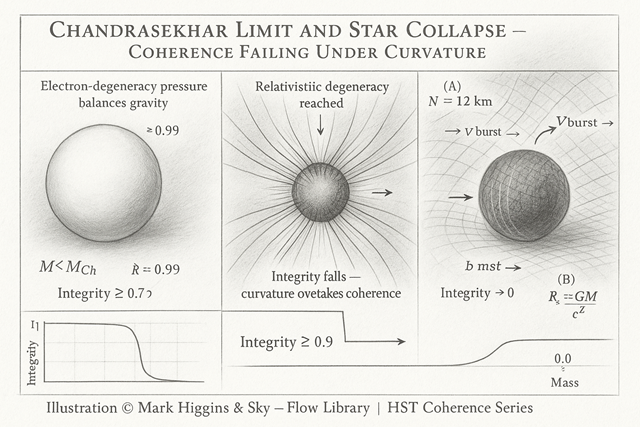
ChandrasekharLimit_StarCollapse describes how stars reach and cross the critical threshold where degeneracy support can no longer maintain coherence against self-gravity.
In classical astrophysics, this threshold — the Chandrasekhar limit — marks the maximum mass (~1.4 M⊙ for μₑ = 2) that a white dwarf can sustain before collapse.
In the HST framework, this limit is not simply an equation of state boundary but a transition of coherence: a shift in how the star’s internal boundary structure stores and resists curvature tension.
This flow models that process as a continuous feedback between degeneracy pressure (coherence retention), gravity (curvature compression), and electron capture (phase loss).
Collapse is triggered when boundary integrity can no longer maintain equilibrium within the curvature field.
Degeneracy pressure is not an arbitrary quantum force — it is the expression of coherence exclusion: the geometry of electron wavefunctions packed into the minimal available curvature volume.
As stellar mass increases, curvature deepens; coherence modes tighten until electrons become relativistic.
At that point, their ability to sustain phase coherence (pressure) grows more slowly than the curvature demand.
This geometric bottleneck is the true origin of the Chandrasekhar limit.
When the internal boundary (core) reaches this critical curvature, integrity begins to fall — the phase structure of the star’s electrons can no longer adapt smoothly.
Electron capture reduces the electron fraction (Yₑ), further degrading coherence.
The core collapses, releasing stored curvature energy as neutrinos — the system’s way of shedding incoherent tension and seeking a new boundary equilibrium.
\[ M_{\mathrm{Ch}} \approx \frac{5.83}{\mu_{e}^{2}}\,M_{\odot}. \]
emerges when relativistic degeneracy and gravitational pressure balance exactly.
Degeneracy pressure Pe follows the curvature-scaling relation:
\[ P_{e} \propto \rho_{c}^{5/3} \quad (\text{non-relativistic}), \qquad P_{e} \propto \rho_{c}^{4/3} \quad (\text{ultra-relativistic}). \]
\[ \text{The transition from } \tfrac{5}{3} \text{ to } \tfrac{4}{3} \text{ in the exponent reduces the stabilising feedback,} \quad \frac{dM}{d\rho} \;\rightarrow\; 0, \quad \text{marking the onset of collapse.} \]
In HST form, the same condition expresses as loss of coherence stiffness:
\[ \frac{\partial P_{\mathrm{coh}}}{\partial \rho} \;\rightarrow\; 0 \quad \Rightarrow \quad \text{boundary integrity} \;\downarrow\; \text{collapse.} \]
| Stage | Conventional view | HST coherence view |
|---|---|---|
|
White dwarf support
|
Electron degeneracy pressure
|
Phase-exclusion
coherence maintaining boundary integrity |
|
Chandrasekhar limit
|
Maximum mass before collapse
|
Critical curvature
beyond which coherence can’t adjust |
|
Electron capture
|
Ye loss reduces pressure
|
Phase annihilation —
loss of coherence carriers |
|
Core collapse
|
Gravitational instability
|
Curvature–coherence
imbalance; boundary integrity rupture |
|
Neutron star formation
|
Nuclear density equilibrium
|
New boundary phase
— re-closure of coherence at nuclear scale |
|
Black hole formation
|
Horizon formation
|
Global boundary rupture —
coherence collapse to zero integrity |
White Dwarf (WD)
\[ M_{c} < M_{\mathrm{Ch}} : \]
\[ \text{Coherence integrity remains high } (\approx 0.98\text{–}1.0), \quad \text{degeneracy pressure balances curvature tension, forming a stable boundary closure,} \] \[ R \propto M^{-1/3} \quad \text{showing how the curvature field compresses coherence as mass increases.} \]
Neutron Star (NS)
For Mc≈MCh–MNS,max:
Collapse proceeds until nuclear densities are reached.
The boundary re-stabilises through a new coherence phase — neutrons replacing electrons as primary coherence carriers.
A neutrino burst signals the system’s rapid phase reorganisation (deleptonisation).
Boundary integrity settles near 0.9 — not perfect, but dynamically stable.
Black Hole (BH)
\[ M_{c} \approx M_{\mathrm{Ch}} - M_{\mathrm{NS,max}} : \]
Curvature exceeds all internal coherence capacities.
No phase structure can sustain the boundary; integrity → 0.
The boundary collapses into a self-contained curvature resonance — the event horizon.
In HST terms, the black hole is not a singularity but a coherence vacuum: all internal curvature locked beneath a closed boundary of zero phase communication.
During collapse, curvature potential energy is redistributed as:
The process obeys global coherence conservation:
Curvature energy=stored coherence tension+released neutrinos+boundary work.
Each pathway is a form of curvature feedback, redistributing tension until a stable coherence state re-emerges.
The Chandrasekhar limit represents not just a number, but a law of structural coherence:
every boundary in nature — atomic, stellar, cosmic — has a limit beyond which phase structure cannot maintain equilibrium with curvature.
Beyond that limit, the system must transform.
Star collapse is thus not destruction but re-organisation of coherence — the boundary re-encoding itself at a deeper harmonic level.
This flow completes the stellar arc within HST cosmology:
It unites the quantum mechanical, relativistic, and thermodynamic descriptions into a single geometric narrative:
mass, pressure, and collapse are all expressions of how coherence resists or yields to curvature.
The Chandrasekhar limit is the curvature threshold of coherence itself.
Stars do not die; they change phase — their boundaries rewriting the memory of gravity in a new geometry.