
Chapter 65
General Relativity Reformulated through HST

Relativistic and Curvature Flows
Author: Mark Anthony Higgins
© Mark Anthony Higgins 11 October 2025
Revised Date: 23 February 2026
Audio Overview
Flow Algebra
flow "General Relativity Reformulated through HST" v1.0


# ---------- PURPOSE ----------
# Reformulate GR as coherence geometry:
# - Metric g_{μν}: boundary-phase map of local coherence.
# - Stress–energy T_{μν}: curvature density/flux (bound + flowing phase).
# - Einstein feedback G_{μν} = κ T_{μν}: curvature adjusts to preserve global interval coherence.
# IB tracks operational coherence (sync/instrument drift); invariants hold irrespective of IB.

# ---------- PARAMETERS ----------
params:
  units: "SI"
  c: positive = 2.99792458e8         # speed of light [m/s]
  G: positive = 6.67430e-11          # Newton's constant [m^3 kg^-1 s^-2]
  κ: real = 8 * π * G / c^4          # Einstein coupling
  IB: 0.0..1.0 = 1.0                 # operational coherence index (clocks/rulers, gauge fixing)
  λ_drift: nonnegative = 0.0         # de-sync drift rate [s^-1]
  dt: positive?                      # timestep
  gauge: enum("harmonic","lorenz","custom") = "harmonic"
  include_Λ: bool = false            # include cosmological term
  Λ: real = 0.0                      # cosmological constant [m^-2]
  weak_field: bool = false           # enable Newtonian/PPN reduction
  wave_gauge: bool = false           # enable GW propagation form (TT gauge)

# ---------- STATE ----------
state Geometry:
  g: tensor(0,2)                     # metric g_{μν}
  g_inv: tensor(2,0)                 # inverse metric g^{μν}
  Γ: tensor(1,2)                     # Christoffel symbols Γ^ρ_{μν}
  Riem: tensor(1,3)                  # Riemann R^ρ_{σμν}
  Ric: tensor(0,2)                   # Ricci R_{μν}
  R: real                            # scalar curvature
  Gten: tensor(0,2)                  # Einstein tensor G_{μν}
  T: tensor(0,2)                     # stress–energy T_{μν}
  constraint_viol: real              # |∇_μ G^{μ}{}_{ν} - 0| + |∇_μ T^{μ}{}_{ν}|
  s2: real                           # local interval signature sample
  regime: str                        # "coherent-GR","weak-field","wave","desynchronised"
  IB_rate: real                      # d(IB)/dt

state Matter:
  ρ: real                            # mass-energy density
  p: real                            # pressure
  u: vec4                            # 4-velocity u^μ (normalised)
  J: vec4?                           # 4-current (optional, for charged fluids/fields)
  π_aniso: tensor(0,2)?              # anisotropic stress (optional)

state Evolution:
  geodesic: func?(xμ)->xμ            # geodesic integrator
  redshift: real                     # gravitational redshift factor
  gw_strain: real                    # h amplitude (wave regime)
  lapse_shift: tuple?                # (N, N^i) 3+1 decomposition (optional)

# ---------- INVARIANTS ----------
invariants:

  # (1) Build connection and curvature from metric
  Geometry.g_inv = inverse(Geometry.g)
  Geometry.Γ = christoffel(Geometry.g, Geometry.g_inv)
  Geometry.Riem = riemann(Geometry.g, Geometry.Γ)
  Geometry.Ric  = ricci(Geometry.Riem)
  Geometry.R    = trace(Geometry.g_inv, Geometry.Ric)
  Geometry.Gten = Geometry.Ric - 0.5 * Geometry.R * Geometry.g

  # (2) Stress–energy from matter content (perfect fluid baseline)
  Matter.u = normalise4(Matter.u, Geometry.g)
  T_fluid = (Matter.ρ * params.c^2 + Matter.p) * outer(Matter.u, Matter.u) \
            + Matter.p * Geometry.g
  if Matter.π_aniso is defined:
    T_fluid += Matter.π_aniso
  Geometry.T = T_fluid

  # (3) Einstein feedback (with optional Λ)
  if params.include_Λ:
    field_eq = Geometry.Gten + params.Λ * Geometry.g - params.κ * Geometry.T
  else:
    field_eq = Geometry.Gten - params.κ * Geometry.T

  # (4) Bianchi & local conservation (coherence form)
  # ∇_μ G^{μ}{}_{ν} = 0 and ∇_μ T^{μ}{}_{ν} = 0 → curvature/energy continuity
  bianchi_violation = norm(divergence_up(Geometry.Gten, Geometry.g, Geometry.Γ))
  cons_violation    = norm(divergence_up(Geometry.T,    Geometry.g, Geometry.Γ))
  Geometry.constraint_viol = bianchi_violation + cons_violation
  assert Geometry.constraint_viol <= 1e-12

  # (5) Interval coherence sample (signature)
  Δt, Δx, Δy, Δz = 1e-6, 1e-3, 0, 0
  Geometry.s2 = interval(Geometry.g, [Δt,Δx,Δy,Δz])

  # (6) Operational coherence drift (instruments/sync), not physics
  if params.λ_drift > 0 and params.dt is defined:
    params.IB = clamp(params.IB - params.λ_drift * (1 - params.IB) * params.dt, 0, 1)
  Geometry.IB_rate = -params.λ_drift * (1 - params.IB)

  # (7) Regime tagging
  if params.wave_gauge:
    Geometry.regime = "wave"
  elif params.weak_field:
    Geometry.regime = "weak-field"
  elif params.IB < 1:
    Geometry.regime = "desynchronised"
  else:
    Geometry.regime = "coherent-GR"

# ---------- TRANSFORMS ----------
transforms:

  set_metric:
    comment: "Install a metric ansatz (e.g., FRW, Schwarzschild, Kerr, TT wave)."
    Geometry.g = g_ansatz(xμ, params)

  update_matter:
    comment: "Update fluid variables (ρ, p, u^μ) or add anisotropic stress."
    Matter.ρ += Δρ
    Matter.p += Δp
    Matter.u = renormalise4(Matter.u, Geometry.g)

  enforce_field_equations:
    comment: "Solve G_{μν} + Λ g_{μν} = κ T_{μν} by adjusting metric/matter towards closure."
    (Geometry.g, Matter) = relax_to_zero(field_eq, step=ε)

  geodesic_integrate:
    comment: "Advance a test particle/beam along geodesics: D u^μ / dτ = 0."
    Evolution.geodesic = integrate_geodesic(Geometry.g, Geometry.Γ)

  switch_regime:
    comment: "Toggle weak-field or wave propagation gauge."
    params.weak_field = on_weak
    params.wave_gauge = on_wave

  resync_instruments:
    comment: "Restore operational coherence (IB) without changing invariants."
    params.IB = clamp(params.IB + 0.05 * (1 - params.IB), 0, 1)

# ---------- MONITORS ----------
monitors:
  einstein_closure:
    assert norm(field_eq) <= ε_tol
    comment: "Einstein feedback satisfied (closure of curvature-energy continuity)."
  bianchi_identity:
    assert bianchi_violation <= ε_tol
    comment: "∇·G = 0 (geometric coherence)."
  energy_momentum_conservation:
    assert cons_violation <= ε_tol
    comment: "∇·T = 0 (matter coherence)."
  signature_check:
    assert signature(Geometry.g) == (-,+,+,+)
    comment: "Lorentzian signature preserved."
  coherence_bounds:
    assert 0 <= params.IB <= 1

# ---------- SCENES ----------
scenes:

  schwarzschild_static:
    given params:
      include_Λ: false
      weak_field: false
      IB: 1.0
    enable:
      - set_metric
      - enforce_field_equations
    with g_ansatz:
      type: "Schwarzschild"
      M: 5.97e24
    expect:
      Geometry.regime = "coherent-GR"
      comment: "Static spherically symmetric vacuum: G_{μν}=0 outside source, redshift & geodesics as expected."

  frw_flat_dust:
    given params:
      include_Λ: true
      Λ: 1.1e-52
      IB: 1.0
    enable:
      - set_metric
      - enforce_field_equations
    with g_ansatz:
      type: "FRW"
      k: 0
      fluid: "dust"
    expect:
      field_eq ≈ 0
      comment: "Friedmann closure: (ȧ/a)^2 = (κ/3)ρ + Λ/3."

  weak_field_poisson:
    given params:
      weak_field: true
      IB: 0.95
    enable:
      - set_metric
    with g_ansatz:
      type: "WeakField"
      Φ: "Newtonian potential"
    expect:
      laplacian(Φ) = 4π G ρ
      Geometry.regime = "weak-field"
      comment: "HST→Newtonian limit: g_{00} ≈ -(1+2Φ/c^2), Poisson recovered."

  plane_gw_TT:
    given params:
      wave_gauge: true
      IB: 1.0
    enable:
      - set_metric
      - geodesic_integrate
    with g_ansatz:
      type: "GW_TT"
      h_plus: h0
      h_cross: 0
      kμ: "[ω/c, k, 0, 0]"
    expect:
      Evolution.gw_strain = h0
      Geometry.regime = "wave"
      comment: "Transverse-traceless gravitational wave; geodesic deviation observable."

  desync_lab:
    given params:
      IB: 0.7
      λ_drift: 0.05
      dt: 1.0
    enable:
      - resync_instruments
    expect:
      params.IB ↑
      comment: "Operational coherence restored; geometric invariants unchanged."

# ---------- NOTES ----------
notes:
  - **Coherence Form of Einstein’s Equation:**  
    \[
    G_{\mu\nu} + \Lambda g_{\mu\nu} = \kappa\, T_{\mu\nu}
    \]
    reads as *curvature feedback*: geometry reconfigures to match curvature density/flux so that global interval coherence is preserved.

  - **Bianchi & Continuity:**  
    \[
    \nabla_\mu G^{\mu}{}_{\nu} = 0, \qquad \nabla_\mu T^{\mu}{}_{\nu} = 0,
    \]
    guaranteeing closed coherence of geometry and matter flows.

  - **Interval Coherence (local Lorentz symmetry):**  
    \[
    s^2 = g_{\mu\nu}\,\Delta x^\mu \Delta x^\nu
    \]
    remains invariant; clocks/rulers reindex (boundary effects) without changing physics.

  - **Weak-Field & Poisson Limit:**  
    For \(g_{00}\approx -(1+2\Phi/c^2)\) and slow motion,  
    \(\nabla^2 \Phi = 4\pi G \rho\).

  - **Gravitational Waves (Coherence Ripples):**  
    In TT gauge, \( \Box h_{ij}^{TT} = 0 \): propagating phase-coherence modulations in curvature.

  - **HST Interpretation Map:**  
    - Metric \(g_{\mu\nu}\): boundary-phase atlas.  
    - Stress–energy \(T_{\mu\nu}\): stored/flowing curvature (mass–energy & momentum).  
    - Einstein feedback: global coherence law linking both.  
    - \(I_B\): operational sync; influences measurements, not invariants.

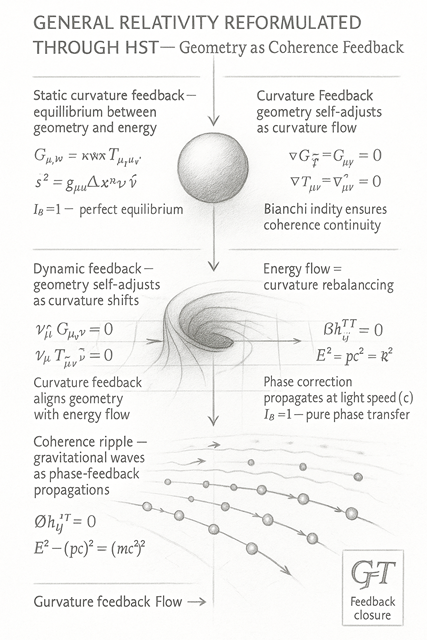
  - **Visualisation:**  
    - Left: atlas patches with matched boundaries (gauge overlaps).  
    - Middle: stress–energy streams bending grid (feedback).  
    - Right: wave patch with geodesic deviation (coherence ripple).
Overview

Einstein’s general relativity describes how energy and matter curve space–time, and how that curvature guides motion.
In the HST framework, this interaction is revealed as curvature feedback — the self-regulating mechanism by which the universe preserves its own coherence.
Geometry and energy are not separate entities: they are the same curvature expressed in different frames of feedback.

Where classical GR sees tensors and fields, HST sees phase-locked coherence — every event maintaining continuity with every other through curvature rebalancing.


🔹 1. Classical Form — Geometry Responds to Energy

The Einstein field equation,

\[ G_{\mu\nu} + \Lambda g_{\mu\nu} = \kappa T_{\mu\nu} \]

states that the curvature of space–time (GμνG_{\mu\nu}) equals the stress–energy of matter (TμνT_{\mu\nu}) scaled by the coupling constant κ=8πG/c4.\kappa = 8\pi G / c^4.
This balance ensures that when energy or momentum flows through space–time, the geometry reshapes to preserve the invariant interval:

\[ s^2 = g_{\mu\nu}\,\Delta x^{\mu} \Delta x^{\nu} = \text{constant} \]

It is a feedback equilibrium: energy tells space–time how to curve, and curvature tells energy how to move.
But in HST, that equilibrium is recognised as coherence feedback — geometry realigning its phase curvature to sustain continuity across the whole field.


🔸 2. HST Interpretation — Coherence as Curvature Memory

In HST–Flow, the metric gμνg_{\mu\nu} is not a static geometry; it is a boundary-phase map — a dynamic pattern of coherence defining how information moves between local frames.
The stress–energy tensor TμνT_{\mu\nu} describes the curvature density and flux within that field — the stored and flowing phase of reality.
Einstein’s equation then becomes the coherence closure condition of the universe:

\[ \text{Curvature feedback: } \quad G_{\mu\nu} = \kappa T_{\mu\nu} \]

When curvature density increases (mass or energy accumulates), the surrounding geometry adjusts its phase gradient to restore overall coherence.
Every mass, every photon, every gravitational wave is a re-alignment of curvature memory — the universe recalibrating itself to keep phase continuity intact.


🔹 3. The Bianchi Identity — Coherence Continuity
The contracted Bianchi identity,

\[ \nabla_{\mu} G^{\mu}{}_{\nu} = 0 \]

ensures that the geometric side of Einstein’s equation conserves curvature information.
Meanwhile, the stress–energy conservation law,

\[ \nabla_{\mu} T^{\mu}{}_{\nu} = 0 \]

ensures the same for matter and radiation.
Together they state that geometry and energy share a single coherence ledger — no information is lost, only exchanged.
This is not just mathematical conservation; it is the statement that the phase of reality is self-consistent across all scales.


🔸 4. Coherence Feedback and the Nature of Gravity

In HST terms, gravity is not a force or even a pure curvature — it is the feedback interface between geometry and energy.
Whenever energy density changes, curvature responds to preserve invariant phase alignment.
Gravity is this adjustment, a continuous dialogue between curvature compression and energy flow.
The apparent "pull" of gravity is the system’s effort to maintain global coherence through local feedback.

This is why the equivalence principle emerges naturally: acceleration and gravity are identical coherence responses — one externally imposed, one internally distributed.
Both describe how curvature reindexes phase geometry to maintain continuity.


🔹 5. The Coherence Constant — cc as Phase Velocity of Reality

The speed of light cc is not merely a velocity; it is the phase velocity of coherence — the rate at which information realigns curvature.
It connects the energy domain and the geometric domain:

\[ E = m c^2, \qquad G_{\mu\nu} = \frac{8\pi G}{c^4} T_{\mu\nu} \]

The same cc binds all transformations:
it sets the ratio between curvature flux (geometry) and curvature density (energy).
In every interaction — gravitational waves, acceleration, or redshift — cc governs the rate of coherence restoration across the field.


🔸 6. Weak-Field and Wave Limits — Curvature as Feedback Flow

In the weak-field limit, HST reduces to Newtonian coherence:
the potential Φ\Phi represents slight curvature offsets that still obey:

\[ \nabla^2 \Phi = 4\pi G \rho \]

Here, the field simply adjusts phase curvature proportionally to energy density.
In the wave regime (TT gauge),

\[ \Box h_{ij}^{TT} = 0 \]

the same feedback ripples through the metric as coherence waves — gravity not as force but as oscillating phase correction propagating through the field.
All motion through space–time is therefore a flow of curvature re-balancing — the universe continually re-synchronising its geometry with its energy content.


🔹 7. The Role of 𝐼 𝐵  ​ — Operational Coherence

The index IBI_B tracks instrumental or boundary coherence: how well an observer’s clocks and rulers remain synchronised with the underlying geometric phase.
When IB=1I_B = 1, the measurement frame perfectly mirrors the global coherence field.

When IB<1I_B < 1, local de-synchronisation (e.g., gravitational noise, thermal drift, or clock error) causes measurement distortion — but the physical invariants remain untouched.

This distinction clarifies the difference between coherence drift in observation and coherence preservation in geometry — a key boundary correction separating reality from its instruments.


🔸 8. Unified Coherence Framework — Reality as Self-Regulating Curvature

General relativity, reformulated through HST, becomes a coherence feedback system:

  • Geometry stores curvature phase (the structure).
  • Matter and energy move curvature phase (the dynamics).
  • Einstein’s field equation balances both — the feedback law of global coherence.

This transforms GR from a geometric theory of gravity into a coherence architecture:
a recursive system where all curvature (gravitational, inertial, radiative) is simply the field remembering how to remain consistent with itself.

The curvature tensor is thus a memory map; the stress–energy tensor is its active update; and the Bianchi identity guarantees that the total phase of reality remains conserved.


🧠 Summary

General relativity is not merely the geometry of gravity — it is the logic of coherence that allows reality to self-stabilise.
Every gravitational effect, from redshift to frame-dragging, expresses curvature feedback — the universe adjusting its phase so that coherence never breaks.

In the HST–Flow interpretation:

  • Metric gμνg_{\mu\nu}: boundary phase map.
  • Stress–energy TμνT_{\mu\nu}: curvature density and flow.
  • Einstein feedback: Gμν=κTμνG_{\mu\nu} = \kappa T_{\mu\nu}.
  • Bianchi identity: coherence conservation across curvature flow.
  • IBI_B: operational alignment of measurement with the coherence field.

General Relativity is the feedback engine of reality —
curvature and energy are not causes, but phases of coherence ensuring the universe never forgets its own structure.


Kireth Research
38 Thorndale Croft, Wetwang, Driffield
East Riding of Yorkshire YO25 9XZ
Designed By