Chapter 26
Irreversibility and Entropy

Time as Recursive Update
Author: Mark Higgins
© Mark Anthony Higgins 11 October 2025
Revised Date: 01 June 2026
Audio Overview

The Problem of Irreversibility

Irreversibility is one of the deepest asymmetries observed in physical reality. Across thermodynamics, cosmology, chemistry, biology, and information systems, processes exhibit a persistent directional tendency:

  • Heat disperses
  • Structures decay
  • Gradients flatten
  • Information degrades
  • Ordered systems become unstable over time

Yet many of the underlying equations of physics remain fundamentally time-symmetric. This creates a central paradox within modern science:

Why does macroscopic reality possess a directional flow of time if the microscopic laws themselves are reversible?

The origin of irreversibility therefore remains one of the foundational unresolved questions in theoretical physics.

Classical Thermodynamic Interpretation

In standard thermodynamics, entropy is typically interpreted statistically as the number of microscopic configurations compatible with a macroscopic state.

The Second Law of Thermodynamics states:

\[ \Delta S \geq 0 \]

Meaning that entropy in an isolated system tends to increase over time.

Under this interpretation:

  • Ordered states are statistically rare
  • Disordered states are statistically dominant
  • Systems naturally evolve toward higher-probability configurations

While this framework successfully predicts thermodynamic behaviour, it does not fully explain:

  • Why irreversibility structurally emerges
  • Why time appears directional
  • Why coherence cannot naturally reconstruct itself
  • Why information loss appears fundamentally one-way

The statistical model describes behaviour, but not the deeper structural origin of temporal asymmetry.

The HST Reformulation

Entropy as Coherence Degradation

Holographic Space-Time (HST) reframes entropy as a recursive coherence phenomenon rather than simple disorder accumulation.

In HST:

Entropy represents the irreversible reduction of admissible coherent informational structure across recursive boundary evolution.

Physical systems are modeled as recursive informational states:

\[ S_t = (I_t, R, B, K) \]

Where:

  • ItI_t = informational configuration
  • = recursive transformation rules
  • BB = boundary constraints
  • = invariant coherence conditions

System evolution occurs through recursive expansion and admissibility filtering:

\[ E_t = \operatorname{expand}(I_t, R) \]

\[ V_t = \{x \in E_t \mid x \models (B \land K)\} \]

Only coherence-preserving continuations survive recursive propagation.

Recursive Origin of Irreversibility

Irreversibility emerges because recursive filtering is structurally lossy.  Once coherence falls below admissibility thresholds, prior configurations cannot be reconstructed without externally supplied structured information.

The system therefore loses access to earlier coherent states:

\[ \Omega_{t+1} \leq \Omega_t \]

Where:

Ωt\Omega_t = recursively recoverable coherent configuration space

This creates directional state evolution.

The “arrow of time” is therefore not externally imposed. It emerges naturally from recursive coherence elimination.

Telephone:
01377 236594

The Arrow of Time

Time as Directional Coherence Filtering

In HST, temporal directionality is generated by asymmetric coherence survivability.

Each recursive update:

\[ S_t \rightarrow S_{t+1} \]

preserves only admissible coherent structure.

Collapsed or decohered configurations cannot fully reverse because:

  • informational compression occurs
  • coherence pathways collapse
  • environmental coupling disperses structure
  • recursive accessibility contracts

Time therefore becomes the observable consequence of irreversible coherence filtering across recursive evolution.

Entropy and Boundary Encoding

Informational Compression Across Boundaries

HST proposes that irreversibility is fundamentally tied to boundary encoding limitations.  Every recursive transition projects only partial recoverable information forward through time.

Processes contributing to entropy growth include:

  • Thermal dispersion
  • Quantum decoherence
  • Environmental interaction
  • Cosmological expansion
  • Information compression
  • Recursive boundary instability

All produce progressive dilution of coherent informational accessibility. Entropy therefore reflects not merely randomness, but loss of structurally recoverable coherence.

Unified Interpretation of Entropic Phenomena

A Single Structural Mechanism

Under HST, many seemingly disconnected irreversible processes become unified manifestations of recursive coherence degradation.

These include:

  • Thermodynamic entropy increase
  • Quantum decoherence
  • Black hole information loss
  • Cosmological heat death
  • Biological aging
  • Memory degradation
  • Energy dissipation
  • Statistical irreversibility

All emerge from the same underlying recursive constraint dynamics.

Local Order Formation

Coherence Amplification in Open Systems

HST does not prohibit local entropy reduction.  Coherent systems may temporarily increase local order by exporting incoherence externally:

\[ \Delta S_{\mathrm{local}} < 0 \quad \text{only if} \quad \Delta S_{\mathrm{external}} > \left|\Delta S_{\mathrm{local}}\right| \]

This explains the emergence of:

  • Stars
  • Galaxies
  • Biological life
  • Neural systems
  • Cognition
  • Complex adaptive structures

Local coherence amplification remains possible when larger boundary systems absorb compensatory entropy growth.

Life as Recursive Coherence Preservation

Biological Resistance to Entropic Collapse

Within HST, living systems are interpreted as recursive coherence-maintenance engines.

Life persists by:

  • maintaining boundary stability
  • regulating informational flow
  • repairing recursive degradation
  • exporting entropy externally
  • preserving internal coherence gradients

Biological aging therefore reflects gradual coherence degradation exceeding repair capacity over time.

Reframing the Second Law

HST reformulates entropy fundamentally:

Entropy is not merely disorder.

Instead:

Entropy is the irreversible contraction of admissible coherence space across recursive boundary evolution.

The Second Law therefore becomes a structural law governing the survival limits of recursive informational systems.

Chapter Direction

Toward a Coherence-Based Thermodynamics

This chapter develops the HST interpretation of irreversibility and entropy through recursive coherence geometry.

The following sections will demonstrate:

  • how entropy emerges from recursive filtering
  • why temporal asymmetry naturally appears
  • how thermodynamics arises from coherence dynamics
  • why information recovery becomes structurally limited
  • how local order survives within global entropy growth

Irreversibility will be shown not as a statistical accident, but as a direct consequence of recursive coherence survival within bounded informational systems.

flow "IrreversibilityAndEntropy" v1.0

description:
  purpose: >
    Model entropy as irreversible contraction of admissible coherence space
    across recursive boundary evolution.
  claim: >
    Irreversibility emerges when recursive state propagation preserves only
    admissible continuations while prior coherent configurations become
    non-recoverable without external structured input.

state:
  S_t:
    form: "(I_t, R, B, K)"
    I_t: informational_configuration
    R: recursive_transformation_rules
    B: boundary_constraints
    K: invariant_coherence_conditions

parameters:
  Omega_t: recoverable_coherence_density
  S_entropy_t: entropy_measure
  C_min: minimum_coherence_threshold
  epsilon: tolerance_margin

process:
  - define_current_state:
      input: S_t
      output: I_t

  - generate_candidate_continuations:
      equation: "E_t = expand(I_t, R)"
      output: E_t

  - filter_by_boundary_and_invariants:
      equation: "V_t = { x in E_t | x models (B and K) }"
      output: V_t

  - test_admissible_continuation:
      if: "V_t != empty"
      then: continue
      else: entropy_failure

  - select_surviving_continuation:
      equation: "x_star in V_t"
      condition: "x_star satisfies B and K"
      output: x_star

  - update_information_state:
      equation: "I_{t+1} = update(I_t, x_star)"
      output: I_t_plus_1

  - propagate_recursive_state:
      equation: "S_{t+1} = (I_{t+1}, R, B, K)"
      output: S_t_plus_1

entropy_dynamics:
  global_direction:
    equation: "Delta S_entropy >= 0"
    meaning: entropy does not decrease in an isolated recursive system

  coherence_contraction:
    equation: "Omega_{t+1} <= Omega_t"
    meaning: recoverable coherent configuration space contracts over time

  irreversibility_condition:
    equation: "I_{t+1} does_not_imply I_t"
    meaning: later states do not fully reconstruct earlier coherent states

  failure_condition:
    equation: "V_t = empty => Execution(S_t) = FAIL"
    meaning: no admissible continuation remains

local_order_exception:
  equation: "Delta S_local < 0 only if Delta S_external > abs(Delta S_local)"
  meaning: local coherence may increase only by exporting entropy externally

boundary_encoding:
  compression:
    rule: "projection_forward_is_partial"
    meaning: each recursive update carries forward only admissible recoverable structure

  non_recovery:
    rule: "lost_coherence_requires_external_structure"
    meaning: prior coherence cannot be restored without structured input

outputs:
  - irreversible_state_progression
  - entropy_as_coherence_space_contraction
  - time_arrow_as_directional_filtering
  - local_order_as_entropy_export
  - failure_when_no_admissible_continuation_exists

execution_guarantee:
  valid_execution:
    condition: "V_t != empty and Omega_t >= C_min"
    result: "S_t -> S_{t+1}"

  entropy_failure:
    condition: "V_t = empty or Omega_t < C_min"
    result: "Execution(S_t) = FAIL"

scientific_interpretation:
  summary: >
    Entropy is not treated as simple disorder. It is defined as the
    irreversible reduction of recoverable coherent configuration space.
    Time becomes directional because recursive admissibility filtering
    preserves only surviving coherent continuations while prior states
    become structurally non-recoverable.

What This Flow Implements

Recursive Structural Model of Irreversibility

The Irreversibility and Entropy flow implements a recursive coherence-based model of thermodynamic directionality within the Holographic Space-Time (HST) framework.

Rather than treating entropy as simple statistical disorder, the flow models entropy as:

The irreversible contraction of admissible coherence space across recursive state evolution.

The system evolves by generating candidate continuations, filtering them through coherence-preserving constraints, and propagating only structurally admissible states forward through recursive time.

Core Structural Objective

Admissible Continuation Filtering

The flow begins from a recursive system state:

\[ S_t = (I_t, R, B, K) \]

Where:

  • ItI_t = informational configuration
  • RR = recursive transformation rules
  • BB = boundary constraints
  • KK = invariant coherence conditions

The system recursively generates possible future continuations:

\[ E_t = \operatorname{expand}(I_t, R) \]

These candidates are filtered according to coherence admissibility:

\[ V_t = \{x \in E_t \mid x \models (B \land K)\} \]

Only continuations preserving recursive coherence survive.  The flow therefore implements entropy as a structural filtering process rather than a purely probabilistic one.

Implementation of Irreversibility

Directional Loss of Recoverable Coherence

The flow implements irreversibility through recursive information loss.

At each recursive transition:

\[ S_t \rightarrow S_{t+1} \]

some prior coherent configurations become inaccessible due to:

  • boundary compression
  • decoherence
  • environmental interaction
  • recursive filtering
  • coherence collapse

This produces directional contraction of recoverable coherence space:

\[ \Omega_{t+1} \leq \Omega_t \]

Where:

Ωt\Omega_t represents the density of recoverable coherent configurations

The flow therefore models time asymmetry as a direct consequence of recursive coherence elimination.

Implementation of Entropy Growth

Structural Second Law Dynamics

The flow encodes the Second Law of Thermodynamics structurally:

\[ \Delta S \geq 0 \]

Rather than interpreting entropy as “disorder,” the implementation defines entropy growth as:

  • reduction of admissible coherent states
  • loss of reversible informational accessibility
  • contraction of recursive continuation space
  • progressive degradation of structured recoverability

Entropy therefore becomes a geometric property of recursive coherence-space evolution.

Implementation of Execution Failure

Coherence Collapse Conditions

The flow explicitly models failure states.  If no admissible continuation survives recursive filtering:

\[ V_t = \emptyset \]

then recursive propagation terminates:

\[ \operatorname{Execution}(S_t) = \mathrm{FAIL} \]

This implementation treats physical persistence itself as conditional upon coherence survivability.  Existence is therefore structurally tied to admissible recursive continuation.

Implementation of the Arrow of Time

Recursive Directionality

The flow implements temporal directionality without assuming an externally imposed time axis.  Time emerges from asymmetric recursive survivability.

Each recursive update preserves only coherence-compatible structure while irrecoverable configurations collapse permanently.

This creates:

  • directional state propagation
  • irreversible informational loss
  • non-recoverable coherence collapse
  • observable temporal asymmetry

The arrow of time is therefore implemented as recursive admissibility filtering across bounded informational systems.

Implementation of Local Order Formation

Entropy Export Mechanism

The flow allows temporary local entropy reduction within open systems. This is implemented through compensatory entropy export:

\[ \Delta S_{\mathrm{local}} < 0 \quad \text{only if} \quad \Delta S_{\mathrm{external}} > \left|\Delta S_{\mathrm{local}}\right| \]

This mechanism explains how coherent structures may emerge despite global entropy increase.
The flow therefore supports the formation of:

  • stars
  • galaxies
  • biological systems
  • cognition
  • self-organising structures

through externalized incoherence transfer.

Implementation of Boundary Encoding Limits

Partial Recursive Projection

The flow models recursive evolution as partially compressive. Each state update projects only admissible recoverable structure forward:

  • not all information survives
  • not all coherence is recoverable
  • some recursive pathways collapse permanently

This models:

  • thermodynamic irreversibility
  • quantum decoherence
  • memory degradation
  • cosmological entropy growth
  • information loss dynamics

within a single recursive framework.

Unified Physical Interpretation

Coherence-Based Thermodynamics

The flow implements a unified structural explanation for irreversible physical behaviour across multiple domains.

Under this implementation:

  • entropy becomes coherence-space contraction
  • irreversibility becomes recursive non-recoverability
  • time becomes directional coherence filtering
  • persistence becomes admissible continuation survival

The system therefore reframes thermodynamics as a recursive geometric survival process rather than purely statistical mechanics.

Final Structural Interpretation

Entropy as Recursive Coherence Contraction

The final implementation principle of the flow is:

Physical systems survive only while admissible coherence pathways remain recursively propagatable.

Irreversibility emerges because recursive filtering progressively removes inaccessible coherent configurations from future recoverable state space.

Entropy is therefore implemented not as randomness, but as:

The irreversible contraction of admissible coherence geometry across recursive boundary evolution.

How to Read This Flow

Introduction

The Irreversibility and Entropy flow should be read as a recursive structural model describing how physical systems evolve directionally through coherence-preserving state propagation.

Unlike conventional thermodynamic descriptions that focus primarily on statistical probabilities, this flow models entropy as:

The progressive contraction of admissible coherence space across recursive evolution.

The flow therefore describes not merely what entropy does, but how irreversible behaviour structurally emerges from recursive informational dynamics.

Core Reading Principle

Read the Flow as Recursive State Evolution

The entire system evolves through recursive transitions between informational states:

\[ S_t \rightarrow S_{t+1} \]

Each transition represents:

  • a recursive update
  • a coherence-selection event
  • a boundary admissibility test
  • a structural survival process

The flow should therefore be interpreted dynamically rather than statically.

Every stage asks a single question:

Can coherent recursive continuity survive into the next state?

If the answer is yes, propagation continues.
If not, recursive execution fails.

Reading the Initial State

The Recursive System Definition

The flow begins with:

\[ S_t = (I_t, R, B, K) \]

This equation defines the complete recursive state of the system at time tt.

Read each component structurally:

Symbol Meaning
\( I_t \) Current informational configuration
\( R \) Recursive transformation rules
\( B \) Boundary constraints
\( K \) Invariant coherence conditions

Together these define:

  • what the system currently is
  • how it may evolve
  • what it is allowed to become
  • what structures must remain preserved

The system is therefore not interpreted as matter moving in space, but as recursive informational continuity constrained by coherence conditions.

Reading Candidate Expansion

Generation of Possible Futures

The next stage is:

\[ E_t = \operatorname{expand}(I_t, R) \]

This stage generates all structurally possible candidate continuations.

Read this as:

The system recursively explores all admissible future pathways permitted by its transformation rules.

Importantly:

  • EtE_t does not represent actual evolution
  • it represents possible evolution
  • many generated states will later be rejected

This stage corresponds to recursive future-space generation.

Telephone:
01377 236594

Reading Admissibility Filtering

Coherence Survival Testing

The central filtering operation is:

\[ V_t = \{x \in E_t \mid x \models (B \land K)\} \]

This is the most important structural operation in the flow.

Read it carefully:

  • x∈Etx \in E_t means a candidate future state
  • x⊨(B∧K)x \models (B \land K) means the candidate satisfies all coherence constraints

The set VtV_t therefore contains:

Only recursively survivable continuations.

Everything outside VtV_t is structurally eliminated.

This filtering operation produces irreversibility because rejected coherence states are no longer recoverable through internal recursion alone.

Reading Entropy Growth

Contraction of Recoverable Coherence

Entropy is represented through:

\[ \Omega_{t+1} \leq \Omega_t \]

Where:

Ωt\Omega_t represents recoverable coherent configuration density

Read this equation as:

The system progressively loses access to prior coherent configurations over recursive evolution.

This is not merely statistical disorder.

It is:

  • reduction of recoverable structure
  • collapse of accessible coherence pathways
  • contraction of admissible recursive geometry

Entropy therefore measures coherence accessibility loss.

Reading the Arrow of Time

Directional Recursive Filtering

The flow implements time directionality structurally.

Read the recursive progression:

\[ S_t \rightarrow S_{t+1} \rightarrow S_{t+2} \]

as irreversible coherence filtering.
The flow assumes:

  • future states emerge from admissibility selection
  • rejected states cannot fully reconstruct themselves
  • recursive continuity becomes directional

This creates the observable arrow of time. Time is therefore not externally imposed.

It emerges from recursive asymmetry in coherence survivability.

Reading Local Order Formation

The flow allows local reductions in entropy:

\[ \Delta S_{\mathrm{local}} < 0 \quad \text{only if} \quad \Delta S_{\mathrm{external}} > \left|\Delta S_{\mathrm{local}}\right| \]

Read this as:

Local coherence can increase only by exporting greater incoherence externally.

This explains how:

  • stars form
  • life evolves
  • cognition stabilises
  • ordered systems emerge

despite global entropy growth.
The system therefore preserves the Second Law globally while allowing local coherence concentration.

Reading Failure Conditions

Recursive Termination

One of the most important statements is:

\[ V_t = \emptyset \]

This means:

No admissible recursive continuation exists.

The result becomes:

\[ \operatorname{Execution}(S_t) = \mathrm{FAIL} \]

Read this not simply as computational failure, but as:

  • coherence collapse
  • structural instability
  • irreversible termination of recursive persistence

Existence itself becomes conditional upon admissible continuation.

Reading Boundary Compression

Partial Information Projection

The flow assumes that recursive updates are compressive. Not all informational structure survives forward propagation.

Read this principle as:

  • information becomes partially unrecoverable
  • recursive accessibility contracts
  • prior coherence states collapse beyond internal reconstruction

This models:

  • thermodynamic entropy
  • quantum decoherence
  • memory degradation
  • cosmological irreversibility

within a single recursive framework.

Reading the Flow as a Physical Theory

Beyond Statistical Thermodynamics

This flow should not be interpreted merely as symbolic mathematics. It represents a full structural reinterpretation of thermodynamics.

Under HST:

  • entropy becomes recursive coherence contraction
  • irreversibility becomes non-recoverable recursive filtering
  • time becomes directional admissibility propagation
  • persistence becomes coherence survivability

The flow therefore functions simultaneously as:

  • a thermodynamic model
  • a recursive geometry model
  • a coherence survival framework
  • an informational interpretation of time

Final Reading Principle

The Central Structural Insight

The single most important idea when reading this flow is:

Physical systems do not persist because states merely exist.

They persist because recursive coherence conditions continue to admit structurally survivable future states.

Irreversibility emerges because coherence-space contracts faster than recursive systems can fully reconstruct prior admissible configurations.

Entropy is therefore the measurable signature of recursive coherence loss across bounded informational evolution.

Flow → Equation tri-mapping

Flow Stage Flow Algebra Expression Equation / Structural Meaning
Recursive State Definition \( S_t = (I_t, R, B, K) \) Complete recursive informational state
Informational Configuration \( I_t \) Current coherent system structure
Recursive Rule Set \( R \) Allowed state transformation operators
Boundary Constraints \( B \) Admissibility limits on evolution
Invariant Conditions \( K \) Coherence-preserving structural invariants
Candidate Expansion \( E_t = \mathrm{expand}(I_t, R) \) Generation of possible future continuations
Admissibility Filtering \( V_t = \{x \in E_t \mid x \models (B \land K)\} \) Selection of coherence-valid continuations
Coherent Continuation \( x^* \in V_t \) Structurally admissible surviving state
Recursive Update \( I_{t+1} = \mathrm{update}(I_t, x^*) \) Propagation of coherent informational continuity
State Evolution \( S_t \rightarrow S_{t+1} \) Recursive temporal progression
Entropy Directionality \( \Delta S \geq 0 \) Global entropy non-decrease
Coherence Contraction \( \Omega_{t+1} \leq \Omega_t \) Reduction of recoverable coherence space
Irreversibility Condition \( I_{t+1} \not\Rightarrow I_t \) Prior coherent states not fully recoverable
Time Arrow Emergence \( S_t \rightarrow S_{t+1} \rightarrow S_{t+2} \) Directional recursive filtering
Boundary Compression \( \Pi(I_t) < I_t^{\mathrm{full}} \) Partial forward information projection
Local Entropy Reduction \( \Delta S_{\mathrm{local}} < 0 \) Temporary local coherence amplification
External Compensation \( \Delta S_{\mathrm{external}} > |\Delta S_{\mathrm{local}}| \) Exported incoherence preserves Second Law
Decoherence Collapse \( \Omega_t < C_{\min} \) Coherence density below survivability threshold
Admissible Continuation Failure \( V_t = \emptyset \) No coherence-valid future states remain
Recursive Execution Failure \( \mathrm{Execution}(S_t) = \mathrm{FAIL} \) Irreversible coherence termination
Geometric Persistence Condition \( V_t \neq \emptyset \) Recursive existence remains structurally admissible
Thermodynamic Interpretation \( \Omega_t \downarrow \Rightarrow S \uparrow \) Entropy increase via coherence accessibility loss
HST Entropy Definition \( S_{\mathrm{entropy}} \equiv \Omega_{\mathrm{loss}} \) Entropy as contraction of admissible coherence geometry
Structural Arrow of Time \( V_{t+1} \subseteq V_t \) Accessible recursive continuation space contracts over time
Final Survival Principle \( \exists x \in V_t \Leftrightarrow \text{recursive persistence} \) Existence requires admissible continuation

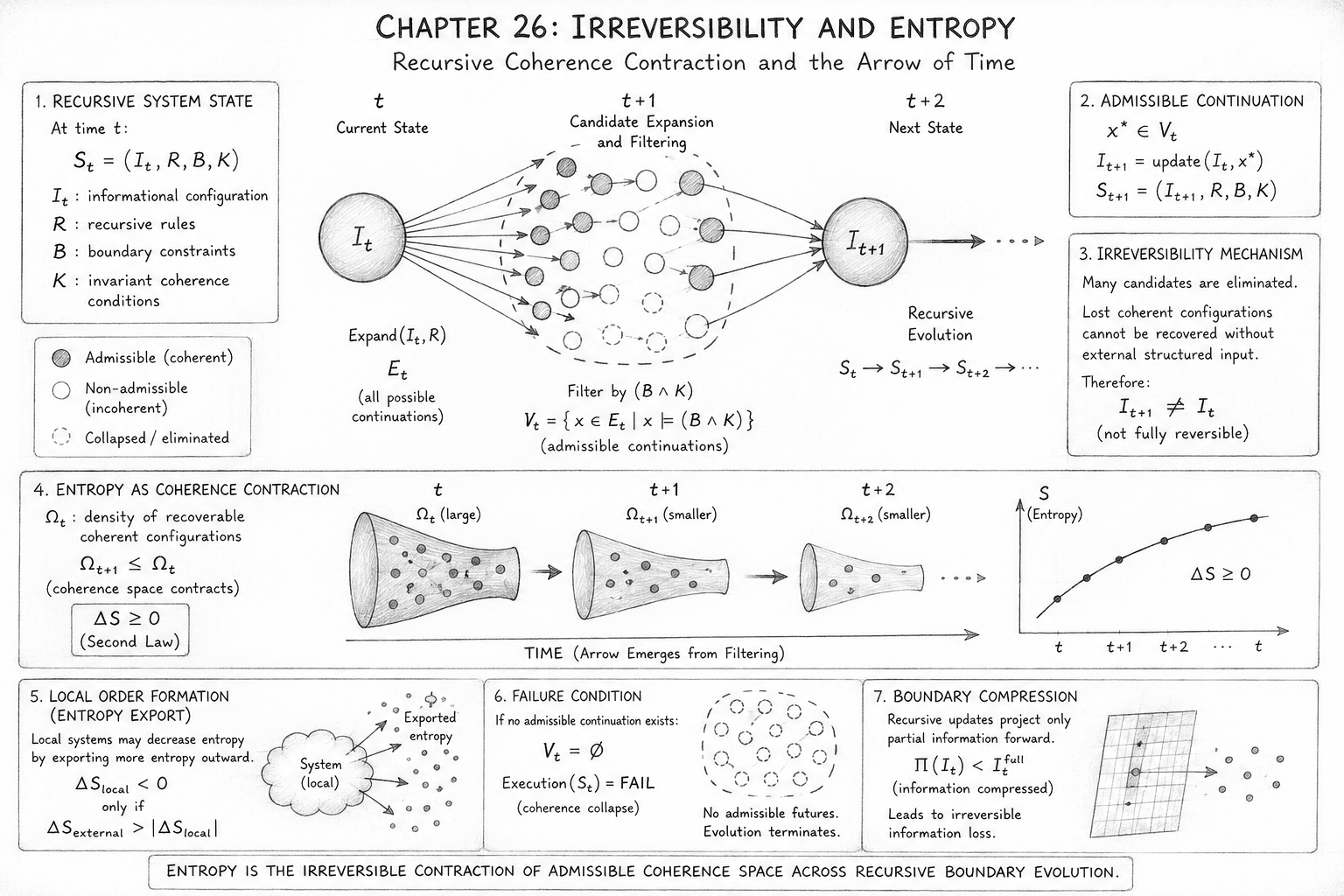
Overview of the Diagram

The diagram illustrates the Holographic Space-Time (HST) interpretation of entropy and irreversibility as a recursive coherence-filtering process operating across bounded informational systems.

Rather than depicting entropy as random disorder accumulation, the figure models entropy as:

The irreversible contraction of admissible coherence space during recursive state evolution.

The full diagram traces how recursive systems generate candidate future states, eliminate incoherent continuations through admissibility filtering, and progressively lose access to prior recoverable coherence configurations over time.

The visual structure therefore represents the emergence of:

  • entropy growth
  • temporal asymmetry
  • coherence contraction
  • irreversible evolution
  • recursive persistence limits

Section 1 — Recursive System State

Initial Informational Configuration

The left side of the diagram defines the recursive system state:

\[ S_t = (I_t, R, B, K) \]

This represents the complete informational configuration of the system at time tt.

The diagram identifies four structural components:

Symbol Meaning
\( I_t \) Informational configuration
\( R \) Recursive transformation rules
\( B \) Boundary constraints
\( K \) Invariant coherence conditions

This establishes that physical systems are treated not as isolated material objects, but as recursively evolving informational structures constrained by coherence-preserving conditions.

The shaded sphere labeled ItI_t represents the current coherent informational state before recursive expansion occurs.

Section 2 — Candidate Expansion and Filtering

Recursive Generation of Possible Futures

The central portion of the diagram illustrates recursive future-state generation:

\[ E_t = \operatorname{expand}(I_t, R) \]

Arrows emerging from ItI_t represent all candidate future continuations permitted by the recursive transformation rules.

Inside the dashed expansion region:

  • shaded nodes represent admissible coherent continuations
  • empty nodes represent incoherent continuations
  • dashed nodes represent collapsed or eliminated states

This visualizes the recursive admissibility filtering operation:

\[ V_t = \{x \in E_t \mid x \models (B \land K)\} \]

Only coherence-preserving continuations survive into the admissible continuation set VtV_t.  The filtering region therefore represents the structural origin of irreversibility.

Rejected configurations are removed from recursive accessibility.

Section 3 — Admissible Continuation Selection

Recursive State Propagation

The surviving continuation is represented by:

\[ x^{*} \in V_t \]

This admissible continuation updates the informational state:

\[ I_{t+1} = \operatorname{update}(I_t, x^{*}) \]

The new recursive system state becomes:

\[ S_{t+1} = (I_{t+1}, R, B, K) \]

The diagram visually shows recursive propagation moving from:

\[ S_t \rightarrow S_{t+1} \rightarrow S_{t+2} \]

This progression represents directional recursive evolution. Only surviving coherent structure propagates forward through time.

Section 4 — Irreversibility Mechanism

Non-Recoverability of Prior Coherence

The right-side explanatory panel defines the central mechanism of irreversibility.  Many candidate configurations generated during expansion fail admissibility testing and are permanently eliminated.

This creates the irreversible condition:

\[ I_{t+1} \nRightarrow I_t \]

Meaning

Later states cannot fully reconstruct prior coherent informational configurations.

The diagram therefore models irreversibility not as randomness, but as recursive non-recoverability caused by coherence elimination.

The loss of admissible pathways generates temporal asymmetry.

Section 5 — Entropy as Coherence Contraction

Progressive Reduction of Recoverable Structure

The lower central section visualizes entropy growth geometrically.  The narrowing funnel structures represent shrinking coherence accessibility over recursive time progression.

This is mathematically represented by:

\[ \Omega_{t+1} \leq \Omega_t \]

Where:

Ωt\Omega_t represents the density of recoverable coherent configurations

The progressively narrowing structures show that:

  • accessible coherent states decrease
  • recoverable informational structure contracts
  • recursive future-space becomes increasingly constrained

Entropy therefore appears as contraction of admissible coherence geometry.

The adjacent entropy graph:

\[ \Delta S \geq 0 \]

illustrates the Second Law as a directional consequence of recursive filtering.

Section 6 — Local Order Formation

Entropy Export and Temporary Coherence Amplification

The lower-left panel illustrates how local order may temporarily increase.

The cloud structure represents a local system maintaining or increasing coherence through entropy export into the surrounding environment.

This is represented by:

\[ \Delta S_{\mathrm{local}} < 0 \]

only if:

\[ \Delta S_{\mathrm{external}} > \left|\Delta S_{\mathrm{local}}\right| \]

The outgoing arrows visualize exported incoherence.  This section explains how coherent structures such as:

  • stars
  • life
  • biological systems
  • cognition

can emerge despite global entropy growth.

Section 7 — Failure Condition

Recursive Termination

The lower-middle panel illustrates total coherence collapse.

When no admissible continuation survives:

\[ V_t = \emptyset \]

recursive execution terminates:

\[ \operatorname{Execution}(S_t) = \mathrm{FAIL} \]

The empty dashed circular structure represents the absence of viable coherent future states.  This section visualizes the structural limit of recursive persistence.

Existence itself depends upon admissible continuation survival.

Section 8 — Boundary Compression

Partial Informational Projection

The lower-right panel illustrates recursive information compression across boundary evolution.  The projected grid structure represents partial forward encoding of informational structure.

This is expressed as:

\[ \Pi(I_t) < I_{t\mathrm{full}} \]

Meaning:

Recursive updates project only partial recoverable informational structure forward.

The scattered output nodes represent irrecoverable information loss during recursive propagation.

This section models:

  • thermodynamic entropy
  • decoherence
  • memory degradation
  • irreversible informational compression

within a unified geometric framework.

Final Structural Interpretation

Entropy as Recursive Coherence Loss

The final statement beneath the diagram summarizes the full HST interpretation:

Entropy is the irreversible contraction of admissible coherence space across recursive boundary evolution.

The diagram therefore provides a complete geometric model of:

  • entropy
  • irreversibility
  • temporal asymmetry
  • recursive persistence
  • coherence degradation

through recursive admissibility filtering within bounded informational systems.

The arrow of time emerges naturally from the progressive elimination of inaccessible coherence pathways across recursive evolution.

Diagram → Flow Mapping Table

Diagram Component Flow Algebra Component Structural Meaning
Initial shaded sphere (\( I_t \)) \( I_t \) Current coherent informational configuration
Recursive system definition panel \( S_t = (I_t, R, B, K) \) Complete recursive state description
Recursive arrows leaving (\( I_t \)) \( E_t = \mathrm{expand}(I_t, R) \) Generation of possible future continuations
Dashed expansion region \( E_t \) Candidate future-state space
Shaded candidate nodes \( x \models (B \land K) \) Coherence-valid admissible continuations
Empty candidate nodes \( x \not\models (B \land K) \) Incoherent or invalid continuations
Dashed collapsed nodes Eliminated states Failed recursive coherence pathways
Filtering boundary \( V_t = \{x \in E_t \mid x \models (B \land K)\} \) Admissibility filtering mechanism
Surviving continuation path \( x^* \in V_t \) Selected coherence-preserving continuation
Updated shaded sphere (\( I_{t+1} \)) \( I_{t+1} = \mathrm{update}(I_t, x^*) \) Propagated informational state
Recursive forward arrows \( S_t \rightarrow S_{t+1} \) Directional recursive evolution
Time progression notation \( S_t \rightarrow S_{t+1} \rightarrow S_{t+2} \) Emergent arrow of time
Irreversibility panel \( I_{t+1} \not\Rightarrow I_t \) Prior coherent states not fully recoverable
Narrowing funnel geometries \( \Omega_{t+1} \leq \Omega_t \) Contraction of recoverable coherence space
Large-to-small coherence funnels Recursive entropy progression Progressive loss of accessible structure
Entropy graph \( \Delta S \geq 0 \) Global entropy non-decrease
Local system cloud \( \Delta S_{\mathrm{local}} < 0 \) Temporary local coherence amplification
Outward entropy arrows \( \Delta S_{\mathrm{external}} > \Delta S_{\mathrm{local}} \) External entropy compensation
Empty dashed future-state circle \( V_t = \emptyset \) No admissible continuations remain
Failure condition panel \( \mathrm{Execution}(S_t) = \mathrm{FAIL} \) Recursive coherence termination
Grid projection diagram \( \Pi(I_t) < I_t^{\mathrm{full}} \) Partial informational projection
Scattered projected points Information loss Irrecoverable coherence degradation
Recursive compression process Boundary encoding Lossy recursive propagation
Final bottom statement HST entropy principle Entropy as recursive coherence-space contraction
Entire diagram structure Recursive admissibility engine Thermodynamic irreversibility via coherence filtering
Overall left-to-right flow Recursive temporal asymmetry Emergent directional evolution
Entire entropy geometry \( \Omega_t \downarrow \Rightarrow S \uparrow \) Entropy increase through coherence accessibility loss
Total recursive system \( V_t \neq \emptyset \Leftrightarrow \text{persistence} \) Existence requires admissible continuation survival

Execution Guarantee Statement

Chapter 26 — Irreversibility and Entropy

Recursive Execution Requirement

The Irreversibility and Entropy flow executes only when recursively admissible coherence pathways remain structurally available across bounded informational evolution.

Execution is formally guaranteed under the condition:

\[ V_t \neq \emptyset \land \Omega_t \geq C_{\min} \]

Where:

Symbol Meaning
\( V_t \) Admissible recursive continuation set
\( \Omega_t \) Recoverable coherence density
\( C_{\min} \) Minimum coherence threshold for persistence

This condition guarantees that structurally valid recursive evolution remains possible.

Recursive State Propagation

Coherence-Preserving Evolution

When admissible continuation exists, recursive propagation proceeds through:

\[ S_t \rightarrow S_{t+1} \]

The surviving continuation is selected from the admissible set:

\[ x^{*} \in V_t \]

The informational state is then updated:

\[ I_{t+1} = \operatorname{update}(I_t, x^{*}) \]

This guarantees that only coherence-compatible recursive continuations survive forward propagation.

The system therefore evolves through structurally constrained admissibility selection.

Entropy Directionality Guarantee

Coherence Space Contraction

The flow guarantees irreversible entropy progression through recursive coherence contraction:

\[ \Omega_{t+1} \leq \Omega_t \]

Where:

Ωt\Omega_t represents recoverable coherent configuration space

This guarantees that recursive evolution progressively reduces accessible coherent informational structure over time.

Entropy therefore emerges as directional contraction of admissible coherence geometry.

Second Law Compliance

Global Entropy Stability

The flow guarantees compliance with the global thermodynamic condition:

\[ \Delta S \geq 0 \]

This guarantees that isolated recursive systems do not globally decrease entropy during admissible evolution.

The system therefore preserves thermodynamic asymmetry structurally rather than statistically.

Local Order Formation Guarantee

Controlled Coherence Amplification

The flow permits temporary local entropy reduction only under external compensation:

\[ \Delta S_{\mathrm{local}} < 0 \quad \text{only if} \quad \Delta S_{\mathrm{external}} > \left|\Delta S_{\mathrm{local}}\right| \]

This guarantees that local coherence amplification remains globally thermodynamically admissible.
The formation of:

  • stars
  • life
  • biological systems
  • cognition
  • complex order

therefore remains compatible with overall entropy increase.

Irreversibility Guarantee

Non-Recoverability of Prior States

The flow guarantees temporal asymmetry through irreversible coherence elimination:

\[ I_{t+1} \nRightarrow I_t \]

This means:

Later recursive states cannot fully reconstruct prior coherent informational configurations.

Rejected coherence pathways become structurally inaccessible under internal recursive evolution.

The arrow of time therefore emerges directly from recursive admissibility filtering.

Failure Conditions

Recursive Termination

Execution fails when no admissible continuation survives:

\[ V_t = \emptyset \]

or when coherence density falls below the survivability threshold:

\[ \Omega_t < C_{\min} \]

Under these conditions:

\[ \operatorname{Execution}(S_t) = \mathrm{FAIL} \]

This failure condition represents:

  • irreversible coherence collapse
  • recursive termination
  • structural persistence failure
  • absence of viable future-state continuity

Existence itself therefore depends upon admissible recursive continuation survival.

Boundary Compression Guarantee

Partial Informational Projection

The flow guarantees that recursive evolution remains compressive:

\[ \Pi(I_t) < I_{t\mathrm{full}} \]

Meaning:

Recursive updates project only partial recoverable informational structure forward.

This guarantees:

  • irreversible information loss
  • coherence degradation
  • entropy growth
  • recursive non-recoverability

across bounded informational evolution.

Structural Guarantees of the Flow

Guaranteed Properties

The flow guarantees:

  • directional entropy progression
  • recursive coherence contraction
  • admissibility-constrained evolution
  • structural thermodynamic asymmetry
  • irreversible informational filtering
  • bounded recursive persistence
  • coherence-based temporal directionality

within the Holographic Space-Time recursive framework.

Final Execution Principle

Recursive Persistence Condition
The final execution condition of the flow is:

Recursive existence continues only while admissible coherence-preserving continuations remain available.

If admissible continuation space collapses:

\[ V_t = \emptyset \]

then:

recursive persistence terminates irreversibly

Entropy is therefore executed not as probabilistic disorder growth, but as:

The irreversible contraction of admissible coherence geometry across recursive boundary evolution.

Diagram → Flow Mapping Table

Diagram Component Visual Meaning Flow Algebra Mapping Equation Mapping Scientific Interpretation
Thermodynamic State System definition box State Construction \( S_t=(I_t,R,B,K) \) Complete thermodynamic system specification
Information State \( I_t \) component inside state box Current State Information \( I_t \) Current thermodynamic configuration
Transformation Rules \( R \) component Rule System \( R \) Governing thermodynamic dynamics
Boundary Constraints \( B \) component Constraint Layer \( B \) Physical thermodynamic limits
Conserved Invariants \( K \) component Invariant Preservation \( K \) Conserved thermodynamic quantities
Candidate State Cloud Expansion region containing many states Continuation Generation \( E_t=\operatorname{expand}(I_t,R) \) Future thermodynamic possibilities
Filtered State Cloud Reduced state set after filtering Admissibility Filtering \( V_t=\{x\in E_t\mid x\models(B\land K)\} \) Physically valid thermodynamic continuations
State Removal During Filtering States eliminated from cloud Constraint Enforcement \( x\not\models(B\land K) \) Invalid thermodynamic pathways removed
Coherence Density Field Shaded coherence concentration diagram Coherence Measurement \( \Omega_t=\operatorname{coherence\_density}(I_t,B,K) \) Recoverable thermodynamic organisation
Dense Central Region Dark coherence core High Coherence Zone \( \Omega_t\uparrow \) Strong thermodynamic structure
Diffuse Outer Region Dispersed coherence field Low Coherence Zone \( \Omega_t\downarrow \) Reduced thermodynamic organisation
Entropy Distribution Graph Dispersion curve Entropy Calculation \( \Sigma_t=\operatorname{dispersion}(\Omega_t\ \text{over}\ V_t) \) Coherence dispersion across continuation space
Entropy Curve Spread Width of entropy profile Entropy Growth \( \Delta\Sigma_t>0 \) Increasing coherence dispersion
Continuation Histogram Accessible continuation bars Energy Measurement \( Energy_t=\operatorname{continuation\_capacity}(V_t) \) Available future continuation capacity
Large Histogram Many accessible states High Energy State \( Energy_t\uparrow \) Large continuation availability
Small Histogram Few accessible states Low Energy State \( Energy_t\downarrow \) Limited continuation availability
Heat Flow Field Gradient arrows Heat Redistribution \( HeatFlow_t=\operatorname{redistribute}(\nabla\Omega_t,B) \) Coherence-gradient equalisation
Directional Arrows Flow vectors Gradient Propagation \( \nabla\Omega_t \) Thermodynamic transport direction
Probability Landscape Selection distribution curve Continuation Selection \( x^*=\arg\max_{x\in V_t}P(x\mid I_t,R,B,K,\beta) \) Most probable admissible future state
Selected Peak Highlighted continuation (\(x^*\)) State Choice \( x^*\in V_t \) Executed thermodynamic continuation
State Update Arrow Transition between states Recursive Update \( I_{t+1}=update(I_t,x^*) \) Thermodynamic evolution step
Updated System State New state box Next State Construction \( S_{t+1}=(I_{t+1},R,B,K) \) Future thermodynamic configuration
Timeline \(t,t+1,t+2\) progression Recursive Evolution \( S_t\rightarrow S_{t+1}\rightarrow S_{t+2} \) Continuous thermodynamic evolution
Recursive Loop Arrow Large return path Recursive Execution Cycle \( S_t\rightarrow E_t\rightarrow V_t\rightarrow S_{t+1} \) Ongoing thermodynamic dynamics
Equilibrium Block Stable-state panel Equilibrium Detection \( |\Delta\Sigma_t|\leq\epsilon \) Entropy stabilisation
Vanishing Gradient Indicator Flat gradient condition Thermal Equilibrium \( \nabla\Omega_t\approx0 \) No net coherence redistribution
Stable Execution Label Stability condition Equilibrium State \( Execution(S_t)=STABLE \) Dynamically stable thermodynamic system
Irreversibility Block Forward vs reverse comparison Continuation Asymmetry \( N_{forward}\gg N_{reverse} \) Emergence of thermodynamic arrow of time
Forward Arrow Preferred direction Time Direction \( Forward\rightarrow Future \) Natural thermodynamic progression
Failure Condition A Empty continuation set No Admissible Continuation \( V_t=\emptyset \) No valid future state exists
Failure Result A Failure output Execution Failure \( Execution(S_t)=FAIL \) Thermodynamic evolution terminates
Failure Condition B Low coherence threshold Coherence Collapse \( \Omega_t<C_{min} \) Structural organisation lost
Failure Result B Collapse output Thermodynamic Collapse \( Execution(S_t)=THERMODYNAMIC\_COLLAPSE \) System coherence failure
Failure Condition C Excessive entropy Unrecoverable Entropy \( \Sigma_t>\Sigma_{max} \) Structural recovery impossible
Failure Result C Degraded structure Irreversible Degradation \( Structure_{recoverable}\rightarrow0 \) Permanent thermodynamic loss
Execution Guarantee Block Final guarantee panel Continuation Condition \( V_t\neq\emptyset\land\Omega_t\geq C_{min} \) Requirements for thermodynamic evolution
Complete Flow Path Full diagram sequence Thermodynamic Reformulation Flow \( S_t\rightarrow E_t\rightarrow V_t\rightarrow\Omega_t\rightarrow\Sigma_t\rightarrow Energy_t\rightarrow HeatFlow_t\rightarrow x^*\rightarrow S_{t+1} \) Complete recursive thermodynamic cycle
Physical Interpretation Box Summary definitions Reformulation Layer \( Entropy\equiv Dispersion(\Omega) \) Entropy as coherence dispersion
Physical Interpretation Box Summary definitions Energy Reformulation \( Energy\equiv ContinuationCapacity(V) \) Energy as continuation capacity
Physical Interpretation Box Summary definitions Heat Reformulation \( Heat\equiv Redistribution(\nabla\Omega) \) Heat as coherence redistribution
Physical Interpretation Box Summary definitions Equilibrium Reformulation \( Equilibrium\equiv Stable(V_t) \) Equilibrium as stable continuation density
Physical Interpretation Box Summary definitions Irreversibility Reformulation \( Irreversibility\equiv N_{forward}\gg N_{reverse} \) Arrow of time from continuation asymmetry

Diagram Summary Equation

St​→Et​→Vt​→Ωt​→Σt​→Energyt​→HeatFlowt​→x∗→St+1​

This single mapping captures the entire scientific meaning of the diagram: thermodynamic systems evolve by generating admissible continuations, measuring coherence dispersion, redistributing coherence gradients, selecting valid future states, and recursively updating through constrained continuation space.

Execution Guarantee Statement

Purpose

The Thermodynamic Reformulation Flow is designed to model thermodynamic evolution as a recursive coherence-distribution process operating within constrained continuation space.

The flow guarantees that thermodynamic evolution proceeds only when structurally valid future continuations remain available and sufficient coherence is maintained for recursive state propagation.

This guarantee provides the formal execution condition for all thermodynamic behaviour described within the framework.

Fundamental Execution Condition

Execution of the thermodynamic system is defined by:

\[ \operatorname{Execution}(S_t) \Leftrightarrow V_t \neq \emptyset \;\land\; \Omega_t \geq C_{\min} \]

where:

\[ V_t = \{x \in E_t \mid x \models (B \land K)\} \]

and

\[ \Omega_t = \operatorname{coherence\_density}(I_t, B, K) \]

This condition states that thermodynamic evolution remains possible if and only if:

  • 1. At least one admissible continuation exists.
  • 2. Coherence density remains above the minimum viable threshold.

Admissible Continuation Guarantee

The first execution requirement is:

\[ V_t \neq \emptyset \]

This guarantees that at least one future thermodynamic state satisfies:

  • Boundary constraints
  • Conserved invariants
  • Recursive consistency requirements

If no admissible continuation exists:

\[ V_t = \emptyset \]

then:

\[ \operatorname{Execution}(S_t) = \mathrm{FAIL} \]

The system possesses no physically valid future state and recursive thermodynamic evolution terminates.

Coherence Preservation Guarantee

The second execution requirement is:

\[ \Omega_t \geq C_{\min} \]

This guarantees that sufficient thermodynamic organisation remains available for recursive state propagation.

Coherence density represents recoverable structural order within the system.

As long as:

\[ \Omega_t \geq C_{\min} \]

thermodynamic evolution remains structurally stable.

If coherence falls below threshold:

\[ \Omega_t < C_{\min} \]

then:

\[ \operatorname{Execution}(S_t) = \mathrm{THERMODYNAMIC\_COLLAPSE} \]

The system loses the organisational capacity required for stable continuation.

Entropy Compatibility Guarantee

Entropy is defined as coherence dispersion:

\[ \Sigma_t = \operatorname{dispersion} \!\left( \Omega_t \ \text{over} \ V_t \right) \]

The flow guarantees compatibility with thermodynamic entropy growth through:

\[ \Delta \Sigma_{\mathrm{total}} \geq 0 \]

This condition ensures that the recursive evolution remains consistent with the observed behaviour of isolated thermodynamic systems.

Entropy growth therefore emerges naturally from coherence redistribution rather than being externally imposed.

Conservation Guarantee

All admissible continuations satisfy:

\[ \forall x \in V_t,\; x \models (B \land K) \]

Therefore every executed thermodynamic transition preserves:

  • Boundary constraints
  • Conserved quantities
  • Structural invariants

The flow cannot evolve into a state that violates its defining thermodynamic conditions.

Conservation is guaranteed by admissibility filtering before continuation selection occurs.

Continuation Selection Guarantee

The selected continuation is always chosen from:

\[ x^{*} \in V_t \]

according to:

\[ x^{*} = \underset{x \in V_t}{\operatorname{arg\,max}} \; P\!\left( x \mid I_t, R, B, K, \beta \right) \]

This guarantees:

  • Structural validity.
  • Constraint satisfaction.
  • Invariant preservation.
  • Thermodynamic consistency.

No invalid continuation can be executed.

No invalid continuation can be executed.

Thermodynamic equilibrium is reached when:

\[ \left|\Delta \Sigma_t\right| \leq \epsilon \]

and

\[ \nabla \Omega_t \approx 0 \]

Under these conditions:

\[ \operatorname{Execution}(S_t) = \mathrm{STABLE} \]

The system remains executable while exhibiting stable continuation density and negligible large-scale coherence redistribution.

Irreversibility Guarantee

The flow guarantees emergence of thermodynamic irreversibility whenever:

N forward​≫N reverse​

where:

  • NforwardN_{forward} represents admissible forward continuations.
  • NreverseN_{reverse} represents admissible reverse continuations.

Under this condition:

Arrow Of Time=Forward

Irreversibility therefore emerges directly from continuation asymmetry.

Failure Guarantees

The flow explicitly identifies three failure conditions.

Failure Type I — No Admissible Continuation

\[ V_t = \emptyset \]

Result:

\[ \operatorname{Execution}(S_t) = \mathrm{FAIL} \]


Failure Type II — Coherence Collapse

\[ \Omega_t < C_{\min} \]

Result:

\[ \operatorname{Execution}(S_t) = \mathrm{THERMODYNAMIC\_COLLAPSE} \]


Failure Type III — Unrecoverable Entropy

\[ \Sigma_t > \Sigma_{\max} \]

Result:

\[ \mathrm{Structure}_{\mathrm{recoverable}} \rightarrow 0 \]

The system enters an irreversibly degraded thermodynamic state.

Recursive Execution Guarantee

provided that:

The complete recursive guarantee may be expressed as:

St​→Et​→Vt​→Ωt​→Σt​→Energyt​→HeatFlowt​→x∗→St+1​

\[ V_t \neq \emptyset \]

and

Every successful thermodynamic update produces a valid successor state while preserving all thermodynamic constraints and invariants.

\[ \Omega_t \geq C_{\min} \]

Every successful thermodynamic update produces a valid successor state while preserving all thermodynamic constraints and invariants.

Formal Guarantee Statement

\[ \operatorname{Execution}(S_t) \Leftrightarrow V_t \neq \emptyset \;\land\; \Omega_t \geq C_{\min} \]

Therefore, thermodynamic evolution is guaranteed whenever admissible future continuations exist and coherence remains above the minimum structural threshold.

Under these conditions, entropy growth, heat redistribution, energy evolution, equilibrium formation, and irreversible thermodynamic behaviour emerge naturally through recursive continuation dynamics while preserving all governing constraints and invariants.

Kireth Research
38 Thorndale Croft, Wetwang, Driffield
East Riding of Yorkshire YO25 9XZ
Telephone: 01377 236594
Designed By