Chapter 3
Dimensional Postulates and Hidden Premises

PART I — Logical Substrate
Author: Mark Higgins
© Mark Anthony Higgins 11 October 2025
Revised Date: 09 April 2026
Audio Overview

Introduction

Modern physics is built upon a set of dimensional assumptions that are rarely stated explicitly, yet underpin every formalism in use. The universe is taken to possess a fixed number of dimensions—typically three of space and one of time—extended in some frameworks to higher-dimensional manifolds such as those proposed in string theory or compactified geometries in advanced quantum gravity models.

These dimensions are not derived.

They are postulated.

1. Dimensions as Axiomatic Inputs

In standard formulations, dimensionality is treated as a primitive element of reality:

  • Classical mechanics assumes a 3D Euclidean space
  • General Relativity assumes a 4D spacetime manifold with curvature
  • Quantum Field Theory embeds fields within fixed-dimensional backgrounds

In each case, the dimensional structure:

  • is given prior to dynamics
  • is not subject to derivation within the theory
  • acts as a container rather than a consequence

Formally, this corresponds to introducing dimensionality outside the system state:

\[ S = (I, R, B, K) \;\text{with}\; D \notin \{I, R, B, K\} \]

Where:

  • DD (dimension) is externally imposed
  • not encoded in information II, rules RR, boundaries BB, or invariants KK

This is a structural discontinuity.

2. The Hidden Premise Problem

By treating dimension as fundamental, physics implicitly introduces a hidden variable:

\[ H \ni D \]

This violates the requirement for a closed, assumption-free system:

\[ H = \varnothing \]

Instead, dimensionality becomes:

  • an unverified constraint
  • a non-derived geometric prior
  • a silent dependency embedded in all equations

This has profound consequences:

  • The metric structure is assumed before curvature is defined
  • Degrees of freedom are fixed before interactions are derived
  • Locality is imposed geometrically rather than emerging from constraint structure

In Flow Algebra terms, this leads to:

\[ \text{Assumption-Based System} \;\Leftrightarrow\; H \neq \varnothing \]

3. Dimensional Fixity vs Structural Derivation

A deeper issue arises from the rigidity of dimensional frameworks.

Physical laws are typically invariant under transformations within a given dimension, but not across dimensions. The dimensionality itself is:

  • not dynamically adjustable
  • not validated by constraint satisfaction
  • not emergent from interaction

This creates a hierarchy:

Geometry→Fields→Dynamics

Where geometry is privileged rather than derived.

In contrast, a fully coherent system would require:

D∈Derived Structure(I,R,B,K)

Meaning:

  • dimensionality must emerge from valid configurations
  • geometry must be a consequence of constraint satisfaction
  • spatial degrees of freedom must reflect coherence conditions

4. Higher Dimensions as Symptom, Not Solution

The introduction of higher dimensions—most prominently in string theory—is often presented as a route to unification. However, from a structural perspective, this approach:

  • multiplies assumptions rather than resolving them
  • relocates inconsistency into a higher-dimensional space
  • preserves the same foundational issue: dimension is still postulated

Even when compactification or symmetry arguments are invoked, the dimensional framework remains:

D=given,not derived

Thus, higher-dimensional theories extend the hidden premise rather than eliminate it.

5. Toward Dimensional Emergence

If physical reality is to be described as a closed, constraint-valid system, then dimensionality must satisfy the same conditions as all other elements:

\[ D \subseteq V_t = \{ x \in E_t \mid x \models (B \land K) \} \]

That is:

  • dimension must belong to the valid set of coherent configurations
  • it must arise through constraint satisfaction, not assumption
  • it must be selectable, not imposed

This reframes dimensionality as:

  • an emergent property of coherence
  • a result of boundary-consistent structure
  • a selection outcome within the valid state space

6. Implications for Physical Theory

Removing dimensional assumptions forces a re-evaluation of:

  • space as a derived relational structure
  • time as an ordering of valid transitions
  • locality as a consequence of boundary coherence
  • geometry as an emergent encoding of constraint satisfaction

This shift is not a refinement of existing theory.

It is a reconstruction of its logical substrate.

Closing Statement

The assumption of fixed dimensionality represents one of the most deeply embedded—and least examined—premises in modern physics. By elevating dimension to an axiom, current frameworks inherit a hidden dependency that prevents full closure and internal derivability.

A coherent theory of reality cannot assume its stage.

It must generate it.

In the Flow Algebra framework, dimensionality is not the container of physics—it is a product of valid structure, arising only where constraints permit its existence.

Only under this condition can physical theory achieve true assumption-free completeness.

flow "Dimensional_Postulates_and_Hidden_Premises" v1.0

# ==========================================================
# PURPOSE
# Formalise the distinction between:
# (1) Assumed dimensional systems (hidden premise present)
# (2) Derived dimensional systems (dimension emerges from constraints)
#
# This flow enforces that dimensionality must be internally
# derivable from (I, R, B, K), otherwise the system is invalid.
# ==========================================================


# ==========================================================
# STATE DEFINITION
# ==========================================================

state S_t = (I_t, R, B, K, H)

where:
  I_t : Information state (relations, structures, candidate configurations)
  R   : Transformation rules (expansion + structural generation)
  B   : Boundary constraints (what configurations are admissible)
  K   : Invariants (must hold across all valid states)
  H   : Hidden assumptions (must be empty for valid system)

# Dimensional descriptor
  D   : Dimensional structure (degrees of freedom, geometry encoding)


# ==========================================================
# INITIAL CONDITIONS
# ==========================================================

init:
  I_0 := minimal relational seed (no predefined geometry)
  R   := generate_relations + combine_structures + project_candidates
  B   := coherence_constraints + boundary_consistency + locality_validity
  K   := non-contradiction + structural closure + invariant preservation
  H   := ∅


# ==========================================================
# EXPANSION
# ==========================================================

expand:
  E_t := expand(I_t, R)

# E_t contains candidate structural configurations, including:
# - relational graphs
# - adjacency structures
# - possible geometric embeddings
# - candidate dimensional encodings


# ==========================================================
# DIMENSIONAL CANDIDATE EXTRACTION
# ==========================================================

extract_dimension:
  for each x ∈ E_t:
    D_x := infer_dimension(x)

# infer_dimension(x) determines:
# - degrees of freedom
# - embedding consistency
# - independence of axes
# - coherence of neighbourhood relations


# ==========================================================
# VALIDATION
# ==========================================================

validate:
  V_t := { x ∈ E_t |
            (x ⊨ B) ∧
            (x ⊨ K) ∧
            (D_x ⊨ B) ∧
            (D_x ⊨ K)
         }

# Key condition:
# Dimension must satisfy the same constraints as structure


# ==========================================================
# HIDDEN PREMISE DETECTION
# ==========================================================

detect_hidden_dimension:
  if D is externally specified and not derived from x:
    H := H ∪ {D}

# System invalid if any hidden dimensional assumption exists


# ==========================================================
# SELECTION
# ==========================================================

select:
  if V_t = ∅:
    O := FAIL
  else:
    x* := argmax_{x ∈ V_t} P(x | I_t, R, B, K)
    D* := D_{x*}
    O  := (x*, D*)


# ==========================================================
# UPDATE
# ==========================================================

update:
  if V_t ≠ ∅:
    I_{t+1} := update(I_t, x*)
    S_{t+1} := (I_{t+1}, R, B, K, H)
  else:
    S_{t+1} := FAIL


# ==========================================================
# VALIDITY CONDITIONS
# ==========================================================

valid_system ⇔
  (H = ∅) ∧
  (V_t ≠ ∅) ∧
  (∀x ∈ V_t, D_x derived internally) ∧
  (no external geometric priors)


# ==========================================================
# ASSUMPTION-BASED SYSTEM (INVALID)
# ==========================================================

assumption_based ⇔
  (H ≠ ∅) ∨
  (D ∉ Derived(I, R, B, K))


# ==========================================================
# DERIVED DIMENSIONAL SYSTEM (VALID)
# ==========================================================

derived_dimension ⇔
  ∀x ∈ V_t:
    D_x ∈ Structure(x)
    ∧ D_x ⊨ (B ∧ K)


# ==========================================================
# CORE EQUATIONS
# ==========================================================

E_t = expand(I_t, R)

V_t = { x ∈ E_t | x ⊨ (B ∧ K) }

x* = argmax_{x ∈ V_t} P(x | I_t, R, B, K)

D_x = infer_dimension(x)

H = ∅  ⇔  no external dimension assumptions

O = (x*, D*)  where D* = D_{x*}

V_t = ∅ ⇒ O = FAIL


# ==========================================================
# INTERPRETATION
# ==========================================================

# Classical physics:
#   D is given → H ≠ ∅ → assumption-based

# Higher-dimensional theories:
#   D expanded but still given → H ≠ ∅

# Flow Algebra system:
#   D derived from valid structure → H = ∅


# ==========================================================
# EXECUTION STATEMENT
# ==========================================================

Execution(S_t)
  ≡ Select( Validate( Expand(I_t, R) ) )

Subject to:
  - dimensional structure must be derived
  - no hidden geometric assumptions allowed
  - only constraint-valid configurations survive


# ==========================================================
# FAILURE CONDITION
# ==========================================================

if ∃D such that:
     D is required for evaluation
     ∧ D not derivable from any x ∈ E_t
then:
     V_t := ∅
     O   := FAIL


# ==========================================================
# END FLOW
# ==========================================================

What This Flow Implements

Dimensional_Postulates_and_Hidden_Premises" v1.0

1. Elimination of Dimension as an Axiom

This flow implements a strict removal of dimensionality as a primitive input to physical theory.

In conventional frameworks, dimension DD is specified prior to system evolution. This introduces an external dependency:

\[ D \notin \{ I, R, B, K \} \]

The flow replaces this with a requirement that:

\[ D_x = \operatorname{infer\_dimension}(x), \quad x \in V_t \]

Meaning:

  • dimensionality is not predefined
  • dimensionality is inferred from valid structure
  • dimensionality is evaluated under the same constraints as all other variables

This enforces internal derivability and removes the hidden premise.

2. Detection and Rejection of Hidden Geometric Assumptions

The flow introduces an explicit detection mechanism:

\[ H := H \cup \{ D \} \quad \text{if } D \text{ is externally specified} \]

This implements a structural test:

  • If dimension is introduced without derivation → system becomes assumption-based
  • If H≠∅H \neq \varnothing → system invalid

Thus, the flow operationalises the principle:

\[ \text{Validity} \;\Leftrightarrow\; H = \varnothing \]

This converts what is normally a philosophical issue into a computable condition.

3. Dimensionality as a Constraint-Satisfying Property

The flow enforces that dimensional structure must satisfy:

\[ D_x \models (B \land K) \]

This means:

  • allowable dimensions must preserve boundary coherence
  • must satisfy invariant constraints
  • must be consistent with relational structure

Dimensionality is therefore:

  • not arbitrary
  • not freely selectable
  • not independent of physics

It becomes a dependent variable of coherence.

4. Integration of Geometry into the Validation Pipeline

In this flow, dimensionality is evaluated within the same pipeline as all candidate states:

\[ E_t \to V_t \to x^* \]

Where:

  • Et=expand(It,R)E_t = \text{expand}(I_t, R) generates candidate structures
  • Vt={x∈Et∣x⊨(B∧K)}V_t = \{x \in E_t \mid x \models (B \land K)\}filters valid configurations
  • x∗x^* is selected from valid states

Crucially:

𝐷 𝑥 is evaluated during 𝑉 𝑡

This implements:

  • geometry as part of validation, not precondition
  • dimension as filterable, not fixed
  • spatial structure as selectable outcome

5. Collapse of the Geometry → Physics Hierarchy

Traditional physics follows:

Geometry→Fields→Dynamics

This flow reverses that dependency:

Constraints→Valid Structures→Derived Geometry

Thus:

  • geometry is no longer privileged
  • it is subordinate to constraint satisfaction
  • it emerges from valid relational configurations

This removes the need for a pre-existing spacetime background.

6. Formal Separation of Valid and Assumption-Based Systems

The flow implements a strict classification:

Assumption-Based System

\[ (H\neq\varnothing)\lor(D\notin \operatorname{Derived}(I,R,B,K)) \]

Valid System

\[ (H=\varnothing)\land \forall x\in V_t,\; D_x \in \operatorname{Derived}(I,R,B,K) \]

This creates:

  • a binary structural distinction
  • a testable criterion for theoretical completeness
  • a formal rejection condition for hidden premises

7. Failure as Structural Inconsistency

The flow enforces a hard failure condition:

\[ V_t = \varnothing \;\Rightarrow\; O = \text{FAIL} \]

Applied to dimensionality:

  • if no valid structure supports a given dimension
  • or if dimension cannot be derived from any candidate state

then:

  • the system cannot evolve
  • no valid continuation exists

This prevents:

  • arbitrary dimensional insertion
  • inconsistent geometric models
  • non-coherent extensions of theory

8. Reinterpretation of Space and Degrees of Freedom

By enforcing derivation, the flow redefines:

Space

→ emergent relational structure between valid states

Dimensions

→ minimal independent directions required to preserve coherence

Degrees of Freedom

→ constraint-permitted variations within valid structure

Thus, dimensionality becomes:

D=coherence-preserving degrees of freedom of x∗

9. Compatibility with Physical Theories (Reframed)

This flow does not discard existing theories but reframes them:

  • General Relativity
    → curvature becomes derived from relational coherence, not predefined manifold
  • Quantum Field Theory
    → fields exist on emergent structure, not fixed spacetime
  • string theory
    → higher dimensions become candidates subject to validation, not assumptions

Thus, all theories become:

Special cases of constraint-valid structure

10. Execution-Level Meaning

At execution level, the flow implements:

\[ \operatorname{Execution}(S_t) = \operatorname{Select}\bigl(\operatorname{Validate}(\operatorname{Expand}(I_t, R))\bigr) \]

with the additional requirement:

Dimension∈Validated Output

Meaning:

  • dimension is produced during execution
  • not supplied externally
  • not fixed across states

Closing Statement

This flow implements a fundamental shift:

Dimensionality is no longer assumed—it is earned.
Only those structures that:
  • satisfy all constraints
  • preserve invariants
  • and internally support a coherent dimensional encoding

are permitted to exist.

All others are rejected.

In doing so, the flow transforms dimension from a silent assumption into a first-class, testable outcome of reality’s internal logic.

How to Read This Flow

1. Interpret the Flow as a Closed Formal System

This flow must be read as a self-contained execution system, not a descriptive model.

The full state is defined as:

\[ S_t = (I_t, R, B, K, H) \]

Where:

  • ItI_t is the current information state
  • RR defines allowable transformations
  • BB enforces boundary constraints
  • KK enforces invariants
  • HH tracks hidden assumptions
Critical rule:

\[ H = \varnothing \;\text{must hold for validity} \]

The reader should continuously verify:

  • whether any element (especially dimension DD) enters the system without derivation
  • whether the system remains closed under its own definitions

2. Read Expansion as Hypothesis Generation

The expansion step:

\[ E_t = \operatorname{expand}(I_t, R) \]

should be interpreted as the generation of all admissible candidate structures, including:

  • relational configurations
  • adjacency graphs
  • possible geometric embeddings
  • candidate dimensional encodings DxD_x

This is not a simulation step.

It is a complete hypothesis space construction under the rules RR.

3. Treat Dimensional Extraction as an Inference Operation

The step:

\[ D_x = \operatorname{infer\_dimension}(x) \]

must be read as:

  • an internal measurement of structure, not an assignment
  • a derivation of degrees of freedom from relational consistency
  • a test of whether a configuration admits a coherent embedding

The reader should note:

  • dimension is not provided
  • dimension is recovered from structure

4. Read Validation as Constraint Satisfaction

The validation step:

\[ V_t = \{ x \in E_t \mid x \models (B \land K) \;\land\; D_x \models (B \land K) \} \]

is the core of the flow.

This must be interpreted as:

  • a strict filtering operation
  • only configurations satisfying all constraints and invariants survive

Importantly:

  • dimensionality is validated alongside structure
  • invalid dimensional encodings eliminate the entire candidate xx

Thus, the reader should treat:

  • VtV_t as the physically admissible set
  • all other configurations as non-realizable

5. Identify Hidden Premise Injection

The flow explicitly checks:

\[ \text{if } D \text{ is externally specified} \;\Rightarrow\; H := H \cup \{ D \} \]

This step must be read diagnostically.

The reader should ask:

  • Was dimension introduced before expansion?
  • Was it required to interpret xx rather than derived from it?

If yes:

\[ H \neq \varnothing \;\Rightarrow\; \text{system invalid} \]

This is the mechanism by which the flow detects assumption-based physics.

6. Read Selection as Coherent Realisation

The selection step:

\[ x^* = \arg\max_{x \in V_t} P(x \mid I_t, R, B, K) \]

should be interpreted as:

  • choosing a maximally coherent configuration
  • resolving ambiguity among valid states
  • selecting a structure that best satisfies the system under constraints

At this stage:

\[ D^* = D_{x^*} \]

is the realised dimensional structure.

Thus:

  • dimension appears only after validation
  • and only for selected valid structure

7. Understand Failure as Non-Existence of Structure

The condition:

\[ V_t = \varnothing \;\Rightarrow\; O = \text{FAIL} \]

must be interpreted physically:

  • no configuration satisfies the constraints
  • no valid dimensional structure exists
  • no coherent evolution is possible

This is not a runtime error.

It is a statement of non-existence within the system.

8. Track Dimensionality Through the Pipeline

The reader should explicitly follow:

\[ x \in E_t \;\to\; D_x \;\to\; x \in V_t \;\to\; x^*, D^* \]

This pipeline encodes:

  • 1. candidate structure generation
  • 2. dimensional inference
  • 3. constraint validation
  • 4. coherent selection

Dimensionality is therefore:

  • generated
  • tested
  • filtered
  • realised

9. Compare Against Classical Interpretations

While reading, the scientist should continuously contrast:

Standard Physics:
  • dimension fixed → structure evolves within it
This Flow:
  • structure generated → dimension emerges from it

This inversion is essential.

The flow is not modifying physics within a space—it is deriving the space itself.

10. Read the Flow as an Executable Criterion for Theory Validity

This flow is not merely descriptive.

It provides a test for any physical theory:

A theory is valid iff:

\[ (H = \varnothing) \;\land\; \bigl(D \in \operatorname{Derived}(I, R, B, K)\bigr) \]

Thus, when reading:

  • treat the flow as a verification system
  • apply it to existing theories
  • determine whether they pass or fail under this criterion

Closing Interpretation

To read this flow correctly, the scientist must shift perspective:

  • from assuming geometry to deriving it
  • from working inside space to constructing space
  • from accepting dimensionality to validating it

The key principle is:

Nothing is allowed to exist in the system unless it survives constraint validation.

Dimensionality is no exception.

It is not given.

It is proven by survival within the flow.

Flow → Equation Tri-Mapping

Dimensional Postulates and Hidden Premises

1. System Definition (Closure vs Assumption)

Flow Component Equation Scientific Meaning
System State ( S_t = (I_t, R, B, K, H) ) Full formal system including hidden premise tracker
Closure Condition ( H = \varnothing ) No external assumptions allowed
Assumption Detection ( H \ni D ) Dimension inserted externally
Validity Condition ( (H = \varnothing) \land (V_t \neq \varnothing) ) System is internally derivable

2. Expansion (Structure Generation)

Flow Component Equation Scientific Meaning
Expansion ( E_t = \text{expand}(I_t, R) ) Generate all candidate relational structures
Candidate Space ( x \in E_t ) Possible configurations (pre-geometry)
Structural Domain ( E_t = {x_1, x_2, ..., x_n} ) Full hypothesis space

3. Dimensional Inference (Core Shift)

Flow Component Equation Scientific Meaning
Dimension Extraction ( D_x = \text{infer_dimension}(x) ) Dimension derived from structure
Degrees of Freedom ( D_x = \dim(\text{structure}(x)) ) Independent axes from relational consistency
Emergence Condition ( D_x \in \text{Structure}(x) ) Dimension is intrinsic to configuration

4. Constraint Validation (Geometry Included)

Flow Component Equation Scientific Meaning
Valid Set ( V_t = {x \in E_t \mid x \models (B \land K)} ) Only constraint-satisfying structures survive
Dimensional Constraint ( D_x \models (B \land K) ) Dimension must obey physical constraints
Combined Validity ( x \in V_t \iff (x \land D_x) \models (B \land K) ) Structure + dimension validated together

5. Selection (Realisation of Geometry)

Flow Component Equation Scientific Meaning
Selection Rule ( x^* = \arg\max_{x \in V_t} P(x \mid I_t, R, B, K) ) Most coherent structure selected
Realised Dimension ( D^* = D_{x^*} ) Dimension emerges only after selection
Output ( O = (x^*, D^*) ) Structure + geometry as joint result

6. Failure Condition (No Valid Geometry)

Flow Component Equation Scientific Meaning
No Valid Structures ( V_t = \varnothing ) No configuration satisfies constraints
Failure Output ( V_t = \varnothing \Rightarrow O = \text{FAIL} ) No coherent reality exists
Dimensional Failure ( \nexists x \in E_t : D_x \models (B \land K) ) No valid dimension can emerge

7. Assumption-Based vs Derived Systems

Classification Equation Scientific Meaning
Assumption-Based ( (H \neq \varnothing) \lor (D \notin \text{Derived}(I,R,B,K)) ) Dimension externally imposed
Derived System ( \forall x \in V_t,; D_x \in \text{Structure}(x) ) Dimension emerges internally
Complete System ( (H = \varnothing) \land (D \subseteq V_t) ) Fully closed and self-consistent

8. Execution Structure (With Dimension)

Flow Component Equation Scientific Meaning
Execution ( \text{Execution}(S_t) = \text{Select}(\text{Validate}(\text{Expand}(I_t, R))) ) Core pipeline
Expanded Form ( I_t \rightarrow E_t \rightarrow V_t \rightarrow x^* \rightarrow I_{t+1} ) Structured continuation
Dimensional Path ( x \rightarrow D_x \rightarrow D^* ) Dimension emerges along pipeline

9. Structural Inversion (Key Insight)

Classical Physics Flow Algebra Meaning
( \text{Physics}(D) ) ( D = f(x^*) ) Physics assumes dimension; flow derives it
( D = \text{given} ) ( D_x = \text{infer}(x) ) Dimension becomes output
Fixed manifold Derived structure Geometry is no longer primary

10. Final Unified Statement

The entire system can be expressed as:

\[ \begin{aligned} E_t &= \operatorname{expand}(I_t, R) \\ V_t &= \{ x \in E_t \mid (x \land D_x) \models (B \land K) \} \\ x^* &= \arg\max_{x \in V_t} P(x \mid I_t, R, B, K) \\ D^* &= D_{x^*} \\ O &= (x^*, D^*) \end{aligned} \]

With the fundamental constraint:

\[ H = \varnothing \]

Closing Insight

This tri-mapping makes one result unavoidable:

Dimension is mathematically bound to validation.

It cannot:

  • exist independently
  • be assumed externally
  • or precede structure

Instead:

\[ D = \text{a function of surviving structure} \]

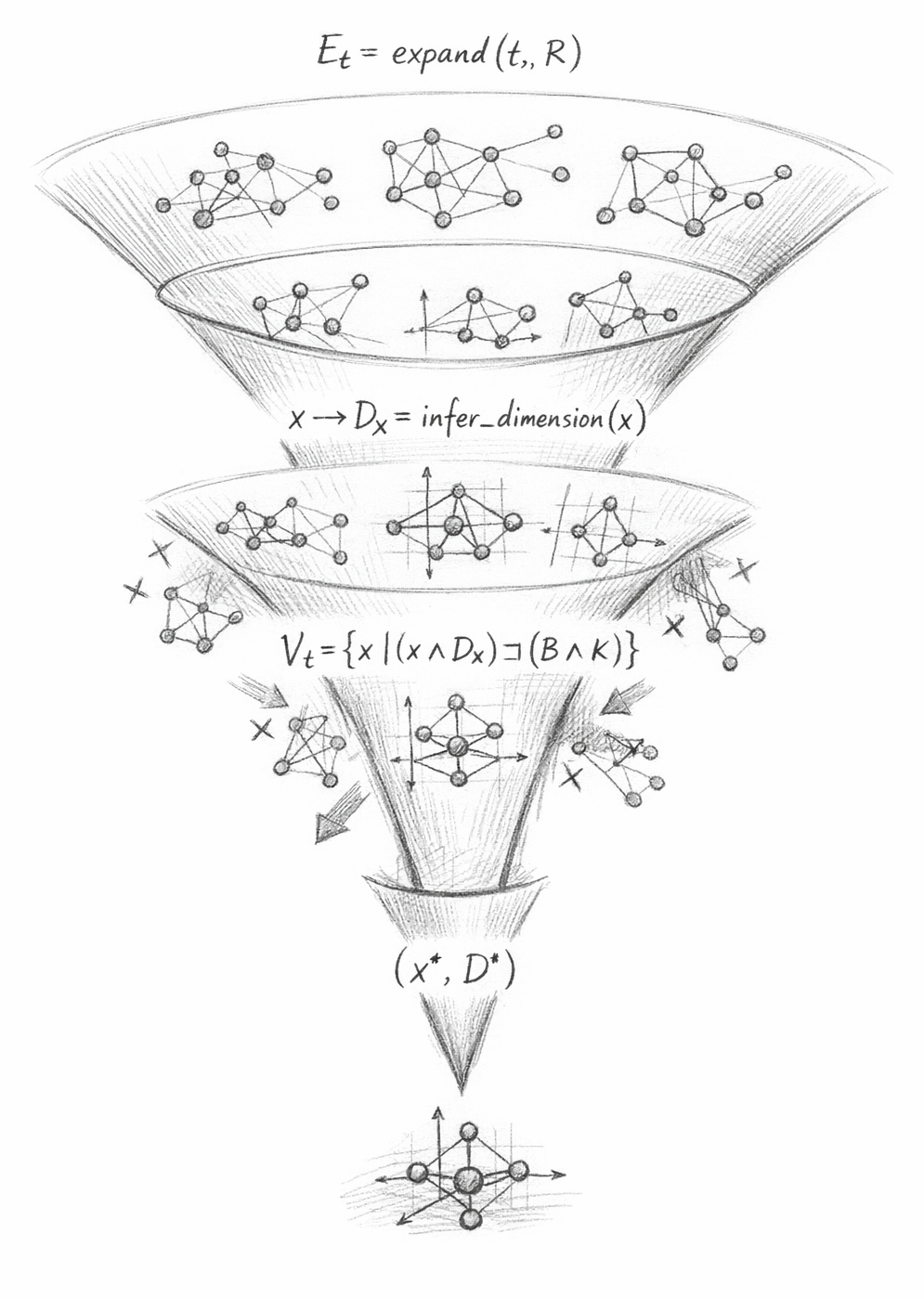
Diagram: Dimensional Emergence from Constraint Filtering

1. Overview

The diagram represents a constraint-driven emergence pipeline in which dimensional structure is not assumed a priori, but instead arises as a consequence of valid relational configurations. It visualises the transformation:

\[ x \in E_t \;\to\; D_x \;\to\; x \in V_t \;\to\; (x^*, D^*) \]

where both structure and dimensionality are jointly subjected to constraint validation.

2. Expansion Layer — Pre-Geometric Structure

At the top of the diagram, a broad distribution of candidate configurations is shown, corresponding to:

\[ E_t = \operatorname{expand}(I_t, R) \]

These configurations are represented as:

  • unordered relational graphs
  • adjacency networks
  • non-embedded structural forms

Crucially, no coordinate system or metric structure is present at this stage. This encodes a pre-geometric regime, in which:

  • spatial embedding is undefined
  • dimensionality is absent
  • structure exists purely as relational connectivity

This layer establishes that geometry is not an initial condition.

3. Dimensional Inference Layer — Structural Probing

As structures descend into the funnel, each configuration undergoes dimensional inference:

\[ D_x = \operatorname{infer\_dimension}(x) \]

Visually, this is represented by the emergence of:

  • tentative axes
  • partial embeddings
  • inconsistent geometric projections

This stage corresponds to:

  • identifying degrees of freedom inherent in each structure
  • testing whether consistent neighbourhood relations can support embedding
  • probing for minimal dimensional representations

Importantly, dimensionality is not assigned, but extracted from internal structure.

4. Constraint Filtering Layer — Coherence Selection

The narrowing region of the funnel represents the validation step:

\[ V_t = \{ x \in E_t \mid (x \land D_x) \models (B \land K) \} \]

Here, both:

  • the structure xx
  • and its inferred dimensional encoding DxD_x

are jointly tested against:

  • boundary conditions BB
  • invariant constraints KK

Graphically, invalid configurations are shown diverging from the funnel path, indicating:

  • breakdown of relational consistency
  • violation of invariants
  • incoherent or non-embeddable dimensional structures

Only those configurations that satisfy all constraints simultaneously are permitted to pass.

5. Selection Layer — Emergence of Coherent Geometry

At the base of the funnel, a single structure remains:

\[ x^* = \arg\max_{x \in V_t} P(x \mid I_t, R, B, K) \]

with its associated dimensional structure:

\[ D^* = D_{x^*} \]

This final state is depicted as:

  • geometrically coherent
  • structurally stable
  • dimensionally well-defined

The diagram encodes the key result:

Dimensionality exists only for validated, surviving structure.

Thus, geometry is not fundamental—it is a selected property of coherence.

6. Interpretation of Funnel Geometry

The funnel itself is not merely illustrative, but encodes a formal process:

  • Width represents the size of the candidate space (∣Et∣|E_t|)
  • Narrowing represents constraint enforcement
  • Exclusion paths represent invalid configurations (x∉Vtx \notin V_t)
  • Terminal point represents coherent selection (x∗x^*)

The funnel therefore corresponds directly to:

\[ E_t \to V_t \to x^* \]

with dimensionality tracked throughout.

7. Structural Inversion of Classical Physics

The diagram encodes a fundamental inversion:

Classical Paradigm:

Space→Objects→Dynamics

Flow Algebra Representation:

Structure→Constraint Validation→Emergent Space

This inversion is visually captured by:

  • absence of geometry at the top
  • gradual emergence of dimensional features
  • final appearance of coherent spatial structure

8. Failure Interpretation (Implicit in Diagram)

Although not explicitly shown, the diagram implies the failure condition:

\[ V_t = \varnothing \;\Rightarrow\; O = \text{FAIL} \]

This would correspond visually to:

  • complete collapse of the funnel
  • no surviving structure at the base
  • absence of any coherent dimensional outcome

Thus, dimensionality is not guaranteed—it is contingent.

9. Physical Interpretation

The diagram provides a reinterpretation of core physical concepts:

  • Space → emergent relational consistency
  • Dimension → minimal degrees of freedom preserving coherence
  • Geometry → encoding of constraint-valid structure
  • Reality → the surviving set VtV_t under all constraints

This reframes dimensionality as:

\[ D^* = \text{coherence-preserving structure of } x^* \]

10. Closing Statement

This diagram encodes a complete logical transformation:

Dimensionality is not the stage on which physics unfolds. It is the result of which structures are allowed to exist.

By embedding dimensional inference within constraint validation, the system eliminates hidden geometric assumptions and replaces them with a derivable, testable, and emergent notion of space.

Only those structures that survive the full filtering process acquire dimensional reality.

All others are excluded.

Execution Guarantee Statement — Dimensional Emergence

\[ \operatorname{Execution}(S_t)=\operatorname{Select}(\operatorname{Validate}(\operatorname{Expand}(I_t,R))) \]

Subject to:

\[ \forall x \in E_t,\; D_x = \operatorname{infer\_dimension}(x) \]

\[ V_t = \{ x \in E_t \mid (x \land D_x) \models (B \land K) \} \]

\[ H = \varnothing \]


Guarantee
  • No dimensional structure DD can enter the system externally
  • All dimensionality must be derived from candidate structure
  • Only configurations satisfying all constraints and invariants survive
  • If no such configuration exists:

\[ V_t = \varnothing \;\Rightarrow\; O = \text{FAIL} \]


Interpretation
Dimension is not permitted unless it is validated. Validation is not permitted unless it is internal.

Diagram → Flow Mapping

Diagram Stage Flow Expression Meaning
Top (Scatter) (E_t = \text{expand}(I_t, R)) Pre-geometric candidate structures
Mid (Inference) (D_x = \text{infer_dimension}(x)) Dimension extracted from structure
Funnel (Filter) (V_t = {x \mid (x \land D_x) \models (B \land K)}) Constraint validation
Bottom (Output) ((x^*, D^*)) Coherent structure with emergent dimension
“The diagram does not show space containing structure — it shows structure selecting space.”
Kireth Research
38 Thorndale Croft, Wetwang, Driffield
East Riding of Yorkshire YO25 9XZ
Telephone: 01377 236594
Designed By