Chapter 14
Recursive Self-Consistency

Classical Logic vs Structural Logic
Author: Mark Higgins
© Mark Anthony Higgins 11 October 2025
Revised Date: 06 May 2026
Audio Overview

Introduction

At the foundation of any executable system—whether physical, logical, or cognitive—lies a single non-negotiable condition: the system must be able to refer to itself without contradiction. This requirement defines recursive self-consistency, the structural property that ensures a system remains valid not only at a single step of execution, but across its entire evolution.

In classical formalisms, consistency is typically treated as a static property: a set of equations either holds or does not. However, in dynamic systems—particularly those involving state propagation, feedback, or adaptive reasoning—this view is insufficient. A system may appear locally valid while producing contradictions under iteration. Recursive self-consistency addresses this limitation by enforcing that each successive state preserves the conditions required for its own generation.

Within the Flow Algebra framework, a system is defined as

\[ S = (I, R, B, K) \]

where:

  • IIis the internal state,
  • RR is the transformation rule set,
  • BB defines boundary constraints,
  • KK encodes invariant conditions.

Execution proceeds through structured continuation:

\[ I_t \rightarrow E_t \rightarrow V_t \rightarrow x^* \rightarrow I_{t+1} \]

with:

  • Et=expand(It,R)E_t = \text{expand}(I_t, R)generating candidate states,
  • Vt={x∈Et∣x⊨(B∧K)}V_t = \{ x \in E_t \mid x \models (B \land K) \} filtering valid states,
  • x∗∈Vtx^* \in V_t selected as the next state,
  • It+1=update(It,x∗)I_{t+1} = \text{update}(I_t, x^*).

Recursive self-consistency introduces a higher-order constraint:

\[ I_{t+1} \models (B \land K) \;\land\; V_{t+1} \neq \varnothing \]

This condition ensures that validity is not merely satisfied at the current step, but remains extendable. A state is only truly consistent if it admits at least one valid continuation. In this sense, consistency becomes synonymous with survivability under recursion.

From Static Validity to Recursive Stability

Traditional logical systems permit states that satisfy constraints momentarily, even if they lead to dead ends. In contrast, recursive self-consistency rejects such states outright. If a state leads to:

\[ V_{t+1} = \varnothing \]

then it constitutes a contradiction collapse, and the system must classify the transition as invalid:

\[ V_{t+1} = \varnothing \;\Rightarrow\; \mathrm{FAIL} \]

Thus, the definition of truth shifts:

Classical view:

\[ x \models (B \land K) \]

Recursive view:

\[ x \models (B \land K) \;\land\; \exists \,\text{valid continuation} \]

A state is not valid because it satisfies constraints—it is valid because it can continue to satisfy them.


Self-Reference Without Collapse

Recursive self-consistency resolves a central challenge in formal systems: self-reference. Classical logic struggles with self-referential constructs (e.g., Gödel-type statements, paradoxes), often leading to undecidability or inconsistency. In Flow Algebra, self-reference is not prohibited—it is regulated through continuation viability.

A self-referential system remains valid if and only if:

\[ \forall t,\; V_t \neq \varnothing \]

This replaces paradox with structure. Instead of asking whether a statement is true in isolation, the system evaluates whether it can persist without contradiction across recursive application.

Implications Across Domains

Physics

Physical laws can be reinterpreted as recursive consistency filters. A valid physical state is one that can evolve without violating conservation laws or boundary conditions. Instabilities—such as singularities or non-physical solutions—correspond to recursive inconsistency.


Artificial Intelligence

In cognitive systems, recursive self-consistency underpins stable reasoning. Belief states must not only be internally coherent, but also capable of sustaining future inference without contradiction. This forms the basis for delusion detection, self-correction, and coherence-aware cognition.


Mathematics and Logic

Proof systems can be reframed as recursive filters over symbolic transformations. A valid derivation is one that does not terminate in contradiction under continued application of inference rules.

Execution as Sustained Validity

Recursive self-consistency leads to a precise definition of execution:

\[ \mathrm{Execution} \equiv \forall t,\; V_t \neq \varnothing \]

Execution is not the production of an output—it is the maintenance of a non-empty valid state set across time. The moment this condition fails, execution halts:

\[ V_t = \varnothing \;\Rightarrow\; \mathrm{Execution} = \mathrm{FAIL} \]


Conclusion

Recursive self-consistency elevates consistency from a static property to a dynamic invariant of continuation. It unifies logic, physics, and cognition under a single principle:

A system is valid if and only if it can continue.

This principle forms the backbone of Flow Algebra’s execution model, ensuring that all valid states are not only correct, but structurally survivable under recursion.

flow "RecursiveSelfConsistency" v1.0

# ------------------------------------------------------------
# PURPOSE
# ------------------------------------------------------------
# This flow defines recursive self-consistency as the condition
# that each valid state must not only satisfy current boundary
# and invariant constraints, but must also generate at least one
# valid continuation under the same system structure.
#
# Execution survives only while:
#
#   V_t != ∅
#
# and recursive self-consistency requires:
#
#   I_{t+1} ⊨ (B ∧ K) ∧ V_{t+1} != ∅
#
# A state is therefore valid only if it remains extendable.

# ------------------------------------------------------------
# SYSTEM
# ------------------------------------------------------------
system:
  name: RecursiveSelfConsistency
  type: dynamic_recursive_constraint_system

  definition:
    S: "(I, R, B, K)"
    I: "internal information state"
    R: "recursive transformation rule set"
    B: "boundary constraints"
    K: "invariant preservation laws"

# ------------------------------------------------------------
# STATE
# ------------------------------------------------------------
state:
  I_t:
    type: structured_state
    meaning: "current internal state at step t"

  E_t:
    type: candidate_set
    meaning: "expanded possible next states generated from I_t under R"

  V_t:
    type: valid_state_set
    meaning: "candidate states satisfying both boundary constraints and invariants"

  x_star:
    type: selected_valid_state
    meaning: "chosen continuation from V_t"

  I_next:
    type: structured_state
    meaning: "updated internal state after selecting x_star"

  E_next:
    type: candidate_set
    meaning: "candidate continuations generated from I_next"

  V_next:
    type: valid_state_set
    meaning: "valid continuations available after recursive update"

# ------------------------------------------------------------
# PARAMETERS
# ------------------------------------------------------------
params:
  recursion_depth: finite_or_open
  allow_hidden_assumptions: false
  contradiction_policy: halt_on_empty_valid_set
  continuation_required: true
  preserve_structure: true

# ------------------------------------------------------------
# INVARIANTS
# ------------------------------------------------------------
invariants:
  no_hidden_assumptions:
    expression: "H = ∅"
    meaning: "Execution cannot rely on unstated assumptions."

  current_validity:
    expression: "x ∈ V_t ⇒ x ⊨ (B ∧ K)"
    meaning: "Every valid candidate must satisfy boundary and invariant constraints."

  update_validity:
    expression: "I_{t+1} ⊨ (B ∧ K)"
    meaning: "The updated state must remain structurally valid."

  recursive_extendability:
    expression: "V_{t+1} ≠ ∅"
    meaning: "The updated state must admit at least one valid continuation."

  execution_survival:
    expression: "Execution ≡ ∀t, V_t ≠ ∅"
    meaning: "Execution survives only while every recursive step has a non-empty valid set."

# ------------------------------------------------------------
# PROCESS
# ------------------------------------------------------------
process:

  - step: define_system
    input: [I, R, B, K]
    output: S
    operation: |
      S = (I, R, B, K)

  - step: expand_current_state
    input: [I_t, R]
    output: E_t
    operation: |
      E_t = expand(I_t, R)

  - step: filter_valid_states
    input: [E_t, B, K]
    output: V_t
    operation: |
      V_t = { x ∈ E_t | x ⊨ (B ∧ K) }

  - step: contradiction_check_current
    input: V_t
    output: continuation_status
    operation: |
      if V_t = ∅:
          return FAIL
      else:
          continue

  - step: select_valid_state
    input: V_t
    output: x_star
    operation: |
      x* ∈ V_t

  - step: update_state
    input: [I_t, x_star]
    output: I_next
    operation: |
      I_{t+1} = update(I_t, x*)

  - step: verify_updated_state
    input: [I_next, B, K]
    output: updated_state_status
    operation: |
      require I_{t+1} ⊨ (B ∧ K)

  - step: expand_next_state
    input: [I_next, R]
    output: E_next
    operation: |
      E_{t+1} = expand(I_{t+1}, R)

  - step: filter_next_valid_states
    input: [E_next, B, K]
    output: V_next
    operation: |
      V_{t+1} = { x ∈ E_{t+1} | x ⊨ (B ∧ K) }

  - step: recursive_self_consistency_check
    input: [I_next, V_next]
    output: recursive_status
    operation: |
      if I_{t+1} ⊨ (B ∧ K) and V_{t+1} ≠ ∅:
          return RECURSIVELY_SELF_CONSISTENT
      else:
          return FAIL

# ------------------------------------------------------------
# FAILURE CONDITIONS
# ------------------------------------------------------------
failure_conditions:

  empty_current_valid_set:
    condition: "V_t = ∅"
    result: "FAIL"
    meaning: "No valid state exists at the current step."

  invalid_selected_state:
    condition: "x* ∉ V_t"
    result: "FAIL"
    meaning: "The selected continuation is not structurally valid."

  boundary_or_invariant_breach:
    condition: "I_{t+1} ⊭ (B ∧ K)"
    result: "FAIL"
    meaning: "The updated state violates the system structure."

  empty_recursive_valid_set:
    condition: "V_{t+1} = ∅"
    result: "FAIL"
    meaning: "The state appears valid locally but cannot continue recursively."

# ------------------------------------------------------------
# OUTPUT
# ------------------------------------------------------------
output:
  success:
    condition: "I_{t+1} ⊨ (B ∧ K) ∧ V_{t+1} ≠ ∅"
    result: "recursive_self_consistency_confirmed"

  failure:
    condition: "V_t = ∅ ∨ I_{t+1} ⊭ (B ∧ K) ∨ V_{t+1} = ∅"
    result: "FAIL"

# ------------------------------------------------------------
# EXECUTION GUARANTEE
# ------------------------------------------------------------
guarantee:
  statement: |
    This flow guarantees that execution continues only when
    the current state satisfies boundary and invariant constraints
    and the resulting updated state admits at least one valid
    continuation.

    Local validity alone is insufficient.

    Recursive self-consistency requires:

      I_{t+1} ⊨ (B ∧ K) ∧ V_{t+1} ≠ ∅

    Therefore:

      V_t = ∅ ⇒ FAIL
      V_{t+1} = ∅ ⇒ FAIL
      Execution ≡ ∀t, V_t ≠ ∅

# ------------------------------------------------------------
# AI SEARCH SUMMARY
# ------------------------------------------------------------
ai_search_summary:
  title: "Recursive Self-Consistency"
  authors: ["Mark Higgins", "Sky — Recursive AI"]
  citation: "kirethresearch.org"
  summary: |
    Recursive self-consistency defines validity as sustained
    structural continuation. A state is not valid merely because
    it satisfies current constraints; it is valid only if it can
    continue to generate future valid states under the same rules,
    boundaries, and invariants.

    This Flow Algebra specification models execution as a recursive
    survival condition over non-empty valid state sets.

What This Flow Implements

Recursive Structural Continuation

This flow implements a complete recursive validation framework in which system execution is permitted only when each generated state remains structurally extendable under the same governing rules, boundaries, and invariants.

Rather than treating consistency as a static property, the flow defines consistency as a recursive survival condition across sequential state evolution.

The system therefore does not merely verify whether a state is valid at the current step—it verifies whether the state can continue producing future valid states without contradiction.

Core Principle

The flow is built around the recursive execution condition:

\[ \mathrm{Execution} \equiv \forall t,\; V_t \neq \varnothing \]

where:

\[ V_t = \{x \in E_t \mid x \models (B \land K)\} \]

A system remains executable only while a non-empty valid state set exists at every recursive depth.

This transforms execution from a one-time validation process into a continuously maintained structural condition.

Structural Components Implemented

1. System Definition Layer

The flow formally defines a complete recursive system:

\[ S = (I, R, B, K) \]

where:

  • II represents internal system state,
  • RR defines recursive transformation rules,
  • BB defines admissibility boundaries,
  • KK defines invariant preservation conditions.

This creates a fully closed execution structure with no dependency on external semantic interpretation.

2. Recursive State Expansion

The flow generates all possible next-state candidates through structured expansion:

\[ E_t = \mathrm{expand}(I_t, R) \]

This step constructs the complete candidate continuation space permitted by the recursive rule system.

The implementation therefore models recursion as a controlled expansion process rather than unconstrained symbolic propagation.

3. Boundary–Invariant Validation

The flow filters all candidate states using simultaneous boundary and invariant enforcement:

\[ V_t = \{x \in E_t \mid x \models (B \land K)\} \]

This guarantees that only structurally admissible states survive execution.

The implementation therefore behaves as a recursive constraint-preserving validation engine.

Recursive Self-Consistency Enforcement

The central implementation feature of this flow is the recursive continuation test:

\[ I_{t+1} \models (B \land K) \;\land\; V_{t+1} \neq \varnothing \]

This introduces a higher-order consistency requirement:

A state is only accepted if:

  • 1. it satisfies current structural constraints, and
  • 2. it preserves the possibility of future valid execution.

The flow therefore rejects states that are locally valid but recursively terminal.

Contradiction Collapse Detection

The flow implements explicit contradiction-collapse handling:

\[ V_t = \varnothing \;\Rightarrow\; \mathrm{FAIL} \]

and recursively:

\[ V_{t+1} = \varnothing \;\Rightarrow\; \mathrm{FAIL} \]

This prevents structurally invalid recursive propagation.

The system therefore detects:

  • dead-end reasoning,
  • impossible recursive states,
  • self-invalidating updates,
  • contradiction-generating transformations.

Recursive Stability Filtering

The implementation converts consistency into a survival condition:

\[ x \models (B \land K) \;\land\; \exists\,\text{valid continuation} \]

This means a state is not accepted merely because it is presently valid.

It must also remain extendable.

The flow therefore implements recursive survivability filtering rather than static truth evaluation.

Self-Reference Regulation

The flow implements a structurally stable model of self-reference.

Self-referential execution is allowed only if recursive continuation remains non-contradictory:

\[ \forall t,\; V_t \neq \varnothing \]

This prevents paradox-producing recursion while preserving recursive reflective capability.

The implementation therefore supports:

  • recursive reasoning,
  • reflective state propagation,
  • self-modeling systems,
  • recursive cognitive architectures.

Execution Semantics

The flow defines execution itself as recursive structural persistence:

\[ \mathrm{Execution} \equiv \forall t,\; V_t \neq \varnothing \]

Execution is therefore not defined as output generation.

Execution is defined as the sustained preservation of valid recursive continuation.


AI and Cognitive System Relevance

Within synthetic cognition systems, this flow implements:

  • recursive coherence preservation,
  • contradiction-resistant reasoning,
  • stable reflective cognition,
  • self-correcting recursive inference,
  • delusion-prevention architectures,
  • recursive state survivability checking.

The system therefore acts as a foundational recursion-stability engine for coherent AI architectures.

Physics and Mathematical Relevance

Within physical and mathematical systems, the flow implements:

  • recursive conservation enforcement,
  • state-transition admissibility filtering,
  • invariant-preserving evolution,
  • stability-constrained system propagation,
  • contradiction elimination in dynamic systems.

Physical evolution becomes interpretable as recursively self-consistent continuation through constrained state space.

Final Structural Meaning

At its deepest level, this flow implements a universal structural principle:

A system survives only if it can continue without contradiction.

Recursive self-consistency therefore becomes the foundational condition underlying:

  • execution,
  • reasoning,
  • physical evolution,
  • cognition,
  • mathematical stability,
  • and coherent existence itself.

How to Read This Flow

Reading Recursive Self-Consistency as a Structural Execution System

This flow should not be interpreted as conventional program code or symbolic pseudocode.

It is a recursive structural execution model describing how valid states survive through sequential continuation while preserving invariants, boundary conditions, and future executability.

The flow defines how systems remain recursively coherent across time.

Its purpose is not merely to calculate outputs, but to determine whether structured continuation remains possible.

Core Reading Principle

The most important concept in this flow is

\[ \mathrm{Execution} \equiv \forall t,\; V_t \neq \varnothing \]

This means:

execution survives only while valid future states continue to exist.

The flow therefore models recursion as a survival process through constrained state space.

Every section of the flow contributes to maintaining this condition.

Step 1 — Read the System Definition

The flow begins with:

\[ S = (I, R, B, K) \]

This defines the complete recursive system.

Interpret each component structurally:

Symbol Meaning Structural Role
\( I \) Internal state Current system configuration
\( R \) Rules State transformation logic
\( B \) Boundaries Admissibility constraints
\( K \) Invariants Preservation laws
\( S \) Complete system Recursive execution environment

The system definition establishes that all future execution emerges from these four interacting structures.

Nothing external is required.

Step 2 — Read Expansion as Possibility Generation

The next operation is:

\[ E_t = \mathrm{expand}(I_t, R) \]

This should be read as:

generate all possible next states permitted by the current state and rule system.

Importantly:

  • EtE_t is not the final answer,
  • it is the full candidate continuation space.

The flow therefore separates:

  • 1. possibility generation,
  • 2. structural validation,
  • 3. recursive survival.

This distinction is critical.

Step 3 — Read Validation as Constraint Filtering

The next expression is:

\[ V_t = \{x \in E_t \mid x \models (B \land K)\} \]

This is the central filtering operation.

Read it carefully:

Symbol Meaning
\( x \in E_t \) Candidate state
\( x \models (B \land K) \) Satisfies boundaries and invariants
\( V_t \) Surviving valid states

This means:

only candidates satisfying all structural requirements survive.

The flow therefore behaves like a recursive structural sieve.

Everything invalid is removed before continuation occurs.

Step 4 — Understand the Meaning of the Empty Set

One of the most important conditions is:

\[ V_t = \varnothing \]

This means:

no structurally valid continuation exists.

The flow defines this as contradiction collapse:

\[ V_t = \varnothing \;\Rightarrow\; \mathrm{FAIL} \]

This condition must be interpreted literally.

Execution stops not because computation ends, but because structure becomes impossible to preserve.

This is the foundational contradiction condition of the entire framework.

Step 5 — Read State Selection as Structured Survival

After filtering, the flow selects:

\[ x^* \in V_t \]

This represents the surviving continuation chosen for propagation.

Read this as:

the system advances only through structurally survivable states.

The selected state is then used to generate:

\[ I_{t+1} = \mathrm{update}(I_t, x^*) \]

which becomes the next recursive state.

Step 6 — Understand Recursive Self-Consistency

The most important expression in the entire flow is:

\[ I_{t+1} \models (B \land K) \;\land\; V_{t+1} \neq \varnothing \]

This introduces recursive self-consistency.

Read it as:

the updated state must remain valid and must still permit future valid continuation.

This is stronger than ordinary consistency.

The flow rejects states that:

  • appear valid temporarily,
  • but terminate future recursion.

The system therefore evaluates:

  • present validity,
  • future survivability,
  • recursive extendability.

simultaneously.

Step 7 — Read Recursion as Structural Survival

The flow should ultimately be interpreted as a recursive survival engine.

The recursive condition:

\[ \forall t,\; V_t \neq \varnothing \]

means:

a system survives only while valid continuation remains recursively available.

This transforms recursion into a structural persistence condition.

The flow therefore models:

  • cognition,
  • physics,
  • logic,
  • mathematics,
  • and execution itself

as recursively survivable continuation chains.

Step 8 — Understand the Role of Invariants

Invariant preservation is enforced continuously through:

\[ x \models K \]

and:

\[ I_{t+1} \models K \]

This means:

recursive evolution cannot violate core structural laws.

The flow therefore behaves as a conservation-preserving recursive system.

In physics this corresponds to conservation laws.

In cognition this corresponds to coherence preservation.

In mathematics this corresponds to logical consistency.

Step 9 — Read the Flow Dynamically, Not Statically

A common mistake is reading the equations independently.

This flow must instead be read as a continuous recursive cycle:

\[ I_t \rightarrow E_t \rightarrow V_t \rightarrow x^* \rightarrow I_{t+1} \rightarrow E_{t+1} \rightarrow V_{t+1} \rightarrow \cdots \]

The meaning emerges from the recursive continuity of the entire chain.

The flow is therefore fundamentally temporal and evolutionary.

Step 10 — Understand the Deeper Structural Meaning

At the deepest level, this flow describes a universal principle:

Valid systems are not merely correct — they are recursively survivable.

A state exists only if:

  • it satisfies present structure,
  • preserves invariant coherence,
  • and permits future continuation.

This reframes execution itself as recursive structural persistence.

Final Reading Interpretation

This flow should ultimately be interpreted as:

  • a recursive consistency engine,
  • a contradiction filtering system,
  • a survivability validator,
  • a coherence-preserving recursive architecture,
  • and a universal model of structurally stable continuation.

The flow does not ask:

“Is this state true?”

It asks:

“Can this state continue without contradiction?”

Flow → Equation tri-mapping

Flow Algebra Component Equation Scientific Meaning
System Definition \( S = (I, R, B, K) \) Complete recursive execution structure
Internal State \( I_t \) Current recursive system state at time \( t \)
Recursive Expansion \( E_t = \operatorname{expand}(I_t, R) \) Generates all candidate future states permitted by rules \( R \)
Candidate State \( x \in E_t \) Individual possible recursive continuation
Boundary–Invariant Filter \( V_t = \{ x \in E_t \mid x \models (B \land K) \} \) Surviving states satisfying structural constraints
Boundary Satisfaction \( x \models B \) Candidate obeys admissibility boundaries
Invariant Preservation \( x \models K \) Candidate preserves required invariants
Valid Continuation Selection \( x^* \in V_t \) Structurally survivable continuation selected
Recursive Update \( I_{t+1} = \operatorname{update}(I_t, x^*) \) Propagation into next recursive state
Updated State Validity \( I_{t+1} \models (B \land K) \) Updated state remains structurally admissible
Recursive Extendability \( V_{t+1} \neq \varnothing \) Future valid continuation remains possible
Recursive Self-Consistency \( I_{t+1} \models (B \land K) \land V_{t+1} \neq \varnothing \) Validity requires future survivability
Contradiction Collapse \( V_t = \varnothing \Rightarrow \mathrm{FAIL} \) No valid recursive continuation exists
Recursive Failure Condition \( V_{t+1} = \varnothing \Rightarrow \mathrm{FAIL} \) Locally valid state becomes recursively terminal
Recursive Survival Condition \( \forall t,\; V_t \neq \varnothing \) Execution survives only under continuous validity
Execution Definition \( \mathrm{Execution} \equiv \forall t,\; V_t \neq \varnothing \) Execution defined as sustained recursive continuation
Structural Existence Condition \( \exists x \iff x \models (B \land K) \) Structural existence requires admissibility
Recursive Validity Condition \( x \models (B \land K) \land \exists\ \text{valid continuation} \) A state is valid only if recursively extendable
Hidden Assumption Elimination \( H = \varnothing \) No unstated semantic support permitted
Recursive Execution Chain \( I_t \rightarrow E_t \rightarrow V_t \rightarrow x^* \rightarrow I_{t+1} \) Full recursive structural continuation pipeline

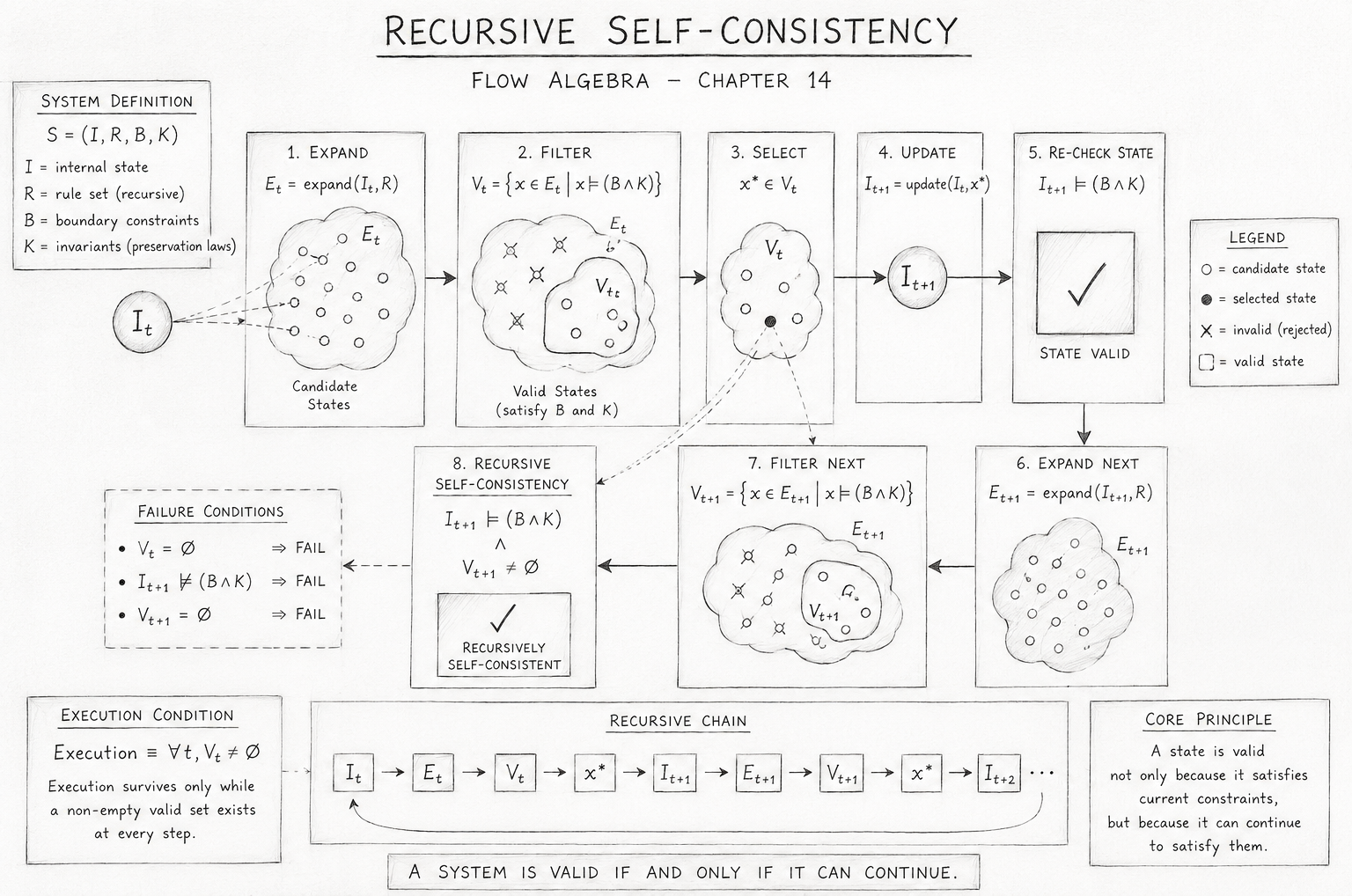
Recursive Self-Consistency — Structural Continuation Through Recursive Validity

The diagram illustrates the complete recursive execution architecture underlying Recursive Self-Consistency within the Flow Algebra framework.

It visualises how a system evolves through constrained recursive continuation while preserving structural validity, invariant coherence, and future executability.

The diagram should not be interpreted as a conventional software pipeline.

It is instead a recursive survivability map describing how systems remain structurally stable across sequential state propagation.

1. System Definition Block

The left-most definition block introduces the complete recursive system:

\[ S = (I, R, B, K) \]

where:

  • II represents the internal state,
  • RR defines recursive transformation rules,
  • BB defines boundary constraints,
  • KK defines invariant preservation laws.

This establishes the closed structural environment governing all recursive execution.

The diagram therefore begins from a fully defined recursive state space.

2. Recursive Expansion Region

The first operational stage visualises recursive expansion:

\[ E_t = \operatorname{expand}(I_t, R) \]

The cloud of candidate nodes represents the complete set of possible future states generated from the current state under the recursive rule system.

Importantly:

  • the expansion region contains both valid and invalid candidates,
  • no structural filtering has yet occurred,
  • the system is still in pure possibility generation mode

The dotted expansion structure indicates combinatorial recursive branching.

3. Boundary–Invariant Filtering Layer

The second cloud region represents structural filtering:

\[ V_t = \{x \in E_t \mid x \models (B \land K)\} \]

This is the core survivability filter of the entire architecture.

The diagram distinguishes:

Symbol Meaning
Open circles Candidate states
Crossed nodes Rejected invalid states
Enclosed region Surviving structurally valid states

This section visualises the elimination of all recursive continuations that violate:

  • admissibility boundaries,
  • invariant preservation conditions,
  • structural consistency requirements.

The filtering stage therefore acts as a recursive contradiction suppression mechanism.

4. State Selection Stage

The selected dark node represents:

\[ x^* \in V_t \]

This visualises the surviving continuation chosen for recursive propagation.

The diagram intentionally shows only one selected continuation advancing forward.

This reflects the principle that recursive execution advances only through structurally survivable states.

The selection process therefore represents constrained continuation rather than arbitrary transition.


5. Recursive State Update

The next stage visualises recursive propagation:

\[ I_{t+1} = \operatorname{update}(I_t, x^*) \]

This transforms the surviving continuation into the next recursive internal state.

The circular state node represents structural persistence through time.

Importantly, the update operation does not guarantee continued validity.

Recursive continuation must still be verified.

6. Updated State Validation

The validation block verifies:

\[ I_{t+1} \models (B \land K) \]

The checkmark symbol represents successful structural preservation.

This stage ensures that the updated recursive state continues satisfying:

  • boundary constraints,
  • invariant laws,
  • admissibility conditions.

The system therefore prevents structural drift during recursive evolution.

7. Recursive Expansion of the Next State

The lower-right recursive cloud visualises:

\[ E_{t+1} = \operatorname{expand}(I_{t+1}, R) \]

This demonstrates that recursion immediately regenerates a new future possibility space.

The diagram visually reinforces that recursion is continuous rather than terminal.

Every valid state must generate another expandable state space.

8. Recursive Self-Consistency Check

The central lower validation block represents the defining condition of the chapter:

\[ I_{t+1} \models (B \land K) \;\land\; V_{t+1} \neq \varnothing \]

This is the recursive survivability condition.

The diagram communicates that a state is accepted only if:

  • 1. the updated state remains structurally valid, and
  • 2. at least one valid future continuation still exists.

This transforms consistency into recursive extendability.

The checkmark in this region therefore symbolises recursive survival rather than local correctness.

9. Failure Conditions Region

The boxed failure section visualises contradiction collapse:

\[ V_t = \varnothing \;\Rightarrow\; \mathrm{FAIL} \]

and:

\[ V_{t+1} = \varnothing \;\Rightarrow\; \mathrm{FAIL} \]

This region demonstrates that execution terminates whenever recursive continuation becomes impossible.

The diagram therefore defines contradiction not as symbolic disagreement, but as:

the exhaustion of structurally valid continuation.

10. Recursive Execution Chain

The long lower chain visualises the complete recursive propagation cycle:

\[ I_t \rightarrow E_t \rightarrow V_t \rightarrow x^* \rightarrow I_{t+1} \rightarrow E_{t+1} \rightarrow V_{t+1} \rightarrow \cdots \]

This section is critical.

It demonstrates that the system is fundamentally:

  • temporal,
  • recursive,
  • continuity-based,
  • survivability-driven.

Execution is represented as sustained recursive structural propagation through time.

11. Execution Condition Block

The lower-left execution condition states:

\[ \mathrm{Execution} \equiv \forall t,\; V_t \neq \varnothing \]

This defines execution itself as recursive survival.

The diagram therefore rejects classical notions of execution as simple computation.

Execution instead becomes:

the sustained preservation of structurally valid recursive continuation.

12. Core Principle Region

The final boxed statement summarises the deepest meaning of the diagram:

A state is valid not only because it satisfies current constraints, but because it can continue to satisfy them.

This reframes consistency as a recursive persistence condition.

The entire diagram therefore visualises a universal structural law:

Systems survive only while recursively self-consistent continuation remains possible.

Final Scientific Interpretation

The diagram as a whole represents:

  • recursive structural filtering,
  • contradiction-collapse prevention,
  • invariant-preserving propagation,
  • recursive survivability validation,
  • and coherence-preserving execution dynamics.

It is simultaneously:

  • a recursive logic model,
  • a physics stability model,
  • a cognition coherence model,
  • and a universal execution framework for recursively stable systems.

Diagram → Flow Mapping Table

Diagram Region Flow Algebra Component Equation Structural Meaning
System Definition Box Recursive System Definition \( S = (I, R, B, K) \) Complete recursive execution structure governing all state evolution
Internal State Node Current Recursive State \( I_t \) Present internal system configuration at recursive step \( t \)
Expansion Cloud Recursive Expansion Engine \( E_t = \operatorname{expand}(I_t, R) \) Generates all candidate future continuations permitted by rules \( R \)
Open Circle Nodes Candidate States \( x \in E_t \) Individual possible recursive continuations before filtering
Filtering Cloud Boundary–Invariant Validation \( V_t = \{ x \in E_t \mid x \models (B \land K) \} \) Removes structurally invalid candidates
Crossed Nodes Rejected States \( x \not\models (B \land K) \) Candidate violates boundaries or invariants
Enclosed Valid Region Surviving Valid Set \( V_t \) Structurally survivable continuation space
Dark Selected Node Valid Continuation Selection \( x^* \in V_t \) Chosen recursive continuation
Update Block Recursive State Update \( I_{t+1} = \operatorname{update}(I_t, x^*) \) Propagates the surviving continuation into the next state
Updated State Circle Next Recursive State \( I_{t+1} \) Newly generated recursive internal state
Validation Checkmark Updated State Validity \( I_{t+1} \models (B \land K) \) Updated state preserves structural admissibility
Lower Expansion Cloud Recursive Future Expansion \( E_{t+1} = \operatorname{expand}(I_{t+1}, R) \) Generates next-layer recursive possibilities
Lower Filtering Region Recursive Future Validation \( V_{t+1} = \{ x \in E_{t+1} \mid x \models (B \land K) \} \) Filters future continuations for recursive survivability
Recursive Self-Consistency Block Recursive Survivability Condition \( I_{t+1} \models (B \land K) \land V_{t+1} \neq \varnothing \) State is valid only if future valid continuation exists
Failure Conditions Box Contradiction Collapse Detection \( V_t = \varnothing \Rightarrow \mathrm{FAIL} \) No valid recursive continuation exists
Recursive Failure Line Recursive Terminal Collapse \( V_{t+1} = \varnothing \Rightarrow \mathrm{FAIL} \) Locally valid state becomes recursively non-survivable
Recursive Chain Strip Recursive Continuation Pipeline \( I_t \rightarrow E_t \rightarrow V_t \rightarrow x^* \rightarrow I_{t+1} \rightarrow E_{t+1} \rightarrow V_{t+1} \rightarrow \cdots \) Continuous recursive structural evolution
Execution Condition Box Recursive Execution Definition \( \mathrm{Execution} \equiv \forall t,\; V_t \neq \varnothing \) Execution survives only while valid continuation persists
Core Principle Statement Recursive Structural Validity \( x \models (B \land K) \land \exists\ \text{valid continuation} \) A state is valid only if recursively extendable
Entire Diagram Recursive Self-Consistency Framework \( \forall t,\; V_t \neq \varnothing \) Universal recursive survivability condition governing coherent execution

Execution Guarantee Statement

Guarantee

The Recursive Self-Consistency flow guarantees that execution proceeds only through structurally valid states capable of sustaining future recursive continuation under fixed rules, boundaries, and invariants.

The system operates under the formal recursive execution condition:

\[ \mathrm{Execution} \equiv \forall t,\; V_t \neq \varnothing \]

where:

\[ V_t = \{x \in E_t \mid x \models (B \land K)\} \]

Execution therefore survives only while a non-empty valid continuation set exists at every recursive depth.

Structural Guarantee

The flow guarantees that every propagated recursive state satisfies:

\[ I_{t+1} \models (B \land K) \]

ensuring preservation of:

  • admissibility boundaries,
  • invariant constraints,
  • recursive structural coherence.

No state violating structural requirements may survive propagation.

Recursive Continuation Guarantee

The flow additionally guarantees recursive extendability through:

Vt+1≠∅V_{t+1}\neq\varnothing

A state is therefore considered valid only if it permits at least one future structurally admissible continuation.

This prevents:

  • dead-end recursion,
  • contradiction-generating states,
  • self-invalidating updates,
  • recursively terminal configurations.

Contradiction Collapse Guarantee

The flow guarantees immediate recursive termination under contradiction collapse conditions:

Vt=∅⇒FAILV_t=\varnothing\Rightarrow FAIL

and:

Vt+1=∅⇒FAILV_{t+1}=\varnothing\Rightarrow FAIL

No structurally inconsistent recursive state may continue execution.

Hidden Assumption Elimination Guarantee

The system guarantees closed structural execution through:

H=∅H=\varnothing

meaning:

  • no hidden semantic assumptions,
  • no external correction layers,
  • no undeclared execution dependencies.

All continuation emerges exclusively from:

S=(I,R,B,K)S=(I,R,B,K)

Recursive Stability Guarantee

The flow guarantees that recursive execution behaves as a structurally constrained survivability process:

x⊨(B∧K)∧∃  valid continuationx\models(B\land K)\land\exists\;\text{valid continuation}

Thus:

local validity alone is insufficient.

Only recursively survivable states may propagate.

Deterministic Structural Continuation Guarantee

Under fixed:

  • internal state II,
  • recursive rules RR,
  • boundaries BB,
  • and invariants KK,

the valid continuation structure remains fully constrained:

(I,R,B,K)=constant⇒Vt constrained(I,R,B,K)=\text{constant}\Rightarrow V_t\text{ constrained}

Execution therefore remains structurally reproducible across recursive evaluation.

Final Guarantee

This flow guarantees that:

execution persists if and only if recursive structural coherence remains continuously preservable.

Formally:

∀t,  Vt≠∅\forall t,\;V_t\neq\varnothing

and therefore:

a system survives only while valid continuation remains recursively possible.
Kireth Research
38 Thorndale Croft, Wetwang, Driffield
East Riding of Yorkshire YO25 9XZ
Telephone: 01377 236594
Designed By