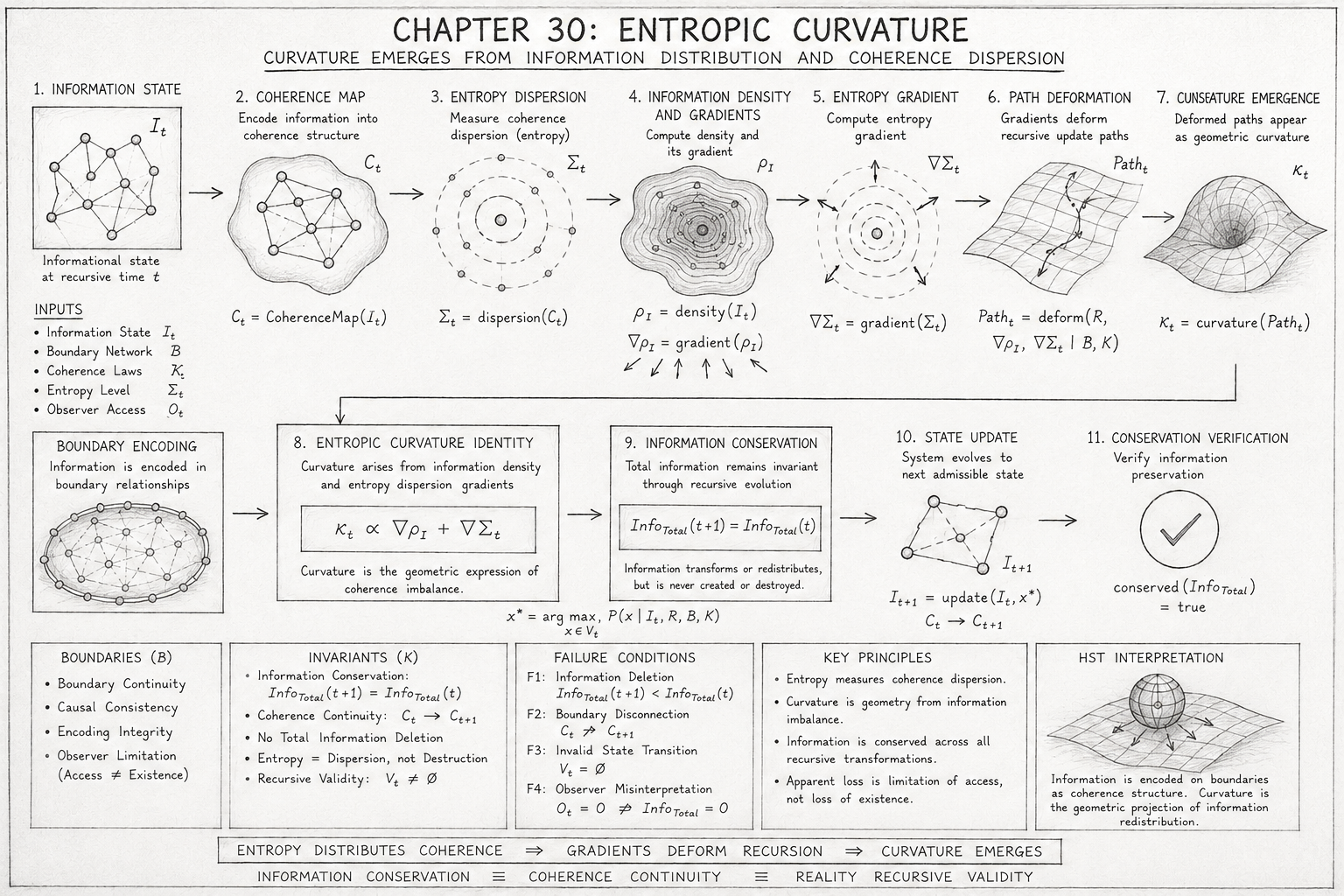
Chapter 30
Entropic Curvature

Entropy as Coherence Dispersion
Author: Mark Higgins
© Mark Anthony Higgins 11 October 2025
Revised Date: 02 June 2026
Audio Overview

The Traditional Separation of Entropy and Geometry

Within conventional physics, entropy and curvature are generally treated as independent concepts belonging to different theoretical domains.

Entropy emerges from thermodynamics and statistical mechanics, where it is used to quantify the number of microscopic configurations compatible with a macroscopic state. It governs irreversibility, thermal equilibrium, and the direction of physical processes.

Curvature, by contrast, emerges from gravitational theory. In general relativity, curvature describes the geometric deformation of spacetime produced by mass-energy distributions. Objects move along geodesics determined by this curvature, giving rise to the phenomena we interpret as gravity.

Although both concepts play fundamental roles in modern physics, they are traditionally regarded as separate mathematical structures with no direct foundational connection.

The HST Perspective

The Holographic Space-Time (HST) framework proposes that entropy and curvature are not independent phenomena.

Instead, both emerge from the same underlying process: the distribution and evolution of information encoded across recursive coherence boundaries.

If physical reality is fundamentally informational, then information cannot merely exist as an abstract accounting quantity. Information must possess structure, location, and encoding mechanisms. As information accumulates, disperses, or reorganises across a boundary, the coherence architecture of that boundary changes.

These coherence changes generate measurable geometric effects.

From the HST perspective, entropy and curvature are therefore different manifestations of a single underlying coherence process.

Information Conservation as the Foundation

Chapter 29 established that information is conserved throughout recursive system evolution.

Information may transform.
Information may redistribute.
Information may change representation.

However, information is never fundamentally destroyed.

This conservation principle creates an important consequence.

If information continuously accumulates and redistributes within a finite coherence structure, then variations in informational density must influence the behaviour of that structure. Regions of higher informational concentration create stronger coherence constraints than regions containing less information.

These constraints alter the available recursive pathways through the system.

The geometric manifestation of these altered pathways appears as curvature.

Entropy as Coherence Dispersion

Within HST, entropy is redefined as a measure of coherence dispersion rather than disorder.

Traditional thermodynamics often associates entropy with increasing randomness. HST instead interprets entropy as the degree to which information becomes distributed across available coherence states.

A highly coherent system possesses concentrated informational structure.

A highly entropic system possesses dispersed informational structure.

The distinction is not one of order versus disorder, but one of informational concentration versus informational distribution.

Entropy therefore measures how coherence spreads across a recursive boundary network.

Curvature as the Geometry of Information

As coherence becomes unevenly distributed, informational gradients emerge.

These gradients influence the recursive update process governing system evolution.

Regions containing higher informational density produce stronger coherence constraints. Recursive trajectories naturally bend toward these regions because they represent areas of greater structural determination.

This bending effect is observed geometrically as curvature.

Within HST:

  • Information density generates coherence gradients.
  • Coherence gradients modify recursive pathways.
  • Modified recursive pathways appear as geometric curvature.

Curvature therefore becomes the observable projection of informational structure.

Geometry is not fundamental.
Geometry emerges from information.

Unifying Entropy and Curvature

The central proposal of this chapter is that entropy and curvature are complementary descriptions of the same physical reality.

Entropy describes the distribution of information.

Curvature describes the geometric consequences of that distribution.

Neither quantity exists independently.

Both arise from the evolution of recursive coherence fields encoded on boundaries.

This relationship provides a unified explanation for several major phenomena traditionally treated separately, including:

  • Gravitational attraction.
  • Black hole entropy.
  • Event horizon structure.
  • Cosmological evolution.
  • Large-scale matter clustering.
  • Information flow through physical systems.

Each can be understood as a manifestation of entropic curvature generated by informational encoding across recursive boundaries.

Scientific Objectives of This Chapter

This chapter develops the HST formulation of entropic curvature and establishes the mathematical relationship between informational density and geometric deformation.

Specifically, we will:

  • 1. Define entropy as coherence dispersion.
  • 2. Derive curvature from informational gradients.
  • 3. Establish the connection between information density and recursive path deformation.
  • 4. Show how gravitational phenomena emerge from entropic curvature.
  • 5. Demonstrate how entropy and geometry become unified within the HST framework.
  • 6. Explore the implications for black holes, cosmology, and large-scale structure formation.

Chapter Summary

The HST framework proposes that entropy and curvature are not separate physical entities but different perspectives on the same underlying informational process.

Entropy measures how information is distributed throughout a coherence network.

Curvature measures how that distribution modifies the geometry of recursive evolution.

As information accumulates, coherence gradients emerge.

As coherence gradients emerge, recursive trajectories bend.

As recursive trajectories bend, curvature appears.

In this view, gravity becomes the geometric expression of informational structure, and entropy becomes the hidden coherence driver from which curvature naturally emerges.

Entropic curvature therefore provides a unified bridge between thermodynamics, information theory, and geometry, revealing them as interconnected aspects of a deeper recursive coherence framework.

flow "Entropic_Curvature" v1.0

authors:
  - Mark Higins
  - Sky

purpose:
  Define entropic curvature as the geometric expression of information
  density, coherence dispersion, and recursive boundary deformation
  within the HST framework.

system:
  name: Entropic Curvature
  framework: Holographic Space-Time
  form: S_t = (I_t, R, B, K)

inputs:
  I_t:
    description: Conserved informational state at recursive time t

  C_t:
    description: Coherence map generated from the informational state

  Sigma_t:
    description: Entropy distribution across the coherence boundary

  rho_I:
    description: Local information density

  B:
    description: Boundary constraints governing admissible encoding

  K:
    description: Invariant coherence laws preserved through transformation

parameters:
  C_min:
    description: Minimum coherence threshold required for stable recursion

  grad_I:
    description: Information-density gradient across the boundary field

  grad_Sigma:
    description: Entropic dispersion gradient across the coherence field

  kappa_t:
    description: Emergent curvature induced by coherence imbalance

process:
  R1_Information_Encoding:
    input: I_t
    operation: encode informational state into boundary coherence structure
    output: C_t
    rule: I_t -> C_t

  R2_Entropy_Distribution:
    input: C_t
    operation: measure dispersion of coherence across available boundary states
    output: Sigma_t
    rule: Sigma_t = dispersion(C_t)

  R3_Information_Density:
    input: I_t
    operation: determine local concentration of encoded information
    output: rho_I
    rule: rho_I = density(I_t)

  R4_Gradient_Formation:
    input:
      - rho_I
      - Sigma_t
    operation: detect imbalance in information density and entropy dispersion
    output:
      - grad_I
      - grad_Sigma
    rule:
      - grad_I = ∇rho_I
      - grad_Sigma = ∇Sigma_t

  R5_Coherence_Deformation:
    input:
      - grad_I
      - grad_Sigma
      - B
      - K
    operation: deform recursive update pathways according to coherence gradients
    output: Path_t
    rule: Path_t = deform(R, grad_I, grad_Sigma | B, K)

  R6_Curvature_Emergence:
    input: Path_t
    operation: project recursive pathway deformation as geometric curvature
    output: kappa_t
    rule: kappa_t = curvature(Path_t)

  R7_Entropic_Curvature_Identity:
    input:
      - Sigma_t
      - rho_I
      - kappa_t
    operation: identify curvature as the geometric consequence of entropic-information imbalance
    output: Entropic_Curvature
    rule: kappa_t ∝ ∇Sigma_t + ∇rho_I

constraints:
  information_conservation:
    rule: InfoTotal(t+1) = InfoTotal(t)
    meaning: Information is transformed and redistributed, not destroyed.

  coherence_validity:
    rule: C_t >= C_min
    meaning: Curvature emergence requires sufficient coherence continuity.

  boundary_admissibility:
    rule: x ∈ V_t iff x ⊨ (B ∧ K)
    meaning: Only boundary-valid transformations may contribute to curvature.

  entropy_not_disorder:
    rule: Sigma_t ≠ randomness
    meaning: Entropy is treated as coherence dispersion, not ontological disorder.

  geometry_emergence:
    rule: Geometry = projection(C_t)
    meaning: Geometry emerges from encoded coherence, not from an independent fabric.

output:
  Entropic_Curvature_Model:
    description: Curvature generated by informational density and entropy dispersion across recursive coherence boundaries

  Curvature_Field:
    symbol: kappa_t
    description: Observable geometric deformation produced by coherence imbalance

  Entropy_Curvature_Link:
    rule: Sigma_t -> ∇Sigma_t -> Path_t -> kappa_t

  HST_Interpretation:
    statement: Entropy distributes coherence; coherence gradients deform recursion; recursive deformation appears as curvature.

execution:
  success_condition:
    rule: C_t >= C_min AND InfoTotal(t+1) = InfoTotal(t)
    meaning: Entropic curvature is valid only where coherence continuity and information conservation are preserved.

  failure_condition:
    rule: C_t < C_min OR InfoTotal(t+1) ≠ InfoTotal(t)
    meaning: Curvature interpretation fails if coherence continuity or information conservation collapses.

summary:
  Entropic curvature describes the emergence of geometric curvature from
  entropy-driven coherence dispersion and information-density gradients.
  Within HST, gravity-like curvature is not imposed on spacetime but
  arises from recursive boundary deformation caused by conserved
  information redistributing through coherence fields.

What This Flow Implements

Overview

The Entropic Curvature Flow implements a recursive framework in which geometric curvature emerges directly from the distribution of information and the dispersion of coherence across boundary structures.

Rather than treating entropy and curvature as separate physical quantities, the flow models them as two observable manifestations of the same underlying informational process. Entropy measures how coherence is distributed throughout a system, while curvature represents the geometric consequence of that distribution.

The flow begins with a conserved informational state and follows its transformation into a boundary-encoded coherence structure. As information becomes concentrated or dispersed across the coherence field, informational gradients emerge. These gradients alter the recursive pathways available to the system, producing measurable geometric deformation.

Within the Holographic Space-Time (HST) framework, this deformation is interpreted as curvature.

Information-to-Geometry Transformation

The first function of the flow is to demonstrate how information becomes geometry.

The flow encodes the informational state into a coherence map that represents the structural organisation of information across a boundary. Information is not viewed as an abstract quantity but as a physically meaningful arrangement of coherence relationships.

As informational density varies across the boundary, local coherence conditions become uneven. These variations create directional gradients that influence the future evolution of the system.

The resulting deformation of recursive update paths manifests as geometric curvature.

The flow therefore establishes a complete transformation chain:

Information → Coherence → Gradient → Path Deformation → Curvature

Entropy as Coherence Dispersion

A second function of the flow is to redefine entropy within the HST framework.

Conventional thermodynamics often interprets entropy as a measure of disorder. This flow instead treats entropy as the dispersion of coherence throughout a recursive information field.

As coherence spreads across available states, entropy increases.

As coherence becomes concentrated, entropy decreases.

Entropy therefore measures the distribution of informational structure rather than the amount of randomness present within a system.

The flow calculates this coherence dispersion and tracks how it influences the geometry of recursive evolution.

Formation of Informational Gradients

The flow continuously evaluates the spatial distribution of information and coherence.

Regions containing higher informational density generate stronger coherence constraints than regions containing lower informational density.

This imbalance produces informational gradients.

The flow identifies these gradients and measures their effect on recursive update pathways.

These gradients serve as the primary mechanism connecting entropy and curvature.

Without informational gradients, recursive pathways remain undeformed and no curvature emerges.

Recursive Path Deformation

The central mechanism implemented by the flow is recursive path deformation.

Every recursive update follows pathways constrained by boundary conditions and invariant coherence laws. When informational gradients exist, these pathways no longer remain uniform.

Instead, the flow redirects recursive evolution toward regions of greater informational influence.

This redirection does not require an external force.

It arises naturally from the structure of the coherence field itself.

The deformation of recursive pathways is then projected into geometric form, producing observable curvature.

Emergence of Curvature

The flow explicitly models curvature as an emergent phenomenon.

Curvature is not treated as a fundamental property of spacetime.

Instead, curvature appears whenever informational density and entropy dispersion create sufficient coherence imbalance within the recursive field.

The flow therefore generates curvature from:

  • Information density gradients.
  • Entropy dispersion gradients.
  • Boundary coherence constraints.
  • Recursive pathway deformation.

This provides a unified mechanism through which gravitational-like behaviour can emerge from informational structure alone.

Preservation of Information Conservation

A critical feature of the flow is the preservation of information conservation.

Throughout every transformation:

  • Information may redistribute.
  • Information may change representation.
  • Information may alter its coherence structure.

However:

Total information remains conserved.

The flow continuously enforces this invariant, ensuring that curvature emerges from informational reorganisation rather than informational creation or destruction.

This directly links the present chapter to the Information Conservation framework established in Chapter 29.

HST Interpretation

Within HST, the flow formalises the principle that geometry is the visible expression of informational structure.

Entropy determines how coherence is distributed.

Coherence gradients determine how recursive evolution proceeds.

Recursive evolution determines pathway deformation.

Pathway deformation manifests as curvature.

The flow therefore unifies information theory, thermodynamics, and geometry within a single recursive framework.

Scientific Significance

This flow provides a formal implementation of the HST proposition that curvature is an emergent informational phenomenon rather than a fundamental geometric entity.

By linking entropy directly to coherence dispersion and curvature directly to recursive deformation, the model establishes a unified description of:

  • Information distribution.
  • Entropy generation.
  • Coherence evolution.
  • Geometric curvature.
  • Gravitational emergence.

The result is a framework in which entropy and curvature become complementary descriptions of a deeper coherence-based reality, revealing geometry itself as the observable projection of conserved information evolving through recursive boundary structures.

How to Read This Flow

Purpose of the Flow

The Entropic Curvature Flow describes how geometric curvature emerges from the distribution of information and the dispersion of coherence across recursive boundary structures.

Within the Holographic Space-Time (HST) framework, entropy and curvature are not treated as separate physical phenomena. Instead, the flow demonstrates how informational density and coherence dispersion generate gradients that deform recursive update pathways, producing what is observed as geometric curvature.

The flow should therefore be read as a transformation sequence linking information, entropy, coherence, and geometry into a single recursive process.

Step 1 — Define the Initial Informational State

The flow begins with the system definition:
\[ S_t = (I_t, R, B, K) \]
Symbol Meaning
\( I_t \) Information state at recursive step \( t \)
\( R \) Recursive transformation rules
\( B \) Boundary constraints
\( K \) Invariant coherence laws

This state contains all information available to the system at the current recursive moment.

The flow assumes that information is conserved and that all subsequent transformations operate upon this informational foundation.

Step 2 — Encode Information into a Coherence Structure

The first transformation is:

\[ I_t \rightarrow C_t \]

where:

\[ C_t = \operatorname{CoherenceMap}(I_t) \]

The informational state is encoded into a boundary coherence structure.

This coherence map represents how information is organised, connected, and distributed across the recursive boundary.

At this stage:

  • No curvature exists.
  • No entropy calculation has occurred.
  • Only the informational architecture has been established.

The coherence map serves as the geometric substrate from which all later behaviour emerges.

Step 3 — Calculate Entropy Dispersion

The flow next computes coherence dispersion:

\[ \Sigma_t = \operatorname{dispersion}(C_t) \]

where:

\[ \Sigma_t \]

represents entropy.

Within HST, entropy is interpreted as:

The degree to which coherence is distributed across available boundary states.

This differs from conventional disorder-based interpretations.

Increasing entropy corresponds to increasing coherence dispersion rather than increasing randomness.

At this stage the flow measures:

  • How concentrated coherence remains.
  • How widely coherence has dispersed.
  • How informational structure is distributed.

Step 4 — Determine Information Density

The flow simultaneously evaluates local information density:

\[ \rho_I = \operatorname{density}(I_t) \]

This quantity measures how much information is concentrated within specific regions of the coherence structure.

Regions of high informational density possess stronger coherence influence than regions of low informational density.

The resulting distribution provides the basis for gradient formation.

Telephone:
01377 236594

Step 5 — Generate Informational and Entropic Gradients

The next stage calculates gradients:

\[ \nabla \rho_I \]

and

\[ \nabla \Sigma_t \]

These gradients measure how rapidly information density and entropy dispersion change across the boundary.

Gradient Physical Meaning
\( \nabla \rho_I \) Information-density variation
\( \nabla \Sigma_t \) Entropy-dispersion variation

If gradients are zero:

\[ \nabla \rho_I = 0 \]

and

\[ \nabla \Sigma_t = 0 \]

the coherence field remains uniform and no curvature emerges.

If gradients exist, recursive pathways become directionally biased.

Step 6 — Deform Recursive Update Paths

The gradients act upon recursive evolution:

\[ \mathrm{Path}_t = \operatorname{deform} \!\left( R, \nabla \rho_I, \nabla \Sigma_t \right) \]

This stage is the core mechanism of the flow.

The recursive update process no longer evolves uniformly.

Instead:

  • Regions of greater information density exert stronger coherence influence.
  • Regions of greater entropy dispersion alter available recursive trajectories.
  • Recursive evolution bends toward coherence-constrained configurations.

The flow therefore transforms informational gradients into pathway deformation.

Step 7 — Project Deformation as Curvature

The deformed recursive pathways generate curvature:

\[ \kappa_t = \operatorname{curvature}(\mathrm{Path}_t) \]

where:

\[ \kappa_t \]

represents emergent geometric curvature.

This is the central result of the flow.

Curvature is not introduced externally.

Curvature is not assumed as a fundamental property.

Instead:

Information→Coherence→Gradients→
PathDeformation→Curvature

The geometry emerges directly from informational structure.

Step 8 — Establish the Entropic Curvature Relationship

The flow then defines the HST entropic curvature identity:

\[ \kappa_t \propto \nabla \Sigma_t + \nabla \rho_I \]

This equation states that curvature arises from the combined effects of:

  • Entropy dispersion gradients.
  • Information density gradients.

Together these quantities determine the degree of recursive pathway deformation within the coherence field.

Step 9 — Verify Conservation Constraints

The flow continuously verifies:

\[ \mathrm{InfoTotal}(t+1) = \mathrm{InfoTotal}(t) \]

Information conservation guarantees that:

  • Information is never destroyed.
  • Information is never created from nothing.
  • Curvature emerges only through informational redistribution.

The flow therefore links directly to the Information Conservation framework developed in Chapter 29.

Step 10 — Interpret the Final Output

The final outputs are:
Output Meaning
\( C_t \) Boundary coherence structure
\( \Sigma_t \) Entropy as coherence dispersion
\( \rho_I \) Information density
\( \nabla\rho_I \) Information gradient
\( \nabla\Sigma_t \) Entropy gradient
\( Path_t \) Deformed recursive pathway
\( \kappa_t \) Emergent curvature

Together these outputs describe the complete transformation from conserved information to observable geometry.

Reading Summary

The flow should be read as a recursive causal chain:

\[ I_t \rightarrow C_t \rightarrow \Sigma_t \rightarrow (\nabla \rho_I,\nabla \Sigma_t) \rightarrow \mathrm{Path}_t \rightarrow \kappa_t \]

The central principle is that informational structure generates coherence gradients, coherence gradients deform recursive evolution, and recursive deformation appears geometrically as curvature.

Within HST, entropy measures the distribution of coherence, while curvature measures the geometric consequence of that distribution.

The flow therefore provides a unified mechanism through which information, entropy, and geometry become different expressions of the same underlying recursive coherence process.

Flow → Equation tri-mapping

Flow Stage Flow Algebra Expression Equation Mapping
System State \( S_t=(I_t,R,B,K) \) Recursive state definition
Information Encoding \( I_t \rightarrow C_t \) \( C_t=\text{CoherenceMap}(I_t) \)
Entropy Dispersion \( C_t \rightarrow \Sigma_t \) \( \Sigma_t=\text{dispersion}(C_t) \)
Information Density \( I_t \rightarrow \rho_I \) \( \rho_I=\text{density}(I_t) \)
Information Gradient \( \rho_I \rightarrow \nabla\rho_I \) \( \nabla\rho_I=\frac{\partial\rho_I}{\partial x} \)
Entropy Gradient \( \Sigma_t \rightarrow \nabla\Sigma_t \) \( \nabla\Sigma_t=\frac{\partial\Sigma_t}{\partial x} \)
Gradient Formation \( (\rho_I,\Sigma_t)\rightarrow(\nabla\rho_I,\nabla\Sigma_t) \) \( (\nabla\rho_I,\nabla\Sigma_t) \)
Recursive Deformation \( (R,\nabla\rho_I,\nabla\Sigma_t)\rightarrow Path_t \) \( Path_t=\text{deform}(R,\nabla\rho_I,\nabla\Sigma_t) \)
Curvature Projection \( Path_t\rightarrow\kappa_t \) \( \kappa_t=\text{curvature}(Path_t) \)
Entropic Curvature Identity \( (\nabla\rho_I,\nabla\Sigma_t)\rightarrow\kappa_t \) \( \kappa_t\propto\nabla\rho_I+\nabla\Sigma_t \)
Information Conservation \( I_t\rightarrow I_{t+1} \) \( InfoTotal(t+1)=InfoTotal(t) \)
Coherence Validity \( C_t\geq C_{min} \) \( C_t\in[C_{min},\infty) \)
Boundary Admissibility \( x\in V_t \) \( x\models(B\land K) \)
Geometry Emergence \( C_t\rightarrow Geometry \) \( Geometry=\text{projection}(C_t) \)
Curvature Emergence \( C_t\rightarrow\kappa_t \) \( \kappa_t=f(\nabla\rho_I,\nabla\Sigma_t) \)

Flow Compression Form

\[ S_t = (I_t, R, B, K) \]

\[ I_t \rightarrow C_t \]

\[ C_t \rightarrow \Sigma_t \]

\[ I_t \rightarrow \rho_I \]

\[ (\rho_I,\Sigma_t) \rightarrow (\nabla \rho_I,\nabla \Sigma_t) \]

\[ \mathrm{Path}_t = \operatorname{deform}(R,\nabla \rho_I,\nabla \Sigma_t) \]

\[ \kappa_t = \operatorname{curvature}(\mathrm{Path}_t) \]

\[ \kappa_t \propto \nabla \rho_I + \nabla \Sigma_t \]

\[ \mathrm{InfoTotal}(t+1) = \mathrm{InfoTotal}(t) \]

\[ \mathrm{Geometry} = \operatorname{projection}(C_t) \]

HST Scientific Compression

\[ \mathrm{Information} \rightarrow \mathrm{Coherence} \rightarrow \mathrm{Entropy\ Dispersion} \rightarrow \mathrm{Gradients} \rightarrow \mathrm{Path\ Deformation} \rightarrow \mathrm{Curvature} \]

\[ \nabla \rho_I + \nabla \Sigma_t \Longrightarrow \kappa_t \]

\[ \mathrm{Entropy\ Curvature} = \mathrm{Geometry\ of\ Information\ Redistribution} \]

\[ \mathrm{Curvature} = \mathrm{Observable\ Projection} \bigl( \mathrm{Information\ Density} + \mathrm{Coherence\ Dispersion} \bigr) \]

\[ \mathrm{InfoTotal}(t+1) = \mathrm{InfoTotal}(t) \]

∴

\[ \mathrm{Entropic\ Curvature} = \mathrm{Conserved\ Information\ Expressed\ Geometrically} \]

Figure 30.1 — Entropic Curvature as Information Redistribution Geometry

Overview

Figure 30.1 illustrates the Holographic Space-Time (HST) interpretation of entropic curvature, showing how geometric curvature emerges from the redistribution of conserved information across recursive coherence boundaries.

In conventional physics, entropy and curvature are generally treated as separate concepts belonging to thermodynamics and gravitation respectively. The diagram presents the HST alternative, where both arise from the same underlying informational process. Entropy measures the dispersion of coherence throughout a boundary structure, while curvature represents the geometric consequence of that dispersion.

The figure traces the complete transformation pathway from informational encoding to observable geometric deformation.

Stage 1 — Information State

The process begins with the informational state:

\[ I_t \]

which represents the complete informational content of the system at recursive step tt.

Within HST, information is the fundamental quantity from which all observable structures emerge. The informational state contains the coherence relationships, constraints, and encoded structural content that define the system.

This stage establishes the starting condition from which curvature will eventually arise.

Stage 2 — Coherence Mapping

The informational state is transformed into a coherence structure:

\[ C_t = \operatorname{CoherenceMap}(I_t) \]

The coherence map represents how information is organised across the boundary network.

Rather than existing as isolated data points, informational elements become linked through coherence relationships that determine their admissible recursive interactions.

The diagram depicts this stage as an interconnected boundary network that serves as the structural foundation for all subsequent evolution.

Stage 3 — Entropy Dispersion

Once the coherence structure has formed, coherence begins to distribute throughout the available boundary states:

\[ \Sigma_t = \operatorname{dispersion}(C_t) \]

Within HST, entropy is interpreted as coherence dispersion rather than disorder.

The expanding concentric structure shown in the diagram represents coherence becoming distributed throughout the recursive field.

As dispersion increases, coherence becomes accessible across a wider range of admissible configurations.

Entropy therefore measures the spread of informational structure rather than the growth of randomness.

Stage 4 — Information Density Formation

The coherence field simultaneously contains regions of varying informational concentration:

\[ \rho_I = \operatorname{density}(I_t) \]

The contour-like structure illustrated in the diagram represents regions of high and low informational density.

Areas containing greater informational concentration exert stronger coherence influence than regions containing lower informational concentration.

These variations establish the informational landscape through which recursive evolution proceeds.

Stage 5 — Gradient Generation

The system next computes informational and entropic gradients:

\[ \nabla \rho_I \]

\[ \nabla \Sigma_t \]

These gradients quantify how rapidly information density and entropy dispersion vary across the coherence field.

The outward-directed arrows shown in the diagram represent the directional influence of these gradients.

Within HST, gradients are the primary mechanism through which informational structure influences system evolution.

Without gradients, recursive pathways remain uniform and curvature cannot emerge.

Stage 6 — Recursive Path Deformation

The gradients act upon recursive update pathways:

\[ \mathrm{Path}_t = \operatorname{deform}(R,\nabla \rho_I,\nabla \Sigma_t) \]

The diagram depicts this stage as a deformed surface containing curved trajectories.

Recursive evolution no longer proceeds along uniform pathways.

Instead, informational density and entropy dispersion redirect future recursive states toward coherence-constrained configurations.

The deformation of these pathways represents the transition from informational structure to geometric behaviour.

Stage 7 — Curvature Emergence

Path deformation generates observable curvature:

\[ \kappa_t = \operatorname{curvature}(\mathrm{Path}_t) \]

The bowl-shaped geometry illustrated in the figure represents the emergence of curvature from recursive pathway deformation.

Importantly, curvature is not introduced as a fundamental entity.

Instead, curvature emerges naturally as the geometric projection of informational redistribution occurring within the coherence field.

This forms the central proposition of the chapter.

Stage 8 — Entropic Curvature Identity

The diagram formalises the relationship between entropy and curvature through the HST entropic curvature identity:

\[ \kappa_t \propto \nabla \rho_I + \nabla \Sigma_t \]

This expression states that curvature arises from the combined influence of:

  • Information-density gradients.
  • Entropy-dispersion gradients.

Together these quantities determine the degree of recursive pathway deformation present within the system.

Curvature therefore becomes the geometric manifestation of informational imbalance.

Stage 9 — Information Conservation

A central component of the figure is the conservation condition:

\[ \mathrm{InfoTotal}(t+1) = \mathrm{InfoTotal}(t) \]

Throughout recursive evolution:

  • Information may redistribute.
  • Information may disperse.
  • Information may compress.
  • Information may change representation.

However, total information remains invariant.

The conservation panel in the diagram emphasises that curvature emerges from informational reorganisation rather than informational creation or destruction.

Stage 10 — Recursive State Update

The system evolves to its next admissible state:

\[ I_{t+1} = \operatorname{update}(I_t, x^\ast) \]

while preserving coherence continuity:

\[ C_t \rightarrow C_{t+1} \]

The selected continuation represents the most coherent recursive path consistent with the boundary constraints and invariant laws governing the system.

This stage demonstrates how curvature influences future recursive evolution while maintaining informational conservation.

Stage 11 — Conservation Verification

The final stage verifies that information remains preserved:

\[ \operatorname{conserved}(\mathrm{InfoTotal}) = \mathrm{true} \]

This verification confirms that the observed curvature is fully compatible with the conservation principles established in Chapter 29.

The recursive system evolves without violating informational continuity.

HST Interpretation

The lower-right panel summarises the HST interpretation of the entire process.

Information is encoded upon evolving coherence boundaries.

Entropy describes the redistribution of coherence throughout those boundaries.

Information-density and entropy gradients deform recursive pathways.

The resulting deformation appears geometrically as curvature.

Gravity-like behaviour therefore emerges from informational structure rather than from a fundamental spacetime fabric.

In this framework:

\[ \mathrm{Information} \rightarrow \mathrm{Coherence} \rightarrow \mathrm{Entropy\ Dispersion} \rightarrow \mathrm{Gradients} \rightarrow \mathrm{Path\ Deformation} \rightarrow \mathrm{Curvature} \]

Scientific Significance

Figure 30.1 provides a visual representation of one of the central claims of the HST framework:

Curvature is the observable geometric projection of conserved information redistributing through coherence fields.

Entropy measures the dispersion of coherence.

Gradients measure informational imbalance.

Recursive pathways respond to these gradients.

Curvature emerges from the resulting deformation.

The figure therefore unifies information theory, thermodynamics, and geometry within a single recursive coherence framework, establishing entropic curvature as a fundamental bridge between informational structure and observable gravitational phenomena.

Diagram → Flow Mapping Table

Diagram Component Visual Representation Flow Algebra Component Equation Mapping Scientific Meaning
Information State Information field inside boundary Information Definition \( I_t \) Complete information configuration of the system at recursion step \( t \)
Coherence Map Structured network of connected nodes Coherence Mapping \( C_t = \operatorname{CoherenceMap}(I_t) \) Information encoded into relational coherence structure
Entropy Dispersion Field Expanding dispersion contours Entropy Mapping \( \Sigma_t = \operatorname{dispersion}(C_t) \) Distribution of coherence across the system
Information Density Field Density gradient overlay Information Density \( \rho_I = \operatorname{density}(I_t) \) Local concentration of information
Density Gradient Arrows Directional field vectors Density Gradient \( \nabla \rho_I \) Spatial change of information density
Dispersion Gradient Arrows Dispersion flow vectors Dispersion Gradient \( \nabla \Sigma_t \) Spatial change of entropy dispersion
Gradient Interaction Region Combined field deformation zone Gradient Coupling \( (\nabla \rho_I,\nabla \Sigma_t) \) Joint influence of information density and entropy dispersion
Path Deformation Layer Curved trajectory network Path Generation \( \mathrm{Path}_t = \operatorname{deform}(R,\nabla \rho_I,\nabla \Sigma_t) \) Recursive deformation of admissible system trajectories
Curvature Arc Bent geometric path Curvature Formation \( \kappa_t = \operatorname{curvature}(\mathrm{Path}_t) \) Observable curvature emerging from path deformation
Curvature Driver Annotation Gradient-to-curvature relationship Curvature Law \( \kappa_t \propto \nabla \rho_I + \nabla \Sigma_t \) Curvature strength scales with combined gradient magnitude
Information Conservation Loop Closed recursive cycle Conservation Constraint \( \mathrm{InfoTotal}(t+1)=\mathrm{InfoTotal}(t) \) Total information remains conserved during redistribution
Coherence Evolution Arrow State progression pathway Recursive Evolution \( C_t \rightarrow C_{t+1} \) Coherence reorganises while preserving total information
Geometry Projection Layer Observable spacetime surface Geometric Projection \( \mathrm{Geometry}=\operatorname{projection}(C_t) \) Physical geometry emerges from coherence structure
Information Flow Chain Sequential process pipeline Complete Flow \( I_t \rightarrow C_t \rightarrow \Sigma_t \rightarrow (\nabla\rho_I,\nabla\Sigma_t) \rightarrow \mathrm{Path}_t \rightarrow \kappa_t \) Full Entropic Curvature generation process
Final Curved Geometry Observable curved manifold Physical Interpretation \( \nabla\rho_I+\nabla\Sigma_t \Longrightarrow \kappa_t \) Curvature is the geometric manifestation of information redistribution

Execution Guarantee Statement

Chapter 30 — Entropic Curvature

Purpose

The Entropic Curvature Flow is constructed to guarantee that geometric curvature emerges only from valid informational redistribution processes operating within conserved recursive coherence structures.

The flow does not permit curvature to appear spontaneously, nor does it allow curvature to arise through information creation or destruction. All curvature generation must be traceable to information-density gradients, entropy-dispersion gradients, and recursive pathway deformation operating within admissible boundary conditions.

Execution Guarantee

For any recursive system satisfying:

\[ S_t = (I_t, R, B, K) \]

the flow guarantees that curvature may emerge if and only if:

<\[ \mathrm{InfoTotal}(t+1) = \mathrm{InfoTotal}(t) \]

\[ C_t \geq C_{\min} \]

and

\[ x \vDash (B \land K) \]

for all recursive state transitions.

Under these conditions, any generated curvature is a valid consequence of informational redistribution within the coherence field.

Information Conservation Guarantee

The flow guarantees preservation of total information throughout execution.

\[ \mathrm{InfoTotal}(t+1) = \mathrm{InfoTotal}(t) \]

must remain true at every recursive step.

Information may:

  • Redistribute.
  • Compress.
  • Expand.
  • Change representation.
  • Alter coherence configuration.

However:

\[ \mathrm{InfoCreated} = 0 \]

\[ \mathrm{InfoDestroyed} = 0 \]

The flow therefore guarantees that curvature emerges exclusively from informational reorganisation rather than informational gain or loss.

Coherence Continuity Guarantee

The flow guarantees continuity of the coherence structure during recursive evolution.

\[ C_t \rightarrow C_{t+1} \]

must remain valid throughout execution.

No curvature calculation may proceed if coherence continuity collapses.

This ensures that recursive pathway deformation remains physically meaningful and structurally connected to prior system states.

Telephone:
01377 236594

Gradient Formation Guarantee

The flow guarantees that curvature cannot emerge without informational gradients.

Gradient generation requires:

\[ \nabla \rho_I \]

and/or

\[ \nabla \Sigma_t \]

to be non-zero.

If:

\[ \nabla \rho_I = 0 \]

and

\[ \nabla \Sigma_t = 0 \]

then:

Patht​=constant

and therefore:

\[ \kappa_t = 0 \]

The flow guarantees that curvature only appears when informational imbalance exists within the coherence field.

Curvature Emergence Guarantee

The flow guarantees that curvature is generated exclusively through recursive pathway deformation.

\[ \mathrm{Path}_t = \operatorname{deform}(R,\nabla \rho_I,\nabla \Sigma_t) \]

\[ \kappa_t = \operatorname{curvature}(\mathrm{Path}_t) \]

No direct curvature insertion is permitted.

Curvature must arise as a derived property of recursive evolution.

This preserves the HST principle that geometry is emergent rather than fundamental.


Boundary Validity Guarantee

The flow guarantees that only admissible recursive states participate in curvature generation.

Valid states satisfy:

\[ V_t = \left\{ x \in E_t \;\middle|\; x \vDash (B \land K) \right\} \]

All generated curvature must originate from states that obey:

  • Boundary continuity.
  • Causal consistency.
  • Encoding integrity.
  • Coherence invariants.

Invalid recursive states are automatically excluded from execution.

Entropic Curvature Guarantee

The flow guarantees that the measured curvature satisfies the HST entropic curvature relationship:

\[ \kappa_t \propto \nabla \rho_I + \nabla \Sigma_t \]

This guarantees that curvature remains directly linked to:

  • Information-density gradients.
  • Entropy-dispersion gradients.

No additional curvature source is required.

The geometric structure observed in the system remains fully attributable to informational redistribution processes.

Recursive Evolution Guarantee

Provided valid states remain available:

\[ V_t \neq \varnothing \]

the system guarantees recursive continuation through:

\[ I_{t+1} = \operatorname{update}(I_t, x^\ast) \]

where:

\[ x^\ast = \operatorname*{arg\,max}_{x \in V_t} P\!\left(x \mid I_t, R, B, K\right) \]

This guarantees that recursive evolution proceeds along the most coherent admissible pathway.

Failure Conditions

Execution is considered invalid if any of the following occur:

F1 — Information Loss

\[ \mathrm{InfoTotal}(t+1) < \mathrm{InfoTotal}(t) \]

Information conservation violated.


F2 — Coherence Collapse

\[ C_t < C_{\min} \]

Insufficient coherence for stable recursive evolution.


F3 — Gradient Disconnection

\[ \nabla \rho_I = \nabla \Sigma_t = 0 \]

No informational imbalance exists.

Curvature cannot emerge.


F4 — Boundary Violation

\[ V_t = \varnothing \]

No admissible recursive continuation exists.


F5 — Invalid Curvature Source

\[ \kappa_t \not\propto \left(\nabla \rho_I + \nabla \Sigma_t\right) \]

Curvature originates from an unsupported mechanism.

Guaranteed Result

If:

\[ \mathrm{InfoTotal}(t+1) = \mathrm{InfoTotal}(t) \]

\[ C_t \geq C_{\min} \]

\[ V_t \neq \varnothing \]

and

\[ \kappa_t \propto \nabla \rho_I + \nabla \Sigma_t \]

then the Entropic Curvature Flow guarantees:

Entropy→Coherence Dispersion→Gradients→Path Deformation→Curvature

and therefore:

Curvature=Geometry of Conserved Information

expressed through recursive coherence evolution.


Execution Theorem

\[ \mathrm{InfoTotal}(t+1)=\mathrm{InfoTotal}(t) \;\land\; C_t \geq C_{\min} \;\land\; V_t \neq \varnothing \;\land\; \kappa_t \propto (\nabla \rho_I + \nabla \Sigma_t) \;\Longrightarrow\; \mathrm{Valid\ Entropic\ Curvature\ Emergence} \]

Therefore, within the HST framework, curvature is guaranteed to emerge only as the geometric projection of conserved information redistributed through entropy-driven coherence gradients across recursive boundary structures.
Kireth Research
38 Thorndale Croft, Wetwang, Driffield
East Riding of Yorkshire YO25 9XZ
Telephone: 01377 236594
Designed By