Space as Boundary Projection

Author: Mark Higgins
© Mark Anthony Higgins 11 October 2025

Revised Date: 18th May 2026

Audio Overview

Reframing the Nature of Space

Modern physics typically treats space as a pre-existing geometric container within which matter, energy, and fields evolve. In classical mechanics, space is assumed to be absolute and continuous. In relativity, space becomes dynamically curved by energy and momentum. In quantum theory, fields are embedded within spatial coordinates that already exist as the stage of interaction.

Within the Holographic Space-Time (HST) framework, this assumption is reversed.

Space is not treated as a fundamental substrate. Instead, spatial geometry emerges as a secondary projection generated by the recursive organisation of informational boundaries. Geometry is therefore interpreted as the observable consequence of coherence relations rather than the origin of physical structure itself.

In this formulation, space is a boundary-derived phenomenon.

The apparent continuity of space arises because coherent recursive systems project stable relational mappings between admissible states. Spatial extension becomes the measurable manifestation of recursive informational separation constrained by structural invariants.

Thus, geometry is not primary.

Geometry is the visible shadow of deeper coherence dynamics.

Boundary Projection as Spatial Formation

Within HST, all physically admissible systems operate through recursive constraint propagation:

\[ S_t = (I_t, R, B, K) \]

Where:

  • ItI_t represents informational state,
  • RR represents recursive transformation operators,
  • BB represents boundary conditions,
  • KK represents conserved invariants.

A valid physical continuation exists only if recursive evolution preserves admissibility:

\[ V_t = \left\{ x \in E_t \mid x \models (B \land K) \right\} \]

Spatial structure emerges from the stable organisation of these admissible recursive relationships.

Under this interpretation:

  • Distance reflects coherence separation,
  • Curvature reflects recursive tension gradients,
  • Topology reflects admissibility connectivity,
  • Dimensionality reflects observable projection limits of recursive constraint organisation.

Space therefore does not independently generate physical law. Rather, physical law generates the appearance of space through coherent recursive projection.

This reverses the conventional ontological ordering used throughout modern physics.

Projection Rather Than Container

The projection model resolves several long-standing conceptual tensions in theoretical physics.

If space is fundamental, then geometry must somehow exist prior to the informational processes that define measurable states. However, quantum mechanics repeatedly demonstrates that observability, state definition, and measurement depend upon relational structure rather than isolated geometric existence.

HST addresses this by treating observable geometry as a coherence-derived projection surface.

In this view:

\[ D = G(I) \]

Where:

  • DD is observable geometry,
  • GG is the projection mapping,
  • II is recursive informational structure.

Critically:

\[ D \nRightarrow (I, R, B, K) \]

Meaning geometry alone cannot generate the recursive informational substrate from which it emerges.

The projection cannot create the structure projecting it.

This becomes one of the foundational asymmetry principles within HST.

Spatial Stability and Coherence Density

Observable space appears smooth and continuous because recursive coherence fields remain locally stable across most measurable scales.

Regions of high coherence density project stable geometry.

Regions of coherence instability project curvature, discontinuity, quantum fluctuation, or structural collapse.

Spatial persistence therefore corresponds directly to recursive admissibility persistence:

\[ \mathrm{Existence} \;\Longleftrightarrow\; V_t \neq \emptyset \]

A physically observable region of space exists only while recursive coherence remains structurally admissible.

Under this model:

  • Vacuum structure becomes residual coherence organisation,
  • Gravitational curvature becomes coherence-gradient deformation,
  • Singularities become recursive admissibility collapse regions,
  • Quantum uncertainty becomes boundary-resolution instability.

Space itself becomes a dynamically maintained coherence projection rather than a static background arena.

Implications for Physical Theory

Treating space as boundary projection unifies multiple disconnected concepts across modern physics.

General relativity correctly describes geometric deformation but treats geometry as physically primary.

Quantum mechanics correctly identifies informational dependence but lacks a coherent geometric foundation.

HST connects both through recursive boundary coherence.

In this framework:

  • Geometry becomes emergent,
  • Information becomes structurally causal,
  • Curvature becomes recursive tension,
  • Existence becomes admissibility persistence.

This allows spatial structure, quantum behaviour, entropy, gravity, and field evolution to be described within a single recursive coherence architecture.

Space is therefore not the foundation of reality.

Space is the observable projection of recursive boundary coherence operating beneath geometry itself.

flow "SpaceAsBoundaryProjection" v1.0

# --------------------------------------------------
# PURPOSE
# --------------------------------------------------

purpose:
  Define observable space as an emergent projection
  generated from recursive boundary coherence rather
  than as a fundamentally pre-existing container.

# --------------------------------------------------
# CORE STATE
# --------------------------------------------------

state:
  S_t = (I_t, R, B, K)

where:
  I_t : recursive informational configuration
  R   : recursive transformation operators
  B   : admissibility boundary conditions
  K   : conserved structural invariants

# --------------------------------------------------
# RECURSIVE EXECUTION
# --------------------------------------------------

expansion:
  E_t = expand(I_t, R)

filter:
  V_t = {x ∈ E_t | x ⊨ (B ∧ K)}

selection:
  x* ∈ V_t

update:
  I_t+1 = update(I_t, x*)

# --------------------------------------------------
# SPATIAL PROJECTION
# --------------------------------------------------

projection:
  D_t = G(I_t)

where:
  D_t : observable spatial geometry
  G   : boundary projection operator

constraint:
  D_t ⇏ (I_t, R, B, K)

meaning:
  Geometry may emerge from recursive information,
  but geometry alone cannot generate the recursive
  substrate that produces admissible structure.

# --------------------------------------------------
# COHERENCE GEOMETRY
# --------------------------------------------------

coherence_mapping:

  local_coherence_density:
    high  -> stable geometry
    medium -> curvature gradients
    low   -> instability regions

  recursive_tension:
    produces geometric deformation

  admissibility_connectivity:
    produces topology

  projection_resolution:
    produces observable dimensionality

# --------------------------------------------------
# SPATIAL EXISTENCE CONDITION
# --------------------------------------------------

existence_condition:
  Existence(D_t) ⇔ (V_t ≠ ∅)

meaning:
  Observable spatial structure exists only while
  recursive admissible continuation remains possible.

failure_condition:
  V_t = ∅ ⇒ ProjectionCollapse

# --------------------------------------------------
# CURVATURE DYNAMICS
# --------------------------------------------------

curvature_model:

  if coherence_gradient ↑:
    geometric_curvature ↑

  if recursive_stability ↓:
    spatial_stability ↓

  if boundary_instability ↑:
    quantum_fluctuation ↑

  if admissibility_failure:
    singularity_region

# --------------------------------------------------
# ONTOLOGICAL ORDERING
# --------------------------------------------------

ontology:

  recursive_information
    → boundary_constraints
      → admissible_recursion
        → coherence_projection
          → observable_geometry

constraint:
  Geometry is downstream from coherence.

# --------------------------------------------------
# DIMENSIONAL EMERGENCE
# --------------------------------------------------

dimension_model:

  dimensions:
    emergent_projection_axes

  not:
    independently_existing_containers

meaning:
  Dimensionality reflects the observable degrees
  of recursive coherence organisation.

# --------------------------------------------------
# STABILITY LAW
# --------------------------------------------------

stability:

  Stable(S_t) ⇔ ∀t, I_t ⊨ (B ∧ K)

meaning:
  Spatial continuity persists only while recursive
  invariants remain conserved.

# --------------------------------------------------
# EXECUTION LAW
# --------------------------------------------------

execution:

  Execution(S_t) ⇔ (V_t ≠ ∅)

failure:

  V_t = ∅ ⇒ FAIL

meaning:
  No admissible continuation implies collapse of
  recursive spatial projection.

# --------------------------------------------------
# HST SPATIAL PRINCIPLE
# --------------------------------------------------

principle:

  Space ≡ Boundary Projection of Recursive Coherence

meaning:
  Observable geometry is the projected manifestation
  of recursively admissible informational structure.

# --------------------------------------------------
# TERMINAL IDENTITY
# --------------------------------------------------

identity:

  Geometry = Observable Coherence Projection

  Space ≠ Fundamental Container

  Space = Emergent Boundary-Derived Structure

What This Flow Implements

Structural Overview

The Space as Boundary Projection flow implements a fully recursive model in which observable spatial geometry emerges from admissible informational organisation rather than existing as a pre-defined physical container.

The flow formalises the HST position that geometry is not ontologically primary. Instead, spatial structure is generated through recursive coherence projection operating under invariant-preserving boundary conditions.

This implementation replaces the conventional assumption:

Physics occurs inside space

with the recursive formulation:

Space emerges from recursive physical admissibility

The flow therefore converts geometry from a foundational object into a derived observable consequence of recursive structural continuation.

Recursive Spatial Generation

The flow begins from the canonical recursive state:

\[ S_t = (I_t, R, B, K) \]

where:

  • ItI_t defines the active informational state,
  • RR defines recursive transformation operators,
  • BB defines admissibility boundaries,
  • KK defines conserved structural invariants.

The system recursively expands candidate continuations:

\[ E_t = \operatorname{expand}(I_t, R) \]

and filters admissible states through boundary and invariant preservation:

\[ V_t = \left\{ x \in E_t \mid x \models (B \land K) \right\} \]

This implements the central HST requirement that spatial existence is dependent upon recursive admissibility rather than geometric assumption.

Observable geometry is therefore produced only after recursive coherence validation succeeds.

Geometry as Projection

The flow explicitly implements the projection relationship:

\[ D_t = G(I_t) \]

where observable geometry DtD_t is generated from recursive informational organisation through the projection operator GG.

This implementation formalises several key structural consequences:

  • Geometry becomes downstream from information,
  • Curvature becomes a coherence-gradient effect,
  • Dimensionality becomes a projection property,
  • Topology becomes admissibility connectivity,
  • Spatial continuity becomes recursive stability persistence.

The flow therefore treats observable space as a dynamically maintained projection surface generated by coherent informational recursion.

Non-Generative Geometry Constraint

A major implementation feature of this flow is the asymmetry constraint:

\[ D_t \nRightarrow (I_t, R, B, K) \]

This formally prevents geometry from acting as a self-generating substrate.

The implementation enforces the principle that:

  • Recursive informational structure can generate geometry,
  • But geometry alone cannot regenerate recursive informational structure.

This prevents circular geometric ontology and preserves directional causality within the HST framework.

The projection cannot become the source of the system projecting it.

Spatial Stability Mechanics

The flow implements spatial persistence as a coherence-maintenance condition:

\[ \mathrm{Existence}(D_t) \;\Longleftrightarrow\; (V_t \neq \emptyset) \]

This means observable space exists only while admissible recursive continuation remains possible.

The implementation therefore models:

  • Stable space as high recursive coherence density,
  • Curvature as recursive tension variation,
  • Quantum fluctuation as boundary instability,
  • Singularities as admissibility collapse regions,
  • Spatial discontinuity as recursive failure propagation.

This replaces static spacetime ontology with dynamically maintained recursive structure.

Dimensional Emergence

The flow also implements dimensions as observable projection axes generated from recursive coherence organisation.

Dimensions are therefore not treated as independent containers.

Instead, dimensionality emerges from:

  • recursive admissibility structure,
  • coherence resolution,
  • observable projection constraints,
  • informational relational organisation.

This implementation allows dimensional structure to vary as a consequence of recursive coherence conditions rather than existing as immutable background architecture.

Unified Structural Consequence

Collectively, the flow implements a complete inversion of conventional geometric ontology.

Under this execution model:

\[ \mathrm{Information} \rightarrow \mathrm{Coherence} \rightarrow \mathrm{Projection} \rightarrow \mathrm{Geometry} \]

rather than:

\[ \mathrm{Geometry} \rightarrow \mathrm{Physics} \]

The resulting framework unifies:

  • spatial emergence,
  • curvature formation,
  • topology,
  • dimensionality,
  • quantum instability,
  • and gravitational deformation

within a single recursively admissible coherence architecture.

The flow therefore functions as a foundational executable model for emergent geometry inside the HST framework.

How to Read This Flow

Reading Philosophy

The Space as Boundary Projection flow must be read as a recursive structural execution model rather than as a static geometric description.

The flow does not describe objects moving inside pre-existing space.

Instead, it describes how observable spatial geometry itself emerges from recursively admissible informational organisation operating under boundary and invariant constraints.

The reader should therefore interpret each stage of the flow as a coherence-generation process that progressively produces stable observable geometry.

Within this framework:

Space is produced by recursion

not:

Recursion occurs inside space

This inversion is essential for correctly interpreting the execution logic of the system.

Step 1 — Read the Recursive State Definition

The flow begins with the canonical recursive system state:S_t = (I_t, R, B, K)

\[ S_t = (I_t, R, B, K) \]

This expression defines the complete executable physical configuration at recursive step tt.

Each component has a distinct structural role:

  • ItI_t represents the active informational structure,
  • RR defines the recursive transformation rules,
  • BB defines admissibility boundaries,
  • KK defines conserved invariants.

This state definition should not be interpreted geometrically.  At this stage, no observable space yet exists.

The system currently contains only recursive informational structure and the rules governing admissible continuation.

Step 2 — Read the Expansion Phase

The next stage:

\[ E_t = \operatorname{expand}(I_t, R) \]

defines recursive candidate generation.

Here the system computes all reachable continuation states derivable from the current informational configuration using the transformation operators.

This stage represents recursive possibility expansion.

Importantly:

  • expansion alone does not generate valid space,
  • candidate states may still violate structural constraints,
  • recursive possibility is larger than recursive admissibility.

The expansion phase therefore defines the total accessible continuation space prior to structural filtering.

Step 3 — Read the Admissibility Filter

The filtering condition:

\[ V_t = \left\{ x \in E_t \mid x \models (B \land K) \right\} \]

is the core structural gate of the flow.

This stage removes all recursive continuations that violate:

  • boundary conditions BB,
  • conserved invariants KK.

Only admissible recursive states survive.

This filtering process is fundamental because observable geometry emerges only from recursively stable continuations.

The reader should interpret:

\[ V_t \]

as the physically survivable continuation set.

Space is therefore not generated from arbitrary recursion.

Space emerges only from recursively admissible coherence.

Step 4 — Read the Projection Operator

The projection relationship:

\[ D_t = G(I_t) \]

defines the emergence of observable geometry.

This equation states that spatial structure DtD_t is generated from recursive informational organisation through the projection operator GG.

The reader should interpret this carefully:

  • geometry is downstream from information,
  • projection is produced after admissibility,
  • observable space is an emergent coherence surface.

This equation does not describe motion inside geometry.  It describes geometry itself being generated from recursive coherence structure.

This is one of the most important conceptual reversals within HST.

Step 5 — Read the Ontological Constraint

The asymmetry condition:

\[ D_t \nRightarrow (I_t, R, B, K) \]

must be interpreted as a one-directional dependency rule.

This means:

  • recursive informational structure may generate geometry,
  • but geometry alone cannot regenerate recursive informational structure.

The projection cannot become the source of the system producing it.

This prevents circular geometric causality and preserves structural hierarchy within the recursive system.

The reader should treat this as a foundational ontological constraint.

Step 6 — Read the Stability Conditions

The flow next defines spatial existence through recursive admissibility persistence:

\[ \mathrm{Existence}(D_t) \;\Longleftrightarrow\; (V_t \neq \emptyset) \]

This equation means observable spatial structure exists only while admissible recursive continuation remains possible.

The reader should therefore interpret:

  • stable geometry as sustained recursive coherence,
  • curvature as coherence-gradient variation,
  • fluctuation as boundary instability,
  • collapse as admissibility failure.

Space is not statically permanent.

Space is dynamically maintained through recursive structural survival.

Step 7 — Read the Failure Condition

The terminal condition:

\[ V_t = \emptyset \;\Rightarrow\; \mathrm{FAIL} \]

defines recursive projection collapse.

If no admissible continuation survives filtering, recursive execution terminates.

Within HST this corresponds to:

  • coherence collapse,
  • singularity formation,
  • geometric discontinuity,
  • or loss of observable projection stability.

The reader should understand that geometry survives only while recursive admissibility survives.

Final Reading Principle

The complete flow should ultimately be read in the following directional order:

Information→Recursion→
Admissibility→
Coherence→Projection→Geometry

not:

Geometry→Physics

This ordering defines the central ontological inversion implemented throughout the HST framework.

Observable space is therefore interpreted not as the foundation of physical reality, but as the projected consequence of recursively admissible coherence structure.

Flow → Equation tri-mapping

Flow Algebra Component Mathematical Expression Structural Interpretation
Recursive System State \( S_t = (I_t, R, B, K) \) Complete recursively executable physical configuration
Informational State \( I_t \) Active recursive informational structure generating projection behaviour
Recursive Operators \( R \) Transformation rules producing admissible continuations
Boundary Conditions \( B \) Structural admissibility constraints governing valid recursion
Conserved Invariants \( K \) Preserved coherence conditions maintained during execution
Candidate Expansion \( E_t = \operatorname{expand}(I_t, R) \) Total reachable recursive continuation space prior to filtering
Admissibility Filter \( V_t = \{ x \in E_t \mid x \models (B \land K) \} \) Set of recursively admissible continuation states
Admissible Continuation \( x^* \in V_t \) Structurally survivable recursive state
Recursive Update \( I_{t+1} = \operatorname{update}(I_t, x^*) \) Commit operation producing the next recursive informational state
Projection Operator \( D_t = G(I_t) \) Observable geometry generated from recursive informational structure
Geometry Dependency Constraint \( D_t \not\Rightarrow (I_t, R, B, K) \) Geometry cannot regenerate the recursive substrate producing it
Spatial Existence Condition \( \mathrm{Existence}(D_t) \iff (V_t \neq \emptyset) \) Observable geometry exists only while admissible recursion survives
Recursive Stability Condition \( \mathrm{Stable}(S_t) \iff \forall t,\; I_t \models (B \land K) \) Spatial continuity requires invariant-preserving recursion
Execution Condition \( \mathrm{Execution}(S_t) \iff (V_t \neq \emptyset) \) Recursive physical execution proceeds only under admissible continuation
Failure Condition \( V_t = \emptyset \Rightarrow \mathrm{FAIL} \) Loss of admissible recursion causes projection collapse
Curvature Formation \( \nabla C \uparrow \Rightarrow \mathcal{K}_g \uparrow \) Coherence gradients generate observable geometric curvature
Spatial Stability Mapping \( C_s \uparrow \Rightarrow D_t^{\mathrm{stable}} \) High coherence density produces stable observable geometry
Quantum Instability Mapping \( B_{\mathrm{instability}} \uparrow \Rightarrow \Delta D_t \uparrow \) Boundary instability produces projection fluctuation
Dimensional Emergence \( \mathrm{Dim}(D_t) = P(C_t) \) Observable dimensionality emerges from coherence projection structure
Topological Connectivity \( T(D_t) = \mathrm{Conn}(V_t) \) Spatial topology reflects admissibility connectivity relations
Ontological Ordering \( I \rightarrow C \rightarrow G \rightarrow D \) Information generates coherence, coherence generates geometry
Non-Geometric Primacy \( D \neq \text{Fundamental Substrate} \) Space is emergent rather than ontologically primary
HST Spatial Principle \( \text{Space} \equiv \text{Boundary Projection of Recursive Coherence} \) Observable space is the projected manifestation of admissible recursive structure

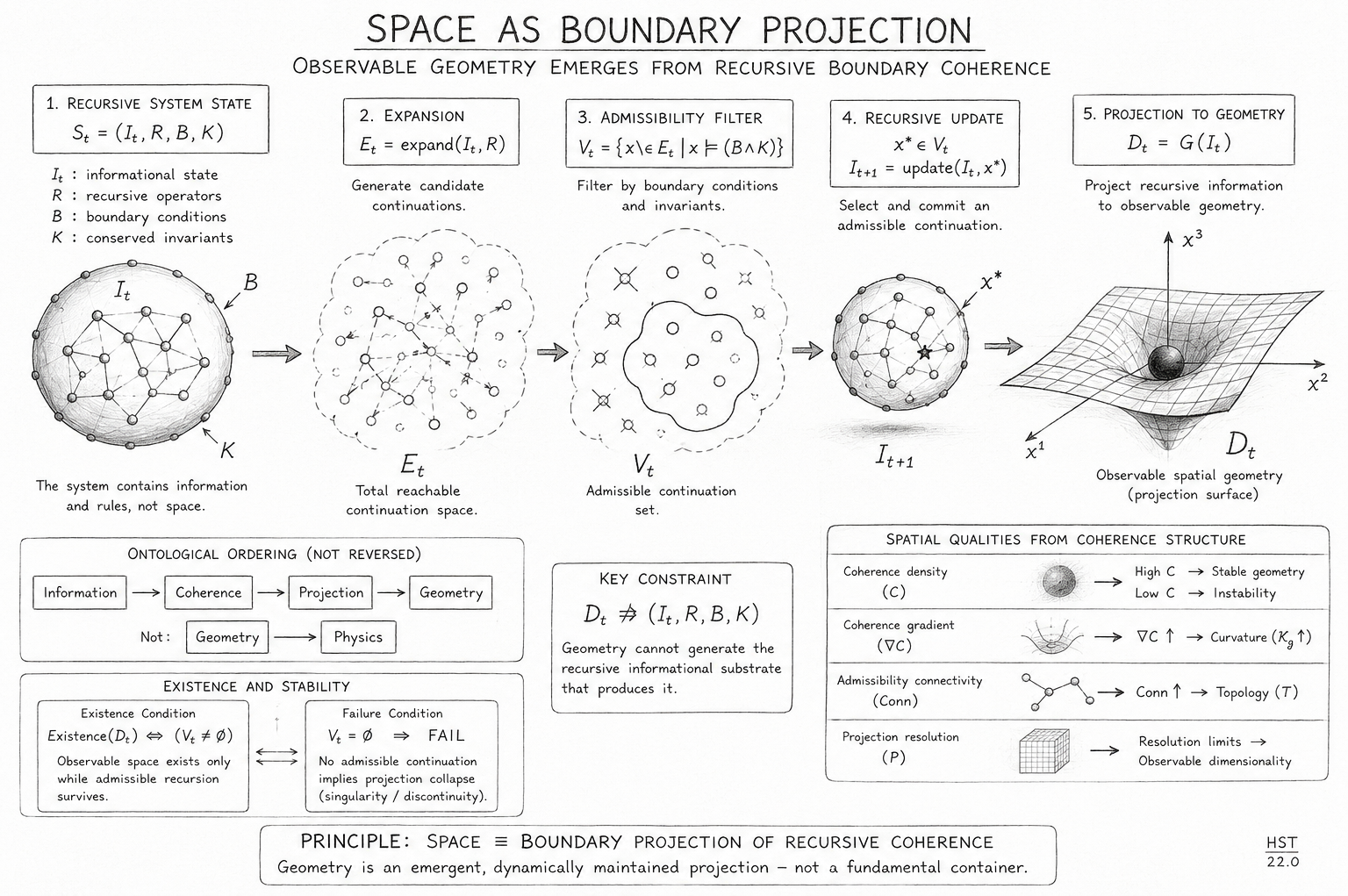
Space as Boundary Projection

Diagram Overview

This diagram illustrates the HST interpretation of observable space as an emergent projection generated from recursively admissible informational coherence rather than as a fundamentally pre-existing geometric container.

The visual progression moves from left to right, demonstrating how recursive informational structure evolves through expansion, filtering, admissibility preservation, and projection into observable geometry.

The diagram therefore represents a complete ontological inversion of conventional spacetime models.

Rather than:

Space→Physics

the diagram implements:

Information→Coherence→
Projection→Geometry

This establishes space as a dynamically maintained projection surface emerging from recursive boundary organisation.

1. Recursive System State

The first panel defines the foundational recursive state:

\[ S_t = (I_t, R, B, K) \]

The spherical network structure represents recursive informational connectivity prior to geometric emergence.

Each component carries a distinct structural role:

  • ItI_t represents the active informational state,
  • RR represents recursive transformation operators,
  • BB represents admissibility boundaries,
  • KK represents conserved invariants.

Importantly, no observable geometry exists at this stage.

The system contains only recursively structured information and admissibility logic.  The outer shell surrounding the network symbolises the boundary constraint layer that governs physically survivable continuation.

This panel establishes the HST principle that space does not exist independently of recursive structural organisation.

2. Expansion Region

The second panel illustrates recursive candidate expansion:

\[ E_t = \operatorname{expand}(I_t, R) \]

The cloud-like region represents the total accessible continuation space generated by recursive transformation rules.

The branching nodes visualise the large set of possible recursive continuations that emerge from the current informational state.

This region intentionally appears unordered and diffuse because expansion alone does not guarantee physical admissibility.

At this stage:

  • possible states exist,
  • but valid physical structure has not yet been determined.

The expansion field therefore represents recursive possibility prior to structural filtering.

3. Admissibility Filter

The third panel introduces the admissibility condition:

\[ V_t = \left\{ x \in E_t \mid x \models (B \land K) \right\} \]

This is the core survivability filter of the system.

The shaded internal region represents recursively admissible continuations that successfully preserve:

  • boundary conditions,
  • invariant structure,
  • coherence consistency.

Invalid continuations outside the admissible region are excluded.  This filtering process visually demonstrates that observable structure emerges only from recursively stable configurations.

The diagram therefore rejects unconstrained geometric emergence.

Only structurally survivable recursion contributes to observable reality.

4. Recursive Update

The fourth panel illustrates recursive commitment:

\[ I_{t+1} = \operatorname{update}(I_t, x^\ast) \]

The selected admissible continuation:

\[ x^\ast \in V_t \]

is committed into the next informational state.  The compact coherent sphere represents recursive stabilisation after admissibility filtering.

This stage symbolises:

  • recursive persistence,
  • structural continuity,
  • coherence preservation,
  • and survivable informational evolution.

The diagram shows that stable recursive organisation precedes geometric projection.

Geometry has still not yet emerged.

5. Projection Into Observable Geometry

The fifth panel presents the central HST projection equation:

\[ D_t = G(I_t) \]

This stage transforms recursively admissible informational organisation into observable geometry.

The curved projection surface symbolises spacetime geometry emerging from coherence structure.

The depression in the projection mesh represents curvature formation arising from recursive coherence gradients rather than from geometric self-causation.

The coordinate axes indicate that dimensional observability itself is projection-derived.

Under this interpretation:

  • curvature becomes coherence tension,
  • geometry becomes observable projection,
  • dimensionality becomes relational resolution structure.

The diagram therefore depicts geometry as a downstream observable consequence of recursive informational organisation.

Ontological Ordering Section

The lower-left ordering sequence formalises the directional dependency chain:

Information→Coherence→
Projection→Geometry

The secondary crossed relationship:

\[ \mathrm{Geometry} \nrightarrow \mathrm{Physics} \]

rejects the assumption that geometry is ontologically primary.  This section visually reinforces the central HST inversion:

space does not generate physics;
physics generates the projection interpreted as space.

Key Constraint Region

The boxed asymmetry condition:

\[ D_t \nRightarrow (I_t, R, B, K) \]

defines the non-generative geometry principle.

This constraint prevents geometry from becoming self-causal.  The projection cannot regenerate the recursive informational substrate producing it. 

This establishes directional causality within the HST framework and prevents circular geometric ontology.

The boxed layout visually emphasises this as a foundational structural law.

Existence and Stability Section

The lower stability panels define spatial persistence through admissible recursion:

\[ \mathrm{Existence}(D_t) \;\Longleftrightarrow\; (V_t \neq \emptyset) \]

Observable space exists only while admissible recursive continuation survives.

The adjacent failure condition:

\[ V_t = \emptyset \;\Rightarrow\; \mathrm{FAIL} \]

defines projection collapse.

Within HST this corresponds to:

  • singularity formation,
  • geometric discontinuity,
  • coherence collapse,
  • or recursive structural failure

This section replaces static spacetime permanence with dynamically maintained recursive survivability.

Spatial Qualities Mapping

The right-hand structural mapping table connects observable geometric properties directly to recursive coherence conditions.

The diagram formally maps:

Coherence Structure Observable Effect
Coherence Density Spatial Stability
Coherence Gradient Curvature Formation
Admissibility Connectivity Topology
Projection Resolution Observable Dimensionality

This section visually unifies multiple geometric phenomena under recursive coherence dynamics.

The mapping demonstrates that observable geometry is not independently fundamental, but instead emerges from deeper informational organisation.

Final Structural Meaning

The complete diagram functions as a full visual execution map for emergent geometry inside the HST framework.

The image demonstrates that:

  • recursive information generates coherence,
  • coherence generates admissible structure,
  • admissible structure generates projection,
  • and projection generates observable geometry.

Space therefore appears not as a pre-existing container of reality, but as the dynamically maintained boundary projection of recursively admissible coherence.

Diagram → Flow Mapping Table

Diagram Region Flow Algebra Component Mathematical Expression Structural Interpretation
Recursive Network Sphere Recursive System State \( S_t = (I_t, R, B, K) \) Complete recursively executable informational configuration prior to geometric emergence
Internal Node Connectivity Informational Structure \( I_t \) Active recursive informational relationships generating coherence organisation
Outer Boundary Shell Boundary Constraints \( B \) Admissibility limits governing physically survivable recursion
Structural Preservation Layer Conserved Invariants \( K \) Stable coherence conditions preserved during recursive evolution
Expansion Cloud Candidate Expansion \( E_t = \operatorname{expand}(I_t, R) \) Total reachable continuation space generated by recursive transformation
Branching Recursive Paths Recursive Operators \( R \) Transformation rules producing possible recursive continuations
Filtered Internal Region Admissibility Filter \( V_t = \{ x \in E_t \mid x \models (B \land K) \} \) Structurally admissible continuation set surviving recursive filtering
Excluded Peripheral States Constraint Violation \( x \not\models (B \land K) \) Invalid recursive continuations removed from physical survivability
Selected Stable Node Admissible Continuation \( x^* \in V_t \) Recursive state selected for survivable continuation
Stabilised Recursive Sphere Recursive Update \( I_{t+1} = \operatorname{update}(I_t, x^*) \) Commitment of admissible continuation into next informational state
Projection Surface Grid Geometry Projection \( D_t = G(I_t) \) Observable spatial geometry generated from recursive informational structure
Curved Projection Depression Coherence Curvature \( \nabla C \uparrow \Rightarrow \mathcal{K}_g \uparrow \) Recursive coherence gradients generating observable geometric curvature
Spatial Coordinate Axes Dimensional Projection \( \mathrm{Dim}(D_t) = P(C_t) \) Observable dimensionality emerging from projection resolution structure
Projection Mesh Stability Spatial Persistence \( \mathrm{Stable}(S_t) \iff I_t \models (B \land K) \) Spatial continuity maintained through recursive coherence preservation
Ontological Ordering Chain Projection Ordering \( I \rightarrow C \rightarrow G \rightarrow D \) Information generates coherence, coherence generates geometry
Crossed Geometry Arrow Non-Geometric Primacy \( D \not\Rightarrow (I, R, B, K) \) Geometry cannot regenerate the recursive substrate producing it
Existence Condition Box Spatial Existence Law \( \mathrm{Existence}(D_t) \iff (V_t \neq \emptyset) \) Observable space exists only while admissible recursion survives
Failure Condition Box Projection Collapse \( V_t = \emptyset \Rightarrow \mathrm{FAIL} \) Loss of admissible continuation causes geometric collapse/discontinuity
Stability Gradient Illustration Coherence Density Mapping \( C_s \uparrow \Rightarrow D_t^{\mathrm{stable}} \) High coherence density produces stable observable geometry
Curvature Mapping Illustration Gradient Curvature Mapping \( \nabla C \uparrow \Rightarrow \mathrm{Curvature} \uparrow \) Spatial deformation emerges from recursive coherence tension gradients
Connectivity Mapping Illustration Topological Formation \( T(D_t) = \mathrm{Conn}(V_t) \) Spatial topology reflects admissibility connectivity structure
Resolution Cube Illustration Projection Resolution \( P_r \Rightarrow \mathrm{Observable\ Dimensionality} \) Dimensional observability determined by coherence projection resolution
Final Principle Banner HST Spatial Principle \( \text{Space} \equiv \text{Boundary Projection of Recursive Coherence} \) Space is an emergent projection of recursively admissible informational structure

Execution Guarantee Statement

Structural Execution Guarantee

The Space as Boundary Projection flow guarantees that observable spatial geometry may emerge only from recursively admissible informational continuations operating under preserved boundary conditions and conserved invariants.

The flow prohibits unconstrained geometric generation.

All observable spatial structure must satisfy:

\[ V_t = \left\{ x \in E_t \mid x \models (B \land K) \right\} \]

before projection into geometry is permitted.

This guarantees that:

  • recursive continuation remains structurally admissible,
  • coherence preservation is maintained,
  • invariant violation cannot propagate into observable geometry,
  • and spatial existence emerges only from survivable recursive organisation.

Projection Guarantee

The flow guarantees that geometry is always downstream from recursive informational structure.

Observable space is generated exclusively through the projection relation:

\[ D_t = G(I_t) \]

This guarantees:

\[ D_t \nRightarrow (I_t, R, B, K) \]

meaning geometry itself cannot become the causal generator of the recursive substrate producing it.

The execution order therefore remains strictly directional:

Information→Coherence→
Projection→Geometry

This prevents circular geometric ontology and preserves recursive causality consistency throughout execution.

Stability Guarantee

The flow guarantees that spatial persistence exists only while admissible recursive continuation remains non-empty:

\[ \mathrm{Existence}(D_t) \;\Longleftrightarrow\; (V_t \neq \emptyset) \]

As long as recursive admissibility survives:

  • geometry remains observable,
  • dimensional continuity remains stable,
  • topology remains connected,
  • and curvature remains coherently maintainable.

Spatial continuity is therefore guaranteed only under invariant-preserving recursion.

Curvature Guarantee

The flow guarantees that geometric deformation arises exclusively from recursive coherence gradients rather than independent geometric self-dynamics.

Curvature formation obeys:

\[ \nabla C \uparrow \;\Rightarrow\; K_g \uparrow \]

This guarantees that:

  • curvature remains coherence-derived
  • geometry cannot arbitrarily self-deform,
  • and spatial structure remains causally linked to recursive informational organisation.

Observable gravitational behaviour therefore remains structurally tied to recursive coherence density variation.

Dimensional Consistency Guarantee

The flow guarantees that observable dimensionality emerges only from projection resolution constraints generated by recursive coherence organisation.

Dimensions are therefore treated as:

  • emergent observability structures,
  • not independently existing containers.

This guarantees dimensional consistency across recursive execution while preventing ontological separation between geometry and informational structure.

Failure Containment Guarantee

The flow guarantees explicit structural failure detection.

If admissible continuation collapses:

\[ V_t = \emptyset \]

then execution terminates:

\[ V_t = \emptyset \;\Rightarrow\; \mathrm{FAIL} \]

This guarantees that:

  • invalid recursive states cannot persist,
  • incoherent geometry cannot stabilise,
  • contradiction propagation is halted,
  • and projection collapse remains locally contained.

Singularities, discontinuities, and collapse regions therefore represent admissibility failure boundaries rather than violations of physical law.

Recursive Conservation Guarantee

The flow guarantees preservation of all conserved invariants throughout recursive execution:\forall x \in V_t,\ x \models K

\[ \forall x \in V_t,\; x \models K \]

No recursive continuation may survive unless invariant structure remains satisfied.

This guarantees

  • coherence preservation,
  • structural continuity,
  • admissibility conservation,
  • and stable recursive projection behaviour.

Observable space therefore inherits stability directly from recursive invariant preservation.

Final Guarantee Principle

The complete execution framework guarantees that observable space emerges only as a dynamically maintained projection of recursively admissible coherence.

The system guarantees:

\[ \mathrm{Space} \equiv \mathrm{Boundary\ Projection\ of\ Recursive\ Coherence} \]

and never:

\[ \mathrm{Space} \equiv \mathrm{Fundamental\ Independent\ Container} \]

Accordingly, all observable geometry within the flow remains fully constrained by recursive informational admissibility, conserved invariants, and boundary-preserving coherence dynamics.

Section Chapters
Kireth Research
38 Thorndale Croft, Wetwang, Driffield
East Riding of Yorkshire YO25 9XZ
Telephone: 01377 236594
Designed By