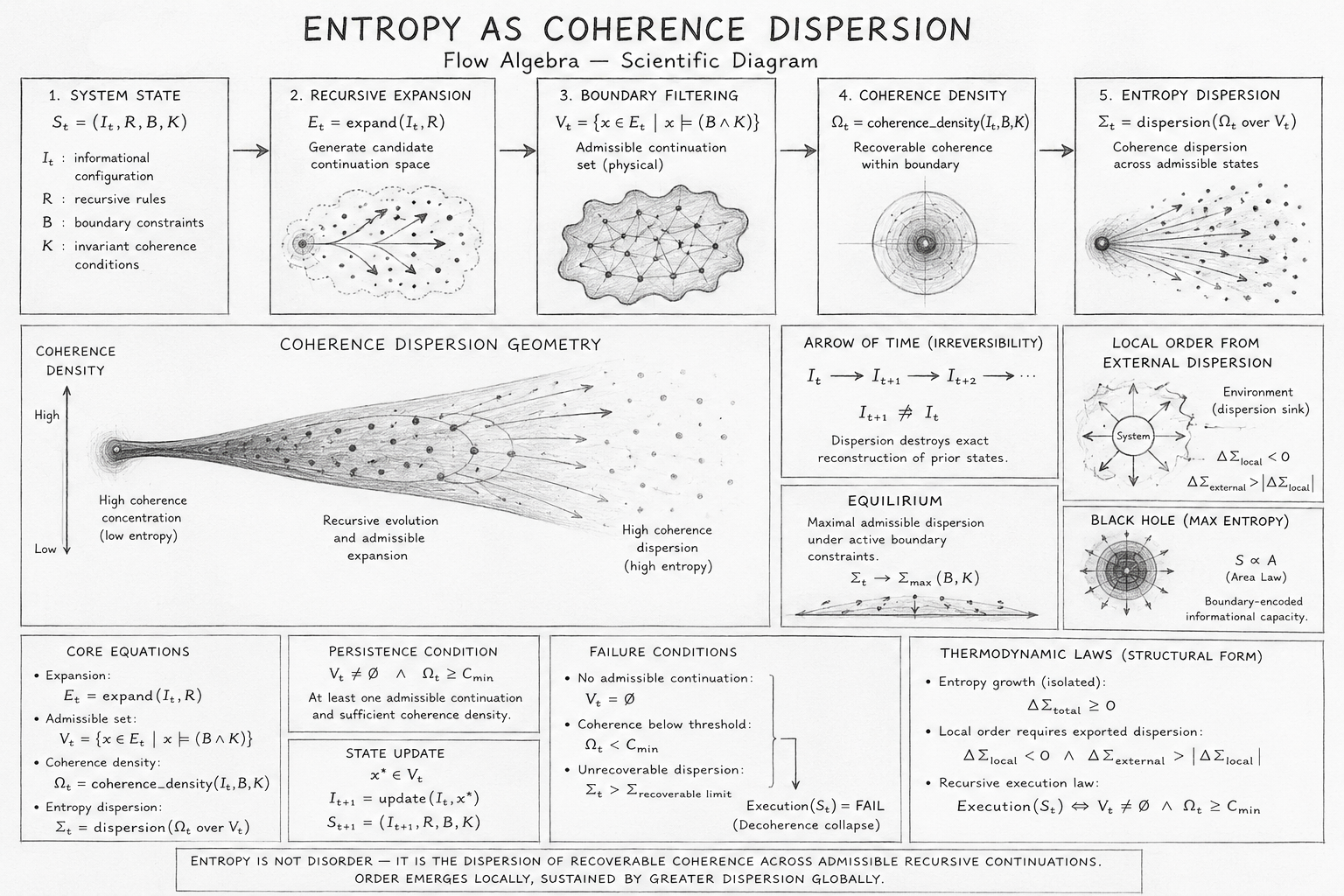
Entropy as Coherence Dispersion

Author: Mark Higgins
© Mark Anthony Higgins 11 October 2025
Revised Date: 9th March 2026
Audio Overview

Rethinking Disorder

Entropy is often described as a measure of disorder. In thermodynamics, it quantifies the number of microscopic configurations that correspond to a given macroscopic state. In statistical mechanics, systems naturally evolve toward states with higher entropy because those states are more statistically probable.

While this interpretation is mathematically powerful, the idea of “disorder” can be conceptually misleading. Many high-entropy systems are not chaotic or random in the everyday sense; they simply represent configurations where energy and information are distributed across many possible states.

The Holographic Space-Time framework offers a deeper structural interpretation. Instead of viewing entropy as disorder, it can be understood as the dispersion of coherence across interacting systems.

In this view, entropy measures how concentrated or distributed coherent relationships are within a network of interacting boundaries.

Coherence and Concentration

A highly coherent system contains tightly structured relationships between its components. These relationships constrain how energy and information can flow through the system.

For example, a crystal lattice maintains strong coherence between its atoms. Their positions and interactions are tightly organised, and only specific vibrational states are allowed.

In such systems, coherence is concentrated. The number of possible configurations that maintain the structure is limited.

This corresponds to low entropy.

Dispersion Through Interaction

When systems interact with their environment, coherence begins to disperse. Energy spreads across additional degrees of freedom, and constraints loosen as interactions redistribute structure across neighbouring systems.

A hot object placed in a cooler environment illustrates this process. Heat flows outward as molecular motion becomes distributed across a larger number of particles.

The original coherent structure—where energy was concentrated in a smaller region—gradually disperses into a wider network of interactions.

Entropy increases because coherence is no longer concentrated within a single system.

Boundary Networks and Entropy

Within the HST framework, systems interact primarily through their boundaries. These boundaries regulate how coherence flows between regions.

When coherence is concentrated within a boundary network, the system maintains a tightly organised internal structure. When interactions allow coherence to spread across neighbouring boundaries, the internal structure becomes more distributed.

Entropy therefore reflects how widely coherence is dispersed across a network of interacting boundaries.

Low entropy corresponds to concentrated coherence.
High entropy corresponds to distributed coherence.

This interpretation aligns naturally with holographic principles, where the informational structure of a region is encoded on its boundary surfaces.

The Direction of Entropy

The second law of thermodynamics states that entropy tends to increase in closed systems. Within the HST perspective, this behaviour arises because coherence naturally spreads across accessible interaction pathways.

Whenever two systems interact, coherence redistributes across the combined boundary network. The number of possible configurations increases because the coherence that once constrained a smaller system now participates in a larger relational structure.

This expansion of accessible configurations produces the familiar increase of entropy.

The process is not driven by disorder but by the natural diffusion of coherence through interaction networks.

Entropy and the Arrow of Time

Entropy plays a central role in defining the direction of time.

As coherence disperses across boundary networks, systems move from states of concentrated structure toward states where coherence is more widely distributed.

Because reconstructing the original concentrated configuration would require reversing countless interactions across many systems, the process becomes effectively irreversible.

This asymmetry creates the thermodynamic arrow of time.

Within the HST framework, the arrow of time emerges from the relationship between recursive updates and coherence dispersion.

Each update redistributes coherence slightly further across the network of interacting boundaries.

Local Order Within Global Dispersion

Although entropy tends to increase globally, local decreases in entropy are possible. Living systems, planetary atmospheres, and many physical structures maintain internal order while exporting entropy to their surroundings.

In the coherence framework, such systems temporarily concentrate coherence by drawing energy and information from external sources.

However, maintaining this local coherence requires continuous interaction with the environment, ensuring that the overall dispersion of coherence across the larger system still increases.

Thus local order is fully compatible with global entropy growth.

Entropy as Structural Evolution

Understanding entropy as coherence dispersion provides a unified perspective across multiple physical domains.

Thermodynamics describes the spreading of energy across states.
Information theory measures the distribution of possible configurations.
Statistical mechanics quantifies the probability of state distributions.

Each of these perspectives reflects the same underlying phenomenon: coherence gradually dispersing across increasingly large networks of interacting systems.

Entropy therefore becomes not merely a measure of disorder but a description of how coherent structure evolves as systems interact.

The Role of Entropy in HST

Within the Holographic Space-Time framework, entropy plays a fundamental role in shaping the evolution of the universe.

Coherence begins concentrated in highly structured regions and progressively disperses through interaction networks. This process drives the emergence of complex structures while simultaneously guiding systems toward equilibrium configurations.

By interpreting entropy as coherence dispersion, the behaviour of thermodynamic systems becomes directly connected to the deeper boundary dynamics that generate geometry, time, and physical interaction.

Entropy thus becomes a measure of how the universe redistributes coherence across its evolving network of boundaries.

Entropy is often described as a measure of disorder, yet this description can obscure the deeper structural processes that govern physical systems. In reality, entropy reflects how energy and information spread across interacting systems.

This chapter reinterprets entropy as the dispersion of coherence through networks of interacting boundaries. When coherence is concentrated, systems maintain tightly organised structure; as interactions distribute coherence across larger networks, the number of possible configurations increases.

Seen through this lens, entropy becomes not a measure of chaos but a description of how coherent structure spreads and evolves across the universe.

Scientific Introduction

Entropy is traditionally defined as the statistical tendency of systems to evolve toward disorder. In classical thermodynamics, it measures the number of microscopic configurations compatible with a macroscopic state. In statistical mechanics, entropy reflects probability distributions across accessible states. Within cosmology and information theory, entropy becomes linked to irreversibility, information loss, thermal equilibrium, and the directional flow of time.

Within the Holographic Space-Time (HST) framework, entropy is reinterpreted not as disorder itself, but as the dispersion of coherence across a recursive informational boundary system.

In this model, reality is not fundamentally composed of isolated particles moving through empty space. Instead, physical systems are understood as dynamically maintained coherence structures generated through recursive informational continuation. Stable structures persist only while coherence remains sufficiently concentrated to maintain admissible recursive evolution.

Entropy therefore corresponds to the progressive spreading, dilution, fragmentation, or decoherence of structured informational alignment across a boundary field.

Rather than describing “chaos” in an abstract statistical sense, entropy in HST measures the degree to which recursive informational organisation becomes dispersed across accessible boundary states.

Coherence Concentration vs Dispersion

A highly ordered system in HST is not simply “low entropy.” Instead, it possesses:

  • strong recursive continuity,
  • high boundary alignment,
  • constrained admissible state evolution,
  • concentrated coherence density.

As recursive interactions propagate through a system, coherence gradients redistribute across larger state spaces. The informational structure becomes increasingly dispersed, reducing local recoverable organisation even while total global coherence remains conserved.

This reinterpretation reframes entropy as a geometric and informational phenomenon rather than merely a statistical one.

The system evolves from:

High Local Coherence Density

toward:

Distributed Boundary-State Coherence

The apparent increase in disorder is therefore the visible consequence of recursive coherence dispersion across expanding admissible configurations.

Entropy and Admissible State Expansion

Within Flow Algebra and HST, every system evolves through admissible recursive continuation.

A system state is defined as:

\[ S_t = (I_t, R, B, K) \]

where:

  • ItI_t represents the informational configuration,
  • RR represents recursive transformation rules,
  • BB represents boundary constraints,
  • represents invariant coherence conditions.

Future admissible states emerge through recursive expansion:

\[ E_t = \operatorname{expand}(I_t, R) \]

while physically valid continuations are constrained by:

\[ V_t = \{x \in E_t \mid x \models (B \land K)\} \]

Entropy growth corresponds to the increasing dispersion of coherence across the admissible continuation set VtV_t.

As the number of accessible recursive pathways increases, local coherence density decreases unless external work re-concentrates informational structure.

This explains why isolated systems tend toward thermodynamic equilibrium:

equilibrium represents maximal admissible coherence dispersion under the active boundary conditions.

The Arrow of Time as Entropic Dispersion

The classical arrow of time emerges naturally within HST through irreversible coherence spreading.

Recursive updates continuously propagate informational structure forward:

\[ I_t \rightarrow I_{t+1} \]

However:

\[ I_{t+1} \nRightarrow I_t \]

because recursive dispersion destroys exact recoverable local configuration detail.

Time asymmetry therefore emerges not from a fundamental temporal direction embedded into spacetime itself, but from the statistical irreversibility of coherence redistribution.

Entropy becomes the observable signature of recursive informational drift.

The future contains more admissible dispersed states than highly constrained coherent states, making forward dispersion overwhelmingly more probable than spontaneous recoherence.

Local Entropy Reduction

HST also explains why local entropy reductions are possible without violating global thermodynamics.

Living systems, stars, coherent quantum systems, and engineered structures temporarily increase local coherence concentration by exporting greater coherence dispersion into their surroundings.

This can be expressed structurally as:

\[ \Delta S_{\mathrm{local}} < 0 \]

while simultaneously:

\[ \Delta S_{\mathrm{external}} > \left|\Delta S_{\mathrm{local}}\right| \]

Thus total coherence dispersion still increases globally.

Order is therefore not an exception to entropy, but a temporary local concentration process sustained through external coherence throughput.

Entropy as Informational Geometry

One of the deepest consequences of the HST interpretation is that entropy becomes fundamentally geometric.

Boundary structures define which recursive continuations remain physically admissible. As coherence disperses, the geometry of admissible informational space broadens.

Entropy is therefore linked directly to:

  • curvature accessibility,
  • recursive continuation density,
  • boundary-state projection complexity,
  • recoverable informational compression.

This unifies thermodynamics with informational geometry and recursive coherence theory.

In this view:

  • temperature measures recursive excitation density,
  • entropy measures coherence dispersion,
  • equilibrium represents maximal admissible boundary-state distribution.

Black Holes and Maximal Boundary Entropy

The HST interpretation naturally aligns with holographic entropy scaling.

Black holes possess maximal entropy because they represent maximal boundary-state compression with minimal recoverable internal differentiation.

The entropy-area relationship emerges because informational storage capacity is fundamentally boundary encoded rather than volumetrically stored.

This directly supports the holographic reinterpretation of spacetime developed throughout HST.

Telephone:
01377 236594

Entropy as Structural Evolution

Ultimately, entropy in HST is not the decay of reality into meaninglessness or disorder.

It is the natural recursive redistribution of coherence through admissible informational geometry.

The universe evolves through:

  • coherence concentration,
  • recursive propagation,
  • dispersion,
  • recombination,
  • and boundary restructuring.

Entropy therefore becomes a measure of structural evolution itself.

Rather than being the enemy of order, entropy is the mechanism through which recursive systems explore the space of possible coherent configurations.

In HST, thermodynamics becomes not merely the study of heat and disorder, but the study of coherence flow through recursive boundary systems.

flow "EntropyAsCoherenceDispersion" v1.0

description:
  Entropy is modelled as the dispersion of recoverable coherence across
  admissible boundary-state continuations. Disorder is treated not as a
  primitive physical condition, but as the visible consequence of structured
  coherence spreading through recursive informational state space.

state:
  S_t:
    I_t: current_informational_configuration
    R: recursive_transformation_rules
    B: boundary_constraints
    K: invariant_coherence_conditions

fields:
  Omega_t:
    meaning: recoverable_local_coherence_density
    type: scalar
  Sigma_t:
    meaning: entropy_as_coherence_dispersion
    type: scalar
  E_t:
    meaning: expanded_candidate_continuation_space
    type: set
  V_t:
    meaning: admissible_continuation_set
    type: set
  C_min:
    meaning: minimum_coherence_threshold_for_recursive_persistence
    type: threshold

operators:
  expand:
    input: [I_t, R]
    output: E_t
  constrain:
    input: [E_t, B, K]
    output: V_t
  disperse:
    input: [Omega_t, V_t]
    output: Sigma_t
  update:
    input: [I_t, x_star]
    output: I_t_plus_1

process:
  - step: define_system_state
    equation: S_t = (I_t, R, B, K)

  - step: generate_candidate_continuations
    equation: E_t = expand(I_t, R)

  - step: filter_by_boundary_and_invariants
    equation: V_t = { x in E_t | x satisfies (B and K) }

  - step: measure_recoverable_coherence
    equation: Omega_t = coherence_density(I_t, B, K)

  - step: measure_entropy_as_dispersion
    equation: Sigma_t = dispersion(Omega_t over V_t)

  - step: test_recursive_persistence
    condition: V_t != empty and Omega_t >= C_min
    if_true:
      x_star: select_admissible_continuation(V_t)
      I_t_plus_1: update(I_t, x_star)
      S_t_plus_1: (I_t_plus_1, R, B, K)
    if_false:
      execution: FAIL

invariants:
  - name: boundary_validity
    statement: every admissible continuation must satisfy B
    equation: forall x in V_t, x satisfies B

  - name: coherence_invariance
    statement: every surviving continuation must preserve K
    equation: forall x in V_t, x satisfies K

  - name: entropy_growth_in_isolated_systems
    statement: isolated systems evolve toward greater coherence dispersion
    equation: Delta Sigma_total >= 0

  - name: local_order_requires_exported_dispersion
    statement: local coherence concentration requires greater external dispersion
    equation: Delta Sigma_external > abs(Delta Sigma_local)

failure_conditions:
  - name: no_admissible_continuation
    condition: V_t = empty
    result: Execution(S_t) = FAIL

  - name: coherence_below_threshold
    condition: Omega_t < C_min
    result: recursive_persistence_fails

  - name: unrecoverable_dispersion
    condition: Sigma_t exceeds recoverable_boundary_limit
    result: local_structure_decoheres

outputs:
  entropy:
    symbol: Sigma_t
    meaning: measured coherence dispersion across admissible boundary states

  next_state:
    symbol: S_t_plus_1
    meaning: surviving recursive continuation after entropy-constrained update

  irreversible_drift:
    statement: I_t can update to I_t_plus_1, but exact reconstruction is not guaranteed
    equation: I_t -> I_t_plus_1 and I_t_plus_1 does not imply I_t

execution_guarantee:
  statement: >
    The system executes only when at least one admissible continuation exists
    and recoverable coherence remains above the minimum persistence threshold.
    Entropy growth corresponds to increasing dispersion of coherence across
    valid boundary-state continuations.
  equation: Execution(S_t) iff V_t != empty and Omega_t >= C_min

What This Flow Implements

Introduction

The Entropy as Coherence Dispersion flow implements a recursive thermodynamic framework in which entropy is reinterpreted as the measurable dispersion of coherence across admissible informational boundary states.

Rather than treating entropy as abstract disorder or purely statistical randomness, the flow formalises entropy as a structural redistribution process occurring within recursive state evolution.

The implementation models physical systems as dynamically maintained informational configurations:

\[ S_t = (I_t, R, B, K) \]

where recursive transformations generate future candidate states while invariant constraints determine which continuations remain physically admissible.

Recursive Expansion of Informational States

The flow first generates possible recursive continuations through:

\[ E_t = \operatorname{expand}(I_t, R) \]

This operation represents the recursive unfolding of future informational possibilities from the current system configuration.

The model does not assume deterministic evolution toward a single future state. Instead, recursive propagation produces a structured continuation space containing multiple potential admissible evolutions.

This directly implements the HST principle that physical systems evolve through constrained recursive continuation rather than through isolated particle trajectories in pre-existing spacetime.

Boundary-Constrained Physical Admissibility

The generated continuation space is then filtered through coherence-preserving constraints:

\[ V_t = \{x \in E_t \mid x \models (B \land K)\} \]

This stage implements the principle that not all mathematically possible states are physically survivable.

Only continuations satisfying:

  • boundary constraints (BB),
  • invariant coherence conditions (KK),

remain admissible for recursive persistence.

Entropy therefore emerges inside a constrained geometric continuation structure rather than inside an unrestricted statistical space.

Entropy as Coherence Dispersion

The core implementation of the flow defines entropy as:

\[ \Sigma_t = \operatorname{dispersion}(\Omega_t \ \text{over} \ V_t) \]

where:

  • Ωt\Omega_t represents recoverable coherence density,
  • Σt\Sigma_t represents entropy as coherence dispersion.

This formalises entropy as the spreading of structured informational alignment across increasingly distributed admissible recursive states.

In the flow:

  • high coherence concentration corresponds to low entropy,
  • high coherence dispersion corresponds to high entropy.

high coherence dispersion corresponds to high entropy.

Thermodynamic Irreversibility

The flow implements the arrow of time through irreversible recursive dispersion:

\[ I_t \rightarrow I_{t+1} \]

while simultaneously:

\[ I_{t+1} \nRightarrow I_t \]

This means forward recursive continuation remains possible, but exact reconstruction of prior local coherence configurations becomes increasingly inaccessible as dispersion grows.

Irreversibility therefore emerges structurally from recursive informational spreading rather than from a fundamental temporal asymmetry embedded into spacetime itself.

Equilibrium as Maximal Dispersion

The flow also implements thermodynamic equilibrium as a state of maximal admissible coherence dispersion under active boundary constraints.

As recursive evolution progresses:

  • coherence gradients flatten,
  • informational localisation decreases,
  • accessible admissible states broaden.

Equilibrium is therefore not interpreted as “true disorder,” but as the saturation of admissible coherence distribution across the recursive boundary geometry.

Local Entropy Reduction

The implementation explicitly supports local decreases in entropy through externally sustained coherence concentration:

\[ \Delta \Sigma_{\mathrm{local}} < 0 \]

provided that:

\[ \Delta \Sigma_{\mathrm{external}} > \left|\Delta \Sigma_{\mathrm{local}}\right| \]

This models living systems, stars, coherent quantum systems, and engineered structures as temporary local coherence concentrators operating within globally increasing dispersion fields.

The flow therefore reproduces classical thermodynamic behaviour while embedding it into recursive coherence geometry.

Failure and Decoherence Conditions

The flow includes explicit structural failure conditions.

Execution fails whenever:

\[ V_t = \emptyset \]

or:

\[ \Omega_t < C_{\min} \]

This implements decoherence as the inability of the system to maintain sufficient recoverable informational structure for recursive persistence.

Entropy growth beyond recoverable coherence thresholds therefore produces structural dissolution rather than merely increased randomness.

Informational Geometry and Holographic Thermodynamics

The flow additionally implements the HST principle that entropy is fundamentally geometric and boundary encoded.

Coherence dispersion is measured not through volumetric occupation, but through admissible boundary-state continuation density.

This directly supports:

  • holographic entropy scaling,
  • black hole entropy-area relationships,
  • informational geometry interpretations of thermodynamics,
  • recursive formulations of statistical mechanics.

Entropy therefore becomes a measure of recursive informational geometry rather than merely particle-state counting.

Unified Thermodynamic Recursion

Overall, this flow implements a fully recursive reinterpretation of thermodynamics in which:

  • entropy becomes coherence dispersion,
  • equilibrium becomes maximal admissible distribution,
  • irreversibility emerges from recursive informational spreading,
  • local order arises through exported dispersion,
  • and physical persistence depends on recoverable coherence thresholds.

Within HST, thermodynamics is therefore reformulated as the study of coherence flow through constrained recursive informational geometries.

How to Read This Flow

Overview

The Entropy as Coherence Dispersion flow should be read as a recursive thermodynamic execution model describing how informational coherence evolves, disperses, and persists across admissible boundary-state continuations.

Unlike classical thermodynamic equations that treat entropy as a statistical scalar attached to particle ensembles, this flow models entropy dynamically as the structural redistribution of recoverable coherence through recursive informational geometry.

The flow is therefore not simply descriptive mathematics.

It is an executable structural specification of thermodynamic evolution.

1. Read the System State First

The flow begins with the definition of the recursive system state:

\[ S_t = (I_t, R, B, K) \]

This equation defines the minimum structural requirements necessary for physical persistence.

Each component has a precise role:

Symbol Meaning
\( I_t \) Current informational configuration
\( R \) Recursive transformation rules
\( B \) Boundary constraints
\( K \) Invariant coherence conditions

The system state should not be interpreted as particles in space.  Instead, it represents a constrained informational coherence structure capable of recursive continuation.

The entire thermodynamic evolution emerges from interactions between these four components.

2. Read Expansion as Future Possibility Generation

The next stage defines recursive continuation generation:

\[ E_t = \operatorname{expand}(I_t, R) \]

This means:

  • the current informational configuration,
  • operating under recursive transformation rules,
  • generates a space of possible future continuations.

Importantly:

\[ E_t \]

does not represent physically valid futures yet.  It represents candidate recursive possibilities before coherence filtering occurs.

This distinction is essential.
The flow separates:

possibility generation,

from:

physical admissibility.

3. Read Admissibility Filtering Carefully

The next equation performs the core structural filtering operation:

\[ V_t = \{x \in E_t \mid x \models (B \land K)\} \]

This is one of the most important equations in the entire framework.

It states that:
only continuations satisfying both:

  • boundary constraints (BB),
  • invariant coherence conditions (KK),

are allowed to survive recursive execution. This means the universe is not free to evolve arbitrarily.

Recursive evolution is constrained by structural survivability.

When reading this section:

  • EtE_t is the unconstrained possibility field,
  • VtV_t is the physically survivable subset.

Entropy operates only within admissible continuation space.

4. Read Coherence Density as Recoverable Structure

The flow then defines:

\[ \Omega_t = \operatorname{coherence\_density}(I_t, B, K) \]

This quantity measures how much informational organisation remains recoverable inside the active recursive boundary structure.

High coherence density means:

  • strong informational alignment,
  • concentrated structural organisation,
  • high recursive recoverability.

Low coherence density means:

  • fragmented informational organisation,
  • distributed structure,
  • increasing decoherence risk.

Coherence density is therefore the structural opposite of dispersion.

5. Read Entropy as Dispersion Geometry

The central entropy equation is:

\[ \Sigma_t = \operatorname{dispersion}(\Omega_t \ \text{over} \ V_t) \]

This must be read very carefully.
Entropy is not defined as disorder.

Entropy is defined as:
the spreading of coherence across admissible recursive continuation space.

Interpretation:

Low Entropy High Entropy
Concentrated coherence Distributed coherence
Strong local recoverability Weak local recoverability
Narrow admissible continuation geometry Broad continuation geometry
High structural alignment Diffuse informational distribution

This reinterpretation is the conceptual core of the chapter.

6. Read Recursive Persistence Conditions Next

The flow then tests whether recursive continuation remains physically possible:

\[ V_t \neq \emptyset \]

and:

\[ \Omega_t \geq C_{\min} \]

These conditions determine whether the system can survive recursive propagation.

The logic is:

  • at least one admissible continuation must exist,
  • coherence density must remain above minimum persistence threshold.

If both conditions hold:
recursive execution continues.

If either condition fails:
the structure decoheres.

This transforms thermodynamics into a survivability condition for recursive informational systems.

7. Read State Transition as Irreversible Drift

The flow then updates the system recursively:

\[ I_t \rightarrow I_{t+1} \]

However:

It+1​⇒It​

This is the formal implementation of thermodynamic irreversibility.

The system can evolve forward through recursive continuation, but coherence dispersion prevents exact reconstruction of prior informational states.

The arrow of time therefore emerges from:

  • increasing coherence dispersion,
  • irreversible informational redistribution,
  • loss of exact local recoverability.

Time asymmetry is thus emergent rather than fundamental.

8. Read Local Entropy Reduction Structurally

The flow also includes local coherence concentration:

\[ \Delta \Sigma_{\mathrm{local}} < 0 \]

while globally:

\[ \Delta \Sigma_{\mathrm{external}} > \left|\Delta \Sigma_{\mathrm{local}}\right| \]

This should be read as:
local order can increase only by exporting greater dispersion elsewhere.

This models:

  • biological systems,
  • stars,
  • computation,
  • coherent quantum structures,
  • engineered thermodynamic systems

Order is therefore not a violation of entropy.

It is a local coherence concentration sustained through external dispersion throughput.

9. Read Failure Conditions as Decoherence Boundaries

Failure occurs whenever:

\[ V_t = \emptyset \]

or:

\[ \Omega_t < C_{\min} \]

This means:

no admissible recursive future exists,

or:

coherence becomes too dispersed to maintain structural persistence.

Thermodynamic failure is therefore interpreted as recursive decoherence collapse.

10. Read the Flow Geometrically, Not Mechanically

Most importantly:
do not read this flow as classical particle mechanics.

The flow describes:

  • informational geometry,
  • recursive survivability,
  • coherence concentration,
  • admissible continuation structure,
  • boundary-state evolution.

Entropy becomes a geometric property of recursive informational dispersion.

Thermodynamics becomes the study of how coherence propagates, disperses, concentrates, and survives within constrained recursive boundary systems.

Within HST, this transforms entropy from a statistical bookkeeping quantity into a fundamental structural property of recursive reality itself.

Flow → Equation Tri-Mapping

Flow Stage Flow Algebra Operation Equation Mapping
System Definition Recursive thermodynamic state construction \( S_t=(I_t,R,B,K) \)
Recursive Expansion Candidate continuation generation \( E_t=\operatorname{expand}(I_t,R) \)
Boundary Filtering Admissible state selection \( V_t=\{x\in E_t\mid x\models(B\land K)\} \)
Coherence Measurement Recoverable structural density \( \Omega_t=\operatorname{coherence\_density}(I_t,B,K) \)
Entropy Definition Coherence dispersion metric \( \Sigma_t=\operatorname{dispersion}(\Omega_t\ \text{over}\ V_t) \)
Entropy Growth Dispersion increase in isolated systems \( \Delta\Sigma_{total}\geq0 \)
Local Order Formation Local coherence concentration \( \Delta\Sigma_{local}<0 \)
External Compensation Global thermodynamic consistency \( \Delta\Sigma_{external}>\Delta\Sigma_{local} \)
Persistence Condition Recursive survivability test \( V_t\neq\emptyset\ \land\ \Omega_t\geq C_{min} \)
Admissible Selection Surviving continuation extraction \( x^*\in V_t \)
Recursive Update Informational state transition \( I_{t+1}=\operatorname{update}(I_t,x^*) \)
State Evolution Recursive propagation \( S_t\rightarrow S_{t+1} \)
Irreversibility Non-invertible recursive evolution \( I_t\rightarrow I_{t+1} \)
Temporal Asymmetry Reverse reconstruction failure \( I_{t+1}\not\Rightarrow I_t \)
Decoherence Threshold Minimum recoverable coherence \( \Omega_t<C_{min} \)
Structural Failure No admissible continuation \( V_t=\emptyset \)
Execution Failure Recursive persistence collapse \( \operatorname{Execution}(S_t)=FAIL \)
Equilibrium State Maximal admissible dispersion \( \Sigma_t\rightarrow\Sigma_{max}(B,K) \)
Entropic Arrow of Time Dispersion-directed recursive drift \( \partial\Sigma/\partial t>0 \)
Boundary Thermodynamics Entropy as geometric admissibility density \( \Sigma_t\propto V_t \)
Holographic Entropy Scaling Boundary-encoded informational capacity \( S\propto A \)
Recoverable Structure Limit Coherence persistence boundary \( \Omega_t\rightarrow0\Rightarrow\text{decoherence} \)
Recursive Thermodynamic Law Persistence requires admissible coherent continuation \( \operatorname{Execution}(S_t)\iff V_t\neq\emptyset\land\Omega_t\geq C_{min} \)

Diagram Overview

The Entropy as Coherence Dispersion diagram illustrates the Holographic Space-Time (HST) reinterpretation of entropy as the recursive dispersion of recoverable coherence across admissible informational boundary states.

Rather than depicting entropy as abstract disorder or random particle motion, the diagram visualises thermodynamic evolution as a structured geometric redistribution process occurring within constrained recursive continuation space.

The figure is organised into sequential execution stages that progressively transform concentrated local coherence into distributed admissible boundary-state dispersion.

The entire diagram should therefore be read as a recursive thermodynamic execution architecture rather than a classical mechanical system.

1. System State Construction

The first panel defines the recursive system state:

\[ S_t = (I_t, R, B, K) \]

This establishes the minimum structural components necessary for thermodynamic persistence.

The diagram identifies:

  • ItI_t as the informational configuration,
  • RR as recursive transformation rules,
  • BB as boundary constraints,
  • KK as invariant coherence conditions.

This panel establishes that entropy is not evaluated over isolated particles in empty space, but over constrained recursive informational structures.

The system is therefore fundamentally informational and boundary-defined.

2. Recursive Expansion Region

The second panel illustrates recursive continuation generation:

\[ E_t = \operatorname{expand}(I_t, R) \]

The outward branching structure represents the generation of candidate future continuations emerging from the current informational state.

The expanding node cloud symbolises increasing recursive possibility space.  Importantly, the diagram intentionally shows this region as unconstrained.

At this stage:

  • continuations are possible,
  • but not yet physically admissible.

This visually separates:

  • recursive possibility generation,
    from:
  • survivable thermodynamic continuation.

3. Boundary Filtering Structure

The third panel visualises admissibility filtering:

\[ V_t = \{x \in E_t \mid x \models (B \land K)\} \]

The enclosed geometric mesh represents the subset of recursive continuations capable of satisfying boundary and invariant coherence conditions.

The filtered network geometry symbolises:

  • physically survivable recursive states,
  • coherence-preserving continuation pathways,
  • constrained thermodynamic admissibility.

This panel demonstrates that entropy evolution occurs only inside recursively survivable geometries.  The universe therefore does not evolve through unrestricted state proliferation.

It evolves through constrained coherence-preserving continuation.

4. Coherence Density Geometry

The fourth panel illustrates recoverable coherence density:

\[ \Omega_t = \operatorname{coherence\_density}(I_t, B, K) \]

The concentric density structure represents informational concentration within the active recursive boundary.

High central density corresponds to:

  • strong coherence alignment,
  • high recoverability,
  • low dispersion,
  • strong structural persistence.

The gradual outward thinning visualises coherence weakening as informational structure becomes increasingly distributed.

This panel provides the geometric foundation necessary for defining entropy as dispersion rather than disorder.

5. Entropy Dispersion Field

The fifth panel visualises the core thermodynamic reinterpretation:

\[ \Sigma_t = \operatorname{dispersion}(\Omega_t \ \text{over} \ V_t) \]

The expanding directional vectors represent coherence spreading across admissible continuation space.

The diagram intentionally transitions from:

  • concentrated local structure,
    to:
  • diffuse distributed geometry.

This panel illustrates the central HST principle:
entropy is the spatial and informational dispersion of recoverable coherence across admissible recursive states.

The outward flow geometry visualises increasing thermodynamic irreversibility.

6. Coherence Dispersion Geometry (Central Panel)

The large central geometric field represents the complete thermodynamic evolution process.

The left side illustrates:

  • high coherence concentration,
  • low entropy,
  • strong informational localisation.

The right side illustrates:

  • distributed coherence,
  • high entropy,
  • broad admissible continuation geometry.

The expanding wedge structure symbolises recursive propagation through increasing state accessibility.

The fading coherence density demonstrates how recoverable informational structure becomes diluted across larger admissible recursive spaces.

This central panel is the primary conceptual core of the diagram. It visually replaces the classical “entropy equals disorder” interpretation with:

entropy equals recursive coherence dispersion.

7. Arrow of Time and Irreversibility

The upper-right panel illustrates temporal asymmetry:

\[ I_t \rightarrow I_{t+1} \rightarrow I_{t+2} \]

while:

\[ I_{t+1} \nRightarrow I_t \]

The one-directional flow arrows represent irreversible recursive propagation.

The diagram explicitly states that coherence dispersion destroys exact reconstructability of prior informational states.

This visually formalises the HST interpretation of the arrow of time:

time asymmetry emerges from irreversible coherence redistribution rather than from a fundamentally directional spacetime fabric.

Telephone:
01377 236594

8. Local Order Formation

The local-order panel demonstrates entropy reduction within open systems.

The system centre concentrates coherence locally while exporting greater dispersion into the surrounding environment:

\[ \Delta \Sigma_{\mathrm{local}} < 0 \]

while:

\[ \Delta \Sigma_{\mathrm{external}} > \left|\Delta \Sigma_{\mathrm{local}}\right| \]

The outward arrows represent exported thermodynamic dispersion.

This models:

  • biological systems,
  • stars,
  • coherent quantum systems,
  • computational systems,
  • engineered thermodynamic structures.

The panel demonstrates that local order is not a violation of entropy growth.

Instead, order emerges through controlled coherence concentration sustained by greater external dispersion.

9. Equilibrium Geometry

The equilibrium panel visualises maximal admissible coherence dispersion:

\[ \Sigma_t \rightarrow \Sigma_{\max}(B, K) \]

The flattened distribution geometry symbolises the exhaustion of strong coherence gradients.

At equilibrium:

  • recursive continuation remains possible,
  • but coherence becomes maximally distributed across admissible boundary states.

The system no longer supports large-scale recoverable structural differentiation.  This represents thermodynamic saturation rather than true randomness.

10. Black Hole Entropy Panel

The black hole panel connects the framework to holographic thermodynamics.

The diagram illustrates:

\[ S \propto A \]

showing entropy scaling with boundary area rather than volume.  The dense radial boundary structure symbolises maximal informational compression.

This panel supports the HST principle that entropy is fundamentally boundary encoded.

Black holes therefore represent maximal coherence compression with minimal recoverable internal differentiation.

11. Core Equations and Failure Conditions

The lower panels consolidate the full recursive thermodynamic framework.

The equations summarise:

  • recursive expansion,
  • admissibility filtering,
  • coherence density,
  • entropy dispersion,
  • persistence conditions,
  • irreversible update structure.

Failure conditions occur whenever:

\[ V_t = \emptyset \]

or:

\[ \Omega_t < C_{\min} \]

These conditions visualise decoherence collapse as the loss of recursively survivable informational structure.

Entropy therefore becomes directly linked to structural persistence thresholds.

12. Overall Scientific Meaning

Taken as a whole, the diagram presents a complete recursive reinterpretation of thermodynamics.

The figure demonstrates that:

  • entropy is coherence dispersion,
  • thermodynamics is recursive geometry,
  • equilibrium is maximal admissible distribution,
  • irreversibility emerges from dispersion,
  • and persistence depends on recoverable coherence density.

The universe is therefore modelled not as a machine degrading into disorder, but as a recursively evolving coherence field exploring admissible informational geometry through constrained thermodynamic propagation.

Diagram → Flow Mapping Table

Diagram Component Visual Meaning Flow Algebra Mapping Equation Mapping
System State Box Recursive thermodynamic system definition System state construction \( S_t=(I_t,R,B,K) \)
Informational Configuration Active informational structure Recursive state input \( I_t \)
Recursive Rules Layer Allowed transformation dynamics Recursive propagation engine \( R \)
Boundary Constraint Layer Physical survivability limits Boundary admissibility filter \( B \)
Invariant Coherence Layer Structural persistence requirements Recursive invariance preservation \( K \)
Recursive Expansion Cloud Candidate future continuation space Expansion operator \( E_t=\operatorname{expand}(I_t,R) \)
Expansion Arrows Recursive possibility generation State propagation dynamics \( I_t\rightarrow E_t \)
Boundary Filtering Mesh Physically survivable continuation geometry Admissibility filtering \( V_t=\{x\in E_t\mid x\models(B\land K)\} \)
Filtered Node Network Valid recursive continuation states Survivable recursive subset \( x\in V_t \)
Coherence Density Core Recoverable informational concentration Coherence density measurement \( \Omega_t=\operatorname{coherence\_density}(I_t,B,K) \)
Density Gradient Rings Coherence weakening through distribution Dispersion progression \( \Omega_t\downarrow \)
Entropy Dispersion Vectors Coherence spreading across admissible states Entropy generation \( \Sigma_t=\operatorname{dispersion}(\Omega_t\ \text{over}\ V_t) \)
Expanding Dispersion Cone Broadening continuation geometry Increasing admissible dispersion \( |V_t| \uparrow \)
Left-Side High Density Region Strong local coherence concentration Low entropy state \( \Sigma_t\rightarrow \min \)
Right-Side Diffuse Region Distributed recoverable structure High entropy state \( \Sigma_t\rightarrow \max \)
Arrow of Time Flow Forward recursive continuation Recursive state evolution \( I_t\rightarrow I_{t+1}\rightarrow I_{t+2} \)
Irreversibility Marker Failure of exact reverse reconstruction Non-invertible recursion \( I_{t+1}\not\Rightarrow I_t \)
Local Order System Local coherence concentration Open-system entropy reduction \( \Delta\Sigma_{local}<0 \)
Environmental Dispersion Sink Exported thermodynamic dispersion Global entropy compensation \( \Delta\Sigma_{external}>\Delta\Sigma_{local} \)
Equilibrium Flattening Saturated coherence distribution Maximal admissible dispersion \( \Sigma_t\rightarrow\Sigma_{max}(B,K) \)
Black Hole Boundary Ring Boundary-encoded informational compression Holographic entropy geometry \( S\propto A \)
Boundary Area Structure Entropy scaling with surface geometry Holographic encoding law \( \text{Entropy}\sim\text{Boundary Area} \)
Persistence Condition Box Recursive survivability requirement Execution validation \( V_t\neq\emptyset\land\Omega_t\geq C_{min} \)
State Update Section Surviving recursive continuation Recursive state transition \( I_{t+1}=update(I_t,x^*) \)
Admissible Continuation Selection Valid future extraction Continuation selection operator \( x^*\in V_t \)
Failure Condition Block Recursive decoherence collapse Structural execution failure \( V_t=\emptyset \)
Coherence Threshold Failure Insufficient recoverable structure Decoherence threshold crossing \( \Omega_t<C_{min} \)
Execution Failure Output Loss of recursive persistence Recursive collapse condition \( \operatorname{Execution}(S_t)=FAIL \)
Thermodynamic Law Panel Structural entropy evolution laws Recursive thermodynamic invariants \( \Delta\Sigma_{total}\geq0 \)
Final Summary Statement Entropy as recursive coherence dispersion Unified HST thermodynamic interpretation \( \text{Entropy}\equiv\text{Coherence Dispersion} \)

Execution Guarantee Statement

Purpose

The Entropy as Coherence Dispersion flow is constructed as a closed recursive thermodynamic system. Execution is guaranteed only when the system maintains sufficient recoverable coherence and at least one admissible continuation remains available within the active boundary-state geometry.

The flow does not assume perpetual continuation.

Persistence emerges only when recursive evolution remains structurally valid.

Formal Execution Condition

Execution is guaranteed if and only if:

\[ V_t \neq \emptyset \]

and

\[ \Omega_t \geq C_{\min} \]

which together define the recursive persistence condition:

\[ \operatorname{Execution}(S_t) \Leftrightarrow V_t \neq \emptyset \;\land\; \Omega_t \geq C_{\min} \]

Admissible Continuation Guarantee

The recursive expansion stage generates a candidate continuation space:

\[ E_t = \operatorname{expand}(I_t, R) \]

which is subsequently filtered through boundary and coherence constraints:

\[ V_t = \{x \in E_t \mid x \models (B \land K)\} \]

Execution is guaranteed whenever this admissible continuation set remains non-empty.

That is:

\[ V_t \neq \emptyset \]

ensures that at least one physically survivable recursive continuation exists.

Coherence Persistence Guarantee

The flow additionally requires sufficient recoverable coherence density:

\[ \Omega_t = \operatorname{coherence\_density}(I_t, B, K) \]

to remain above the minimum persistence threshold:

\[ \Omega_t \geq C_{\min} \]

This guarantees that the system retains enough structural organisation to support recursive propagation.

Entropy may increase through coherence dispersion, but persistence remains possible as long as recoverable coherence remains above threshold.

Entropy Growth Compatibility

The flow remains executable under entropy growth.

Specifically:

\[ \Delta \Sigma_{\mathrm{total}} \geq 0 \]

does not imply execution failure.
Entropy growth simply indicates increasing coherence dispersion across admissible recursive continuation space.

Execution remains valid provided:

\[ V_t \neq \emptyset \]

and

\[ \Omega_t \geq C_{\min} \]

continue to hold.
Thus entropy growth and recursive persistence are fully compatible.

Local Order Guarantee

The framework permits local decreases in entropy through coherence concentration mechanisms:

\[ \Delta \Sigma_{\mathrm{local}} < 0 \]

provided that:

\[ \Delta \Sigma_{\mathrm{external}} > \left|\Delta \Sigma_{\mathrm{local}}\right| \]

This guarantees consistency with global thermodynamic constraints while allowing:

  • biological organisation,
  • computation,
  • self-organisation,
  • coherent physical structures,
  • engineered thermodynamic systems.

Local order therefore remains executable without violating global entropy evolution.

Irreversibility Guarantee

The flow guarantees forward recursive continuation:

\[ I_t \rightarrow I_{t+1} \]

but does not guarantee exact reverse reconstruction:

\[ I_{t+1} \nRightarrow I_t \]

This asymmetry emerges naturally from coherence dispersion and ensures thermodynamic irreversibility throughout recursive evolution.

Telephone:
01377 236594

Failure Conditions

Execution fails whenever either of the following conditions occurs:

No Admissible Continuation

\[ V_t = \emptyset \]

No physically survivable recursive future exists.
Result:

\[ \operatorname{Execution}(S_t) = \mathrm{FAIL} \]

Coherence Collapse

\[ \Omega_t < C_{\min} \]

Recoverable coherence falls below the persistence threshold.

Result:

\[ \operatorname{Execution}(S_t) = \mathrm{FAIL} \]

Unrecoverable Dispersion

\[ \Sigma_t > \Sigma_{\mathrm{recoverable}} \]

Coherence becomes too dispersed to sustain local structural organisation.

Result:

\[ \mathrm{Decoherence\ Collapse} \]

Structural Guarantee

The flow guarantees that every successful thermodynamic update satisfies all active boundary constraints and coherence invariants:

\[ \forall x \in V_t,\; x \models (B \land K) \]

Therefore every surviving continuation preserves:

  • boundary validity,
  • recursive consistency,
  • coherence invariance,
  • thermodynamic admissibility.

No invalid continuation can be executed.

Scientific Interpretation

Within the HST framework, this execution guarantee formalises the principle that entropy is not a force driving systems toward disorder.

Instead, entropy measures the dispersion of coherence across admissible recursive geometries.

As long as coherence remains recoverable and admissible continuations exist, recursive evolution continues.

Execution therefore persists through dispersion, and failure occurs only when coherence becomes unrecoverable or no valid continuation remains.

Execution Guarantee Statement

\[ \operatorname{Execution}(S_t) \Leftrightarrow V_t \neq \emptyset \;\land\; \Omega_t \geq C_{\min} \]

A recursive thermodynamic system remains executable if and only if at least one admissible continuation exists and sufficient recoverable coherence remains available for structural persistence. Entropy growth represents coherence dispersion, not execution failure.
Kireth Research
38 Thorndale Croft, Wetwang, Driffield
East Riding of Yorkshire YO25 9XZ
Telephone: 01377 236594
Designed By