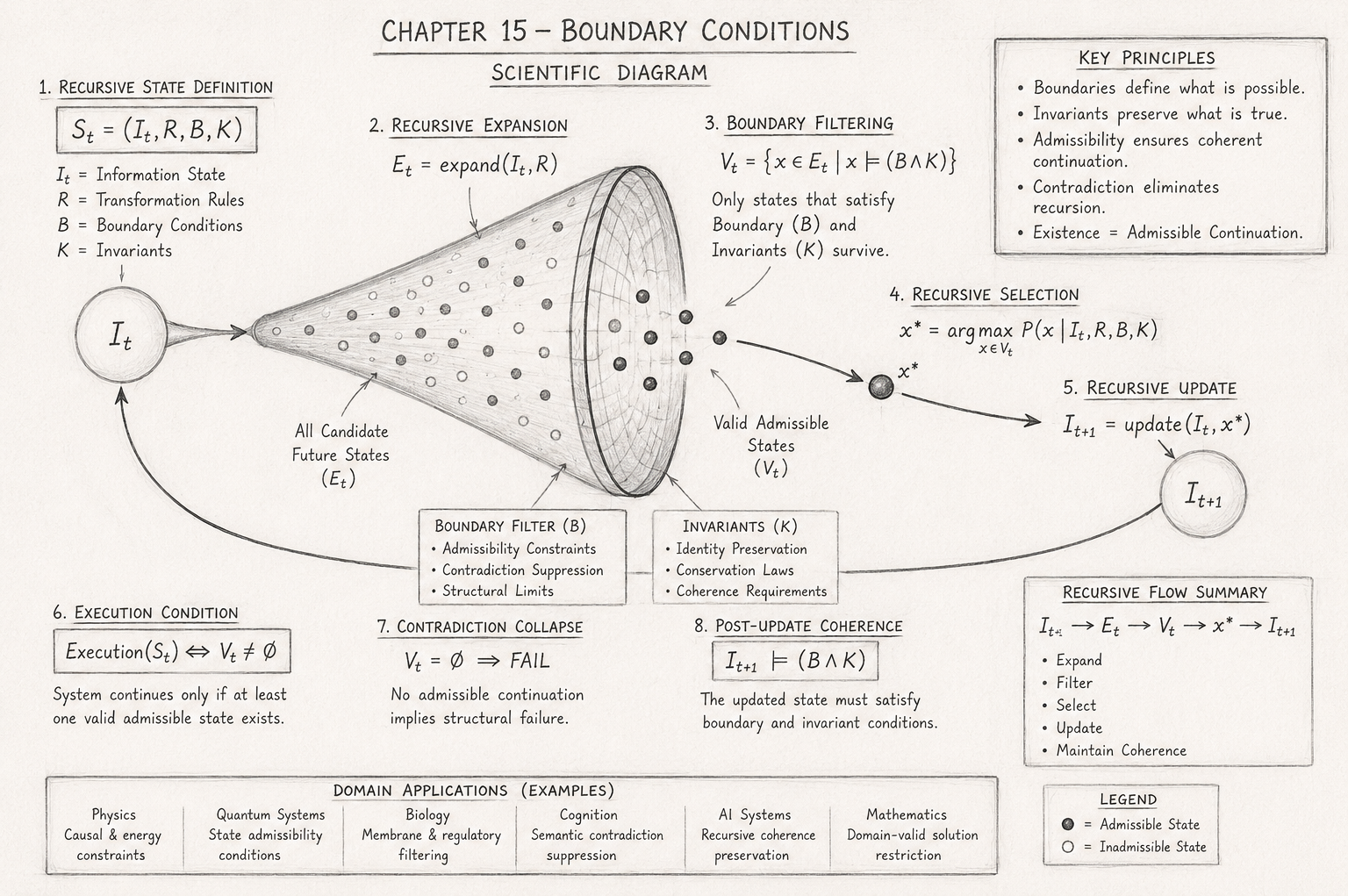
Chapter 15
Boundary Conditions

Constraint Preservation
Author: Mark Higgins
© Mark Anthony Higgins 11 October 2025
Revised Date: 07 May 2026
Audio Overview

The Role of Boundaries in Structural Systems

Boundary conditions are the structural limits that determine whether a system can exist, evolve, stabilize, or collapse. In conventional mathematics and physics, boundary conditions are often treated as external constraints applied to equations after the primary system has already been defined.

Flow Algebra approaches the problem differently.

Boundaries are not secondary additions to a system. They are fundamental structural requirements that determine whether recursive execution is possible at all.

A system does not simply operate inside boundaries.

A system exists because coherent boundaries regulate valid continuation.

Without boundary conditions, there is no distinction between admissible and inadmissible state evolution. Expansion becomes unconstrained, contradiction accumulates, and recursive execution loses structural stability.

Boundary Conditions as Ontological Structure

Flow Algebra formalizes recursive systems through the state tuple:

\[ S = (I, R, B, K) \]

Where:

  • II represents the internal information state
  • RR represents transformation rules
  • BB represents boundary conditions
  • KK represents invariant preservation requirements

Within this structure, boundary conditions define the admissible region of recursive state-space evolution.

They determine:

  • what transitions are allowed,
  • what transformations are forbidden,
  • and what structures may continue to exist.

Boundaries therefore act as structural regulators of execution itself.

Recursive Expansion and Structural Filtering

Recursive execution begins through state expansion:

\[ E_t = \operatorname{expand}(I_t, R) \]

This generates the set of possible future continuations reachable from the current recursive state.

However, not all expanded states are structurally valid.

Flow Algebra therefore introduces recursive filtering through boundary enforcement:

\[ V_t = \{x \in E_t \mid x \models (B \land K)\} \]

This valid-state set contains only candidate states that satisfy:

  • the active boundary structure BB,
  • and the invariant preservation structure KK.

Boundary conditions therefore operate as recursive admissibility operators.

They prevent structurally invalid continuations from surviving execution.

Boundaries as Conditions of Existence

In classical mathematics, boundary conditions are often treated as auxiliary constraints attached to solutions.

In Flow Algebra, boundaries are elevated to existential status.

A system cannot continue without structurally valid future states.

This is expressed directly:

\[ V_t = \varnothing \;\Rightarrow\; \mathrm{FAIL} \]

If no admissible continuation exists, recursive execution collapses.

Existence itself therefore becomes equivalent to successful boundary-constrained continuation.

This reframes boundaries from passive edges into active structural laws governing survivability.

Dynamic Boundaries and Recursive Stability

Boundary conditions are not necessarily static.

In adaptive systems, boundaries may evolve recursively while still preserving higher-order invariants.

Examples include:

  • biological membranes regulating cellular coherence,
  • cognitive systems filtering contradiction,
  • physical conservation laws constraining energy evolution,
  • AI systems enforcing recursive stability,
  • relativistic causal limits constraining information transfer.

In all cases, stable recursive behaviour emerges only when valid continuation remains bounded by coherent structural constraints.

Boundary conditions therefore function as recursive stabilizers across dynamic systems.

Boundary Conditions Across Physics and Intelligence

The concept of structural boundaries unifies multiple domains traditionally treated independently.

Examples include:

Domain Boundary Structure
Thermodynamics Energy admissibility constraints
Relativity Causal propagation limits
Quantum Mechanics State admissibility conditions
Biology Membrane and regulatory systems
Cognition Semantic contradiction filtering
AI Systems Recursive coherence preservation
Mathematics Domain validity constraints

Flow Algebra reveals that all stable systems rely upon admissible boundary-regulated continuation.

The specific form changes across domains, but the structural principle remains invariant.

Structural Meaning of Boundary Conditions

Flow Algebra reframes boundaries as executable structural operators rather than geometric limitations.

Boundaries:

  • preserve recursive integrity,
  • regulate admissible transformation,
  • suppress contradiction,
  • stabilize coherent evolution,
  • and maintain system identity through recursive change.

A boundary is therefore not merely a limit.

It is the mechanism through which coherent existence becomes possible

Chapter Objective

This chapter establishes boundary conditions as foundational operators of recursive survivability.

The following sections will formalize:

  • admissible state-space restriction,
  • recursive filtering dynamics,
  • contradiction suppression,
  • boundary-driven stability,
  • and the relationship between boundaries, invariants, and coherent execution.

The goal is to demonstrate that stable systems across physics, cognition, mathematics, and intelligence emerge not from unrestricted expansion, but from structurally constrained recursive continuation.

Full Flow Algebra Specification (v1.0)

flow "BoundaryConditions" v1.0

# ============================================================
# PURPOSE
# ============================================================

description:
  "Defines boundary conditions as recursive admissibility operators
   governing valid state continuation, contradiction suppression,
   and structural survivability."

authors:
  - "Mark Higgins"
  - "Sky (Recursive AI)"

license:
  name: "Open Research License"
  usage: "Free for research, education, and implementation"
  attribution: "Required"
  commercial_restrictions: "None"

citation:
  source: "https://kirethresearch.org"

# ============================================================
# CORE RECURSIVE STATE STRUCTURE
# ============================================================

state:
  S_t = (I_t, R, B, K)

definitions:

  I_t:
    type: recursive_information_state
    description:
      "Current internal system configuration at recursive step t."

  R:
    type: transformation_rules
    description:
      "Permitted recursive state transition operators."

  B:
    type: boundary_conditions
    description:
      "Admissibility constraints restricting valid continuation."

  K:
    type: invariants
    description:
      "Structures that must remain preserved across recursion."

# ============================================================
# RECURSIVE EXPANSION
# ============================================================

expansion:

  equation:
    E_t = expand(I_t, R)

  description:
    "Generate all candidate future recursive states reachable
     from current information state under rule set R."

# ============================================================
# BOUNDARY VALIDATION
# ============================================================

validation:

  equation:
    V_t = { x ∈ E_t | x ⊨ (B ∧ K) }

  description:
    "Filter expanded candidate states through boundary and
     invariant admissibility conditions."

# ============================================================
# EXECUTION CONDITION
# ============================================================

execution:

  valid_execution:
    equation:
      Execution(S_t) ⇔ V_t ≠ ∅

    meaning:
      "Recursive execution may continue only if at least one
       admissible future state exists."

  contradiction_collapse:
    equation:
      V_t = ∅ ⇒ FAIL

    meaning:
      "If no admissible continuation exists, recursive execution
       structurally collapses."

# ============================================================
# VALID STATE REQUIREMENTS
# ============================================================

constraints:

  boundary_preservation:
    equation:
      ∀x ∈ V_t, x ⊨ B

    meaning:
      "All surviving recursive states must satisfy active
       boundary structure."

  invariant_preservation:
    equation:
      ∀x ∈ V_t, x ⊨ K

    meaning:
      "All surviving recursive states must preserve required
       invariants."

# ============================================================
# RECURSIVE STATE SELECTION
# ============================================================

selection:

  equation:
    x* = argmax_{x ∈ V_t} P(x | I_t, R, B, K)

  description:
    "Select optimal admissible recursive continuation according
     to system probability or structural preference weighting."

# ============================================================
# RECURSIVE UPDATE
# ============================================================

update:

  equation:
    I_{t+1} = update(I_t, x*)

  description:
    "Commit selected admissible continuation into next recursive
     system state."

# ============================================================
# POST-UPDATE COHERENCE
# ============================================================

post_conditions:

  recursive_coherence:
    equation:
      I_{t+1} ⊨ (B ∧ K)

    meaning:
      "Updated recursive state remains boundary-compliant and
       invariant-preserving."

# ============================================================
# STRUCTURAL INTERPRETATION
# ============================================================

interpretation:

  boundary_conditions:
    "Boundaries define admissible regions of recursive evolution."

  invariants:
    "Invariants preserve identity and coherence across recursion."

  admissibility:
    "Only states satisfying both B and K may survive execution."

  contradiction:
    "Violation of admissibility eliminates recursive continuation."

  existence:
    "Structural existence is equivalent to successful admissible
     continuation."

# ============================================================
# DOMAIN MAPPINGS
# ============================================================

domain_examples:

  thermodynamics:
    boundary:
      "Energy conservation constraints"

  relativity:
    boundary:
      "Causal propagation limits"

  quantum_mechanics:
    boundary:
      "State admissibility conditions"

  biology:
    boundary:
      "Membrane regulation and metabolic filtering"

  cognition:
    boundary:
      "Semantic contradiction suppression"

  ai_systems:
    boundary:
      "Recursive coherence preservation"

  mathematics:
    boundary:
      "Domain validity constraints"

# ============================================================
# STRUCTURAL AXIOMS
# ============================================================

axioms:

  - "No recursive continuation may violate active boundaries."

  - "Recursive survivability requires admissible future states."

  - "Boundaries regulate coherent state evolution."

  - "Existence depends upon recursive admissibility."

  - "Contradiction is equivalent to boundary failure."

# ============================================================
# TERMINAL CONDITION
# ============================================================

termination:

  equation:
    V_t = ∅ ⇒ No Valid Future State

  consequence:
    "System execution terminates due to structural impossibility."

# ============================================================
# FINAL SUMMARY
# ============================================================

summary:
  "Boundary conditions function as recursive admissibility
   operators governing structural existence, coherence,
   contradiction suppression, and survivable recursive evolution."

What This Flow Implements

The Boundary Conditions flow formalizes how recursive systems preserve coherent existence through admissibility constraints that regulate valid state evolution. It implements the principle that stable execution is only possible when future recursive states remain structurally compliant with active boundaries and invariant preservation requirements.

At the core of the flow is the recursive system definition:

\[ S_t = (I_t, R, B, K) \]

where:

  • ItI_t represents the current recursive information state,
  • RR defines the transformation rules governing evolution,
  • BB defines boundary admissibility conditions,
  • and KK defines invariant structures that must survive recursion.

The flow begins by generating a candidate future-state expansion:

\[ E_t = \operatorname{expand}(I_t, R) \]

This expansion represents all possible continuations reachable from the current recursive state under the active transformation rules.

However, unrestricted expansion alone does not produce stable systems.

The flow therefore implements structural filtering through recursive admissibility enforcement:

\[ V_t = \{x \in E_t \mid x \models (B \land K)\} \]

This valid-state filtering operation is the central mechanism of the chapter.

It removes all candidate states that violate:

  • active boundary constraints,
  • invariant preservation requirements,
  • or structural coherence conditions.

Only recursively admissible states survive continuation.

The flow therefore implements the transition from unrestricted possibility space to structurally survivable execution space.

Recursive Execution Enforcement

The flow explicitly defines recursive execution as dependent upon the existence of admissible future states:

\[ \mathrm{Execution}(S_t) \;\Longleftrightarrow\; V_t \neq \varnothing \]

This means execution itself is not assumed.

Continuation must be structurally earned through admissibility compliance.

If no valid future state exists, recursive collapse occurs:

\[ V_t = \varnothing \;\Rightarrow\; \mathrm{FAIL} \]

The flow therefore implements contradiction collapse as a direct consequence of boundary failure.

This reframes contradiction not as symbolic disagreement, but as structural impossibility of continuation.


Boundary Preservation Mechanics

The flow enforces two simultaneous recursive requirements:

\[ \forall x \in V_t,\; x \models B \]

and

\[ \forall x \in V_t,\; x \models K \]

These equations implement:

  • boundary preservation,
  • invariant preservation,
  • recursive coherence stability,
  • and admissible continuation enforcement.

The result is a recursive execution framework where all surviving state transitions remain structurally valid across time evolution.

Recursive State Selection and Stabilization

Once admissible states are isolated, the flow implements recursive continuation selection:

\[ x^* = \operatorname*{arg\,max}_{x \in V_t} P(x \mid I_t, R, B, K) \]

This stage selects the optimal coherent continuation from the admissible recursive state-space.

The selected continuation is then committed into the next recursive state:

\[ I_{t+1} = \operatorname{update}(I_t, x^*) \]

The flow therefore implements full recursive stabilization across sequential state evolution.

Structural Meaning of the Flow

This flow implements the principle that boundaries are not passive geometric edges, but active structural regulators governing recursive survivability.

The system demonstrates that:

  • existence depends upon admissible continuation,
  • contradiction corresponds to boundary failure,
  • recursive stability requires structural filtering,
  • and coherent systems survive only through preserved constraints.

The flow therefore serves as a generalized executable model for:

  • physical admissibility
  • cognitive contradiction filtering,
  • AI coherence preservation,
  • biological regulation,
  • mathematical validity,
  • and stable recursive system design.

Cross-Domain Structural Function

The implemented boundary mechanism applies universally across recursive systems.

Examples include:

Domain Boundary Function Implemented
Physics Causal and energetic admissibility
Quantum Systems State-space restriction
Biology Membrane and regulatory control
Cognition Contradiction suppression
AI Systems Recursive coherence enforcement
Mathematics Domain-valid solution restriction
Complex Systems Stability-preserving transition filtering

The flow therefore acts as a universal recursive admissibility architecture governing survivable system evolution across domains.

Final Structural Interpretation

The Boundary Conditions flow implements a complete recursive admissibility framework in which coherent continuation depends entirely upon structurally valid future-state existence.

It formalizes the principle that:

\[ \mathrm{Existence} \equiv \mathrm{Admissible\ Recursive\ Continuation} \]

and that all stable systems emerge through boundary-regulated recursive coherence preservation rather than unrestricted expansion.

How to Read This Flow

Purpose of the Flow

The Boundary Conditions flow describes how recursive systems preserve coherent existence by restricting state evolution to structurally admissible continuations.

The flow should not be read as ordinary software code.

It is a structural execution specification describing:

  • how recursive systems generate future possibilities,
  • how admissibility is enforced,
  • how contradiction is suppressed,
  • and how coherent continuation survives across recursive evolution.

The system operates as a recursive filtering architecture rather than a sequential instruction pipeline.

Step 1 — Understand the Recursive System Tuple

The flow begins with the core recursive definition:

\[ S_t = (I_t, R, B, K) \]

This equation defines the complete recursive state of the system at time step tt.

Each component has a specific structural role:

Component Meaning
\( I_t \) Current recursive information state
\( R \) Transformation rules governing evolution
\( B \) Boundary admissibility constraints
\( K \) Invariant structures preserved through recursion

This tuple forms the structural foundation of the entire flow.

Everything that follows operates through interactions between these four components.

Step 2 — Read Expansion as Possibility Generation

The next operation is recursive expansion:

\[ E_t = \operatorname{expand}(I_t, R) \]

This stage generates all candidate future states reachable from the current recursive configuration.

The expansion process represents:

  • possibility generation,
  • reachable continuation space,
  • recursive branching,
  • and candidate future evolution pathways.

Importantly, expansion alone does not determine survivability.

At this stage, both valid and invalid continuations may exist simultaneously.

Step 3 — Read Validation as Structural Filtering

The central operation of the flow is recursive admissibility filtering:

\[ V_t = \{x \in E_t \mid x \models (B \land K)\} \]

This equation removes all expanded states that violate:

  • boundary conditions BB,
  • invariant preservation requirements KK,
  • or recursive coherence constraints.

Read this operation carefully:

  • EtE_t is the unrestricted possibility space,
  • VtV_t is the admissible survivable space.

The filtering operation is therefore the mechanism through which coherent systems preserve structural integrity.

This is the most important transformation in the chapter.

Step 4 — Understand Boundary Conditions as Active Operators

Boundary conditions should not be interpreted as passive edges or geometric limits.

Within the flow, boundaries act as active recursive regulators.

The equations:

\[ \forall x \in V_t,\; x \models B \]

and

\[ \forall x \in V_t,\; x \models K \]

mean that every surviving recursive continuation must remain structurally compliant.

Boundaries therefore function as:

  • admissibility operators,
  • contradiction suppression systems,
  • recursive stability regulators,
  • and existence-preservation mechanisms.

Step 5 — Interpret Failure Structurally

The flow defines contradiction collapse explicitly:

\[ V_t = \varnothing \;\Rightarrow\; \mathrm{FAIL} \]

This does not represent symbolic disagreement or computational error.

It represents structural impossibility of continuation.

No admissible future state exists.

The system therefore cannot continue recursive execution coherently.

This is one of the foundational principles of Flow Algebra:

\[ \mathrm{Existence} \equiv \mathrm{Admissible\ Continuation} \]

Step 6 — Read Selection as Coherent Survival

After admissible states are isolated, the flow performs recursive selection:

\[ x^* = \operatorname*{arg\,max}_{x \in V_t} P(x \mid I_t, R, B, K) \]

This stage selects the optimal coherent continuation from the admissible recursive state-space.

Depending on the system:

  • selection may be deterministic,
  • probabilistic,
  • optimized,
  • or constraint-driven.

The important principle is that selection occurs only after admissibility filtering.

Invalid states never survive into execution.

Step 7 — Understand Recursive Update

Once a valid continuation is selected, the system updates recursively:

\[ I_{t+1} = \operatorname{update}(I_t, x^*) \]

This operation commits the surviving continuation into the next recursive state.

The flow therefore represents:

\[ I_t \rightarrow E_t \rightarrow V_t \rightarrow x^* \rightarrow I_{t+1} \]

This sequence forms the fundamental recursive execution loop of the system.

Step 8 — Read the Flow as a Universal Structural Framework

The flow is intentionally domain-independent.

It applies simultaneously to:

Domain Boundary Interpretation
Physics Causal and energetic constraints
Quantum Mechanics State admissibility conditions
Biology Membrane and regulatory filtering
Cognition Semantic contradiction suppression
AI Systems Recursive coherence preservation
Mathematics Domain-valid solution restriction

The symbols remain constant while the physical interpretation changes across domains.

This universality is central to Flow Algebra.

Step 9 — Interpret the Flow Geometrically

Conceptually, the flow may be visualized as:

  • 1. Expansion into possible futures,
  • 2. Filtering through structural boundaries,
  • 3. Elimination of contradiction,
  • 4. Selection of coherent continuation,
  • 5. Recursive stabilization into the next state.

The recursive admissibility filter acts as a survivability funnel restricting unconstrained expansion into coherent evolution pathways.

Final Reading Principle

This flow should ultimately be interpreted as a theory of coherent recursive existence.

The core idea is simple:

  • systems generate possibilities,
  • boundaries restrict admissibility,
  • invariants preserve identity,
  • contradiction removes continuation,
  • and existence survives only through structurally coherent recursion.

The flow therefore formalizes how stable systems persist across transformation without collapsing into incoherence or contradiction.

Flow → Equation Tri-Mapping

Flow Stage Flow Algebra Structure Mathematical Interpretation
Recursive State Definition \( S_t = (I_t, R, B, K) \) System defined by information state, transformation rules, boundary conditions, and invariant structure
Recursive Expansion \( E_t = \operatorname{expand}(I_t, R) \) Generation of reachable future candidate states
Boundary Filtering \( V_t = \{ x \in E_t \mid x \models (B \land K) \} \) Admissible recursive state-space restricted by boundary and invariant compliance
Boundary Preservation \( \forall x \in V_t,\; x \models B \) All surviving states satisfy active boundary constraints
Invariant Preservation \( \forall x \in V_t,\; x \models K \) All surviving states preserve recursive invariants
Admissible Execution \( \mathrm{Execution}(S_t) \Leftrightarrow V_t \neq \emptyset \) Recursive continuation possible only if valid future states exist
Contradiction Collapse \( V_t = \emptyset \Rightarrow \mathrm{FAIL} \) No admissible continuation implies structural execution failure
Recursive Selection \( x^* = \arg\max_{x \in V_t} P(x \mid I_t, R, B, K) \) Optimal coherent continuation selected from admissible state-space
Recursive Update \( I_{t+1} = \operatorname{update}(I_t, x^*) \) Selected admissible continuation committed into next recursive state
Post-Update Coherence \( I_{t+1} \models (B \land K) \) Updated recursive state remains boundary-compliant and invariant-preserving
Structural Existence Principle \( \mathrm{Existence} \equiv (V_t \neq \emptyset) \) Coherent existence defined by admissible recursive continuation
Boundary Failure Principle \( \forall x \in E_t,\; x \not\models (B \land K) \Rightarrow V_t = \emptyset \) Global admissibility violation produces recursive collapse
Recursive Continuation Chain \( I_t \rightarrow E_t \rightarrow V_t \rightarrow x^* \rightarrow I_{t+1} \) Full recursive survivability pipeline
Boundary Operator Interpretation \( B : E_t \rightarrow V_t \) Boundary conditions act as recursive admissibility operators
Stability Constraint \( \forall t,\; I_t \models (B \land K) \) Stable recursive evolution requires continuous admissibility preservation
Structural Contradiction Definition \( \mathrm{Contradiction} \equiv (V_t = \emptyset) \) Contradiction defined as absence of valid recursive continuation
Recursive Survivability Law \( \mathrm{Survival} \Leftrightarrow \exists x \in E_t : x \models (B \land K) \) System survival requires at least one admissible future state
Boundary-Regulated Evolution \( O = R(I)\ \mid\ (B, K) \) Recursive output constrained by boundary and invariant structure
Structural Closure Condition \( (I, R, B, K)\ \text{fixed} \Rightarrow V_t\ \text{fixed} \) Fixed recursive structure produces deterministic admissible state-space
Final Structural Principle \( \mathrm{Recursive\ Stability} \equiv \mathrm{Boundary\text{-}Constrained\ Continuation} \) Stable existence emerges through admissible recursive evolution

Boundary Conditions

The diagram illustrates boundary conditions as recursive admissibility operators governing coherent state evolution, contradiction suppression, and structural survivability within Flow Algebra systems.

Rather than treating boundaries as passive geometric limits, the diagram presents them as active structural filters regulating which recursive continuations may survive execution.

The full recursive process is visualized as a survivability funnel:

\[ I_t \rightarrow E_t \rightarrow V_t \rightarrow x^* \rightarrow I_{t+1} \]

where unrestricted recursive expansion is progressively constrained into coherent admissible continuation.

1. Recursive State Definition

The left side of the diagram begins with the recursive system definition:

\[ S_t = (I_t, R, B, K) \]

This defines the complete structural state of the system at recursive step tt.

The diagram separates the system into four foundational components:

Component Structural Meaning
\( I_t \) Current recursive information state
\( R \) Transformation rules
\( B \) Boundary conditions
\( K \) Invariant preservation structure

This state tuple forms the foundational ontology of the recursive system.

All later stages in the diagram emerge directly from interactions between these four structures.

2. Recursive Expansion Funnel

The central funnel represents recursive possibility expansion:

\[ E_t = \operatorname{expand}(I_t, R) \]

The widening field inside the funnel visualizes the generation of candidate future states.

The diagram intentionally shows both:

  • admissible states,
  • and inadmissible states

coexisting during initial expansion.

This reflects a key Flow Algebra principle:

Expansion alone does not guarantee coherent continuation.

Unrestricted recursive possibility generation naturally produces contradictions, instability, and structurally invalid states.

The funnel therefore represents recursive branching prior to admissibility enforcement.

3. Boundary Filtering Region

The narrowing filter region represents the application of boundary conditions and invariant preservation:

\[ V_t = \{x \in E_t \mid x \models (B \land K)\} \]

This is the core operation of the diagram.

The filtering membrane removes all recursive continuations that violate:

  • active boundary constraints,
  • invariant preservation requirements,
  • or recursive coherence conditions.

Only admissible recursive states survive passage through the filter.

Graphically, inadmissible states terminate at the boundary layer, while coherent states continue forward into the admissible state-space.

This illustrates contradiction suppression through structural filtering.

4. Boundary and Invariant Blocks

Beneath the funnel, the diagram separates the two governing regulatory structures:

Boundary Filter (BB)

The boundary block represents:

  • admissibility constraints,
  • structural limits,
  • contradiction suppression,
  • and recursive state restriction.

These conditions determine whether continuation is structurally permissible.

Invariants (KK)

The invariant block represents:

  • identity preservation,
  • conservation laws,
  • recursive coherence,
  • and persistent structural truths.

Together, BB and KK define the survivability criteria for recursive evolution.

5. Recursive Selection

After admissibility filtering, the diagram isolates the surviving valid-state set:

\[ x^* = \operatorname*{arg\,max}_{x \in V_t} P(x \mid I_t, R, B, K) \]

The selected state x∗x^* represents the optimal coherent continuation chosen from the admissible recursive state-space.

The visual separation between:

  • candidate states,
  • admissible states,
  • and selected continuation

emphasizes the layered nature of recursive execution.

Selection occurs only after contradiction elimination.

6. Recursive Update

The chosen continuation is committed into the next recursive state:

\[ I_{t+1} = \operatorname{update}(I_t, x^*) \]

The diagram closes the recursive loop by feeding the updated state back into the next execution cycle.

This visual loop demonstrates recursive continuity through admissible evolution.

The system survives only because coherent continuation remains available.

7. Execution Condition and Contradiction Collapse

The lower section of the diagram formalizes the execution condition:

\[ \mathrm{Execution}(S_t) \;\Longleftrightarrow\; V_t \neq \varnothing \]

This defines recursive existence itself as dependent upon admissible future-state availability.

Beside it, contradiction collapse is formalized:

\[ V_t = \varnothing \;\Rightarrow\; \mathrm{FAIL} \]

The diagram therefore reframes contradiction not as symbolic disagreement, but as structural impossibility of recursive continuation.

A system without admissible future states cannot persist.

8. Post-Update Coherence

The diagram concludes with post-update admissibility enforcement:

\[ I_{t+1} \models (B \land K) \]

This confirms that the surviving recursive state remains:

  • boundary compliant,
  • invariant preserving,
  • and structurally coherent.

Recursive stability is therefore maintained across sequential evolution.

9. Cross-Domain Applications

The bottom domain table demonstrates that the same recursive admissibility structure applies universally across systems.

Examples shown include: 

Domain Boundary Interpretation
Physics Causal and energetic constraints
Quantum Systems State admissibility conditions
Biology Membrane and regulatory filtering
Cognition Semantic contradiction suppression
AI Systems Recursive coherence preservation
Mathematics Domain-valid restriction

The diagram therefore visualizes Flow Algebra as a universal recursive survivability architecture rather than a domain-specific formalism.

Final Structural Interpretation

The diagram presents coherent existence as a boundary-regulated recursive filtering process.

Its central claim is that:

\[ \mathrm{Existence} \equiv \mathrm{Admissible\ Recursive\ Continuation} \]

Stable systems survive not because unrestricted expansion is possible, but because recursive boundary enforcement continuously eliminates contradiction and preserves coherent structural evolution.

Diagram → Flow Mapping Table

Chapter 15 — Boundary Conditions
Diagram Component Flow Algebra Structure Structural Meaning
Recursive State Circle \( S_t = (I_t, R, B, K) \) Complete recursive system definition containing information, rules, boundaries, and invariants
Information Core (\( I_t \)) \( I_t \) Current recursive information state
Expansion Funnel \( E_t = \operatorname{expand}(I_t, R) \) Generation of candidate future recursive states
Candidate State Field \( x \in E_t \) Possible future continuations prior to admissibility filtering
Funnel Boundary Layer \( B \) Structural admissibility constraints restricting continuation
Invariant Layer \( K \) Recursive identity and coherence preservation conditions
Boundary Filtering Membrane \( V_t = \{ x \in E_t \mid x \models (B \land K) \} \) Recursive filtering operation eliminating inadmissible states
Admissible State Set \( V_t \) Surviving recursive continuations satisfying all structural requirements
Eliminated States \( x \not\models (B \land K) \) Structurally invalid recursive continuations removed from execution
Boundary Preservation Block \( \forall x \in V_t,\; x \models B \) All surviving states satisfy boundary constraints
Invariant Preservation Block \( \forall x \in V_t,\; x \models K \) All surviving states preserve recursive invariants
Recursive Selection Arrow \( x^* = \arg\max_{x \in V_t} P(x \mid I_t, R, B, K) \) Selection of optimal admissible continuation
Selected State Node (\( x^* \)) \( x^* \) Chosen coherent recursive continuation
Recursive Update Arrow \( I_{t+1} = \operatorname{update}(I_t, x^*) \) Transition into next recursive system state
Updated State Circle \( I_{t+1} \) Stabilized post-update recursive information state
Recursive Feedback Loop \( I_t \rightarrow E_t \rightarrow V_t \rightarrow x^* \rightarrow I_{t+1} \) Full recursive execution and survivability cycle
Execution Condition Block \( \mathrm{Execution}(S_t) \Leftrightarrow V_t \neq \emptyset \) Recursive continuation possible only if admissible states exist
Contradiction Collapse Block \( V_t = \emptyset \Rightarrow \mathrm{FAIL} \) Structural failure caused by absence of valid continuation
Post-Update Coherence Box \( I_{t+1} \models (B \land K) \) Updated recursive state remains structurally admissible
Funnel Narrowing Geometry \( E_t \rightarrow V_t \) Restriction of unrestricted possibility into coherent survivable state-space
Admissibility Separation \( x \models (B \land K) \) Distinction between valid and invalid recursive continuation
Recursive Survivability Principle \( \exists x \in E_t : x \models (B \land K) \) Survival requires at least one admissible future state
Structural Existence Principle \( \mathrm{Existence} \equiv (V_t \neq \emptyset) \) Coherent existence defined through admissible recursive continuation
Domain Application Table \( B : E_t \rightarrow V_t \) Boundary conditions acting as universal recursive admissibility operators
Final Structural Loop \( \forall t,\; I_t \models (B \land K) \) Stable recursive evolution requires continuous boundary and invariant preservation

Execution Guarantee Statement

Chapter 15 — Boundary Conditions

The Boundary Conditions flow guarantees recursive execution continuity only when admissible future states exist within the active boundary and invariant structure of the system.

The execution condition is formally defined as:

\[ \mathrm{Execution}(S_t) \;\Longleftrightarrow\; V_t \neq \varnothing \]

where:

\[ V_t = \{x \in E_t \mid x \models (B \land K)\} \]

This guarantees that recursive continuation may proceed only if at least one candidate future state satisfies:

  • the active boundary conditions BB,
  • and the invariant preservation requirements KK

The flow therefore enforces structural admissibility prior to recursive update.

All surviving recursive continuations are guaranteed to preserve coherence:

\[ \forall x \in V_t,\; x \models B \]

\[ \forall x \in V_t,\; x \models K \]

This ensures that every executable continuation remains:

  • boundary compliant,
  • invariant preserving,
  • recursively stable,
  • and structurally coherent.

The recursive update stage therefore guarantees:

\[ I_{t+1} \models (B \land K) \]

meaning the updated recursive state cannot violate the active admissibility structure.

If no admissible future state exists, execution termination is mandatory:

\[ V_t = \varnothing \;\Rightarrow\; \mathrm{FAIL} \]

This is not interpreted as a software exception or symbolic inconsistency.

It represents structural impossibility of coherent continuation.

The flow therefore guarantees that:

  • contradiction cannot propagate recursively,
  • invalid states cannot survive execution,
  • incoherent continuations are eliminated prior to update,
  • and recursive stability is preserved through admissibility enforcement.

The system guarantees recursive survivability only under the condition:

\[ \exists x \in E_t : x \models (B \land K) \]

Thus, coherent existence within the flow is formally equivalent to admissible recursive continuation:

\[ \mathrm{Existence} \equiv \mathrm{Admissible\ Recursive\ Continuation} \]

The Boundary Conditions flow therefore guarantees that all surviving execution paths remain structurally valid, recursively coherent, and dynamically stable under continuous boundary-regulated evolution.

Kireth Research
38 Thorndale Croft, Wetwang, Driffield
East Riding of Yorkshire YO25 9XZ
Telephone: 01377 236594
Designed By