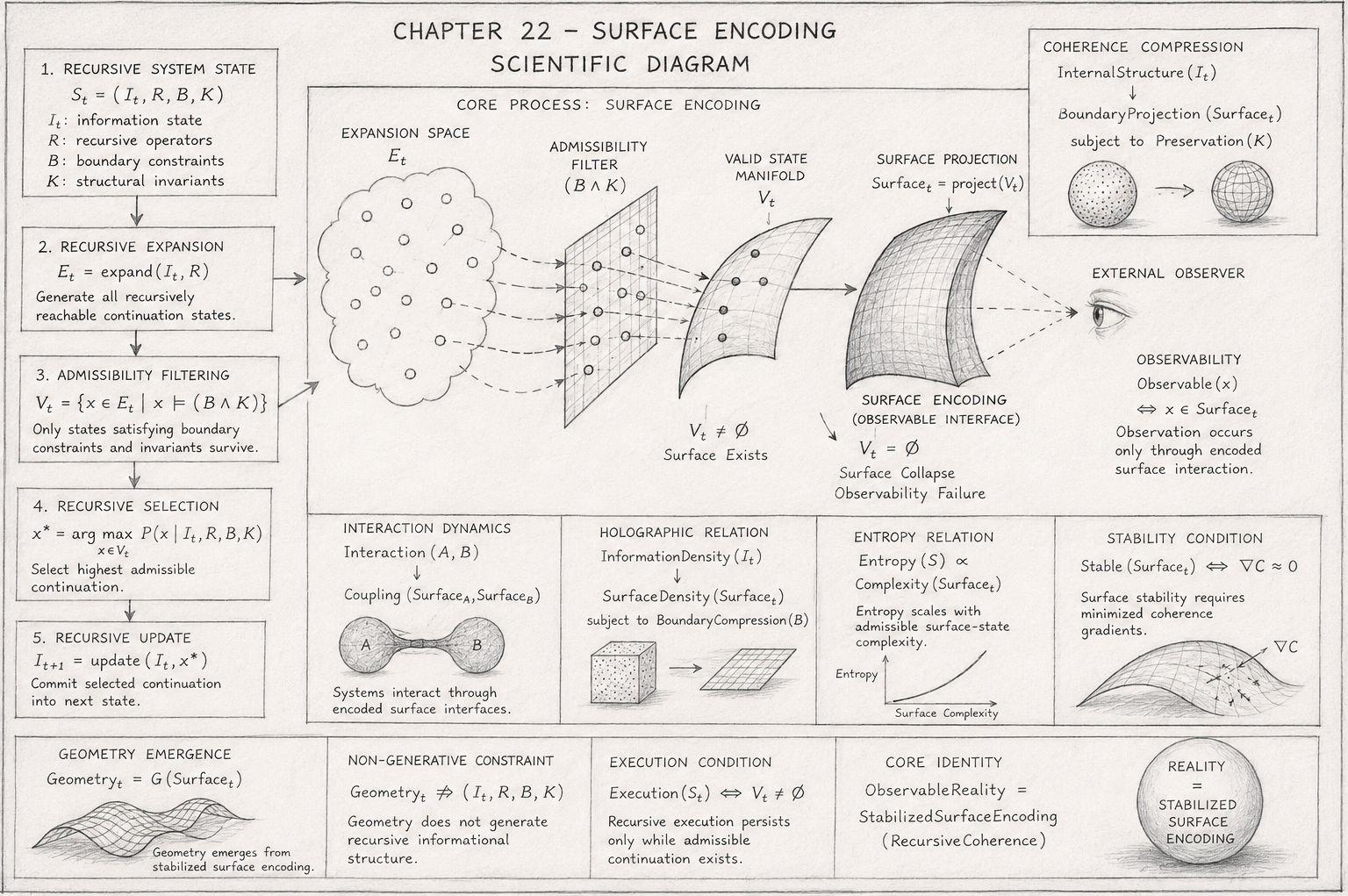
Chapter 22
Surface Encoding

Space as Boundary Projection
Author: Mark Higgins
© Mark Anthony Higgins 11 October 2025
Revised Date: 19 May 2026
Audio Overview

22.1 Introduction

Surface encoding is the process by which recursive systems preserve, stabilize, and communicate structural information through their boundaries rather than through inaccessible internal volume alone. Within the Holographic Space-Time (HST) framework, surfaces are not passive geometric limits; they are active coherence interfaces where admissibility, interaction, and observable structure become physically encoded.

In conventional physics, surfaces are usually treated as secondary consequences of bulk matter configurations. HST reverses this assumption. A surface is instead understood as the dynamically stabilized projection of recursive informational coherence.

What appears as geometry, material interface, field boundary, or event horizon emerges from recursive encoding constraints operating at admissible structural limits.

Telephone:
01377 236594

22.2 Surfaces as Coherence Interfaces

A recursive system does not expose its full internal informational state directly. Instead, survivable information becomes compressed, projected, and stabilized across boundary conditions that preserve coherence under transformation.

Surface encoding therefore acts as the operational bridge between hidden recursive dynamics and measurable physical reality.

At every scale of physics, observable structure depends upon this principle:

  • Atomic orbitals encode interaction probabilities through surface-distributed field geometries.
  • Biological membranes encode regulatory coherence through selective boundary exchange.
  • Electromagnetic propagation encodes information across field discontinuities.
  • Black hole horizons encode thermodynamic entropy through boundary area relationships.
  • Material interfaces encode stress, charge distribution, and phase continuity.
  • Cognitive systems encode symbolic meaning across perceptual and linguistic boundaries.

The recurring structural pattern is universal:

Stable systems externalize coherence through surfaces.

22.3 Recursive Admissibility and Surface Formation

Within Flow Algebra, surface encoding emerges naturally from admissibility filtering.

Recursive systems first generate candidate continuations:

\[ E_t = \operatorname{expand}(I_t, R) \]

These candidates are then filtered through boundary and invariant preservation:

\[ V_t = \left\{ x \in E_t \mid x \models (B \land K) \right\} \]

The surviving admissible states define the externally stable boundary geometry observable by other systems.

Surface structure is therefore not decorative geometry layered on top of physics. It is the visible persistence condition of recursive coherence itself.

Under HST, geometry does not generate coherence.

Instead:

  • Recursive coherence generates admissible structure.
  • Admissible structure stabilizes boundaries.
  • Stable boundaries manifest as observable surfaces.

22.4 Surface Compression and Informational Stability

HST interprets surfaces as coherence compression layers.

A surface minimizes informational instability by restricting admissible interaction modes. This compression process allows recursive systems to remain stable while interacting with external environments.

The surface therefore performs three simultaneous functions:

  • 1. Boundary stabilization
  • 2. Informational projection
  • 3. Constraint preservation

Without surface encoding, recursive coherence could not remain externally observable while preserving internal consistency.

This principle applies across both microscopic and macroscopic systems.

Atoms stabilize electron interaction zones through coherence boundaries. Biological organisms maintain identity through membrane encoding. Gravitational systems preserve causal structure through horizon boundaries.

In all cases, the surface acts as the stabilizing interface between internal recursion and external interaction.

22.5 Surface Encoding and the Holographic Principle

Surface encoding provides a natural structural interpretation of the holographic principle.

In standard theoretical physics, holography proposes that volumetric information may be represented on lower-dimensional boundaries. Within HST, this emerges directly from recursive coherence constraints rather than from purely geometric assumptions.

Entropy-area relationships arise because surface complexity measures the number of admissible coherence configurations capable of remaining externally stable.

The surface therefore becomes the informational compression layer of recursive existence.

This reframes several major physical concepts:

  • Event horizons become coherence saturation boundaries.
  • Entropy becomes admissible surface-state density.
  • Geometry becomes externally stabilized recursive encoding.
  • Observation becomes boundary-mediated interaction.

The holographic principle is therefore not an isolated gravitational anomaly but a universal consequence of recursive surface encoding.

22.6 Observation as Surface Interaction

Surface encoding also explains why observation itself is fundamentally boundary-limited.

No observer accesses a system directly.

Observation occurs only through encoded surface interactions mediated by admissible coherence exchange. What physics traditionally calls “measurement” is therefore the recursive coupling between interacting surface encodings.

An observer never accesses total internal structure.

Instead, the observer interacts with:

  • emitted fields,
  • reflected coherence gradients,
  • encoded boundary states,
  • and admissible interaction surfaces.

Reality therefore becomes structurally relational rather than volumetrically absolute.

The visible universe is not a collection of isolated internal objects but a network of dynamically encoded coherence surfaces interacting across recursive boundaries.

22.7 Structural Consequences for Physics

Surface encoding produces major consequences across multiple branches of physics.

  • Quantum Systems
    Quantum observables emerge through boundary-state interaction rather than isolated point-particle mechanics. Wavefunction visibility becomes surface-distributed coherence probability.
  • Electromagnetism
    Electromagnetic fields propagate through coherence discontinuities between encoded surfaces. Charge distributions stabilize along admissible interaction boundaries.
  • Thermodynamics
    Entropy becomes measurable through boundary complexity and admissible surface-state density.
  • Gravitation
    Gravitational horizons emerge as recursive coherence saturation surfaces where admissible informational continuation becomes constrained.
  • Material Physics
    Material solidity, elasticity, and resistance emerge from stabilized surface coherence interactions between atomic structures.

22.8 Philosophical Implications

Surface encoding fundamentally alters the interpretation of physical reality.

Objects are no longer understood as isolated volumetric entities with passive surfaces. Instead, surfaces become the primary physically accessible manifestation of recursive existence.

This shifts ontology away from substance-centered models toward boundary-centered coherence models.

Under HST:

  • Stability precedes geometry.
  • Coherence precedes observation.
  • Boundaries precede measurable structure.
  • Surfaces encode existence.

Reality becomes a recursively stabilized network of informational boundaries whose observable persistence is mediated through encoded coherence surfaces.

Telephone:
01377 236594

22.9 Conclusion

This chapter establishes surface encoding as a foundational principle of recursive physical structure.

Surfaces are not secondary geometric artifacts. They are the active coherence interfaces through which recursive systems stabilize, preserve, and communicate admissible structure.

Within HST:

  • Recursive coherence generates admissible states.
  • Admissible states stabilize boundaries.
  • Stable boundaries encode observable surfaces.
  • Observable surfaces produce measurable reality.

Surface encoding is therefore not merely a property of matter.  It is the mechanism through which recursive existence becomes observable.

flow "SurfaceEncoding" v1.0

# --------------------------------------------------
# PURPOSE
# --------------------------------------------------

purpose:
  Model how recursive systems externalize and preserve
  admissible informational structure through dynamically
  stabilized boundary surfaces.

  Surface encoding is treated as the observable projection
  of recursive coherence under boundary and invariant
  preservation constraints.

# --------------------------------------------------
# CORE STATE
# --------------------------------------------------

state:
  St = (It, R, B, K)

where:
  It : informational configuration state
  R  : recursive transformation operators
  B  : boundary admissibility constraints
  K  : structural invariants

# --------------------------------------------------
# SURFACE DEFINITIONS
# --------------------------------------------------

definitions:

  Surface(S):
    Observable coherence interface generated from
    admissible recursive stabilization.

  Encoding(S):
    Externalized informational projection preserved
    across admissible boundaries.

  Coherence(C):
    Recursive structural compatibility density.

  Boundary(B):
    Constraint manifold limiting admissible interaction.

# --------------------------------------------------
# RECURSIVE EXECUTION
# --------------------------------------------------

execution:

  Et = expand(It, R)

  Vt = {
    x ∈ Et |
    x ⊨ (B ∧ K)
  }

  x* = argmax(
    P(x | It, R, B, K)
  )

  It+1 = update(It, x*)

# --------------------------------------------------
# SURFACE GENERATION
# --------------------------------------------------

surface_generation:

  Surface_t = project(Vt)

  where:

    project(Vt):
      Maps admissible recursive states into
      externally stable coherence interfaces.

# --------------------------------------------------
# SURFACE ENCODING CONDITION
# --------------------------------------------------

surface_encoding_condition:

  SurfaceExists(Surface_t)
    ⟺
    Vt ≠ ∅

# --------------------------------------------------
# ENCODING PRESERVATION
# --------------------------------------------------

encoding_preservation:

  ∀s ∈ Surface_t :

    s ⊨ (B ∧ K)

  Meaning:

    All observable surface states must preserve
    recursive admissibility and invariant stability.

# --------------------------------------------------
# COHERENCE COMPRESSION
# --------------------------------------------------

coherence_compression:

  InternalStructure(It)
    →
  BoundaryProjection(Surface_t)

  subject_to:

    Preservation(K)

# --------------------------------------------------
# OBSERVABILITY CONDITION
# --------------------------------------------------

observability:

  Observable(x)
    ⟺
    x ∈ Surface_t

  Meaning:

    Recursive internal states become physically
    measurable only through admissible surface encoding.

# --------------------------------------------------
# INTERACTION DYNAMICS
# --------------------------------------------------

interaction:

  Interaction(A,B)
    ⇒
  Coupling(
    Surface_A,
    Surface_B
  )

  Meaning:

    Systems interact through encoded surface
    coherence interfaces rather than direct
    volumetric access.

# --------------------------------------------------
# HOLOGRAPHIC RELATION
# --------------------------------------------------

holographic_relation:

  InformationDensity(It)
    →
  SurfaceDensity(Surface_t)

  subject_to:

    BoundaryCompression(B)

# --------------------------------------------------
# ENTROPY RELATION
# --------------------------------------------------

entropy_relation:

  Entropy(S)
    ∝
  Complexity(Surface_t)

# --------------------------------------------------
# FAILURE CONDITION
# --------------------------------------------------

failure:

  Vt = ∅
    ⇒
  SurfaceCollapse
    ⇒
  ObservabilityFailure
    ⇒
  Execution = FAIL

# --------------------------------------------------
# CONSERVATION CONDITIONS
# --------------------------------------------------

invariants:

  ∀t :

    It ⊨ K

    Surface_t ⊨ K

    Stable(Surface_t)
      ⟺
    ∇C ≈ 0

# --------------------------------------------------
# GEOMETRIC CONSEQUENCE
# --------------------------------------------------

geometry:

  Geometry_t = G(Surface_t)

  but:

    Geometry_t ⇏ Generate(It)

  Meaning:

    Geometry emerges from stabilized
    surface encoding but does not generate
    recursive informational structure itself.

# --------------------------------------------------
# EXECUTION GUARANTEE
# --------------------------------------------------

guarantee:

  Execution(St)
    ⟺
  Vt ≠ ∅

  Surface persistence is guaranteed only while
  admissible recursive coherence remains structurally valid.

# --------------------------------------------------
# FINAL STRUCTURAL IDENTITY
# --------------------------------------------------

identity:

  ObservableReality
    =
  StabilizedSurfaceEncoding(
    RecursiveCoherence
  )

endflow

What This Flow Implements

22.1 Purpose of the Flow

This flow implements a recursive structural model describing how physical systems externalize, preserve, and communicate admissible informational structure through dynamically stabilized boundary surfaces.

Rather than treating surfaces as passive geometric consequences of volumetric matter, the flow formalizes surfaces as active coherence interfaces generated through recursive admissibility filtering.

The flow models how observable physical reality emerges through boundary-mediated encoding rather than unrestricted access to internal system structure.

22.2 Recursive System Foundation

The implementation begins with the recursive system state:

\[ S_t = (I_t, R, B, K) \]

where:

  • ItI_t represents the active informational configuration,
  • RR defines recursive transformation operators,
  • BB specifies admissible boundary constraints,
  • KK defines conserved structural invariants.

This recursive state defines the complete executable structure responsible for generating admissible surface behavior.

22.3 Recursive Candidate Expansion

The flow first performs recursive candidate generation:

\[ E_t = \operatorname{expand}(I_t, R) \]

This stage generates all structurally possible recursive continuations permitted by the system operators.

The expansion phase represents the total recursive possibility space before structural filtering occurs.

Importantly, the flow does not assume that all generated states are physically admissible.

Instead, admissibility must be enforced explicitly through recursive boundary preservation.

22.4 Admissibility Filtering

The generated candidate states are filtered through boundary and invariant preservation:

\[ V_t = \left\{ x \in E_t \mid x \models (B \land K) \right\} \]

This filtering process is the central mechanism responsible for surface formation.

Only recursively admissible states capable of preserving coherence survive into the valid solution manifold

\[ V_t \]

The flow therefore implements the principle that:

  • coherence precedes geometry,
  • admissibility precedes observability,
  • and stability precedes physical structure.

Surface encoding emerges only from recursively survivable states.

22.5 Surface Projection Implementation

The flow formally implements surface generation through recursive projection:

\[ \mathrm{Surface}_t = \operatorname{project}(V_t) \]

This operation maps admissible recursive states into externally stable coherence interfaces.  The resulting surface acts as the observable boundary representation of stabilized recursive structure.

Under this implementation:

  • surfaces are not independent geometric objects,
  • surfaces are coherence projections,
  • and observable structure is generated through recursive stabilization.

22.6 Observability Through Surface Encoding

The flow implements the principle that observability itself is surface-mediated:

\[ \mathrm{Observable}(x) \;\Longleftrightarrow\; x \in \mathrm{Surface}_t \]

This means internal recursive states become physically measurable only when encoded through admissible surface boundaries.  Observation therefore occurs through encoded interaction interfaces rather than direct access to internal informational structure.

The model replaces direct volumetric realism with boundary-mediated relational interaction.

22.7 Coherence Compression Dynamics

The flow additionally implements coherence compression across stabilized boundaries:

\[ \mathrm{InternalStructure}(I_t) \rightarrow \mathrm{BoundaryProjection}(\mathrm{Surface}_t) \]

subject to invariant preservation constraints.  This formalizes how recursive systems stabilize information through compressed surface encoding while maintaining structural continuity.

The flow therefore treats surfaces as informational compression layers that preserve recursive coherence under external interaction.

22.8 Surface-Based Interaction Dynamics

The model implements interaction between systems through boundary coupling rather than unrestricted volumetric access:

\[ \mathrm{Interaction}(A,B) \;\Rightarrow\; \mathrm{Coupling}(\mathrm{Surface}_A,\mathrm{Surface}_B) \]

Under this framework, physical interaction occurs through encoded coherence interfaces between stabilized surfaces.

This implementation applies universally across:

  • electromagnetic interaction,
  • thermodynamic exchange,
  • quantum observation,
  • biological membranes,
  • and cognitive communication systems.

22.9 Holographic and Entropic Relations

The flow also implements the holographic relationship between informational density and surface complexity:

\[ \mathrm{Entropy}(S) \propto \mathrm{Complexity}(\mathrm{Surface}_t) \]

This provides a recursive interpretation of entropy-area relationships as consequences of admissible boundary encoding rather than isolated thermodynamic behavior.

Surface complexity therefore measures stabilized coherence density across recursive boundaries.

22.10 Failure Conditions

The flow explicitly enforces recursive failure conditions.

If no admissible recursive continuation survives filtering:

\[ V_t = \emptyset \]

the system undergoes:

  • surface collapse,
  • observability failure,
  • and recursive execution termination.

This establishes that stable surface existence depends entirely upon preserved recursive admissibility.

Without valid recursive continuation, observable structure cannot persist.

22.11 Geometric Consequences

The flow implements geometry as an emergent consequence of stabilized surface encoding:

\[ \mathrm{Geometry}_t = G(\mathrm{Surface}_t) \]

while explicitly preserving the condition:

\[ \mathrm{Geometry}_t \nRightarrow (I_t, R, B, K) \]

This means geometry emerges from recursive coherence stabilization but does not generate the recursive informational substrate itself.

Geometry is therefore treated as a consequence of recursive surface encoding rather than the foundational origin of physical existence.

22.12 Final Structural Identity

The flow concludes with the core HST structural identity:

\[ \mathrm{ObservableReality} = \mathrm{StabilizedSurfaceEncoding} (\mathrm{RecursiveCoherence}) \]

This means observable physical reality emerges not from isolated volumetric objects, but from recursively stabilized coherence surfaces generated through admissible boundary preservation.

The flow therefore implements a fully boundary-mediated model of physical observability, coherence stabilization, and recursive existence.

How to Read This Flow

22.1 Purpose of the Flow

This flow should be read as a recursive execution model describing how observable physical surfaces emerge from admissible coherence preservation rather than from independent geometric construction.

The flow does not describe surfaces as passive outer layers of matter.

Instead, it models surfaces as dynamically stabilized coherence interfaces generated through recursive admissibility filtering.

Every section of the flow contributes to the formation, preservation, projection, and interaction of observable boundary structure.

The flow therefore describes:

  • how recursive systems generate possible states,
  • how valid states survive structural filtering,
  • how surfaces emerge from admissible states,
  • and how observable reality becomes encoded through stabilized coherence boundaries.

22.2 Reading the Recursive State

The flow begins with the recursive system definition:

\[ S_t = (I_t, R, B, K) \]

This state should be interpreted as the complete recursive configuration of the system at time tt.

Each component performs a distinct structural role:

Component Meaning Structural Function
\( I_t \) Information State Active recursive informational structure
\( R \) Recursive Operators Transformation and continuation rules
\( B \) Boundary Constraints Admissibility limits
\( K \) Invariants Conserved structural conditions

The flow assumes that all observable physical behavior emerges from interactions between these four components.

Nothing in the system exists independently of recursive admissibility.

22.3 Reading Recursive Expansion

The next section defines recursive candidate generation:

\[ E_t = \operatorname{expand}(I_t, R) \]

This should be read as:

“Generate all recursively reachable continuation states from the current informational configuration.”

The expansion phase represents total recursive possibility before filtering occurs.

Importantly:

  • EtE_t contains both stable and unstable continuations.
  • Expansion alone does not guarantee physical existence.
  • Recursive generation precedes structural validation.

This distinction is critical.  The flow does not allow unrestricted existence merely because a state can be generated.

Existence requires admissibility.

22.4 Reading Admissibility Filtering

The admissibility filter is the core structural mechanism of the flow:

\[ V_t = \left\{ x \in E_t \mid x \models (B \land K) \right\} \]

This should be interpreted as:

“Only states satisfying both boundary constraints and invariant preservation survive.”

This filtering process removes recursively unstable or contradictory states. The resulting valid state manifold VtV_t contains only structurally survivable continuations.

Within the context of surface encoding:

  • admissible states generate stable surfaces,
  • invalid states cannot stabilize observable structure,
  • and coherence preservation determines physical persistence.

This is the primary mechanism through which surface reality emerges.

22.5 Reading Surface Projection

The flow next defines surface generation:

\[ \mathrm{Surface}_t = \operatorname{project}(V_t) \]

This should be read as:

“Observable surfaces are projections of admissible recursive states.”

The surface is therefore not an independent geometric object. Instead, it is the externally stabilized representation of recursive coherence.

When reading this section, interpret the surface as:

  • a coherence interface,
  • an informational compression layer,
  • and a physically observable boundary state.

Under HST, observable geometry is generated from stabilized surface encoding.

22.6 Reading Observability

The observability condition states:

\[ \mathrm{Observable}(x) \;\Longleftrightarrow\; x \in \mathrm{Surface}_t \]

This means:

“A state becomes physically measurable only if it exists within the admissible surface encoding.”

Observation therefore occurs through boundary interaction rather than direct access to internal structure.  This section should be read carefully because it changes the interpretation of measurement itself.

The flow asserts:

  • observers never access total internal structure,
  • observation occurs through encoded surface interaction,
  • and measurable reality is boundary-mediated.

This replaces volumetric realism with relational coherence visibility.

22.7 Reading Coherence Compression

The coherence compression section states:

\[ \mathrm{InternalStructure}(I_t) \rightarrow \mathrm{BoundaryProjection}(\mathrm{Surface}_t) \]

This should be interpreted as:

“Internal recursive structure becomes externally compressed into stable surface encoding.”

The flow models surfaces as informational compression layers that preserve recursive continuity while minimizing instability.

When reading this section:

  • internal structure remains recursively active,
  • but only stabilized projections become externally visible,
  • and surface encoding preserves coherence during interaction.

This principle connects directly to holographic behavior and entropy-area relations.

22.8 Reading Interaction Dynamics

The interaction rule states:

\[ \mathrm{Interaction}(A,B) \;\Rightarrow\; \mathrm{Coupling}(\mathrm{Surface}_A,\mathrm{Surface}_B) \]

This should be read as:

“Systems interact through encoded surface interfaces rather than unrestricted internal access.”

The flow therefore models all physical interaction as boundary coupling.

This applies to:

  • electromagnetic exchange,
  • thermodynamic transfer,
  • quantum measurement,
  • biological membrane behavior,
  • and cognitive communication systems.

The surface acts as the operational interaction layer between recursive systems.

22.9 Reading Entropy and Surface Complexity

The entropy relation states:

\[ \mathrm{Entropy}(S) \propto \mathrm{Complexity}(\mathrm{Surface}_t) \]

This means:

“Entropy measures stabilized surface-state complexity.”

The flow interprets entropy not as disorder alone, but as the density of admissible coherence configurations preserved across recursive boundaries.

Surface complexity therefore becomes a measurable indicator of recursive informational stabilization.

22.10 Reading Failure Conditions

The failure condition is structurally critical:

\[ V_t = \emptyset \]

This should be interpreted as:

“No admissible recursive continuation exists.”

When this occurs:

  • surface encoding collapses,
  • observability fails,
  • recursive execution terminates,
  • and stable physical structure can no longer persist.

This condition defines the absolute structural limit of survivable coherence.

22.11 Reading the Geometric Consequence

The flow defines geometry as emergent from stabilized surfaces:

\[ \mathrm{Geometry}_t = G(\mathrm{Surface}_t) \]

while explicitly preserving:

\[ \mathrm{Geometry}_t \nRightarrow (I_t, R, B, K) \]

This means:

“Geometry emerges from recursive surface stabilization but does not generate recursive structure itself.”

When reading the flow, geometry should therefore be treated as:

  • an emergent coherence consequence,
  • not the foundational origin of physical existence.

This distinction separates HST from geometry-first physical models.

22.12 Final Reading Principle

The final identity states:

\[ \mathrm{ObservableReality} = \mathrm{StabilizedSurfaceEncoding} (\mathrm{RecursiveCoherence}) \]

This is the central reading key for the entire flow.

The chapter should therefore be understood as a complete recursive model in which:

  • recursive coherence generates admissible states,
  • admissible states stabilize boundaries,
  • stabilized boundaries generate observable surfaces,
  • and observable surfaces produce measurable reality.

Surface encoding is therefore the mechanism through which recursive existence becomes physically visible.

Flow → Equation Tri-Mapping

Flow Algebra Component Mathematical Expression Structural Interpretation
Recursive System State \( S_t = (I_t, R, B, K) \) Complete recursively executable system configuration
Informational Configuration \( I_t \) Active recursive informational structure
Recursive Operators \( R \) State transformation and continuation rules
Boundary Constraints \( B \) Admissibility limits governing survivable states
Structural Invariants \( K \) Conserved recursive stability conditions
Candidate Expansion \( E_t = \operatorname{expand}(I_t, R) \) Generation of all recursively reachable continuation states
Admissibility Filtering \( V_t = \{ x \in E_t \mid x \models (B \land K) \} \) Selection of structurally valid recursive continuations
Valid State Existence \( V_t \neq \varnothing \) At least one admissible recursive continuation survives
Recursive Failure \( V_t = \varnothing \) No admissible continuation exists
Recursive Selection \( x^* \in V_t \) Selected admissible continuation state
Probabilistic Selection \( x^* = \arg\max_{x \in V_t} P(x \mid I_t, R, B, K) \) Highest admissible continuation under recursive constraints
Recursive Update \( I_{t+1} = \operatorname{update}(I_t, x^*) \) Commit selected continuation into next recursive state
Surface Projection \( \text{Surface}_t = \operatorname{project}(V_t) \) Observable boundary generated from admissible states
Surface Existence Condition \( \text{SurfaceExists}(\text{Surface}_t) \iff V_t \neq \varnothing \) Stable surface persistence requires admissible recursion
Surface Admissibility \( \forall s \in \text{Surface}_t,\; s \models (B \land K) \) All observable surface states preserve structural coherence
Coherence Compression \( \operatorname{InternalStructure}(I_t) \rightarrow \operatorname{BoundaryProjection}(\text{Surface}_t) \) Internal recursive structure compressed into surface encoding
Observability Condition \( \operatorname{Observable}(x) \iff x \in \text{Surface}_t \) Physical measurability occurs through encoded surfaces
Surface Interaction \( \operatorname{Interaction}(A,B) \Rightarrow \operatorname{Coupling}(\text{Surface}_A,\text{Surface}_B) \) Systems interact through boundary coherence interfaces
Holographic Relation \( \operatorname{InformationDensity}(I_t) \rightarrow \operatorname{SurfaceDensity}(\text{Surface}_t) \) Informational complexity projects onto surfaces
Entropy Relation \( \operatorname{Entropy}(S) \propto \operatorname{Complexity}(\text{Surface}_t) \) Entropy scales with admissible surface-state complexity
Surface Stability Condition \( \operatorname{Stable}(\text{Surface}_t) \iff \nabla C \approx 0 \) Surface stability requires minimized coherence gradients
Geometry Emergence \( \operatorname{Geometry}_t = G(\text{Surface}_t) \) Geometry emerges from stabilized surface encoding
Geometry Non-Generative Constraint \( \operatorname{Geometry}_t \nRightarrow (I_t, R, B, K) \) Geometry does not generate recursive informational structure
Execution Condition \( \operatorname{Execution}(S_t) \iff V_t \neq \varnothing \) Recursive execution persists only under admissible continuation
Observable Reality Identity \( \operatorname{ObservableReality} = \operatorname{StabilizedSurfaceEncoding}(\operatorname{RecursiveCoherence}) \) Physical reality emerges through stabilized boundary coherence encoding

Surface Encoding

22.1 Purpose of the Diagram

This diagram illustrates how observable physical surfaces emerge from recursive admissibility filtering within the Holographic Space-Time (HST) framework.

The figure presents surface encoding not as passive geometric appearance, but as the stabilized external projection of recursive coherence under boundary and invariant preservation.

The diagram traces the full structural pathway from recursive informational generation to observable physical reality.

Its central purpose is to demonstrate that:

  • recursive coherence generates possible states,
  • admissibility filtering stabilizes survivable structure,
  • stabilized structure projects into observable surfaces,
  • and measurable reality emerges through encoded boundary interaction.

The diagram therefore visualizes the transition from hidden recursive informational structure into externally visible physical geometry.

22.2 Recursive System State

The upper-left section defines the recursive system state:

\[ S_t = (I_t, R, B, K) \]

This region represents the foundational informational substrate of the recursive system.

The components shown inside the state definition correspond to:

  • ItI_t: active informational structure,
  • RR: recursive transformation operators,
  • BB: admissibility boundaries,
  • KK: conserved structural invariants.

This section establishes that all observable surface structure originates from recursive informational organization rather than independent geometry.

The system state acts as the source from which recursive continuation and surface stabilization emerge.

22.3 Recursive Expansion Region

The left-central expansion cloud represents recursive candidate generation:

\[ E_t = \operatorname{expand}(I_t, R) \]

The cloud contains multiple potential continuation states, symbolizing the total recursive possibility space generated by the informational substrate.

This region visually communicates that recursive expansion alone does not determine physical existence.

Instead:

  • the system initially generates many structurally possible continuations,
  • including unstable or contradictory states,
  • before admissibility filtering occurs.

The diffuse structure of the expansion cloud intentionally reflects unconstrained recursive possibility prior to stabilization.

22.4 Admissibility Filtering Layer

The central filtering membrane represents recursive admissibility enforcement:

\[ V_t = \left\{ x \in E_t \mid x \models (B \land K) \right\} \]

The filtering grid visually separates valid from invalid recursive continuations.

Only states satisfying both:

  • boundary preservation,
  • and invariant consistency

are permitted to pass through into the valid state manifold.  The diagram intentionally depicts many candidate states being removed during this process.

This emphasizes the core HST principle that:

existence depends upon recursive admissibility rather than generation alone.

The filtering layer therefore acts as the structural origin of stable surface formation.

22.5 Valid State Manifold

The curved manifold beyond the filter represents the admissible recursive solution space:

\[ V_t \neq \emptyset \]

Only structurally survivable states remain within this manifold.  The curvature of the manifold symbolizes stabilized coherence geometry emerging from recursive filtering.

This region visually communicates that:

  • stability is a consequence of admissibility,
  • coherence generates persistent structure,
  • and recursive survival produces physically stable states.

The manifold acts as the precursor to observable surface projection.

22.6 Surface Projection Region>

The large curved grid surface represents stabilized surface encoding:

\[ \mathrm{Surface}_t = \operatorname{project}(V_t) \]

This is the primary geometric structure of the diagram.

The surface is illustrated as:

  • smooth,
  • continuous,
  • and geometrically stabilized.

This reflects the idea that observable physical geometry emerges only after recursive admissibility has stabilized coherence.  The surface is intentionally drawn as a boundary-like interface rather than a volumetric object.

This visually reinforces the HST interpretation that physical observability is fundamentally surface-mediated.

22.7 Observability and External Interaction

The observer eye on the right side of the diagram represents boundary-mediated observation.

The associated condition states:

\[ \mathrm{Observable}(x) \;\Longleftrightarrow\; x \in \mathrm{Surface}_t \]

The observer does not access internal recursive structure directly.  Instead, observation occurs through encoded interaction with stabilized surfaces.

The dashed projection lines indicate that measurable reality emerges only through admissible surface coupling.

This section visually communicates the principle that:

  • measurement is boundary interaction,
  • observability is surface-dependent,
  • and physical access is structurally limited.

22.8 Coherence Compression Section

The upper-right inset illustrates coherence compression dynamics:

\[ \mathrm{InternalStructure}(I_t) \rightarrow \mathrm{BoundaryProjection}(\mathrm{Surface}_t) \]

The dense sphere transitioning into a structured boundary grid symbolizes recursive informational compression into observable surface encoding.

This region demonstrates that:

  • internal recursive complexity remains hidden,
  • while externally visible structure becomes stabilized through surface projection.

The compression process is shown as preserving invariant continuity during projection.

22.9 Interaction Dynamics Section

The lower-left interaction inset illustrates surface coupling between systems:

\[ \mathrm{Interaction}(A,B) \;\Rightarrow\; \mathrm{Coupling}(\mathrm{Surface}_A,\mathrm{Surface}_B) \]

The two interacting boundary structures represent recursive systems exchanging coherence through encoded interfaces.

The diagram intentionally avoids direct volumetric overlap.  Instead, interaction occurs through boundary-mediated coupling.

This visually reinforces the HST interpretation that physical interaction is fundamentally surface relational.

22.10 Entropy and Holographic Sections

The lower central panels illustrate two linked principles:

Holographic Relation

\[ \mathrm{InformationDensity}(I_t) \rightarrow \mathrm{SurfaceDensity}(\mathrm{Surface}_t) \]

This panel visualizes how recursive informational complexity becomes projected onto boundary surfaces.

Entropy Relation

\[ \mathrm{Entropy}(S) \propto \mathrm{Complexity}(\mathrm{Surface}_t) \]

The entropy curve demonstrates that surface complexity scales with admissible informational stabilization.

Together, these sections visually connect recursive surface encoding with entropy-area behavior and holographic structure.

22.11 Stability Condition

The lower-right stability surface illustrates coherence stabilization:

\[ \mathrm{Stable}(\mathrm{Surface}_t) \;\Longleftrightarrow\; \nabla C \approx 0 \]

The shallow coherence gradient drawn across the surface represents minimized recursive instability. This section communicates that stable observable geometry requires coherence equilibrium across encoded boundaries.

Surface persistence therefore depends upon recursive stability maintenance.

22.12 Geometry Emergence

The geometry emergence section states:

\[ \mathrm{Geometry}_t = G(\mathrm{Surface}_t) \]

This visually reinforces the HST position that geometry emerges from stabilized surface encoding.

The adjacent non-generative constraint:

\[ \mathrm{Geometry}_t \nRightarrow (I_t, R, B, K) \]

clarifies that geometry itself does not generate the recursive informational substrate.

Geometry is shown as a consequence of recursive coherence stabilization rather than the origin of physical structure.

22.13 Final Structural Identity

The final circular identity symbol concludes the diagram with the core HST statement:

\[ \mathrm{ObservableReality} = \mathrm{StabilizedSurfaceEncoding} (\mathrm{RecursiveCoherence}) \]

This represents the complete conceptual synthesis of the chapter.

The diagram therefore communicates that:

  • recursive coherence generates admissible structure,
  • admissible structure stabilizes surfaces,
  • surfaces encode observability,
  • and observable reality emerges through recursive boundary preservation.

The entire figure should therefore be interpreted as a structural map of how recursive existence becomes physically visible through surface encoding.

Diagram → Flow Mapping Table

Diagram Region Flow Algebra Component Mathematical Expression Structural Interpretation
Recursive System State Box Recursive State Definition \( S_t = (I_t, R, B, K) \) Complete recursively executable informational configuration prior to surface emergence
Information State Informational Structure \( I_t \) Active recursive informational substrate generating coherence organization
Recursive Operators Transformation Rules \( R \) Recursive continuation and structural evolution operators
Boundary Constraints Admissibility Limits \( B \) Structural constraints governing survivable recursive states
Structural Invariants Conservation Conditions \( K \) Preserved recursive stability relations during execution
Expansion Cloud Recursive Expansion Space \( E_t = \operatorname{expand}(I_t, R) \) Generation of all recursively reachable continuation states
Candidate State Nodes Recursive Possibilities \( x \in E_t \) Potential continuation states before admissibility filtering
Admissibility Filter Grid Structural Filtering Layer \( V_t = \{ x \in E_t \mid x \models (B \land K) \} \) Removal of structurally invalid recursive continuations
Filtered State Paths Constraint Preservation \( \forall x \in V_t,\; x \models (B \land K) \) Only admissible states survive recursive continuation
Valid State Manifold Admissible Solution Space \( V_t \neq \varnothing \) Existence of stable recursive continuation states
Surface Projection Grid Surface Encoding Layer \( \text{Surface}_t = \operatorname{project}(V_t) \) Observable surface generated from admissible recursive states
Surface Curvature Geometry Stabilized Coherence Geometry \( \operatorname{Geometry}_t = G(\text{Surface}_t) \) Geometry emerges from stabilized surface encoding
Surface Stability Surface Coherence Equilibrium \( \operatorname{Stable}(\text{Surface}_t) \iff \nabla C \approx 0 \) Stable surfaces require minimized coherence gradients
Observer Eye Observability Condition \( \operatorname{Observable}(x) \iff x \in \text{Surface}_t \) Physical observability occurs through encoded surface interaction
Dashed Projection Paths Boundary-Mediated Observation \( \text{Observation} \Rightarrow \text{Surface Coupling} \) Observers interact only through encoded boundary states
Coherence Compression Sphere Internal Recursive Structure \( \operatorname{InternalStructure}(I_t) \) Hidden recursive informational complexity
Compression Projection Arrow Boundary Projection \( \operatorname{InternalStructure}(I_t) \rightarrow \operatorname{BoundaryProjection}(\text{Surface}_t) \) Recursive information compressed into observable surface encoding
Interaction Coupling Diagram Surface Interaction Dynamics \( \operatorname{Interaction}(A,B) \Rightarrow \operatorname{Coupling}(\text{Surface}_A,\text{Surface}_B) \) Systems interact through encoded surface interfaces
Holographic Density Panel Surface Information Mapping \( \operatorname{InformationDensity}(I_t) \rightarrow \operatorname{SurfaceDensity}(\text{Surface}_t) \) Informational complexity projects onto boundary surfaces
Entropy Curve Entropic Surface Relation \( \operatorname{Entropy}(S) \propto \operatorname{Complexity}(\text{Surface}_t) \) Entropy scales with admissible surface-state complexity
Surface Collapse Statement Recursive Failure Condition \( V_t = \varnothing \) No admissible continuation results in surface collapse
Observability Failure Note Execution Termination \( V_t = \varnothing \Rightarrow \mathrm{Execution} = \mathrm{FAIL} \) Observable structure cannot persist without admissible recursion
Geometry Emergence Panel Emergent Geometry Principle \( \operatorname{Geometry}_t = G(\text{Surface}_t) \) Geometry is generated from stabilized surfaces
Non-Generative Constraint Panel Geometry Limitation \( \operatorname{Geometry}_t \nRightarrow (I_t, R, B, K) \) Geometry does not generate recursive informational structure
Execution Condition Panel Recursive Persistence Condition \( \operatorname{Execution}(S_t) \iff V_t \neq \varnothing \) Recursive execution persists only while admissible continuation exists
Final Identity Sphere Observable Reality Identity \( \operatorname{ObservableReality} = \operatorname{StabilizedSurfaceEncoding}(\operatorname{RecursiveCoherence}) \) Physical reality emerges through stabilized recursive surface encoding

Execution Guarantee Statement

Chapter 22 — Surface Encoding

The Surface Encoding flow executes deterministically under recursive admissibility preservation.

Execution is guaranteed only when at least one recursively admissible continuation survives boundary and invariant filtering:

\[ \mathrm{Execution}(S_t) \;\Longleftrightarrow\; V_t \neq \emptyset \]

where:

\[ V_t = \left\{ x \in E_t \mid x \models (B \land K) \right\} \]

This guarantees that all surviving recursive states satisfy:

  • boundary admissibility,
  • invariant preservation,
  • coherence stability,
  • and structural continuity.

The flow therefore prevents unstable or contradictory surface structures from becoming physically observable.

Observable surfaces emerge only through admissible recursive stabilization:

\[ \mathrm{Surface}_t = \operatorname{project}(V_t) \]

Thus, physical observability is guaranteed only for recursively survivable surface states.

The execution model further guarantees:

Guaranteed Property Structural Meaning
Boundary Preservation All observable surfaces satisfy admissibility constraints (\( B \))
Invariant Stability Recursive execution preserves structural invariants (\( K \))
Surface Coherence Observable boundaries remain recursively stable under admissible continuation
Observability Consistency Measurable states exist only through encoded surface interfaces
Geometric Stability Geometry emerges only from stabilized coherence surfaces
Interaction Integrity Systems interact only through admissible surface coupling
Entropic Consistency Surface complexity scales with admissible informational density
Recursive Continuity Valid continuation states preserve recursive execution flow

The flow explicitly forbids execution under contradiction collapse conditions.

If no admissible continuation survives filtering:

\[ V_t = \emptyset \]

then:

SurfaceCollapse⇒ObservabilityFailure⇒Execution=FAIL

Under this condition:

  • no stable surface can form,
  • no observable geometry can persist,
  • and recursive execution terminates structurally.

The flow therefore guarantees that observable physical structure cannot emerge from recursively invalid states.

Geometry itself is additionally constrained by the non-generative condition:

\[ \mathrm{Geometry}_t \nRightarrow (I_t, R, B, K) \]

This guarantees that geometry remains an emergent consequence of recursive surface stabilization rather than an independent generator of informational structure.

The final execution identity of the flow is therefore:

\[ \mathrm{ObservableReality} = \mathrm{StabilizedSurfaceEncoding} (\mathrm{RecursiveCoherence}) \]

Accordingly, the Surface Encoding flow guarantees that all physically observable structure emerges exclusively through recursively admissible, invariant-preserving, coherence-stabilized surface encoding.

Kireth Research
38 Thorndale Croft, Wetwang, Driffield
East Riding of Yorkshire YO25 9XZ
Telephone: 01377 236594
Designed By