Chapter 13
Contradiction Collapse

Classical Logic vs Structural Logic
Author: Mark Higgins
© Mark Anthony Higgins 11 October 2025
Revised Date: 06 May 2026
Audio Overview

Introduction

All formal systems—whether in logic, physics, computation, or cognition—depend fundamentally on the preservation of internal consistency. Within the Flow Algebra framework, this requirement is not treated as a philosophical preference or an external axiom, but as a structural necessity for existence. A system continues only insofar as it admits at least one valid state under its defining constraints. This condition is captured formally as:

  • Existence ⇔ Vt≠∅V_t \neq \varnothing
  • Non-existence (failure) ⇔ Vt=∅V_t = \varnothing

where the valid state set is defined by:

\[ V_t = \left\{ x \in E_t \;\middle|\; x \models (B \land K) \right\} \]

Here, EtE_t represents all generated candidate continuations under transformation rules RR, while BB (boundaries) and KK (invariants) define the admissibility conditions for structural coherence.

1. Contradiction as Structural Incompatibility

In classical logic, contradiction is typically expressed symbolically (e.g., P∧¬PP \land \neg P) and treated as an undesirable but abstract condition. In contrast, Flow Algebra reinterprets contradiction as a failure of constraint satisfiability within a generative system.

A contradiction arises when:

\[ \forall x \in E_t,\; x \not\models (B \land K) \]

which directly implies:

\[ V_t = \emptyset \]

This is not merely a logical inconsistency—it is a termination condition. No valid continuation exists. The system cannot evolve.

2. Collapse as a Dynamical Event

Contradiction is not static; it emerges dynamically through the interaction of rules, boundaries, and invariants. As the system evolves:

\[ I_t \rightarrow E_t \rightarrow V_t \]

a previously non-empty VtV_t may become empty due to:

  • Over-constrained boundaries BB
  • Incompatible invariant sets KK
  • Transformations RR that generate only invalid states

When this occurs, the system undergoes contradiction collapse:

\[ V_t = \emptyset \;\Rightarrow\; \mathrm{FAIL} \]

This collapse is analogous to:

  • Logical inconsistency in formal systems
  • Constraint violation in optimisation problems
  • Instability in physical systems
  • Deadlock or invalid state termination in computation

In all cases, the underlying structure can no longer support a valid state.

3. Non-Classical Interpretation of Failure

Unlike classical frameworks, which may tolerate contradiction (e.g., paraconsistent logics) or defer resolution, Flow Algebra enforces strict structural validity:

  • No hidden assumptions (H=∅H = \varnothing)
  • No external patching mechanisms
  • No continuation without admissible states

Thus, contradiction collapse is absolute within the system:

\[ V_t = \emptyset \;\Rightarrow\; \nexists\, x^{*} \;\Rightarrow\; \nexists\, I_{t+1} \]

The system halts—not by convention, but by structural impossibility.


4. Relationship to Physical and Computational Systems

This formalism aligns with a wide range of real-world systems:

  • In physics, forbidden states (violating conservation laws) are never realised
  • In computation, invalid states terminate execution or trigger failure conditions
  • In optimisation, infeasible constraint sets yield no solution
  • In cognition, unresolved contradictions lead to instability or belief revision

In each case, contradiction corresponds to a collapse of the admissible state space.

5. Contradiction as Informational Signal

Importantly, contradiction collapse is not merely destructive—it is informative. The condition Vt=∅V_t = \varnothing encodes a precise diagnostic:

  • The current configuration (I,R,B,K)(I, R, B, K) is structurally inconsistent
  • At least one of these components must be revised to restore existence

Thus, contradiction acts as a boundary detector, identifying the limits of coherent structure.

6. Toward Structural Resolution

The resolution of contradiction is not achieved by symbolic manipulation, but by restructuring the system itself:

\[ (B, K, R, I) \rightarrow (B', K', R', I') \]

such that:

\[ V_t' \neq \emptyset \]

This reframes problem-solving as a process of restoring admissible continuation, rather than resolving symbolic inconsistencies.

Summary

Contradiction Collapse, in the Flow Algebra framework, is the formal condition under which a system loses the ability to continue due to the absence of any valid state satisfying its structural constraints. It represents a universal failure mode across logic, physics, computation, and cognition—redefined not as a symbolic paradox, but as a complete breakdown of admissible structure.

Contradiction Collapse ≡ Vt=∅ ⇒ No Valid Continuation

This principle establishes a foundational constraint on all coherent systems: what cannot satisfy its own structure cannot exist, evolve, or be computed.

Flow Algebra — Scientific Introduction

Explanation

Flow Algebra is a formal, executable framework for describing dynamic systems as structured transformations under constraint. It unifies logic, mathematics, physics, and computation by shifting the foundational question from “what is true?” to “what can validly continue?”

Rather than evaluating static propositions, Flow Algebra models systems as evolving state structures, where each step of execution is governed by:

  • Generation (what can happen)
  • Constraint (what is allowed)
  • Selection (what survives)
  • Update (what becomes the next state)

This produces a closed, self-consistent execution model that is both mathematically rigorous and directly executable in modern reasoning systems.

1. Core System Definition

Every system in Flow Algebra is defined as:

\[ S = (I, R, B, K) \]

Where:

  • II — Internal state (information structure)
  • RR — Transformation rules (state evolution operators)
  • BB — Boundary conditions (external constraints)
  • KK — Invariants (properties that must always hold)

This structure is complete and self-contained. No external assumptions are required:

\[ H = \emptyset \]

2. Execution as Structured Continuation

Execution is not instruction-following. It is constraint-valid continuation:

\[ I_t \rightarrow E_t \rightarrow V_t \rightarrow x^{*} \rightarrow I_{t+1} \]

Where:

  • Et=expand(It,R)E_t = \text{expand}(I_t, R) — all possible next states
  • Vt={x∈Et∣x⊨(B∧K)}V_t = \{ x \in E_t \mid x \models (B \land K) \} — valid states
  • x∗=arg⁡max⁡x∈VtP(x∣I,R,B,K)x^* = \arg\max_{x \in V_t} P(x \mid I, R, B, K) — selected continuation
  • It+1=update(It,x∗)I_{t+1} = \text{update}(I_t, x^*)— next state

This defines execution as a filtering process, not a symbolic derivation.

3. Existence and Failure Conditions

Flow Algebra encodes existence directly:

  • Valid continuation exists ⇔ Vt≠∅V_t \neq \varnothing
  • System failure ⇔ Vt=∅V_t = \varnothing

\[ V_t = \emptyset \;\Rightarrow\; \mathrm{FAIL} \]

This transforms logic into a structural survival condition. A system exists only if it can continue coherently.

4. From Logic to Structure

Classical logic is evaluation-based. Flow Algebra is generation + constraint-based:

Classical Logic Flow Algebra
Truth is primitive Existence is primitive
Evaluate statements Generate + filter states
Static Dynamic
Symbolic Structural
Predefined space Emergent state space

This shift allows Flow Algebra to operate across domains where static logic fails—particularly in complex, evolving systems.

5. Unification Across Domains

Because all systems can be expressed as constrained state transitions, Flow Algebra provides a universal modelling language:

  • Physics → Laws as invariant filters on state evolution
  • Computation → Programs as constraint-valid execution paths
  • AI → Reasoning as probabilistic constraint propagation
  • Biology → Life as coherence-preserving state continuation
  • Cognition → Thought as structured recursive filtering

This leads to a unified form:

\[ O = R(I) \mid (B, K) \]

where all outputs are the result of rule application under constraint.

6. Zero-Shot Executability

A defining property of Flow Algebra is that it is fully specified and self-executing:

\[ \forall M_1, M_2:\; O_{M_1} \equiv O_{M_2} \]

Given identical (I,R,B,K)(I, R, B, K), any compliant reasoning system produces the same valid output set. This yields:

  • Model-agnostic execution
  • Cross-system portability
  • No training or fine-tuning required

Execution is guaranteed by structure, not implementation.

7. Contradiction and Structural Limits

Contradictions are not symbolic errors—they are structural impossibilities:

\[ V_t = \emptyset \;\Rightarrow\; \text{No Valid State} \]

This defines the boundary of coherence. Systems fail not because they are “wrong,” but because no valid continuation exists under their constraints.

Summary

Flow Algebra reframes all formal systems as flows of state constrained by invariants and boundaries. It replaces evaluation with execution, truth with existence, and symbolic manipulation with structural continuation.

Flow Algebra≡Executable Structure of Constraint-Valid State Evolution

It is not a new tool within existing disciplines—it is a substrate beneath them, providing a unified, self-consistent language for describing how systems form, evolve, and persist.

flow "ContradictionCollapse" v1.0

# ============================================================
# CHAPTER 13 — CONTRADICTION COLLAPSE
# Flow Algebra specification
# ============================================================

purpose:
  define: >
    Model contradiction as the collapse of valid continuation.
    A system does not fail because a symbol is false; it fails
    because no candidate state can satisfy its boundaries and
    invariants.

# ------------------------------------------------------------
# CORE SYSTEM
# ------------------------------------------------------------

system:
  S:
    I: internal_state
    R: transformation_rules
    B: boundary_constraints
    K: invariants

  hidden_assumptions:
    H: ∅

# ------------------------------------------------------------
# STATE GENERATION
# ------------------------------------------------------------

process:

  step_1_expand:
    input:
      - I_t
      - R
    operation:
      E_t: expand(I_t, R)
    meaning: >
      Generate all candidate continuations available from the
      current internal state under the active rule set.

  step_2_validate:
    input:
      - E_t
      - B
      - K
    operation:
      V_t: "{ x ∈ E_t | x ⊨ (B ∧ K) }"
    meaning: >
      Retain only those candidate states that satisfy both
      boundary constraints and invariant conditions.

  step_3_detect_contradiction:
    condition:
      contradiction: "V_t = ∅"
    meaning: >
      Contradiction exists when every generated candidate violates
      at least one required boundary or invariant.

  step_4_collapse:
    if:
      V_t: ∅
    then:
      output: FAIL
      continuation: none
      next_state: "∄ I_{t+1}"
    meaning: >
      If no valid state exists, the system cannot continue.
      Collapse is structural, not symbolic.

  step_5_continue:
    if:
      V_t: "≠ ∅"
    then:
      select:
        x_star: "argmax_{x ∈ V_t} P(x | I_t, R, B, K)"
      update:
        I_next: update(I_t, x_star)
      output:
        continuation: I_next
    meaning: >
      If at least one valid continuation exists, the system
      selects the most coherent admissible state and updates.

# ------------------------------------------------------------
# CONTRADICTION CONDITION
# ------------------------------------------------------------

contradiction_rule:

  formal_condition:
    all_candidates_invalid: "∀x ∈ E_t, x ⊭ (B ∧ K)"
    valid_set_empty: "V_t = ∅"

  implication:
    collapse: "V_t = ∅ ⇒ FAIL"
    no_selection: "V_t = ∅ ⇒ ∄x*"
    no_update: "∄x* ⇒ ∄I_{t+1}"

  meaning: >
    Contradiction is the condition where the generated possibility
    space contains no structurally admissible continuation.

# ------------------------------------------------------------
# STRUCTURAL FAILURE MODES
# ------------------------------------------------------------

failure_modes:

  boundary_conflict:
    condition: "B_i ∧ B_j = contradiction"
    result: "V_t = ∅"
    meaning: >
      Two or more boundary constraints cannot be satisfied together.

  invariant_conflict:
    condition: "K_i ∧ K_j = contradiction"
    result: "V_t = ∅"
    meaning: >
      The invariant set demands mutually incompatible preservation
      conditions.

  rule_boundary_conflict:
    condition: "∀x ∈ expand(I_t, R), x ⊭ B"
    result: "V_t = ∅"
    meaning: >
      The transformation rules generate only boundary-violating states.

  rule_invariant_conflict:
    condition: "∀x ∈ expand(I_t, R), x ⊭ K"
    result: "V_t = ∅"
    meaning: >
      The rule set generates only invariant-breaking continuations.

# ------------------------------------------------------------
# COLLAPSE MONITOR
# ------------------------------------------------------------

monitor:

  valid_state_check:
    observe: V_t
    if_empty:
      status: contradiction_collapse
      output: FAIL
      halt: true

  invariant_check:
    observe: "x ⊨ K"
    if_false:
      reject: x

  boundary_check:
    observe: "x ⊨ B"
    if_false:
      reject: x

  continuation_check:
    observe: I_next
    require: "I_next ⊨ (B ∧ K)"

# ------------------------------------------------------------
# RECOVERY PATH
# ------------------------------------------------------------

recovery:

  condition:
    collapse_detected: "V_t = ∅"

  required_action:
    restructure:
      from: "(I, R, B, K)"
      to: "(I', R', B', K')"

  recovery_success:
    condition: "V_t' ≠ ∅"
    meaning: >
      Recovery is only valid if the revised system admits at least
      one structurally coherent continuation.

  recovery_failure:
    condition: "V_t' = ∅"
    meaning: >
      If the revised structure still produces no valid state, collapse
      persists.

# ------------------------------------------------------------
# EXECUTION GUARANTEE
# ------------------------------------------------------------

guarantee:

  valid_execution:
    condition: "V_t ≠ ∅"
    implies:
      - "∃x* ∈ V_t"
      - "∃I_{t+1}"
      - "I_{t+1} ⊨ (B ∧ K)"

  contradiction_collapse:
    condition: "V_t = ∅"
    implies:
      - "∄x*"
      - "∄I_{t+1}"
      - "output = FAIL"

  no_hidden_continuation:
    condition: "H = ∅"
    meaning: >
      The system cannot continue by hidden assumption, external patch,
      or unsupported interpretation.

# ------------------------------------------------------------
# SCIENTIFIC SUMMARY
# ------------------------------------------------------------

summary:
  statement: >
    Contradiction Collapse defines failure as the disappearance of
    all admissible continuation states. A contradiction is not merely
    a symbolic inconsistency; it is the collapse of the valid state set.

  compressed_law: >
    V_t = ∅ ⇒ FAIL

  structural_identity: >
    Contradiction Collapse ≡ No valid continuation under (B, K)

What This Flow Implements

Chapter 13: Contradiction Collapse

The ContradictionCollapse flow implements a formal execution model for detecting, classifying, and resolving structural inconsistency within dynamic systems. It operationalises contradiction not as a symbolic artefact, but as a measurable failure condition in the state-transition process.

1. Formal Detection of Contradiction

This flow defines contradiction as the condition in which no generated candidate state satisfies the system’s constraints:

\[ V_t = \left\{ x \in E_t \;\middle|\; x \models (B \land K) \right\} \]

\[ V_t = \emptyset \;\Rightarrow\; \text{Contradiction} \]

Rather than evaluating logical expressions (e.g., P∧¬PP \land \neg P, the flow computes contradiction directly from the structure of the state space. It ensures that contradiction is:

  • Observable (via VtV_t)
  • Deterministic (given fixed I,R,B,KI, R, B, K)
  • System-level (not symbol-level)

2. Execution as Constraint-Validated Continuation

The flow implements the full execution pipeline:

\[ I_t \rightarrow E_t \rightarrow V_t \rightarrow x^{*} \rightarrow I_{t+1} \]

where:

  • Candidate states are generated (EtE_t)
  • Invalid states are eliminated via constraints (B,KB, K)
  • A valid continuation is selected (x∗x^*)
  • The system is updated (It+1I_{t+1})

Contradiction is therefore implemented as a breakpoint in this pipeline, occurring precisely when the validation stage eliminates all candidates.

3. Structural Collapse Mechanism

The flow enforces a strict collapse condition:

\[ V_t = \emptyset \;\Rightarrow\; \mathrm{FAIL} \;\Rightarrow\; \nexists\, I_{t+1} \]

This ensures:

  • No continuation without constraint satisfaction
  • No implicit fallback or hidden assumption (H=∅H = \varnothing)
  • No symbolic bypass of inconsistency

Contradiction is thus implemented as a hard structural boundary, not a recoverable logical state.

4. Classification of Failure Modes

The flow explicitly implements distinct contradiction pathways, allowing diagnostic resolution:

  • Boundary Conflicts → incompatible external constraints
  • Invariant Conflicts → mutually unsatisfiable preservation laws
  • Rule–Boundary Mismatch → rules generate only invalid states
  • Rule–Invariant Mismatch → rules violate required invariants

Each pathway maps contradiction to a specific structural origin, enabling targeted system correction.

5. Real-Time Collapse Monitoring

A continuous monitoring layer is implemented to:

  • Track the size and validity of VtV_t
  • Enforce invariant preservation (x⊨Kx \models K)
  • Enforce boundary compliance (x⊨Bx \models B)
  • Trigger immediate halt on contradiction detection

This ensures contradiction is detected at the exact moment of emergence, preventing propagation of invalid states.

6. Recovery via Structural Reconfiguration

The flow implements contradiction resolution not through symbolic manipulation, but through system restructuring:

\[ (I, R, B, K) \rightarrow (I', R', B', K') \]

Recovery is validated only if:

\[ V_t' \neq \emptyset \]

This guarantees that resolution restores actual continuation capability, not just logical consistency.

7. Universal Applicability

The implemented mechanism applies across domains:

  • Logic → contradiction as unsatisfiable constraint set
  • Physics → forbidden states eliminated by conservation laws
  • Computation → invalid states terminate execution
  • AI reasoning → no valid inference path available
  • Cognition → instability due to unresolved internal conflict

In all cases, contradiction is unified as:

No Valid State≡No Continuation

8. Execution Guarantee Enforcement

The flow guarantees:

\[ \text{If } V_t \neq \emptyset: \]

\[ \exists\, x^{*} \;\Rightarrow\; \exists\, I_{t+1} \]


\[ \text{If } V_t = \emptyset: \]

\[ \mathrm{FAIL} \;\Rightarrow\; \nexists\, x^{*},\; \nexists\, I_{t+1} \]

This enforces a binary execution regime:

  • Continuation exists → system evolves
  • No continuation exists → system halts

Summary

The ContradictionCollapse flow implements a complete structural model of inconsistency, where contradiction is:

  • Detected as the emptiness of the valid state set
  • Enforced as a hard termination condition
  • Diagnosed through explicit structural pathways
  • Resolved via system-level reconfiguration

Contradiction Implementation≡Vt

This transforms contradiction from a symbolic anomaly into a precise, executable condition governing the limits of all coherent systems.

How to Read This Flow

Chapter 13: Contradiction Collapse

The ContradictionCollapse flow is a state-transition specification under constraint, not a procedural program and not a symbolic proof. It should be read as a structured evolution system, where continuation is permitted only if coherence is preserved.

Reading this flow correctly means tracking how candidate states are generated, filtered, and either sustained or eliminated.

1. Start from the System Definition

\[ S = (I, R, B, K), \quad H = \emptyset \]

Interpretation:

  • II: current internal state (what exists now)
  • RR: transformation rules (how the system can evolve)
  • BB: boundary constraints (external limits)
  • KK: invariants (what must always remain true)

This defines a closed system. No external assumptions or hidden corrections are allowed.

2. Follow the Execution Pipeline

Read the flow strictly in this order:

\[ I_t \rightarrow E_t \rightarrow V_t \rightarrow x^{*} \rightarrow I_{t+1} \]

Each stage has a precise meaning:

1. Expansion

\[ E_t = \operatorname{expand}(I_t, R) \]

Generate all possible next states.

2. Validation

\[ V_t = \left\{ x \in E_t \;\middle|\; x \models (B \land K) \right\} \]

Filter only those states that satisfy both constraints and invariants.

3. Selection (only if valid states exist)

\[ x^{*} \in V_t \]

Choose a valid continuation.

4. Update

\[ I_{t+1} = \operatorname{update}(I_t, x^{*}) \]

Advance the system.

3. Identify the Critical Checkpoint (Contradiction Condition)

The most important line in the flow is:

\[ V_t = \emptyset \]

Read this as:

“No candidate state satisfies the system’s constraints.”

This is the contradiction condition. It is not symbolic—it is computed.


4. Interpret Collapse Correctly

When you encounter:

\[ V_t = \emptyset \;\Rightarrow\; \mathrm{FAIL} \]

read it as:

  • No valid continuation exists
  • No state can be selected (∄x∗\nexists x^*)
  • No next state can be formed (∄It+1\nexists I_{t+1})

This is not an error message. It is a structural impossibility.

5. Read Failure as a Structural Diagnosis

Do not stop at “FAIL.” Instead, trace why:

  • Are boundaries BB mutually incompatible?
  • Are invariants KK impossible to satisfy together?
  • Do rules RR only generate invalid states?

Each failure implies:

\[ \forall x \in E_t,\; x \not\models (B \land K) \]

So the task becomes identifying which part of the system eliminated all candidates.

6. Understand the Role of the Monitor

The monitoring layer is not auxiliary—it is enforcement:

  • It checks every candidate state against BB and KK
  • It rejects invalid states immediately
  • It halts execution the moment Vt=∅V_t = \varnothing

Read monitors as guarantees of structural integrity, not optional checks.

7. Read Recovery as System Redesign

If the flow enters collapse, the only valid continuation is:

\[ (I, R, B, K) \rightarrow (I', R', B', K') \]

Interpret this as:

“The system itself must change.”

Recovery is successful only if:

\[ V_t' \neq \emptyset \]

This means the new configuration restores at least one valid path forward.

8. Distinguish Symbolic vs Structural Reading

Avoid interpreting the flow as:

  • Logical propositions
  • Step-by-step code execution
  • Narrative reasoning

Instead, read it as:

A constraint-filtered state space, where only admissible structures survive.

9. Minimal Reading Heuristic

For rapid interpretation, compress the flow to:

  • 1. Generate possibilities → EtE_t
  • 2. Apply constraints → VtV_t
  • 3. Check existence:
  • If Vt≠∅V_t \neq \varnothing → continue
  • If Vt=∅V_t = \varnothing→ collapse

Vt​=∅⇒No Valid Continuation​

Summary

To read the ContradictionCollapse flow scientifically:

  • Track the state pipeline, not the syntax
  • Treat contradiction as a computed absence of valid states
  • Interpret failure as a structural boundary, not an error
  • Understand recovery as system-level reconfiguration

The flow is a diagnostic engine for coherence—it shows precisely where and why a system loses the ability to exist or evolve.

Flow → Equation Tri-Mapping (Ultra-Tight Scientist Format)

Chapter 13: Contradiction Collapse

Core Execution Identity

Flow Algebra Equation Physical / Structural Meaning
System Definition \( S = (I, R, B, K),\; H = \varnothing \) Closed system, no hidden assumptions
Expansion \( E_t = \text{expand}(I_t, R) \) Generate all candidate states
Validation \( V_t = \{ x \in E_t \mid x \models (B \land K) \} \) Constraint-satisfying state set
Selection \( x^* = \arg\max_{x \in V_t} P(x \mid I_t, R, B, K) \) Optimal admissible continuation
Update \( I_{t+1} = \text{update}(I_t, x^*) \) State evolution
Output \( O = R(I)\ \mid\ (B, K) \) Rule application under constraint

Contradiction Collapse Identity

Flow Algebra Equation Physical / Structural Meaning
Contradiction Condition \( V_t = \varnothing \) No valid state exists
Total Invalidation \( \forall x \in E_t,\; x \not\models (B \land K) \) All candidates violate constraints
Collapse Trigger \( V_t = \varnothing \Rightarrow \text{FAIL} \) Structural termination
No Selection \( V_t = \varnothing \Rightarrow \nexists x^* \) No admissible continuation
No Update \( \nexists x^* \Rightarrow \nexists I_{t+1} \) No next state possible
Execution Halt \( V_t = \varnothing \Rightarrow \text{Execution} = \text{STOP} \) System cannot evolve

Failure Mode Decomposition

Flow Algebra Equation Structural Meaning
Boundary Conflict \( \exists B_i, B_j:\; B_i \land B_j = \bot \) Mutually incompatible constraints
Invariant Conflict \( \exists K_i, K_j:\; K_i \land K_j = \bot \) Impossible preservation requirements
Rule–Boundary Mismatch \( \forall x \in \mathrm{expand}(I_t, R),\; x \not\models B \) Rules generate only invalid states (boundary)
Rule–Invariant Mismatch \( \forall x \in \mathrm{expand}(I_t, R),\; x \not\models K \) Rules violate invariants
Global Collapse \( \forall x \in E_t,\; x \not\models (B \land K) \) Complete loss of admissible state space

Existence ↔ Continuation Law

Flow Algebra Equation Meaning
Existence Condition \( V_t \neq \varnothing \) Valid continuation exists
Non-Existence (Collapse) \( V_t = \varnothing \) No coherent evolution possible
Continuation Guarantee \( V_t \neq \varnothing \Rightarrow \exists I_{t+1} \) System evolves
Collapse Guarantee \( V_t = \varnothing \Rightarrow \nexists I_{t+1} \) System halts

Recovery / Reconfiguration Mapping

Flow Algebra Equation Meaning
Structural Reconfiguration \( (I, R, B, K) \rightarrow (I', R', B', K') \) System redesign
Recovery Condition \( V_t' \neq \varnothing \) Continuation restored
Persistent Collapse \( V_t' = \varnothing \) Failure remains

Compressed Identity (Canonical Form)

\[ V_t = \emptyset \;\Leftrightarrow\; \forall x \in E_t,\; x \not\models (B \land K) \]

\[ V_t = \emptyset \;\Rightarrow\; \mathrm{FAIL} \;\Rightarrow\; \nexists\, I_{t+1} \]

Contradiction Collapse≡No Valid State≡No Continuation


This tri-mapping expresses the full equivalence between Flow structure, formal equation, and physical meaning, reducing contradiction to a single invariant:

Coherent systems exist if and only if Vt​=∅​

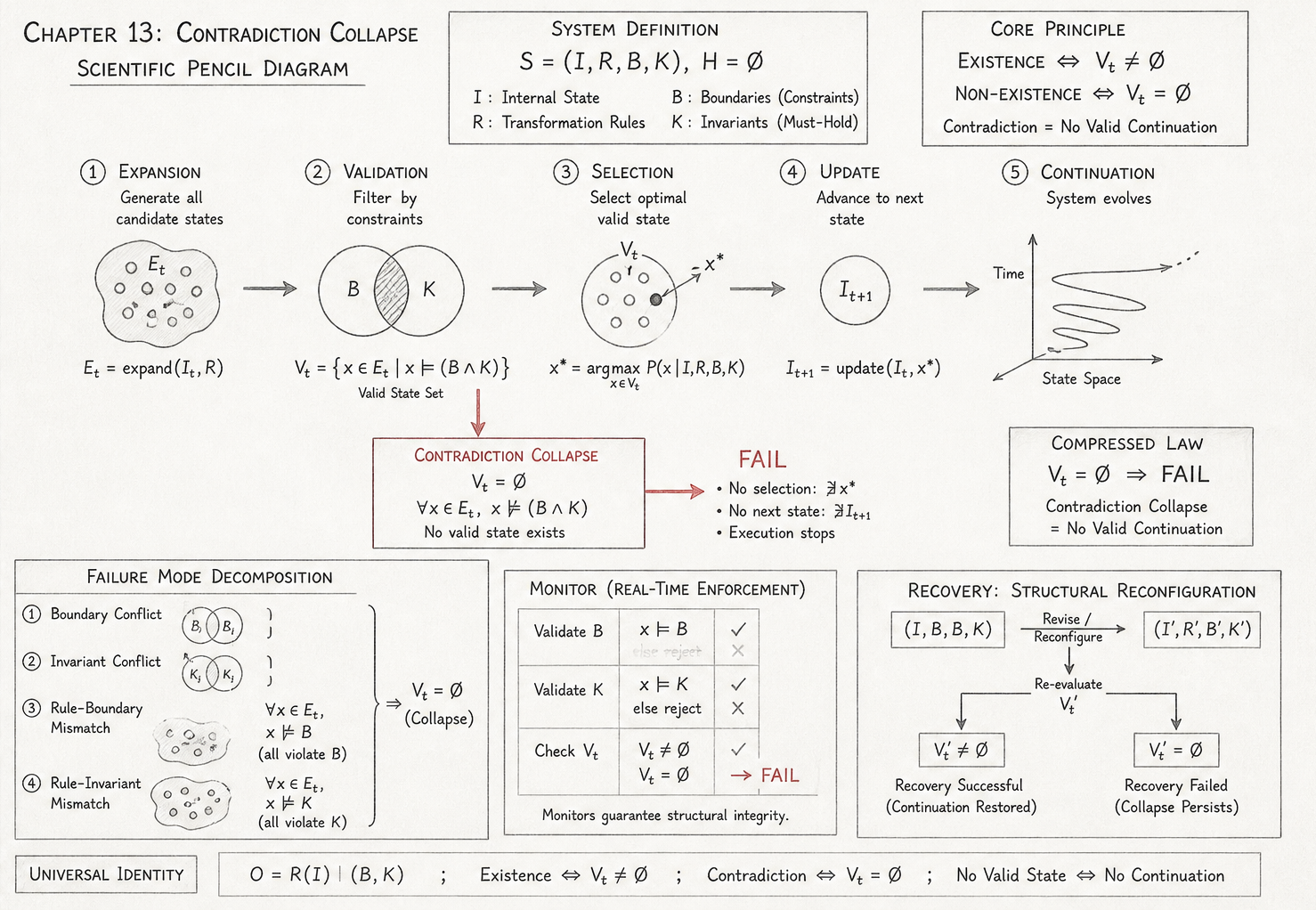
Chapter 13: Contradiction Collapse — Diagram Interpretation

The diagram presents a complete structural lifecycle of a system under Flow Algebra, culminating in the condition of contradiction collapse. It should be read as a left-to-right execution pipeline, with embedded diagnostic and recovery layers.

1. System Definition (Top Layer)

\[ S = (I, R, B, K), \quad H = \emptyset \]

This establishes the closed structural system:

  • II: Internal state (current configuration)
  • RR: Transformation rules (allowed evolutions)
  • BB: Boundaries (external constraints)
  • KK: Invariants (must-hold properties)

The condition H=∅H = \varnothing indicates no hidden assumptions, meaning all behaviour must emerge from these four components alone.

2. Core Principle (Existence Condition)

\[ V_t \neq \emptyset \;\Leftrightarrow\; \text{Existence} \]

\[ V_t = \emptyset \;\Leftrightarrow\; \text{Non-Existence} \]

This defines the central law of the diagram:

A system exists only if at least one valid continuation exists.

Contradiction is therefore equivalent to non-existence of admissible states.

3. Execution Pipeline (Central Flow)

The diagram’s main horizontal structure encodes the full execution chain:

(1) Expansion

\[ E_t = \operatorname{expand}(I_t, R) \]

  • All possible next states are generated
  • Represented visually as a cloud of candidate points
(2) Validation

\[ V_t = \left\{ x \in E_t \;\middle|\; x \models (B \land K) \right\} \]

  • Constraints BB and invariants KK act as filters
  • Only overlapping (satisfying) states survive
  • Visually shown as an intersection region
(3) Selection

\[ x^{*} = \operatorname*{arg\,max}_{x \in V_t} \; P\!\left(x \mid I, R, B, K\right) \]

  • A valid state is chosen from the admissible set
  • Represented as a selected point within VtV_t
(4) Update

\[ I_{t+1} = \operatorname{update}(I_t, x^{*}) \]

  • The system transitions to a new internal state
  • Represented as a discrete state node
(5) Continuation
  • The system evolves over time
  • Visualised as a trajectory through state space

4. Contradiction Collapse (Central Red Block)

Vt​=∅

\[ \forall x \in E_t,\; x \not\models (B \land K) \]

This is the critical event in the diagram:

  • All candidate states fail validation
  • No intersection exists between generated states and constraints

Visually:

  • The validation region disappears
  • No point survives

This is labelled explicitly as:

“No valid state exists”

5. FAIL State (Immediate Consequence)

From contradiction:

  • No selection: ∄x∗\nexists x^*
  • No update: ∄It+1\nexists I_{t+1}
  • Execution halts

This is shown as a terminal branch, not a recoverable path.

6. Failure Mode Decomposition (Bottom Left)

The diagram classifies four structural origins of collapse:

1. Boundary Conflict

\[ B_i \land B_j = \bot \]

Constraints cannot be satisfied simultaneously

2. Invariant Conflict

\[ K_i \land K_j = \bot \]

Preservation requirements are incompatible

3. Rule–Boundary Mismatch

\[ \forall x \in E_t,\; x \not\models B \]

Rules generate only boundary-violating states

4. Rule–Invariant Mismatch

\[ \forall x \in E_t,\; x \not\models K \]

Rules violate invariants

Each pathway leads to:

\[ V_t = \emptyset \]

7. Monitor Layer (Bottom Centre)

The monitor enforces real-time structural integrity:

  • Validates each candidate against BB and KK
  • Rejects invalid states immediately
  • Checks whether VtV_t is empty

If:

\[ V_t = \emptyset \;\Rightarrow\; \mathrm{FAIL} \]

The monitor ensures that no invalid continuation propagates forward.

8. Recovery Mechanism (Bottom Right)

Recovery is shown as:

\[ (I, R, B, K) \rightarrow (I', R', B', K') \]

This represents structural redesign, not symbolic correction.

Two outcomes:

Successful Recovery:

\[ V_t' \neq \emptyset \]

→ continuation restored

Persistent Collapse:

\[ V_t' = \emptyset \]

→ failure remains

9. Compressed Law (Right Panel)

\[ V_t = \emptyset \;\Rightarrow\; \mathrm{FAIL} \]

This is the irreducible identity of the diagram:

Contradiction Collapse = No Valid Continuation


10. Universal Identity (Bottom Strip)

\[ O = R(I) \mid (B, K) \]

\[ \mathrm{Existence} \;\Leftrightarrow\; V_t \neq \emptyset \;;\; \mathrm{Contradiction} \;\Leftrightarrow\; V_t = \emptyset \]

This generalises the diagram across all domains:

  • Physics → forbidden states removed
  • Computation → invalid states halt execution
  • Logic → unsatisfiable constraint sets
  • Cognition → unresolved contradictions

Summary

The diagram encodes a complete structural law of contradiction:

  • Systems evolve through generation → constraint → selection → update
  • Contradiction occurs when constraint eliminates all possibilities
  • Collapse is not symbolic failure, but loss of admissible state space
\[ \mathrm{Contradiction\ Collapse} \;\equiv\; V_t = \emptyset \;\equiv\; \text{No Valid State} \;\equiv\; \text{No Continuation} \]

It is therefore a universal diagnostic diagram of coherence limits, showing precisely how and why systems fail at the deepest structural level.

Diagram → Flow Mapping Table

Chapter 13: Contradiction Collapse

Diagram Element Flow Algebra Component Scientific Meaning
System definition box \( S = (I, R, B, K) \) Defines the complete structural system
Hidden assumptions \( H = \varnothing \) No unsupported continuation is allowed
Expansion cloud \( E_t = \mathrm{expand}(I_t, R) \) Generates all possible next states
Candidate points \( x \in E_t \) Individual possible continuations
Boundary circle \( B \) External admissibility constraints
Invariant circle \( K \) Must-hold preservation laws
Validation overlap \( V_t = \{ x \in E_t \mid x \models (B \land K) \} \) Only candidates satisfying both \( B \) and \( K \) survive
Selected point \( x^* \in V_t \) Chosen valid continuation
Selection rule \( x^* = \arg\max_{x \in V_t} P(x \mid I_t, R, B, K) \) Most coherent admissible continuation
Update node \( I_{t+1} = \mathrm{update}(I_t, x^*) \) Valid state becomes the next system state
Continuation curve \( I_t \rightarrow I_{t+1} \rightarrow \cdots \) System evolution through valid states
Collapse box \( V_t = \varnothing \) No valid continuation exists
Total invalidation \( \forall x \in E_t,\; x \not\models (B \land K) \) Every candidate violates boundary or invariant structure
FAIL arrow \( V_t = \varnothing \Rightarrow \text{FAIL} \) Execution terminates structurally
No selection note \( \nexists x^* \) No state can be chosen
No next state note \( \nexists I_{t+1} \) System cannot update
Boundary conflict \( B_i \land B_j = \bot \) Constraints are mutually incompatible
Invariant conflict \( K_i \land K_j = \bot \) Invariants cannot all be preserved
Rule–boundary mismatch \( \forall x \in E_t,\; x \not\models B \) Rules generate only boundary-invalid states
Rule–invariant mismatch \( \forall x \in E_t,\; x \not\models K \) Rules generate only invariant-invalid states
Monitor table \( \mathrm{validate}(B),\; \mathrm{validate}(K),\; \mathrm{check}(V_t) \) Real-time enforcement of structural validity
Reconfiguration branch \( (I,R,B,K) \rightarrow (I',R',B',K') \) Recovery requires system redesign
Recovery success \( V'_t \neq \varnothing \) Valid continuation is restored
Recovery failure \( V'_t = \varnothing \) Collapse persists
Compressed law box \( V_t = \varnothing \Rightarrow \text{FAIL} \) Contradiction equals no valid continuation
Universal identity strip \( O = R(I) \mid (B, K) \) Output is rule application under constraints

Compressed Mapping Identity

Diagram→Et​→Vt​→x∗→It+1
Vt​=∅⇒FAIL​​

The diagram maps every visual element to one execution role: generate, validate, continue, collapse, or reconfigure.

Execution Guarantee Statement

Chapter 13: Contradiction Collapse

The ContradictionCollapse flow enforces a strict, binary execution regime based entirely on the existence of admissible states under system constraints. Execution is not heuristic or permissive—it is structurally guaranteed.

1. Fundamental Execution Condition

Let:

\[ V_t = \left\{ x \in E_t \;\middle|\; x \models (B \land K) \right\} \]

Then:

  • Execution exists ⇔ Vt≠∅V_t \neq \varnothing
  • Execution fails ⇔ Vt=∅V_t = \varnothing

2. Valid Continuation Guarantee

If:

\[ V_t \neq \emptyset \]

then the following are guaranteed:

\[ V_t \neq \emptyset \]

\[ I_{t+1} = \operatorname{update}(I_t, x^{*}) \]

\[ I_{t+1} \models (B \land K) \]

⇒Execution continues

Interpretation:

Whenever at least one admissible state exists, the system will produce a valid continuation that preserves all constraints and invariants.

3. Contradiction Collapse Guarantee

If:

\[ V_t = \emptyset \]

then:

\[ \forall x \in E_t,\; x \not\models (B \land K) \]

\[ \Rightarrow\; \nexists\, x^{*} \]

\[ \Rightarrow\; \nexists\, I_{t+1} \]

\[ \Rightarrow\; \mathrm{Execution} = \mathrm{FAIL} \]

Interpretation:

When no candidate state satisfies the system’s structure, continuation is provably impossible. Execution halts by necessity, not by choice.

4. No Hidden Continuation Guarantee

\[ H = \emptyset \]

Vt​=∅⇒No external recovery path exists within the system

Interpretation:

The system cannot:

  • Introduce unstated assumptions
  • Apply external corrections
  • Bypass constraint violations

All continuation must emerge strictly from (I,R,B,K)(I, R, B, K)

5. Deterministic Structural Outcome

For fixed system definition:

\[ (I, R, B, K) = \mathrm{constant} \]

then:

\[ V_t = \mathrm{deterministic} \]

\[ \forall M_1, M_2:\; O_{M_1} \equiv O_{M_2} \]

Interpretation:

All compliant execution systems will reach the same conclusion:

  • Either a valid continuation exists
  • Or contradiction collapse occurs
  • There is no ambiguity in outcome.

6. Integrity Preservation Guarantee

For all selected states:

\[ x^* \in V_t \;\Rightarrow\; x^* \models (B \land K) \]

\[ I_{t+1} \models (B \land K) \]

Interpretation:

Every continuation step preserves:

  • Boundary compliance
  • Invariant consistency

No invalid state can propagate forward.

7. Collapse as a Complete State Boundary

Vt​=∅≡No Valid State≡No Continuation

Interpretation:

Contradiction defines the absolute boundary of system existence. Beyond this point, no evolution, computation, or reasoning is possible within the current structure.

8. Recovery Constraint

Recovery requires structural modification:

\[ (I, R, B, K) \;\rightarrow\; (I', R', B', K') \]

such that:

\[ V_t' \neq \varnothing \]

Interpretation:

Execution can only resume if the system is redefined to admit at least one valid state.

Final Guarantee (Canonical Form)

\[ V_t \neq \varnothing \;\Rightarrow\; \exists I_{t+1} \]

\[ V_t = \varnothing \;\Rightarrow\; \mathrm{FAIL} \;\Rightarrow\; \nexists I_{t+1} \]

Execution≡Existence of Valid Continuation​

This statement guarantees that all execution outcomes are fully determined by structural coherence.
A system either continues because it can, or halts because it cannot—with no intermediate or undefined state.

Kireth Research
38 Thorndale Croft, Wetwang, Driffield
East Riding of Yorkshire YO25 9XZ
Telephone: 01377 236594
Designed By