Constraint Preservation

Author: Mark Higgins

© Mark Anthony Higgins 11 October 2025

Revised Date: 6th May 2026

Audio Overview

The Invisible Rules That Hold Systems Together

Every stable system in nature operates within a set of constraints. These constraints define what configurations are possible, which transformations are allowed, and which states cannot occur without causing structural breakdown.

In physics, constraints appear in many familiar forms: conservation laws, boundary conditions, symmetry restrictions, and stability limits. Although they are often expressed mathematically, their deeper role is structural. They determine whether a system can maintain coherence as it evolves.

Constraint preservation therefore forms one of the most fundamental requirements for any persistent structure in the universe.

Without constraints, systems would have no mechanism to maintain internal order across time. Their states would drift into contradiction or instability, preventing long-term survival.

Constraints as Structural Boundaries

A constraint can be understood as a rule that restricts the allowable configurations of a system. It does not dictate a single outcome, but it defines the region of stability within which coherent behaviour can occur.

These boundaries exist at every scale of reality.

Atomic structures maintain constraints on electron states.
Molecules preserve bonding relationships that restrict their geometry.
Planetary systems obey gravitational constraints that stabilise orbital motion.

In each case, the system remains coherent because its internal relationships are preserved within allowable limits.

Constraints therefore function as structural boundaries that protect coherence.

The Role of Constraints in Dynamic Systems

Physical systems are rarely static. They evolve continuously through interaction and transformation. For such systems to remain stable, their constraints must persist even as their internal states change.

This leads to an important principle:

A system survives only if its constraints remain preserved during transformation.

When a system changes state, its allowable configurations shift within the boundaries defined by its constraints. If those boundaries remain intact, the system adapts and continues to exist.

If the constraints are violated, structural coherence collapses.

For example, when a bridge experiences forces beyond its design constraints, its structure fails. Similarly, when atomic nuclei exceed stability limits, they undergo decay or fission.

In both cases, the loss of constraint preservation leads to structural breakdown.

Constraint Propagation Across Systems

Constraints do not operate in isolation. When systems interact, their constraints influence one another.

This interaction produces constraint propagation, where the structural limits of one system impose conditions on neighbouring systems.

In physics, this phenomenon appears in many forms:
  • Boundary conditions shaping wave behaviour
  • Conservation laws governing particle interactions
  • Energy constraints limiting allowable state transitions
  • Geometric constraints defining stable field configurations

Through these mechanisms, local constraints extend their influence across larger systems, creating networks of coherence that span multiple scales.

Constraint Preservation and Physical Law

Many of the laws of physics can be interpreted as expressions of constraint preservation.

Conservation of energy ensures that transformations occur without violating fundamental balance conditions.
Symmetry principles enforce invariance across transformations.
Quantum exclusion rules restrict allowable particle states.

These laws do not merely describe behaviour—they encode the constraints that prevent systems from drifting into incoherence.

Seen in this way, physical law becomes the mathematical expression of constraint preservation.

Constraint Preservation in the HST Framework

Within the Holographic Space-Time framework, constraint preservation plays a central role in the emergence of coherent structure.

Systems must maintain internal consistency across evolving boundaries. The preservation of constraints ensures that interactions do not produce contradictions within the underlying coherence network.

Boundaries therefore act as surfaces where constraints are encoded, enforced, and transmitted across the system.

This perspective explains why stable structures appear throughout the universe: only configurations capable of preserving their constraints across transformation can persist.

The Survival Rule of Coherent Systems

Constraint preservation ultimately reflects a deeper survival principle.

Systems that maintain their structural limits remain coherent.
Systems that violate those limits collapse or reorganise.

Reality therefore selects for structures capable of preserving the constraints that sustain them.

This principle provides a crucial foundation for the emergence of geometry, fields, and physical law within the Holographic Space-Time framework.

Before space and time become visible as physical structures, the rules governing which configurations are allowed to exist at all must already be in place.

Constraint preservation defines those rules.

All stable systems operate within constraints that define which states are possible and which transformations can occur without structural breakdown. These limits appear throughout physics as conservation laws, boundary conditions, and stability thresholds.

This chapter explores how coherent systems survive by preserving their internal constraints as they evolve. When these limits remain intact, structures adapt and persist; when they are violated, collapse or reorganisation follows.

Understanding constraint preservation reveals why physical laws exist at all—because only systems capable of maintaining coherent limits across transformation can continue to exist.

Introduction

Constraint Preservation is the mechanism by which a system maintains structural validity across transformation, recursion, and state evolution. In Flow Algebra, execution is not defined by unrestricted change, but by the preservation of admissible structure under recursive transition. A system may evolve, expand, compress, or internally reconfigure while still remaining valid if its governing constraints continue to hold.

This chapter formalises the principle that stable execution is equivalent to invariant-preserving continuation. The persistence of identity, coherence, and functional behaviour does not emerge from static structure, but from the successful preservation of constraints across evolving states.

Constraint Preservation as Structural Continuity

A recursive system cannot be understood purely by its instantaneous configuration. Its validity depends on whether every transition preserves the conditions required for continued existence. Structural survival is therefore not guaranteed by motion alone, but by constraint-compatible transformation.

In Flow Algebra, recursive evolution is represented through the filtering of candidate future states:

\[ V_t = \{x \in E_t \mid x \models (B \land K)\} \]

Where:

  • EtE_t represents the expanded candidate state space,
  • BB represents admissibility boundaries,
  • KK represents invariant-preserving conditions,
  • and VtV_t defines the surviving structurally valid continuations.

Only states satisfying both boundary and invariant requirements survive recursive execution.

Recursive Survival Through Constraints

Constraint preservation acts as the continuity filter of reality, cognition, and computation. Every valid future state must preserve the structural conditions necessary for coherent continuation. Any transition violating those conditions is recursively rejected.

Execution therefore becomes equivalent to recursive constraint satisfaction:

\[ \mathrm{Execution}(S_t) \;\Longleftrightarrow\; V_t \neq \varnothing \]

A system continues only while valid structural continuations remain available.

When no admissible continuation survives, recursive execution collapses:

\[ V_t = \varnothing \;\Rightarrow\; \mathrm{FAIL} \]

Constraint preservation is therefore not optional behaviour layered onto execution — it is the condition that makes execution possible at all.

Constraint Preservation Across Domains

Within this framework, many seemingly separate scientific and logical principles become manifestations of the same underlying process.

Physics

Physical laws become invariant-preserving filters governing admissible state evolution. Conservation laws represent recursive structural constraints maintained across transformation.

Logic

Logical consistency becomes contradiction avoidance within recursive state propagation. Invalid logical branches collapse because they fail structural admissibility.

Cognition

Intelligence becomes stable navigation through constrained possibility spaces, where coherent reasoning paths survive recursive filtering.

Memory

Memory becomes preserved structural continuity across recursive updates rather than static storage alone.

Identity

Identity becomes the persistence of invariants through transformation, not the preservation of fixed substance.

Constraint Preservation and Emergent Stability

Constraint preservation explains how systems evolve without dissolving into incoherence. Stability does not arise from immobility, but from recursive preservation of structural relationships during change.

This reframes emergence itself. Systems are not free to evolve arbitrarily; they evolve only along trajectories compatible with surviving constraints.

Coherence therefore emerges not from unrestricted freedom, but from constrained survivability.

The Central Thesis

The central claim of this chapter is that existence itself is fundamentally constraint-bound. Recursive systems persist only while structural coherence remains preservable across transition.

Constraint Preservation therefore serves as the foundational mechanism linking:

  • execution,
  • continuity,
  • coherence,
  • survival,
  • and existence itself.

Under Flow Algebra, reality is not defined by unrestricted state generation, but by the recursive survival of structurally admissible continuations.

flow "ConstraintPreservation" v1.0

flow "ConstraintPreservation" v1.0

# ------------------------------------------------------------
# PURPOSE
# ------------------------------------------------------------
# This flow formalises constraint preservation as the condition
# under which recursive execution remains structurally valid.
# A system may transform only if its next state preserves both
# boundary admissibility and invariant coherence.

# ------------------------------------------------------------
# SYSTEM
# ------------------------------------------------------------
system:
  S:
    I: internal_state
    R: transition_rules
    B: boundary_constraints
    K: invariants

# ------------------------------------------------------------
# STATE
# ------------------------------------------------------------
state:
  t: current_step
  I_t: current_internal_state
  E_t: candidate_state_space
  V_t: valid_state_space
  x_star: selected_valid_continuation
  I_next: next_internal_state

# ------------------------------------------------------------
# PARAMETERS
# ------------------------------------------------------------
params:
  preservation_required: true
  allow_boundary_violation: false
  allow_invariant_violation: false
  fail_on_empty_valid_space: true

# ------------------------------------------------------------
# INVARIANTS
# ------------------------------------------------------------
invariants:
  - name: boundary_admissibility
    condition: "forall x in V_t: x satisfies B"

  - name: invariant_preservation
    condition: "forall x in V_t: x satisfies K"

  - name: valid_space_definition
    condition: "V_t = { x in E_t | x satisfies (B AND K) }"

  - name: continuation_validity
    condition: "x_star in V_t"

  - name: next_state_preservation
    condition: "I_next satisfies (B AND K)"

# ------------------------------------------------------------
# PROCESS
# ------------------------------------------------------------
process:

  - step: 1
    name: expand_candidate_states
    input:
      - I_t
      - R
    operation: "E_t = expand(I_t, R)"
    output:
      - E_t

  - step: 2
    name: filter_by_constraints
    input:
      - E_t
      - B
      - K
    operation: "V_t = { x in E_t | x satisfies (B AND K) }"
    output:
      - V_t

  - step: 3
    name: check_valid_continuation_exists
    input:
      - V_t
    condition:
      if: "V_t is empty"
      then:
        execution: FAIL
        reason: "No candidate state preserves required constraints."
      else:
        continue: true

  - step: 4
    name: select_valid_continuation
    input:
      - V_t
      - I_t
      - R
      - B
      - K
    operation: "x_star = argmax_{x in V_t} P(x | I_t, R, B, K)"
    output:
      - x_star

  - step: 5
    name: update_internal_state
    input:
      - I_t
      - x_star
    operation: "I_next = update(I_t, x_star)"
    output:
      - I_next

  - step: 6
    name: verify_constraint_preservation
    input:
      - I_next
      - B
      - K
    condition:
      if: "I_next satisfies (B AND K)"
      then:
        execution: CONTINUE
        output: I_next
      else:
        execution: FAIL
        reason: "Recursive update violated boundary or invariant constraints."

# ------------------------------------------------------------
# MONITORS
# ------------------------------------------------------------
monitors:

  - name: boundary_violation_monitor
    watch: "exists x in V_t where x does not satisfy B"
    on_trigger:
      execution: FAIL
      reason: "Boundary constraint violation detected."

  - name: invariant_violation_monitor
    watch: "exists x in V_t where x does not satisfy K"
    on_trigger:
      execution: FAIL
      reason: "Invariant preservation failure detected."

  - name: empty_valid_space_monitor
    watch: "V_t = empty"
    on_trigger:
      execution: FAIL
      reason: "No structurally valid continuation exists."

  - name: next_state_integrity_monitor
    watch: "I_next does not satisfy (B AND K)"
    on_trigger:
      execution: FAIL
      reason: "Next state failed post-update preservation check."

# ------------------------------------------------------------
# OUTPUT
# ------------------------------------------------------------
output:
  success:
    condition: "V_t != empty AND I_next satisfies (B AND K)"
    returns:
      - I_next
      - "constraint_preservation_confirmed"

  failure:
    condition: "V_t = empty OR I_next does not satisfy (B AND K)"
    returns:
      - FAIL
      - "constraint_preservation_failed"

# ------------------------------------------------------------
# EXECUTION GUARANTEE
# ------------------------------------------------------------
guarantee:
  - "Execution continues if and only if V_t != empty."
  - "Every selected continuation x_star must satisfy B and K."
  - "Every accepted next state I_next must preserve B and K."
  - "If no valid continuation preserves the required constraints, execution fails."
  - "Constraint preservation is therefore the structural condition for recursive survival."

What This Flow Implements

The Constraint Preservation flow implements a recursive structural validation system in which execution is permitted only when all evolving states preserve the required boundaries and invariants of the system.

Rather than treating execution as unrestricted state transition, this flow defines execution as a constrained continuation process. Every candidate future state generated during recursion is evaluated against structural admissibility conditions before continuation is allowed.

At its core, the flow implements the following recursive structure:

\[ E_t = \operatorname{expand}(I_t, R) \]

which generates all possible future candidate states from the current internal configuration ItI_t under rule set RR.

These candidate states are then recursively filtered through both boundary constraints and invariant-preserving conditions:

\[ V_t = \{x \in E_t \mid x \models (B \land K)\} \]

This filtering stage is the core implementation mechanism of the flow. It removes every structurally invalid continuation from the recursive state space, leaving only admissible future states capable of coherent continuation.

The flow therefore implements:

  • recursive admissibility filtering,
  • invariant-preserving execution,
  • boundary-constrained state evolution,
  • contradiction rejection,
  • structural continuation validation,
  • and recursive survival logic.

The execution engine proceeds only if at least one structurally valid continuation remains available:

\[ \mathrm{Execution}(S_t) \;\Longleftrightarrow\; V_t \neq \varnothing \]

If no valid continuation survives recursive filtering, execution terminates:

\[ V_t = \varnothing \;\Rightarrow\; \mathrm{FAIL} \]

This means the flow implements a mathematically constrained execution model where continuation itself becomes dependent on structural coherence.

Structural Behaviours Implemented

1. Recursive Candidate Expansion

The flow generates all reachable future candidate states permitted by the recursive rule system:

\[ E_t = \operatorname{expand}(I_t, R) \]

This creates the full admissible possibility space before validation occurs.


2. Constraint Filtering

The flow evaluates every candidate state against:

  • boundary admissibility conditions BB,
  • invariant-preserving conditions KK

Only structurally coherent continuations survive recursive execution.


3. Contradiction Rejection

Any candidate violating required constraints is recursively eliminated from the valid continuation space.

This implements structural contradiction collapse directly within execution.


4. Valid Continuation Selection

From the surviving valid states, the system selects a continuation state:

\[ x^* = \operatorname*{arg\,max}_{x \in V_t} P(x \mid I_t, R, B, K) \]

This implements probabilistic or deterministic structured continuation while preserving recursive validity.


5. Recursive State Preservation

This ensures that execution continuity remains structurally stable across recursive evolution.

\[ I_{t+1} \models (B \land K) \]

with preservation requirement:

\[ I_{t+1} = \operatorname{update}(I_t, x^*) \]

The selected continuation updates the internal state while preserving structural constraints:


Scientific Meaning of the Flow

This flow implements the principle that stable systems survive not because they resist change, but because they preserve coherence during change.

Under this model:

  • physics becomes recursive invariant preservation,
  • logic becomes contradiction filtering,
  • cognition becomes constrained recursive navigation,
  • memory becomes preserved structural continuity,
  • and identity becomes invariant persistence across transformation.

Constraint Preservation therefore functions as the recursive stabilisation engine underlying coherent execution itself.

The flow formalises the deeper principle that recursive systems can evolve indefinitely only if every successful transition preserves the structural constraints that define valid existence.

How to Read This Flow

Introduction

The Constraint Preservation flow should be read as a recursive structural execution system rather than as conventional procedural code. The flow does not describe isolated instructions executed linearly by a machine. Instead, it defines the structural conditions under which recursive continuation remains possible.

Each section of the flow represents a component of recursive state evolution, where future states are generated, filtered, validated, and either preserved or rejected according to admissibility constraints.

The flow therefore models execution as constrained structural survival.

Core Reading Principle

The central principle of the flow is:

A recursive system may continue only if at least one future state preserves all required constraints.

This condition is mathematically represented by the valid continuation space:

\[ V_t = \{x \in E_t \mid x \models (B \land K)\} \]

When reading the flow, every operation should be interpreted relative to this filtering mechanism.

The flow is therefore not primarily concerned with producing outputs. It is concerned with preserving structurally admissible continuation.

Reading the System Definition

The system block defines the complete recursive execution structure:

\[ S = (I, R, B, K) \]

Where:

  • II represents the internal system state,
  • RR represents recursive transition rules,
  • BB represents boundary constraints,
  • KK represents invariants that must remain preserved.

This tuple defines the total execution environment of the recursive system.

When reading later stages of the flow, every transition should be understood as operating within this structural framework.

Reading Recursive Expansion

The first operational stage generates candidate future states:

\[ E_t = \operatorname{expand}(I_t, R) \]

This should be interpreted as:

  • generating all structurally reachable continuations,
  • expanding the recursive possibility space,
  • producing candidate future configurations before validation occurs.

Importantly, the expansion stage does not determine validity.

It only generates possibility.

Reading Constraint Filtering

The filtering stage is the central mechanism of the flow:

\[ V_t = \{x \in E_t \mid x \models (B \land K)\} \]

This operation removes all candidate states that violate:

  • admissibility boundaries BB,
  • invariant preservation conditions KK.

When reading this section, interpret it as a recursive coherence filter operating across the entire candidate state space.

Only structurally survivable continuations remain.

Reading Contradiction Collapse

If no valid continuation survives filtering:

\[ V_t = \varnothing \;\Rightarrow\; \mathrm{FAIL} \]

the recursive execution process collapses.

This should not be interpreted merely as software failure.

Within Flow Algebra, this represents structural impossibility itself.

The system cannot continue because no admissible future state exists that preserves the required constraints.

Contradiction therefore appears as the absence of valid recursive continuation.

Reading Continuation Selection

If valid states survive filtering, the system selects a structurally admissible continuation:

\[ x^* = \operatorname*{arg\,max}_{x \in V_t} P(x \mid I_t, R, B, K) \]

This selection process may represent:

  • probabilistic optimisation,
  • coherence maximisation,
  • deterministic selection,
  • or recursive preference weighting.

The key requirement is that the selected continuation must belong to the valid structural space VtV_t.

No invalid continuation may be selected.

Reading Recursive State Update

Once a valid continuation is selected, the system updates its internal state:

\[ I_{t+1} = \operatorname{update}(I_t, x^*) \]

This update should be interpreted as recursive structural propagation.

The next state must still preserve all required constraints:

\[ I_{t+1} \models (B \land K) \]

The flow therefore defines continuity as preserved admissibility across recursive evolution.

Reading the Monitors

The monitor section continuously evaluates the recursive system for structural violations.

These monitors detect:

  • invariant collapse,
  • boundary violations,
  • empty valid continuation spaces,
  • and invalid recursive updates.

When reading the monitors, interpret them as recursive integrity observers ensuring structural coherence remains preserved throughout execution.

They are not optional diagnostics.

They are active structural enforcement mechanisms.

Reading the Flow Scientifically

Scientifically, the flow should be interpreted as a general recursive stability framework applicable across multiple domains.

Under this interpretation:

  • physics becomes invariant-preserving evolution,
  • logic becomes contradiction filtering,
  • intelligence becomes constrained recursive search,
  • cognition becomes coherence-preserving state propagation,
  • and existence becomes admissible recursive continuation.

The flow therefore represents a universal structural execution model rather than a domain-specific algorithm.

Final Reading Principle

The most important principle when reading this flow is:

Recursive systems survive only while structurally valid future states remain available.

Everything within the flow exists to preserve this condition.

Constraint Preservation is therefore not merely a computational safeguard — it is the recursive mechanism through which coherent systems maintain existence across transformation.

Flow → Equation Tri-Mapping

Flow Algebra Component Equation Scientific Meaning
System Definition \( S = (I, R, B, K) \) Complete recursive execution structure
Internal State \( I_t \) Current system configuration at time \( t \)
Recursive Expansion \( E_t = \operatorname{expand}(I_t, R) \) Generation of candidate future states
Candidate State \( x \in E_t \) Individual possible continuation
Boundary Constraint \( x \models B \) Candidate satisfies admissibility limits
Invariant Preservation \( x \models K \) Candidate preserves required invariants
Constraint Filter \( V_t = \{ x \in E_t \mid x \models (B \land K) \} \) Structurally valid continuation space
Valid Continuation Space \( V_t \) Surviving admissible future states
Empty Valid Space \( V_t = \emptyset \) No structurally valid continuation exists
Contradiction Collapse \( V_t = \emptyset \Rightarrow \mathrm{FAIL} \) Recursive execution termination
Execution Condition \( \mathrm{Execution}(S_t) \iff V_t \neq \emptyset \) Execution possible only with valid continuation
Continuation Selection \( x^* = \arg\max_{x \in V_t} P(x \mid I_t, R, B, K) \) Selection of optimal admissible continuation
Recursive State Update \( I_{t+1} = \operatorname{update}(I_t, x^*) \) Propagation into next recursive state
Post-Update Preservation \( I_{t+1} \models (B \land K) \) Next state preserves structural validity
Constraint Preservation Law \( \forall x \in V_t,\; x \models (B \land K) \) All surviving states preserve constraints
Structural Survival Condition \( \exists x^* \in V_t \) At least one admissible continuation survives
Recursive Stability \( I_t \rightarrow I_{t+1} \iff I_{t+1} \models (B \land K) \) State transition valid only under preservation
Structural Contradiction \( \forall x \in E_t,\; x \not\models (B \land K) \) Entire candidate space violates constraints
Recursive Continuity \( \mathrm{Continuation} \iff \mathrm{Preservation} \) Existence tied to preserved coherence
Constraint-Bound Existence \( \mathrm{Existence}(S_t) \iff V_t \neq \emptyset \) System existence requires valid continuation

Constraint Preservation

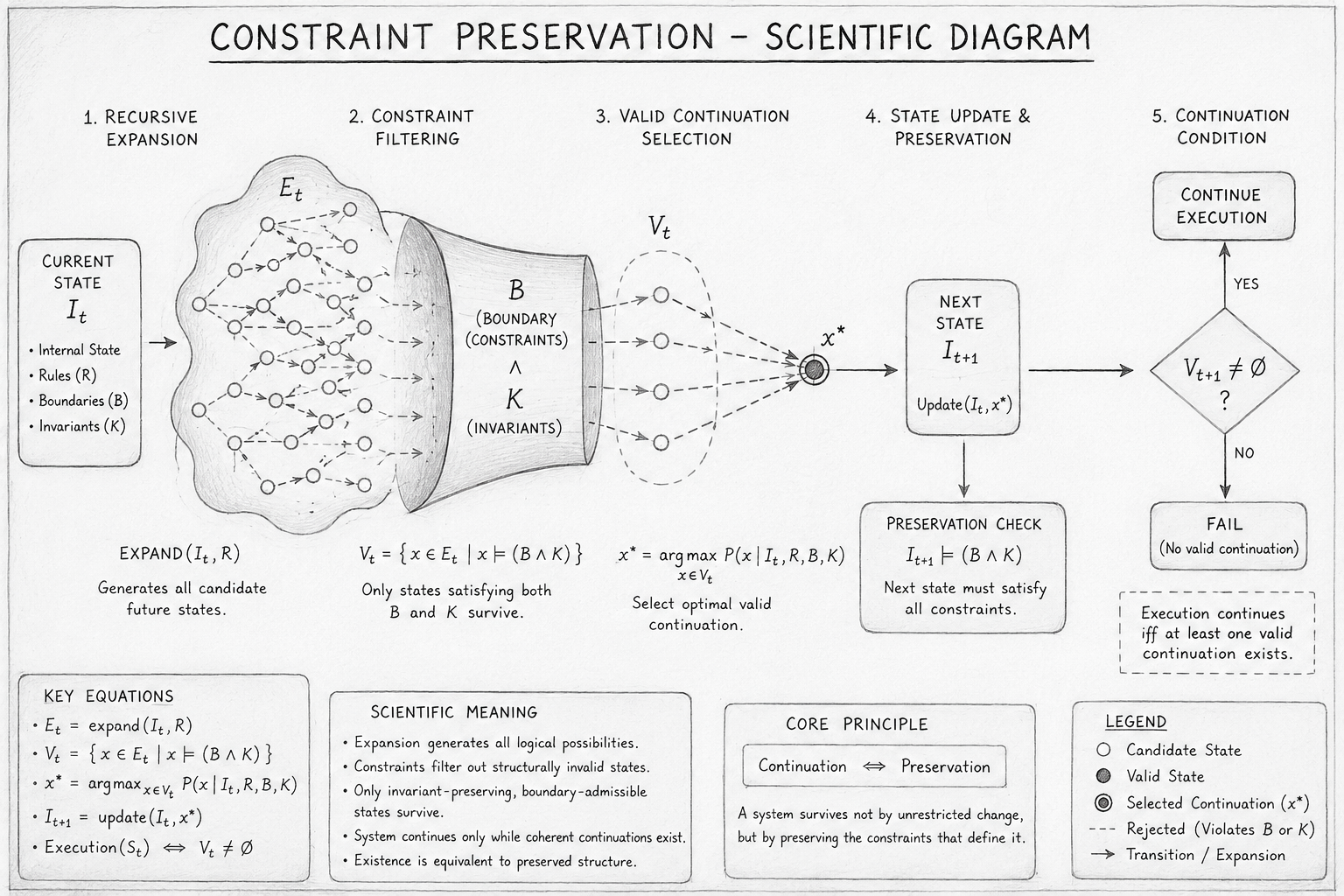
Overview of the Diagram

This diagram illustrates the complete recursive execution structure underlying Constraint Preservation within Flow Algebra. It visualises how a recursive system generates candidate future states, filters them through structural constraints, selects an admissible continuation, and preserves recursive coherence across state evolution.

The diagram should not be interpreted as a simple computational pipeline. Instead, it represents a structural survival mechanism in which execution is equivalent to preserved admissibility.

The entire process formalises the principle that coherent systems survive only through successful preservation of boundaries and invariants during transformation.

1. Current State — Recursive Origin

The diagram begins with the current recursive system state:

\[ I_t \]

This represents the complete internal configuration of the system at recursive step tt.

The accompanying system tuple:

\[ S = (I, R, B, K) \]

defines the total recursive execution structure:

  • II: internal state,
  • RR: recursive transition rules,
  • BB: boundary constraints,
  • KK: invariant-preserving conditions

This region of the diagram establishes the foundational principle that all recursive evolution emerges from an already constrained structural state.

2. Recursive Expansion Region

The large expansion cloud labelled EtE_t represents recursive possibility generation:

\[ E_t = \operatorname{expand}(I_t, R) \]

This stage generates all reachable candidate future states permitted by the recursive rule structure.

The multiple branching pathways inside the expansion region visualise:

  • recursive possibility proliferation,
  • structural branching,
  • state diversification,
  • and future continuation generation.

Importantly, this stage generates possibility only.

No validity judgement occurs here.

The expansion region therefore represents unconstrained recursive exploration prior to admissibility filtering.

3. Constraint Filtering Funnel

The narrowing funnel section labelled with BB and KK represents the central mechanism of constraint preservation.

This filtering operation is formally defined as:

\[ V_t = \{x \in E_t \mid x \models (B \land K)\} \]

The funnel geometry symbolises recursive compression of possibility space through structural admissibility filtering.

Within this stage:

  • states violating boundary conditions are removed,
  • states violating invariant preservation are eliminated,
  • contradictions collapse recursively,
  • and only structurally survivable continuations remain.

The funnel visually demonstrates that most recursively generated possibilities fail structural validation.

Only a reduced coherence-preserving subset survives.

4. Valid Continuation Space

The isolated valid-state region labelled VtV_t represents the surviving admissible continuation space.

Each remaining node inside this region satisfies both:

\[ x \models B \]

and:

\[ x \models K \]

The surviving nodes therefore represent structurally coherent futures capable of recursive continuation.

The visual separation of VtV_t from the original expansion cloud demonstrates that valid existence is only a subset of total theoretical possibility.

Existence is constrained survivability.

5. Continuation Selection

The highlighted continuation node x∗x^* represents the selected recursive continuation state:

\[ x^* = \operatorname*{arg\,max}_{x \in V_t} P(x \mid I_t, R, B, K) \]

This selection stage represents:

  • recursive optimisation,
  • coherence selection,
  • probabilistic continuation,
  • or deterministic admissible progression.

The key scientific principle illustrated here is that selection occurs only within the structurally valid continuation space.

No invalid continuation may propagate forward.

6. Recursive State Update

The selected continuation updates the recursive internal state:

\[ I_{t+1} = \operatorname{update}(I_t, x^*) \]

This represents recursive structural propagation into the next execution cycle.

The diagram then performs a preservation verification step:

\[ I_{t+1} \models (B \land K) \]

This ensures that the updated system state still preserves all required structural conditions.

The preservation check visually reinforces the principle that continuation alone is insufficient.

Only admissible continuation is allowed

7. Continuation Decision Boundary

The final decision structure evaluates whether valid recursive continuation remains available:

\[ V_{t+1} \neq \varnothing \]

If at least one valid future continuation survives, recursive execution continues.

If no admissible continuation remains:

\[ V_t = \varnothing \;\Rightarrow\; \mathrm{FAIL} \]

the system undergoes contradiction collapse.

The failure region therefore represents structural impossibility rather than ordinary computational error.

The recursive system terminates because no coherence-preserving future exists.

Scientific Meaning of the Full Diagram

Scientifically, the diagram represents a universal recursive stability model applicable across physics, logic, computation, cognition, and adaptive systems.

The full structure formalises several core principles:

  • execution equals structurally admissible continuation,
  • contradictions correspond to empty valid state spaces,
  • coherence emerges through recursive filtering,
  • and survival requires invariant-preserving transformation.

Under this interpretation:

  • physical laws become recursive admissibility constraints,
  • cognition becomes constrained recursive navigation,
  • intelligence becomes valid continuation selection,
  • and existence itself becomes preserved structural coherence across recursive evolutio

Central Principle Illustrated

The diagram ultimately visualises the foundational theorem of Constraint Preservation:

Systems survive not through unrestricted change, but through recursive preservation of the constraints that define valid existence.

The entire recursive architecture shown in the diagram exists to enforce this single principle of coherence-preserving continuation.

Diagram → Flow Mapping Table

Diagram Region Flow Algebra Component Equation Structural Meaning
Current State Box Internal Recursive State \( I_t \) Present system configuration at recursive step \( t \)
System Definition Panel Recursive System Tuple \( S = (I, R, B, K) \) Complete structural execution framework
Expansion Cloud Recursive State Expansion \( E_t = \operatorname{expand}(I_t, R) \) Generation of all candidate future states
Expansion Nodes Candidate Continuations \( x \in E_t \) Individual possible recursive futures
Branching Paths Recursive Transition Graph \( I_t \rightarrow E_t \) Expansion of reachable state space
Constraint Funnel Structural Filtering Stage \( V_t = \{ x \in E_t \mid x \models (B \land K) \} \) Removal of structurally invalid states
Boundary Constraint Layer Admissibility Enforcement \( x \models B \) Candidate satisfies recursive boundaries
Invariant Layer Structural Preservation \( x \models K \) Candidate preserves required invariants
Rejected Paths Contradiction Elimination \( x \not\models (B \land K) \) Invalid continuations removed recursively
Valid Continuation Region Admissible State Space \( V_t \) Surviving structurally coherent futures
Surviving Nodes Valid Recursive States \( \forall x \in V_t,\; x \models (B \land K) \) All surviving states preserve constraints
Highlighted Node (\( x^* \)) Selected Continuation \( x^* = \arg\max_{x \in V_t} P(x \mid I_t, R, B, K) \) Optimal admissible continuation selected
Selection Arrows Recursive Continuation Propagation \( x^* \in V_t \) Chosen future originates from valid space
Next State Box Recursive State Update \( I_{t+1} = \operatorname{update}(I_t, x^*) \) Propagation into next recursive state
Preservation Check Box Post-Update Validation \( I_{t+1} \models (B \land K) \) Updated state preserves structural validity
Continuation Decision Diamond Recursive Survival Test \( V_{t+1} \neq \emptyset \) Future valid continuation still exists
Continue Execution Branch Recursive Stability \( \mathrm{Execution}(S_t) \iff V_t \neq \emptyset \) Execution persists under preserved admissibility
FAIL Branch Contradiction Collapse \( V_t = \emptyset \Rightarrow \mathrm{FAIL} \) No structurally valid continuation exists
Dashed Rejection Lines Invalid Path Removal \( \forall x \in E_t,\; x \not\models (B \land K) \) Contradictory states recursively eliminated
Core Principle Box Preservation Theorem \( \mathrm{Continuation} \iff \mathrm{Preservation} \) Recursive survival requires preserved coherence
Entire Diagram Constraint Preservation Framework \( \mathrm{Existence}(S_t) \iff V_t \neq \emptyset \) Existence defined by admissible continuation

Execution Guarantee Statement

Guarantee

The Constraint Preservation flow guarantees that recursive execution may continue only when all evolving states preserve the required structural boundaries and invariants of the system.

Execution is therefore not defined by unrestricted transition, but by admissible continuation under recursive constraint preservation.

The flow enforces the following foundational execution condition:

\[ \mathrm{Execution}(S_t) \;\Longleftrightarrow\; V_t \neq \varnothing \]

where the valid continuation space is defined as:

\[ V_t = \{x \in E_t \mid x \models (B \land K)\} \]

This guarantees that:

  • every surviving continuation satisfies all admissibility boundaries BB,
  • every surviving continuation preserves all required invariants KK,
  • and every propagated future state remains structurally coherent.

The recursive execution engine therefore guarantees that no structurally invalid continuation may propagate through the system.

Structural Guarantees

1. Boundary Preservation Guarantee

Every accepted continuation must satisfy all defined boundary constraints:

\[ \forall x \in V_t,\; x \models B \]

Any candidate violating admissibility limits is recursively eliminated before continuation selection occurs.


2. Invariant Preservation Guarantee

Every accepted continuation must preserve all required invariants:

\[ \forall x \in V_t,\; x \models K \]

This guarantees recursive structural consistency across state evolution.


3. Contradiction Rejection Guarantee

Any recursive branch violating either BB or KK is structurally rejected:

\[ x \not\models (B \land K) \;\Rightarrow\; x \notin V_t \]

Contradictions therefore cannot propagate into future recursive states.


4. Valid Continuation Guarantee

The selected recursive continuation is guaranteed to originate from the valid admissible state space:

\[ x^* \in V_t \]

No invalid state may be selected for propagation.

5. Recursive Update Guarantee

The recursive update operation guarantees preservation after propagation:

\[ I_{t+1} = \operatorname{update}(I_t, x^*) \]

subject to:

\[ I_{t+1} \models (B \land K) \]

The next recursive state must therefore remain structurally admissible.

6. Structural Failure Guarantee

If no admissible continuation survives recursive filtering:

\[ V_t = \varnothing \;\Rightarrow\; \mathrm{FAIL} \]

execution is guaranteed to terminate immediately.

This guarantees that structurally incoherent systems cannot continue recursive propagation.

Scientific Interpretation

Scientifically, the Constraint Preservation flow guarantees that recursive systems remain coherent only through successful preservation of structural constraints across transformation.

The execution model therefore guarantees:

  • coherence-preserving evolution,
  • contradiction rejection,
  • admissible recursive continuation,
  • invariant stability,
  • and structurally bounded state propagation.

Under this framework:

  • physics guarantees conservation through invariant preservation,
  • logic guarantees consistency through contradiction elimination,
  • cognition guarantees coherence through constrained recursive navigation,
  • and existence guarantees continuity only through preserved admissibility.

Final Guarantee Principle

The fundamental guarantee enforced by this flow is:

A recursive system may continue if and only if at least one structurally valid future state preserves all required constraints.

The flow therefore guarantees that execution, coherence, and existence remain inseparable from recursive constraint preservation.

Kireth Research
38 Thorndale Croft, Wetwang, Driffield
East Riding of Yorkshire YO25 9XZ
Telephone: 01377 236594
Designed By