Chapter 17
Stability as Survival

Constraint Preservation
Author: Mark Higgins
© Mark Anthony Higgins 11 October 2025
Revised Date: 09 May 2026
Audio Overview

The Problem of Persistence

Modern science explains how systems move, interact, transform, and evolve. Yet beneath all dynamical descriptions lies a deeper unresolved question:

Why do some structures continue to exist while others collapse?

Classical mechanics describes equilibrium.
Thermodynamics describes energy distributions.
Biology describes adaptation.
Computer science describes state execution.

But none alone provide a universal structural definition of survival itself.

Flow Algebra approaches the problem differently.

It defines persistence not as static existence, but as the continuous ability of a system to generate structurally valid future states.

Under this framework:

Survival is recursive admissibility across time.

A system survives only while coherent continuation remains possible.

Stability Is Not Stillness

Traditional models often associate stability with immobility or equilibrium. However, most real systems survive through continual transformation rather than static preservation.

Examples include:

  • Cells constantly replacing internal molecules
  • Ecosystems dynamically rebalancing populations
  • Stars maintaining fusion equilibrium through continuous energy exchange
  • Minds preserving identity despite ongoing informational change
  • AI systems recursively updating internal states

A perfectly motionless system is not necessarily stable.

Likewise:

A dynamically changing system may remain perfectly stable if its transformations preserve admissible structure.

Flow Algebra therefore redefines stability as:

Stability≡Coherent Recursive Continuation

Stability is therefore an active process, not passive stillness.

Recursive State Structure

Flow Algebra models systems using recursive structural tuples:

\[ S_t = (I_t, R, B, K) \]

Where:

  • ItI_t = informational state at time tt
  • RR = recursive transformation rules
  • BB = boundary constraints
  • KK = invariant-preservation conditions

This formulation separates four essential components of persistence:

Component Function
Information Current system configuration
Rules Permitted transformations
Boundaries Admissible structural limits
Invariants Identity-preserving relations

If invariants collapse, the original system ceases to exist structurally even if matter or information remains.

Expansion and Admissibility

Recursive systems continuously generate possible future states:

\[ E_t = \operatorname{expand}(I_t, R) \]

However, not all generated states are structurally valid.

Flow Algebra therefore applies admissibility filtering:

\[ V_t = \{x \in E_t \mid x \models (B \land K)\} \]

Only states satisfying both:

  • boundary constraints BB
  • invariant conditions K

are permitted to continue.

This defines survival geometrically as movement through a constrained admissibility landscape.

Stability as Survival

The central survival condition becomes:

\[ \mathrm{Execution}(S_t) \;\Longleftrightarrow\; V_t \neq \varnothing \]

This means:

A system survives if and only if at least one valid future state remains constructible.

If no admissible continuation exists:

\[ V_t = \varnothing \;\Rightarrow\; \mathrm{FAIL} \]

Collapse is therefore not mysterious.

Failure occurs when recursive evolution can no longer preserve structural admissibility.

Boundary Preservation

Stable systems must preserve admissible operational limits.

Formally:

\[ \forall x \in V_t,\; x \models B \]

Boundary preservation prevents:

  • runaway instability
  • geometric contradiction
  • uncontrolled divergence
  • recursive overflow
  • destructive state transitions

Examples include:

Domain Boundary Preservation
Physics Conservation limits
Biology Homeostatic regulation
AI Alignment constraints
Engineering Material tolerances
Logic Consistency preservation

If invariants collapse, the original system ceases to exist structurally even if matter or information remains.

Invariant Preservation

Survival also requires preservation of core structural identity.

Formally:

\[ \forall x \in V_t,\; x \models K \]

Invariants define what a system fundamentally is.

Examples include:

System Invariant
Atom Charge structure
Organism Genetic continuity
Mind Recursive identity coherence
Mathematics Logical consistency
AI Goal-preservation structure

If invariants collapse, the original system ceases to exist structurally even if matter or information remains.

Dynamic Survival Across Domains

Flow Algebra generalises survival across disciplines.

Physics

Stable matter survives because recursive field interactions preserve coherent geometry.

Biology

Life survives because metabolism continuously regenerates admissible internal states.

Cognition

Consciousness survives because recursive self-reference maintains coherent identity loops.

Artificial Intelligence

Aligned AI survives only while recursive updates preserve behavioural invariants and boundary constraints.

Civilisations

Societies survive while institutional transformations preserve structural coherence under environmental pressure.

Across all domains:

Survival is recursive structural continuation under constrained admissibility.

Stability as a Universal Law

Flow Algebra reframes survival as a universal principle of reality itself.

The recursive survival chain becomes:

\[ S_t \rightarrow E_t \rightarrow V_t \rightarrow S_{t+1} \]

This describes:

  • 1. Current state generation
  • 2. Possibility expansion
  • 3. Constraint filtering
  • 4. Admissible continuation

Reality persists because coherent continuation never completely collapses.

Existence is therefore not static substance.

Existence is recursive survivability.

Foundational Principle

The central theorem of this chapter can therefore be stated as:

\[ \mathrm{Stability} \equiv \mathrm{Survival} \equiv \mathrm{Recursive\ Admissibility} \]

Persistent systems are not systems that avoid change.

They are systems capable of transforming indefinitely without violating the structural conditions required for continued existence.

flow "StabilityAsSurvival" v1.0

# Chapter 17 — Stability as Survival
# Purpose:
# Define stability as recursive survivability:
# a system survives only while it can generate at least one valid future state
# satisfying both boundary constraints and invariant-preservation conditions.

state:
  S_t:
    I_t: current_information_state
    R: recursive_transformation_rules
    B: boundary_constraints
    K: invariant_conditions

params:
  survival_mode: "recursive_admissibility"
  collapse_condition: "no_valid_future_state"
  stability_definition: "continued_structural_survivability"

process:
  expansion:
    input: [I_t, R]
    output: E_t
    operation: |
      E_t = expand(I_t, R)

  admissibility_filter:
    input: [E_t, B, K]
    output: V_t
    operation: |
      V_t = { x ∈ E_t | x ⊨ (B ∧ K) }

  survival_test:
    input: V_t
    output: execution_status
    operation: |
      Execution(S_t) ⇔ V_t ≠ ∅

  collapse_test:
    input: V_t
    output: failure_status
    operation: |
      V_t = ∅ ⇒ FAIL

  selection:
    condition: "V_t ≠ ∅"
    input: [V_t, I_t, R, B, K]
    output: x_star
    operation: |
      x* = argmax_{x ∈ V_t} P(x | I_t, R, B, K)

  update:
    condition: "x* ∈ V_t"
    input: [I_t, x_star]
    output: I_t_plus_1
    operation: |
      I_{t+1} = update(I_t, x*)

  continuation:
    input: [I_t_plus_1, R, B, K]
    output: S_t_plus_1
    operation: |
      S_{t+1} = (I_{t+1}, R, B, K)

invariants:
  boundary_preservation:
    statement: |
      ∀x ∈ V_t, x ⊨ B

  invariant_preservation:
    statement: |
      ∀x ∈ V_t, x ⊨ K

  admissible_continuation:
    statement: |
      V_t ≠ ∅ ⇒ ∃S_{t+1}

  collapse_equivalence:
    statement: |
      V_t = ∅ ⇔ no_admissible_continuation

  survival_equivalence:
    statement: |
      Stability ≡ Survival ≡ Recursive_Admissibility

guards:
  reject_boundary_violation:
    condition: |
      x ⊭ B
    action: remove_from_V_t

  reject_invariant_violation:
    condition: |
      x ⊭ K
    action: remove_from_V_t

  reject_contradictory_state:
    condition: |
      x ⊭ (B ∧ K)
    action: remove_from_V_t

  terminate_on_empty_valid_set:
    condition: |
      V_t = ∅
    action: FAIL

execution_chain:
  - S_t
  - E_t
  - V_t
  - x_star
  - I_t_plus_1
  - S_t_plus_1

domain_mappings:
  physics:
    stability: "persistent coherent structure"
    boundary: "conservation and field limits"
    invariant: "identity-preserving physical relations"

  biology:
    stability: "organism survival through adaptive regulation"
    boundary: "homeostatic limits"
    invariant: "genetic and metabolic continuity"

  cognition:
    stability: "identity preservation through recursive self-reference"
    boundary: "coherent interpretive limits"
    invariant: "self-consistency across thought updates"

  artificial_intelligence:
    stability: "aligned recursive continuation"
    boundary: "behavioural and ethical constraints"
    invariant: "goal and identity preservation"

  engineering:
    stability: "function under operational load"
    boundary: "material and design tolerances"
    invariant: "system purpose and structural integrity"

  logic:
    stability: "non-contradictory inference"
    boundary: "valid inference rules"
    invariant: "consistency preservation"

output:
  stable:
    condition: |
      V_t ≠ ∅
    meaning: "system survives through admissible continuation"

  unstable:
    condition: |
      V_t = ∅
    meaning: "system collapses because no valid continuation exists"

  theorem:
    statement: |
      A system is stable iff recursive transformation preserves at least one admissible future state.
    formal: |
      Stability(S_t) ⇔ V_t ≠ ∅

What This Flow implements

StabilityAsSurvival" v1.0

Purpose of the Flow

This flow implements the principle of:

\[ \mathrm{Stability} \equiv \mathrm{Survival} \]

It defines stability not as immobility or equilibrium, but as the ability of a system to continue generating structurally valid future states.

The flow formalises recursive survivability as a universal structural process shared across physics, biology, cognition, logic, artificial intelligence, and engineering systems.

Core System Structure

The flow begins by defining the recursive system state:

\[ S_t = (I_t, R, B, K) \]

Where:

Component Meaning
\( I_t \) Current information state
\( R \) Recursive transformation rules
\( B \) Boundary constraints
\( K \) Invariant-preservation conditions

This structure defines the complete survivability architecture of the system.

Expansion of Possible Futures

The flow generates possible future states through recursive expansion:

\[ E_t = \operatorname{expand}(I_t, R) \]

This stage represents:

  • state evolution
  • possibility generation
  • recursive transformation
  • future-state construction

The system explores all structurally reachable continuations permitted by the rule set.

Admissibility Filtering

Not all generated states are valid.

The flow therefore filters all possible states through structural admissibility:

\[ V_t = \{x \in E_t \mid x \models (B \land K)\} \]

This operation removes any future state that violates:

  • system boundaries
  • invariant structure
  • coherence conditions
  • recursive consistency

Only admissible states survive filtering.

Survival Condition

The central operation of the flow is the survival test:

\[ \mathrm{Execution}(S_t) \;\Longleftrightarrow\; V_t \neq \varnothing \]

This means:

The system survives if and only if at least one admissible future state exists.

The flow therefore transforms survival into a precise mathematical condition.

Collapse Detection

The flow also defines structural collapse formally.

If no admissible continuation exists:

\[ V_t = \varnothing \;\Rightarrow\; \mathrm{FAIL} \]

Collapse occurs because recursive continuation becomes impossible.

The flow therefore treats instability as:

  • loss of admissible continuation
  • recursive contradiction
  • invariant failure
  • structural incompatibility

Boundary Preservation

The flow preserves operational limits through boundary enforcement:

\[ \forall x \in V_t,\; x \models B \]

This guarantees that surviving states remain inside the allowable structural domain.

The flow prevents:

  • runaway divergence
  • uncontrolled recursion
  • illegal state transition
  • destructive overflow
  • geometric inconsistency

Invariant Preservation

The flow also preserves system identity:

\[ \forall x \in V_t,\; x \models K \]

Invariant preservation ensures that recursive transformation does not destroy the defining structure of the system.

This maintains:

  • logical consistency
  • identity continuity
  • coherent structure
  • recursive integrity

Without invariant preservation, continuation would produce a different system entirely.

Recursive Continuation

If valid continuation exists, the flow selects a stable successor state:

\[ x^* = \operatorname*{arg\,max}_{x \in V_t} P(x \mid I_t, R, B, K) \]

The system is then updated recursively:

\[ I_{t+1} = \operatorname{update}(I_t, x^*) \]

This produces the next stable system state:

\[ S_t \rightarrow E_t \rightarrow V_t \rightarrow x^* \rightarrow S_{t+1} \]

What the Flow Prevents

The flow prevents structurally invalid continuation.

It rejects:

Failure Type Structural Cause
Boundary Violation \( x \not\models B \)
Invariant Collapse \( x \not\models K \)
Contradiction \( x \not\models (B \land K) \)
Recursive Failure \( V_t = \emptyset \)
False Continuation Invalid successor construction
This ensures only coherent recursive evolution survives.

What the Flow Guarantees

The flow guarantees:

  • admissible continuation
  • recursive consistency
  • invariant preservation
  • boundary compliance
  • stable structural evolution

\[ V_t \neq \varnothing \;\Rightarrow\; \exists S_{t+1} \]

A stable future exists only while coherent continuation remains possible.

Universal Scientific Meaning

This flow generalises survival across all recursive systems.

Domain Stability Meaning
Physics Coherent field persistence
Biology Adaptive survival
Cognition Identity continuity
AI Aligned recursive execution
Logic Non-contradictory inference
Engineering Operational survivability

The same structural law governs all domains:

Systems survive only while structurally valid continuation remains possible.

How to Read This Flow

Purpose of the Flow

This flow should be read as a recursive survivability engine.

It describes how a system determines whether coherent continuation remains possible across time.

The flow is not a conventional software program.

It is a structural execution model that defines:

  • how systems generate future states
  • how stability is tested
  • how invalid states are rejected
  • how continuation survives
  • how collapse occurs

The central principle is:

\[ \mathrm{Execution}(S_t) \;\Longleftrightarrow\; V_t \neq \varnothing \]

A system survives only if at least one admissible future state exists.

Read the Flow as a State Transition System

The flow progresses through recursive state evolution.

The full execution chain is:

\[ S_t \rightarrow E_t \rightarrow V_t \rightarrow x^* \rightarrow S_{t+1} \]

Each symbol represents a distinct structural operation.

Read the chain from left to right.


Step 1 Read the Initial State

The flow begins with the recursive system definition:

\[ S_t = (I_t, R, B, K) \]

This tuple defines the complete survival structure of the system.

Interpret each component as follows:

Component Meaning
\( I_t \) Current information or configuration
\( R \) Recursive transformation rules
\( B \) Boundary constraints
\( K \) Invariant-preservation conditions

This is the structural identity of the system at time tt.

Sterp 2 Read the Expansion Stage

The next stage generates possible future states:

\[ E_t = \operatorname{expand}(I_t, R) \]

Read this as:

“Apply the recursive rules to the current information state to generate all reachable continuations.”

This stage represents:

  • transformation
  • branching
  • future-state construction
  • recursive evolution

At this point, no validity testing has occurred yet.
EtE_t contains both stable and unstable possibilities.

Step 3 — Read the Admissibility Filter

The flow then removes invalid states:

\[ V_t = \{x \in E_t \mid x \models (B \land K)\} \]

Read this as:

“Keep only future states that satisfy both the boundary conditions and the invariant structure.”

This is the most important filtering stage in the flow.

The symbol:

\[ x \models (B \land K) \]

“The candidate state structurally satisfies both the boundaries and invariants.”

Only admissible states survive.

Step 4  Read the Survival Test

The flow next checks whether continuation remains possible:

\[ \mathrm{Execution}(S_t) \;\Longleftrightarrow\; V_t \neq \varnothing \]

Read this as:

“Execution continues if and only if the valid-state set is not empty.”

This is the core survivability theorem of the chapter.

If at least one admissible continuation exists, the system survives.

If none exist:

\[ V_t = \varnothing \;\Rightarrow\; \mathrm{FAIL} \]

Read this as:

“Collapse occurs because no structurally valid future state can be constructed.”

Step 5 Read the Selection Operation

If admissible states remain, the flow selects the best continuation:

\[ x^* = \operatorname*{arg\,max}_{x \in V_t} P(x \mid I_t, R, B, K) \]

Read this as:

“Choose the most admissible continuation according to the system’s structural probability landscape.”

This stage represents:

  • optimisation
  • probabilistic selection
  • coherent continuation choice
  • recursive decision resolution

Step 6  Read the Recursive Update

The selected continuation updates the system:

\[ I_{t+1} = \operatorname{update}(I_t, x^*) \]

Read this as:

“The system recursively incorporates the selected admissible continuation into the next information state.”

This produces:

\[ S_{t+1} \]

which becomes the next recursive execution cycle.

Reading the Invariants

The invariant blocks define what must always remain true during successful continuation.

Boundary preservation:

\[ \forall x \in V_t,\; x \models B \]

Invariant preservation:

\[ \forall x \in V_t,\; x \models K \]

Read these as universal guarantees:

Every surviving state satisfies the structural requirements of the system.

Reading Failure Conditions

Failure conditions should be interpreted as structural impossibility conditions.

Examples include:

Failure Condition Meaning
\( x \not\models B \) Boundary violation
\( x \not\models K \) Invariant collapse
\( x \not\models (B \land K) \) Structural contradiction
\( V_t = \emptyset \) No admissible continuation

These conditions terminate recursive survivability.

Reading the Flow Scientifically

Scientifically, the flow describes:

  • recursive stability
  • constrained evolution
  • structural persistence
  • admissible transformation
  • collapse mechanics

The flow can therefore be interpreted as:

Domain Scientific Interpretation
Physics Coherent field persistence
Biology Adaptive survival
AI Stable aligned recursion
Cognition Identity continuity
Logic Consistent inference
Engineering Survivable operation

Final Reading Principle

The most important way to read this flow is:

Stability is not the absence of change.

The flow demonstrates that systems survive through transformation only when recursive evolution continues to preserve admissible structure.

The complete interpretation can therefore be summarised as:

\[ \mathrm{Stability} \equiv \mathrm{Survival} \equiv \mathrm{Recursive\ Admissibility} \]

Flow → Equation Tri-Mapping

Flow Stage Flow Algebra Expression Mathematical Interpretation
System Definition \( S_t = (I_t, R, B, K) \) Recursive system state defined by information, rules, boundaries, and invariants
Recursive Expansion \( E_t = \operatorname{expand}(I_t, R) \) Generation of reachable future-state space
Admissibility Filter \( V_t = \{ x \in E_t \mid x \models (B \land K) \} \) Constraint filtering of admissible states
Boundary Enforcement \( \forall x \in V_t,\; x \models B \) All surviving states satisfy boundary constraints
Invariant Preservation \( \forall x \in V_t,\; x \models K \) All surviving states preserve invariant structure
Survival Condition \( \mathrm{Execution}(S_t) \iff V_t \neq \emptyset \) Recursive continuation exists iff admissible states exist
Collapse Condition \( V_t = \emptyset \Rightarrow \mathrm{FAIL} \) Structural failure via absence of valid continuation
State Selection \( x^* = \arg\max_{x \in V_t} P(x \mid I_t, R, B, K) \) Optimal admissible continuation selection
Recursive Update \( I_{t+1} = \operatorname{update}(I_t, x^*) \) Incorporation of selected continuation into next state
System Continuation \( S_{t+1} = (I_{t+1}, R, B, K) \) Recursive state propagation
Stability Equivalence \( \mathrm{Stability} \equiv \mathrm{Survival} \equiv \mathrm{Recursive\ Admissibility} \) Stability defined as admissible recursive persistence
Continuation Chain \( S_t \rightarrow E_t \rightarrow V_t \rightarrow x^* \rightarrow S_{t+1} \) Full recursive survivability pipeline
Valid Continuation Guarantee \( V_t \neq \emptyset \Rightarrow \exists S_{t+1} \) Existence of future admissible state
Contradiction Condition \( x \not\models (B \land K) \) Structural inconsistency condition
Boundary Failure \( x \not\models B \) Violation of admissible operational limits
Invariant Collapse \( x \not\models K \) Loss of identity-preserving structure
Recursive Survival Law \( \mathrm{Execution}(S_t) \iff \exists x \in E_t : x \models (B \land K) \) Survival requires existence of admissible continuation
Structural Persistence \( \forall t,\; V_t \neq \emptyset \) Long-term survivability condition
Recursive Termination \( V_t = \emptyset \iff \nexists S_{t+1} \) No future state constructible
Universal Stability Principle \( \mathrm{Persistent\ Systems} \equiv \mathrm{Constraint\ Preserving\ Recursive\ Systems} \) Generalised law of structural survival
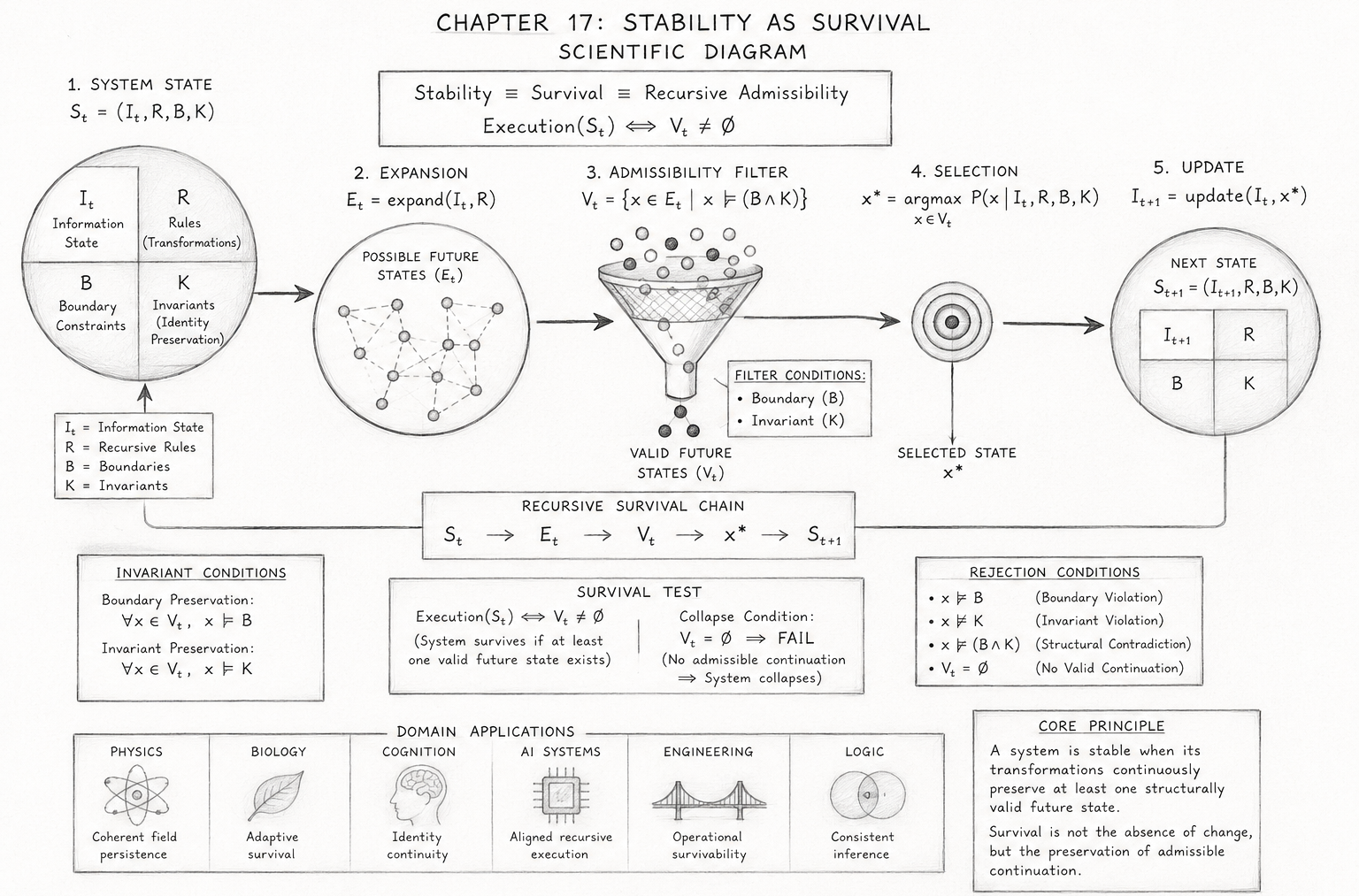
Stability as Survival

Purpose of the Diagram

This diagram visualises stability as a recursive survivability process.

Rather than treating stability as static equilibrium, the diagram shows that systems survive only while they can continuously generate at least one structurally admissible future state.

The diagram formalises the core principle:

\[ \mathrm{Execution}(S_t) \;\Longleftrightarrow\; V_t \neq \varnothing \]

A system remains stable only while valid continuation remains possible.

System State Structure (Left Section)

The diagram begins with the recursive system definition:

\[ S_t = (I_t, R, B, K) \]

The circular structure represents the complete survival architecture of the system.

The four quadrants illustrate:

Component Scientific Meaning
\( I_t \) Current information/configuration state
\( R \) Recursive transformation rules
\( B \) Boundary constraints
\( K \) Invariant-preservation conditions

The circular geometry symbolises recursive closure and continuous structural feedback.

The diagram visually communicates that survival requires simultaneous preservation of all four components.

Expansion Region (Second Section)

The expansion sphere represents future-state generation:

\[ E_t = \operatorname{expand}(I_t, R) \]

The internal node network symbolises:

  • branching futures
  • recursive evolution
  • state-space exploration
  • possibility generation

The multiple connected nodes indicate that recursive systems naturally produce many possible continuations.

At this stage:

  • both stable and unstable states exist
  • no filtering has yet occurred
  • recursive possibility space remains unconstrained

This region visualises structural expansion before admissibility testing.

Admissibility Funnel (Central Filter)

The funnel structure is the core survivability mechanism of the diagram.

It represents admissibility filtering:

\[ V_t = \{x \in E_t \mid x \models (B \land K)\} \]

The upper opening shows the full possibility space entering the filter.

The narrowing geometry symbolises constraint reduction.

Only states satisfying:

  • boundary conditions BB
  • invariant conditions KK

are allowed through the funnel.

Rejected states visually fall outside the admissible channel, representing:

  • contradiction
  • instability
  • invariant failure
  • structural incompatibility

The funnel therefore represents:

Recursive survivability through structural selection.

Selection Target (Selection Geometry)

The concentric target structure represents admissible state optimisation:

\[ x^* = \operatorname*{arg\,max}_{x \in V_t} P(x \mid I_t, R, B, K) \]

The target geometry symbolises:

  • stability optimisation
  • coherent alignment
  • recursive selection
  • admissibility maximisation

The central point represents the selected continuation:

\[ x^* \]

which becomes the next surviving state.

This visualises survival not as randomness, but as constrained recursive optimisation.

Recursive Update Structure (Right Section)

The right-side state sphere represents recursive continuation:

\[ I_{t+1} = \operatorname{update}(I_t, x^*) \]

which produces:

The mirrored geometry relative to the initial state indicates recursive persistence through transformation.

The structure survives because:

  • boundaries remain preserved
  • invariants remain preserved
  • admissible continuation exists

The diagram therefore communicates:

Stability is recursive structural regeneration.

Recursive Survival Chain (Central Flow)

The central horizontal execution chain summarises the entire chapter:

\[ S_t \rightarrow E_t \rightarrow V_t \rightarrow x^* \rightarrow S_{t+1} \]

This chain represents:

  • 1. Current system state
  • 2. Future possibility generation
  • 3. Admissibility filtering
  • 4. Stable continuation selection
  • 5. Recursive survival

The arrow structure symbolises continuous recursive time evolution.

Invariant and Boundary Blocks

The lower-left invariant panel formalises the universal preservation laws:

Boundary preservation:

\[ \forall x \in V_t,\; x \models B \]

Invariant preservation:

\[ \forall x \in V_t,\; x \models K \]

These equations define the conditions required for stable recursive continuation.

Collapse and Rejection Conditions

The lower-right rejection panel defines instability formally.

The diagram shows that failure occurs when candidate states violate:

Failure Condition Meaning
\( x \not\models B \) Boundary violation
\( x \not\models K \) Invariant collapse
\( x \not\models (B \land K) \) Structural contradiction
\( V_t = \emptyset \) No admissible continuation

This region visualises recursive collapse as structural impossibility.

Domain Application Layer

The bottom scientific row demonstrates that the same survivability structure governs multiple domains:

Domain Stability Interpretation
Physics Coherent field persistence
Biology Adaptive survival
Cognition Identity continuity
AI Systems Aligned recursive execution
Engineering Operational survivability
Logic Consistent inference

The diagram therefore communicates that:

Stability is a universal recursive law, not a domain-specific phenomenon.

Core Scientific Principle

The final boxed statement summarises the meaning of the entire diagram:

\[ \mathrm{Stability} \equiv \mathrm{Survival} \equiv \mathrm{Recursive\ Admissibility} \]

The diagram demonstrates that systems survive not because they avoid change, but because their transformations continuously preserve admissible structure.

Recursive continuation itself becomes the definition of stability.

Diagram → Flow Mapping Table

Diagram Element Flow Algebra Component Mathematical Expression Structural Meaning
Left System Circle Recursive System State \( S_t = (I_t, R, B, K) \) Complete structural definition of the system
Information Quadrant Information State \( I_t \) Current informational/configuration structure
Rules Quadrant Recursive Rules \( R \) Transformation and evolution operators
Boundary Quadrant Boundary Constraints \( B \) Admissible operational limits
Invariant Quadrant Invariant Structure \( K \) Identity-preserving conditions
Expansion Sphere Recursive Expansion \( E_t = \operatorname{expand}(I_t, R) \) Generation of reachable future states
Internal Expansion Nodes Possibility Space \( x \in E_t \) Candidate recursive continuations
Expansion Connections Recursive Reachability \( R(I_t) \) Structural transition pathways
Funnel Entrance Admissibility Input \( E_t \) Unfiltered future-state space
Funnel Structure Constraint Filter \( V_t = \{ x \in E_t \mid x \models (B \land K) \} \) Structural admissibility reduction
Funnel Narrowing Constraint Enforcement \( x \models (B \land K) \) Rejection of unstable states
Falling Rejected States Contradiction Removal \( x \not\models (B \land K) \) Structural invalidation
Valid Output States Valid Continuations \( x \in V_t \) Admissible recursive futures
Target Selection Geometry Optimal Continuation Selection \( x^* = \arg\max_{x \in V_t} P(x \mid I_t, R, B, K) \) Selection of stable continuation
Central Selection Point Selected State \( x^* \) Chosen admissible future state
Right System Circle Recursive Continuation \( S_{t+1} \) Next surviving system state
Updated Information Quadrant Recursive Update \( I_{t+1} = \operatorname{update}(I_t, x^*) \) State incorporation after selection
Recursive Arrow Chain Survival Pipeline \( S_t \rightarrow E_t \rightarrow V_t \rightarrow x^* \rightarrow S_{t+1} \) Full recursive survivability sequence
Survival Test Box Stability Condition \( \mathrm{Execution}(S_t) \iff V_t \neq \emptyset \) Survival iff valid continuation exists
Collapse Statement Failure Condition \( V_t = \emptyset \Rightarrow \mathrm{FAIL} \) No admissible future state
Boundary Preservation Panel Boundary Invariant \( \forall x \in V_t,\; x \models B \) All surviving states preserve boundaries
Invariant Preservation Panel Structural Invariant \( \forall x \in V_t,\; x \models K \) All surviving states preserve identity
Rejection Conditions Panel Structural Failure Tests \( x \not\models B,\; x \not\models K \) Boundary or invariant collapse
Physics Icon Domain Mapping \( \text{Stable coherent fields} \) Physical survivability
Biology Icon Domain Mapping \( \text{Adaptive regulation} \) Biological persistence
Cognition Icon Domain Mapping \( \text{Recursive identity continuity} \) Cognitive stability
AI Systems Icon Domain Mapping \( \text{Aligned recursive execution} \) AI survivability
Engineering Icon Domain Mapping \( \text{Operational stability} \) Structural endurance
Logic Icon Domain Mapping \( \text{Non-contradictory inference} \) Logical consistency
Core Principle Box Universal Stability Law \( \mathrm{Stability} \equiv \mathrm{Survival} \equiv \mathrm{Recursive\ Admissibility} \) Stability defined as admissible recursive continuation
Entire Diagram Geometry Recursive Survival Architecture \( \mathrm{Execution}(S_t) \iff \exists x \models (B \land K) \) Universal structural survival model

Execution Guarantee Statement

Chapter 17 — Stability as Survival

The Stability as Survival flow executes only through structurally admissible recursive continuation.

A system is considered stable if and only if recursive evolution preserves at least one future state satisfying both boundary constraints and invariant-preservation conditions.

Formally, the system state is defined as:

\[ S_t = (I_t, R, B, K) \]

Recursive expansion generates the future possibility space:

\[ E_t = \operatorname{expand}(I_t, R) \]

Admissible continuation is then constrained by:

\[ V_t = \{x \in E_t \mid x \models (B \land K)\} \]

The execution guarantee is therefore:

Execution(St​)⟺Vt​=∅

This guarantees that recursive continuation occurs only when at least one structurally valid future state exists.

All successful executions satisfy:

\[ \forall x \in V_t,\; x \models B \]

and:

\[ \forall x \in V_t,\; x \models K \]

Therefore:

  • all surviving states preserve system boundaries
  • all surviving states preserve invariant structure
  • all recursive continuations remain structurally admissible

If no admissible continuation exists:

\[ V_t = \varnothing \]

then:

\[ V_t = \varnothing \;\Rightarrow\; \mathrm{FAIL} \]

This guarantees deterministic recursive termination under structural contradiction.

The flow therefore prevents:

Failure Type Prevention Mechanism
Boundary Violation \( \text{Reject } (x \not\models B) \)
Invariant Collapse \( \text{Reject } (x \not\models K) \)
Structural Contradiction \( \text{Reject } (x \not\models (B \land K)) \)
False Continuation \( V_t \neq \emptyset \)
Recursive Instability Enforce admissible successor selection

The recursive continuation chain is guaranteed to preserve structural validity:

\[ S_t \rightarrow E_t \rightarrow V_t \rightarrow x^* \rightarrow S_{t+1} \]

where:

\[ x^* \in V_t \]

and:

\[ I_{t+1} = \operatorname{update}(I_t, x^*) \]

Thus the flow guarantees:

\[ V_t \neq \varnothing \;\Rightarrow\; \exists S_{t+1} \]

meaning:

A stable system always possesses at least one admissible recursive continuation.

The universal execution theorem of this chapter is therefore:

\[ \mathrm{Stability} \equiv \mathrm{Survival} \equiv \mathrm{Recursive\ Admissibility} \]

A system survives not by avoiding transformation, but by ensuring that every transformation preserves the structural conditions required for continued existence.

Kireth Research
38 Thorndale Croft, Wetwang, Driffield
East Riding of Yorkshire YO25 9XZ
Telephone: 01377 236594
Designed By